The Road to WisCon 14 (1990)

WisCon, the world’s first and probably only fantasy/science fiction convention that focuses on feminist speculative fiction, was born in 1977 in Madison, Wisconsin. Thanks to Joan Nestle at the Lesbian Herstory Archives, an avid f/sf fan, I learned about it and f/sf fandom, including feminist f/sf fandom, before too many years had passed; see “I Discover Women Writing F/SF” for details.

But it wasn’t till February 1990 that I attended my first WisCon, WisCon 14. I got there by a circuitous route, which looks something like this:

I could have sworn this T said “WISCON 14” on it but obviously it doesn’t. Hal Davis gave it to me @ WisCon 14. I’d never met Hal before, and I know all that stuff about not accepting gifts from strangers, but I’m glad I accepted this one. Hal and I are still in touch 34 years later, though my last WisCon was in 2006. That’s some kind of record.

In the late 1970s, having got wind of the wealth of fantasy and science fiction being written by women, I started haunting Moonstone Bookcellar, the f/sf bookstore on Connecticut Ave., near Washington Circle. After a skim through the pages, I’d buy almost anything with a woman’s name on the cover.

While several of us were prepping for my 30th birthday party, in June 1981, Mary Farmer, owner and manager of Lammas, D.C.’s feminist bookstore, asked me to sign on as Lammas’s book buyer. Once I got my bearings, surprise, surprise, I started building up the store’s f/sf collection.

In 1984, Carol Seajay, founder, editor, and publisher of Feminist Bookstore News, invited me to become FBN’s first columnist. “Susanna Sturgis on Science Fiction” debuted shortly thereafter. Big perk was that I could now get free review copies from publishers.1

Also in 1984, I attended the Feminist Women’s Writing Workshops for the first time. FW3 in those years was held at Wells College in tiny Aurora, N.Y., but was based in Ithaca, 30 miles away. I got to meet Irene “Zee” Zahava, proprietor of Smedley’s, Ithaca’s feminist bookstore, and Nancy Bereano, then the editor of Crossing Press’s great feminist series and about to establish her own trail-blazing Firebrand Books.

Zee was just starting to edit anthologies, often of women’s writing; by now she has edited a gazillion and branched out into offering writers’ workshops. Back then, however, she opened the way for me to edit three anthologies of women’s f/sf for Crossing: Memories and Visions (1989), The Women Who Walk Through Fire (1990), and Tales of Magic Realism by Women (Dreams in a Minor Key) (1991).
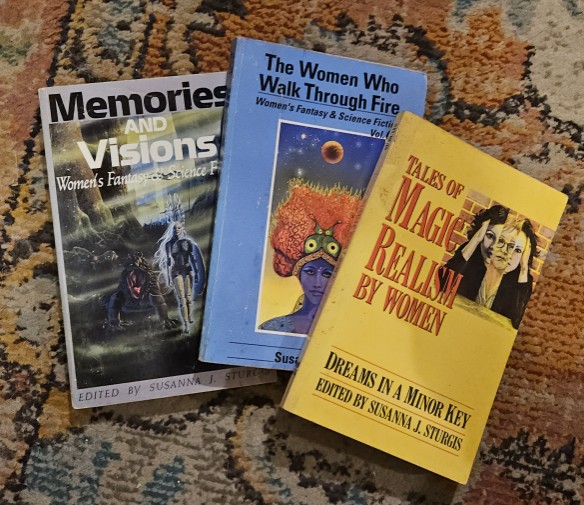
My three women’s f/sf anthologies

By the time Tales of Magic Realism came out, my relationship with Crossing had frayed so that was my last anthology. Personalities aside, the real underlying problem was the structural disconnect between feminist publishing and feminist f/sf readers. Feminist publishing and bookselling emphasized the trade paperback format; f/sf was overwhelmingly a mass-market world. Feminist f/sf fans could find their favorite women authors in f/sf bookstores. Only a handful of feminist booksellers knew f/sf well enough to build a feminist f/sf section, notably Karen Axness at Room of One’s Own in Madison and Paula Wallace at Full Circle in Albuquerque.

While at Lammas I had stocked a fine feminist f/sf section, which f/sf fans appreciated but was a hard sell to other fans of fiction by women. The widespread conviction that f/sf was only about spaceships and elves resisted all my attempts to unseat it.2 But my work at Lammas and especially my Feminist Bookstore News column did catch the attention of Crossing Press and others.

Among those who noticed my FBN column was the archivist/librarian for the Boston chapter of Daughters of Bilitis (DOB), who was also the East Coast half of fantasy writer J. F. Rivkin. In those days female protagonists had become more common in f/sf, but often they were the only woman in a team of men. If a novel had two significant female characters, they tended to be rivals, not allies. So J. F. Rivkin’s first novel, Silverglass (1986), was right up my alley: sword & sorcery featuring lesbian partners who had adventures together.

J. F. Rivkin/East was also well connected with the women writers in the New England f/sf scene, which is how I came to be included in a group signing at Glad Day, Boston’s gay bookstore, then located on Boylston Street near Copley Square. I’m pretty sure the year was 1990, after The Women Who Walk Through Fire came out that spring and after I had attended my first WisCon in February. There for the first time I met Ellen Kushner, Delia Sherman, Melissa Scott, Lisa A. Barnett, and “J.F./East” herself. Wow.

With WisCon and that momentous Glad Day signing, a whole world opened up, one I’d been only dimly aware of in my feminist bookselling days. Not only did it keep me busy for most of the 1990s, it greatly expanded my T-shirt collection, thanks in particular to the wonderful Ts created by Freddie Baer for the James Tiptree Jr. Award. The Tiptree, for speculative fiction that explores and expands our understanding of gender, was launched by authors Pat Murphy and Karen Joy Fowler at WisCon 15, my second WisCon, and I chaired the Tiptree jury in 1994. More about that later.

NOTES

  1. I continued writing the f/sf column till 1996, 11 years after I left D.C., so the freebies continued to arrive. Since I was only interested in the ones by women, I’d take the rest down to Book Den East, which sold used and rare books, and sell them. Bookseller Cindy Meisner [1944–2023] told me these were snatched up by young male sf fans who loved getting brand-new books for cheap. ↩︎
  2. Genre fiction per se was never the problem. Mysteries have been huge in the feminist press since they were introduced, and don’t get me started about lesbian romance. Lammas customers would tell me they found fantasy or science fiction too unbelievable then come to the check-out counter with a lesbian romance about a nice lesbian on vacation who falls in love with a slightly older woman who turns out to be independently wealthy and they live happily ever after. ↩︎

1990: Visiting the AIDS Quilt with My Mother

I’d already seen the whole AIDS Quilt twice, but my mother hadn’t seen any of it ever. I think going to see this display of a small part of it was her idea, but I was up for it. I also think she bought me the T-shirt, but I was up for that too.1

For the record, although the T-shirt says “Boston,” the display we went to was at MIT in Cambridge.

1990 stands out in my memory as the year Martha’s Vineyard discovered AIDS. Since HIV/AIDS was already looming large in the gay community, and increasingly in the lesbian community, when I left D.C. in 1985, this caused some cognitive dissonance, to put it mildly.

In D.C., since I was immersed in “the community” and worked at the feminist bookstore, I was generally and accurately assumed to be a lesbian. I never had to come out. When I got to the Vineyard, I realized I didn’t know how. Life was further complicated by the fact that at the time, most women dressed like the dykes I knew in D.C. — jeans, flannel or button-down shirts, shoes you could walk in. I learned to surreptitiously check for the presence or absence of a ring on the ring finger of any new acquaintance, though this could be misleading.

Me in my Common Threads shirt, 34 years later.

Life was even further complicated by the fact that if you said the word “lesbian” out loud everyone would (a) turn to look at you, and (b) assume you were one. This was OK with me but it wasn’t OK with others.2 So people really did use the American Sign Language sign for “L” or say (I’m not kidding about this) “Lebanese” when they meant “lesbian.”

As related in “1985–1986 (etc.): Adult Child of Theater,” I lucked out early. I’d arrived on the Vineyard in search of a 12-step program, and in finding ACA (Adult Children of Alcoholics) meetings, I also found lesbians — one lesbian in particular, the late Mary Payne, founder and artistic director of Island Theatre Workshop. She lured me into theater, and through theater I found my tribe(s).3

Is it fair to say that the island in general was less welcoming, less friendly? Since little if anything made it into the public eye, e.g., the newspapers or the island’s bulletin boards, it’s hard to know what people “in general” were thinking. I do remember attending a public meeting about HIV/AIDS in the very late 1980s where one of the main speakers, a locally prominent mental-health professional, implied that HIV/AIDS could only be contracted through blood transfusions and dirty needles.

This was beginning to change, however. Around that time, or maybe a little later, a proposal to install condom dispensers at the high school sparked controversy. Naturally some people disapproved because it was seen to condone students being sexually active, but the tide seemed to be moving in a more practical direction: if/when students were sexually active, they should be safely sexually active. Condoms helped avoid pregnancy, yes, but they also helped prevent the spread of STDs (sexually transmitted diseases), and the scariest STD at that time was HIV/AIDS.

Here’s where chronology gets a little fuzzy. My memory is clear, but so far I’ve found nothing to confirm or correct what I remember. What I remember is that a youngish Vineyard man named Joel Counsell died in a house fire in Vineyard Haven. The backstory, which I knew through word of mouth, mainly through 12-step connections, was that Joel, an addict and/or alcoholic who was also HIV-positive, had been trying to get help, but the island’s health-care options were too fragmented. The only support he found was in AA meetings that included gay or lesbian members.

After Joel’s death, and at least partly in response to it, the AIDS Alliance of Martha’s Vineyard was formed, both to coordinate and publicize the services available to people with HIV/AIDS, from testing to counseling to treatment, and to educate the public about the disease.4 (Rumors and misinformation about HIV/AIDS spread much more readily than the disease itself.)

Around this time, and related at least indirectly, the Island Lesbian & Gay Association (ILGA) was formed. I was one of the 26 Vineyarders at the first meeting, which was held in the big room at the Wooden Tent, then owned by a lesbian couple.5 More about ILGA in the next installment of The T-Shirt Chronicles.

NOTES

  1. In my defense, I’m pretty sure this was at least a decade before I swore “No more T-shirts!” ↩︎
  2. It took me a while to fully understand how small towns were different from big cities. Once words came out of your mouth, they couldn’t be taken back — and they traveled. Fast. Depending on the subject, you wouldn’t believe how fast. Many of my D.C. friends had moved there from, you guessed it, the small or smallish towns they’d grown up in and, often, where their families lived. So had I. Going in the opposite direction taught me a few things. ↩︎
  3. This included Wintertide Coffeehouse, which until January 1991 happened only on winter weekends. Music, theater, and the grassroots arts more generally tend to be where we outsiders and misfits find each other. ↩︎
  4. AZT was available at this point, but its effectiveness was limited and it was very expensive. Treatment options began to increase and improve in the early 1990s. Here’s a brief summary of how they advanced. ↩︎
  5. A couple of years later, in 1992, I became their tenant, moving into the separate guest house on the property. I lived there till the fall of 2001, which at that point was by far the longest I’d lived anywhere on the Vineyard. ↩︎