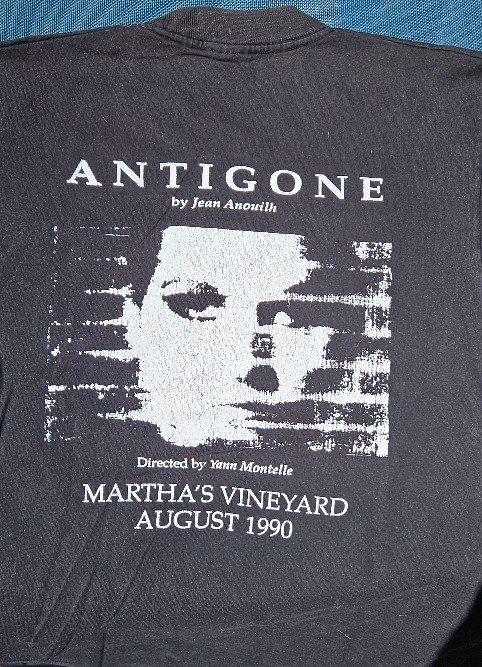
The second of my two show-specific shirts, unlike the first, commemorates a production mounted entirely on the Vineyard, but not by either of the two established theater companies, Island Theatre Workshop and the Vineyard Playhouse.[1]
Concerts and road races are far more likely to have their own T-shirts. Not only is this a rarity in Vineyard annals, but it even includes the essential who, what, when, and where. The image may be that of Kristina Kreyling, who had the title role.
Seen from several decades later, the late 1980s and early ’90s were a golden age in Vineyard theater, and in the grassroots performing arts in general. “The Play’s the Thing,” a July 1990 story in the Martha’s Vineyard Times summer supplement, counted no fewer than seven companies in action that summer.[2]
Essential to this flowering was available space.[3] The Vineyard Playhouse could host full productions upstairs, and smaller ones downstairs, like the late-night comedy troupe Afterwords. Island Theatre Workshop (ITW) didn’t have its own home, but it had regular access to Katharine Cornell Theatre, upstairs from Tisbury Town Hall, and, for auditions and early rehearsals, to the parish hall at Grace Episcopal Church not far away.
Once Wintertide moved into its year-round home at Five Corners in January 1991, all sorts of creativity took root and flowered there, including WIMP, the Wintertide Improv group. Among WIMP’s offerings was “Troubled Shores,” a long-running soap-opera-style satire of island life.[4] I still vividly remember Theodore Sturgeon, chief surgeon at Wing and a Prayer Hospital (Toby Wilson), Sengekontacket Vanderhoop (Lisa Elliott), and John Farmboy (Chris Brophy).
Some performers and techies were identified primarily with one or the other theater groups, ITW or the Vineyard Playhouse, but most moved between them and Wintertide depending on available opportunities. Having both space and a pool of capable actors and tech crew available made it so much easier to mount a show than it would have been if you had to start from scratch.
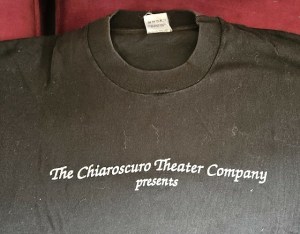
Not only to mount a show, but to birth a new theater company: Chiaroscuro, the company behind the 1990 production of Jean Anouilh’s Antigone, was born on Martha’s Vineyard. Ironically, when Yann Montelle arrived on the Vineyard to visit a friend on Chappy, he was taking a break from theater in his native France. Then fate intervened: he met, then married, Anne Cook, an artist with a long family connection to the Vineyard. Together they founded Chiaroscuro.
Chiaroscuro’s name was featured on the front of the shirt.
Yann and Chiaroscuro were active on the Vineyard for well under two years before Yann and Anne left for Portland, Maine, but the energy and quality of their activities were astonishing and invigorating to the island’s theater scene. In addition to directing, Yann ran workshops, at least two of which grew into full productions: Macchiavelli’s The Mandrake and Molière’s The Misanthrope. Of the former, he later told an interviewer[5] that “I wanted to do it to see if I could speak English. I had trouble because – you guys don’t realize it but you speak very fast!” To say he quickly became fluent is an understatement.
Yann also collaborated with fellow Frenchman Dominique Pochat (1956–2003) in the latter’s Red Nose Reviews, featuring Martin, Dominique’s clown persona. Dozens of Vineyarders, actors and non-actors, took their workshops; Red Noses started appearing in unexpected places. Red noses, by the way, have long been associated with clowns, but where did they come from? Origin stories vary: poke around online and you’ll find some of them. They’ve been described as “the smallest mask in the world.” I love this. With a red nose on, your face becomes both yours and not-yours. You’re free to become a you that isn’t seen in polite company.
And Yann directed several outstanding shows in 1990 and 1991. In addition to Antigone, I remember especially The Merchant of Venice (summer 1991) — which like Antigone was staged at the outdoor Tisbury Amphitheater[6] — and Sartre’s No Exit. I have copies of the reviews I wrote of several of these shows, so it’s not hard to remember the details. About Antigone I wrote that it was “one to see more than once, to discuss passionately far into the night over cappuccino or wine. Directed with care, graced with several outstanding performances, this ‘Antigone’ jerks you back and forth by the hair and leaves you breathless, dizzy, even awed.”
Randy Rapstine, who appeared in both Antigone and Merchant as well as other Vineyard productions (and with the Afterwords troupe), was one of several theater people who were then moving regularly between New York and the Vineyard. Asked to compare the two scenes, he noted that “in New York, you’re a small fish in a big pond,” while the Vineyard provided opportunities that were rare in New York. As a result, actors can take on a range of roles so audiences “see different parts of you.” He praised Vineyard theatergoers for being willing and able to do that.[7]
NOTES
[1] They rarely if ever created a T-shirt for a particular show. This makes sense. From auditions through rehearsals to opening and then closing night, a production’s life cycle might be eight weeks at most. Designing a shirt from scratch, then getting it printed and out on the street, would probably take at least four, by which point the run would be half over.
[2] For the record, they were the Vineyard Playhouse Company, Chiaroscuro Theatre Company, Full Circle, Island Entertainment Productions, Island Theatre Workshop, Red Nose and More, and Theater Arts Productions. The story was by yours truly.
[3] Also important was reasonably affordable housing. Year-round housing could usually be found at a realistic (for the Vineyard) price, and seasonal actors and techies could be put up in the spare rooms of year-rounders. As time went on, spare rooms became scarce, in part because young people who’d grown up on the Vineyard couldn’t afford to move out on their own.
[4] Led by WIMP veteran Donna Swift, Troubled Shores became the name of a Vineyard nonprofit focusing on theater (including improv) for young people on the Vineyard.
[5] That would be me. This was sort of Yann’s exit interview from the Vineyard: “Yann Montelle Seeks Out New Risks,” Martha’s Vineyard Times (August 29, 1991).
[6] If in warm weather, especially toward the end of the afternoon, you see vehicles parked bumper to bumper on both sides of State Road near the Tashmoo Overlook, that’s a sure sign there’s a show on at the Tisbury Amphitheater. This is a glorious clearing in the woods with a natural embankment that’s been augmented with very basic seating, e.g., railroad ties. Playgoers often bring their own beach chairs or blankets, and often a picnic. If you’ve never been there, pull off on the overlook when there isn’t a play going on, start walking down the access road, then take one of the paths on your right that leads into the amphitheater itself.
[7] Writing in the T-Shirt Chronicles about people I knew decades ago, I’m often afraid to look them up online. Randy was so talented and so motivated but the New York theater scene is so crowded and demanding. I didn’t want to learn that Randy had given it up and become a stockbroker. Good news: His subsequent career has included directing, producing, and teaching as well as acting in films as well as theater, and he’s still at it. Check out his website for details.
Considering how many years I was involved in Vineyard theater and how many shows I was involved in, it’s surprising that I have only two T-shirts devoted to specific shows: this is one and the other will be up next.
I was the main theater reviewer for the Martha’s Vineyard Times when For Colored Girls Who Have Considered Suicide opened at the Old Whaling Church in Edgartown in August 1989. It’s obvious from the opening paragraph of my review (M.V. Times, Aug. 24, 1989) that I was blown away:
At its most profound, theater melds language and movement into a whole that overwhelms the individual senses, an experience so powerful that it becomes sacred. Marla Blakey’s production of Ntozake Shange’s “For Colored Girls Who Have Considered Suicide / When the Rainbow Is Enuf” . . . is that kind of theater.
Reviewers get to see the show for free, but I went back at full price (which I think was $20) at least once and I’m pretty sure twice before the run ended. Some while later a smaller production was mounted at Piatelli Studios, a multi-purpose space in the building next door to the West Tisbury post office.1 I saw that at least once too.
Note the “Martha’s Vineyard, 1989” at the bottom. This shirt was designed for this particular production. Sorry about the stains. My first couple of decades on the Vineyard, my clothes were often at the mercy of laundromats so I avoided white for this very reason.
NOTE
When pianist Cheryl Piatelli owned it, the building was vivid pink. After Cheryl left, the pink disappeared and the building was given over to various healthy activities, e.g., exercise and alternative health care, so I never saw what it looked like inside. In October 2019, Vineyard-based nonprofit radio station MVY bought the building. After extensive renovations were completed, the station took up residence at the end of 2020. If the creative energy of the Piatelli years is still around, I think it’s happy with the new occupants. ↩︎
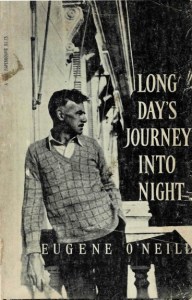
Where to begin? The family I grew up in had upper-crusty antecedents on both sides — New England on my father’s side, Virginia/Maryland/New England on my mother’s — but we looked middle/upper-middle class. My father was an architect. My mother didn’t work outside the home while my brothers, sister, and I were growing up. She talked with such evident longing about having done summer stock theater after WWII (during which she was in the SPARs, the women’s unit of the Coast Guard Reserve) that when I first read Eugene O’Neill’s Long Day’s Journey into Night my senior year of high school, I connected her instantly with Mary Tyrone, who clings to a belief that she could have been a concert pianist if only she hadn’t got married.
I’ve carried this copy with me since my senior year of high school.
That was not the only connection between my mother and Mary Tyrone: the latter was addicted to morphine, while my mother’s drug of choice was alcohol. She didn’t stop drinking till after a family intervention when I was in my mid-40s. As a teenager I was deep down convinced that if I drank, I would become an alcoholic too. So I didn’t drink.
In my mid-teens, however, I started eating compulsively. Between the beginning and end of junior year I gained 40 pounds and was totally oblivious till spring weigh-in in gym class. It took several years before I intuited the connection. Nancy Friday’s book My Mother, My Self came out in 1977, the same year I did, in case I needed any encouragement.
Alcoholism was no secret in lesbian and gay communities. For many years, lesbian and gay life had revolved around bars, but even in the late ’70s, when we were conscientiously creating “chem-free” spaces and events, it was impossible to avoid. By the early ’80s we were arguing about ways to deal with it. In the feminist and lesbian circles I moved in by then, the 12-Step program of Alcoholics Anonymous (AA) and Al-Anon was suspect from the get-go for its heavily patriarchal Christian God orientation. I didn’t know how to go about finding meetings that welcomed gay men, lesbians, and/or feminists. Coming up with effective alternatives, however, was a challenge.[1]
Among the first things I did when I landed on Martha’s Vineyard was go looking for a 12-Step program. They weren’t hard to find: both weekly papers included lists of meetings for several programs, mainly AA, Al-Anon, Narcotics Anonymous (NA), and Overeaters Anonymous (OA). That first fall I attended a couple of Al-Anon meetings. Most of the attendees were women with alcoholic husbands or ex-husbands. I was a lesbian who had grown up with an alcoholic mother but had left home a long time ago. They were dealing with day-in-day-out reality; I was dealing with patterns rooted in the past.
Since food was obviously my drug of choice, I tried a couple of OA meetings. At the time the few OA options on the Vineyard followed the “Grey Sheet” plan, which looked like, and indeed was, a diet. Not what I was looking for. I wanted to deal with the compulsion part, not control the calories I was taking in.
Then I found an Adult Children of Alcoholics (ACA) 12-Step meeting in the doctors’ wing of Martha’s Vineyard Hospital. There I found my tribe. I kept coming back. I was asked to lead the fourth meeting I ever attended. I didn’t realize at the time that this was highly unusual. Leading the meeting was Mary Payne, who was sure not only that the newcomer was, like her, a lesbian but that she would come out if she had to introduce herself. She had my number: I was and I did. On the Vineyard in the mid to late ’80s, gay men and lesbians lived mostly under the public radar. We knew each other, but no one was, as they say, “flaunting it.” This was my invitation. A door opened up. I walked through it, not knowing what the reaction would be. The reaction in that ACA meeting was pretty much “No big deal” and “Keep coming back.”
Along with being the chair of that particular meeting, Mary (1932–1996), the founding director of Island Theatre Workshop (ITW), was frequently described as “a dynamo.” This is 100% accurate. She was under five feet tall but had the presence and impact of a six-footer. AA’s 11th Tradition says that “our public relations policy is based on attraction rather than promotion.” Mary’s PR policy was the exact opposite: she was a tireless promoter, and in her worldview the overlap between theater and recovery was significant. Come by the theater — Katharine Cornell Theatre, “KC” as I soon learned to call it — during a rehearsal, said Mary. ITW was rehearsing Molière’s The Miser. I could help with PR. (This was probably my introduction to the Tisbury Printer, which printed all of ITW’s posters and programs.)
This T isn’t a T at all — it’s got a collar — and it predates my involvement with ITW, but it’s the only ITW shirt I’ve got.
I hadn’t done theater since high school, but over the years I’d often been at least on the peripheries of the performing arts, especially music. Hallowmas, my D.C. writers’ group, had given public readings. I was tempted, but I was also terrified. I envisioned the theater as a cavernous space with tiny figures at the far end, none of whom I recognized and none of whom noticed me.
When I finally mustered the nerve to walk up the outside stairs and open the door for real, what I saw was a cozy, even intimate space, flooded with light from tall multi-paned windows on both sides. Between the windows were four giant murals, two on each wall, depicting scenes from island history and island life.[2] In the mid-1980s the seats were covered in a green vinyl that could emit a sound like flatulence if you changed position. They’ve long since been replaced by a textured blue fabric that remains blessedly silent.
The front of the house, just in front of the proscenium stage, was bustling with activity. Rehearsals usually had two or three dogs in attendance: Mary’s Schipperke, Jenny; Nancy Luedeman’s Lhasa Apso, Featherbell; and Lee Fierro’s Meggie, who was larger than the other two but not by much. Dogs were of course verboten in KC, and equally of course Mary and company ignored the prohibition.
You’ve seen this shirt before, but some shirts keep coming back.
I was quickly hooked. Mary was impossible to say no to, but the reasons for “yes” were compelling. I was still getting my bearings on the Vineyard, still half thinking that I was just here for a year, and here, abracadabra, was a ready-made multigenerational circle of interesting friends and acquaintances, quite a few of whom were lesbian or gay. I got included in potlucks, holiday gatherings, and birthday parties. I got part-time jobs and house-sitting gigs through theater connections. On solstices, equinoxes, and cross-quarter days — the sacred days between the solstices and equinoxes: Samhain (Hallowmas), Brigid (Candlemas), Beltane (May Eve), and Lammas — Mary often hosted witchy celebrations in her living room.
Not surprisingly, all this theatrical ferment affected my writing. I set aside the novel I thought I’d come to the Vineyard to write. What came out of my pen and my brand-new computer was poetry, along with reviews and occasional essays for the lesbian and feminist publications I hadn’t quite left behind. My two first stage-managing gigs, first of Shakespeare’s Scottish Play and then of Medea, inspired work that I’m still proud of, including “The Assistant Stage Manager Addresses Her Broom After a Performance of Macbeth” (see below). I was giving readings and sometimes hosting an open-mic poetry night at Wintertide Coffeehouse (you’ll hear more about Wintertide in a future post). “MacPoem,” as I came to call it, was my favorite performance piece.
Step 2 of the 12-Step Program: “Came to believe that a Power greater than ourselves could restore us to sanity.” Theater was part of that power for me. While growing up, I had associated theater with addiction, so it was wildly appropriate that it become part of my recovery. Mary’s approach was, to say the least, unorthodox, but it worked.
Notes
[1] This was what prompted me in the early 1990s to write a series of columns for the feminist wiccan journal Of a Like Mind, on working the steps from a pagan/feminist perspective. In keeping with the 11th and 12th Traditions, these were bylined “A Pagan Twelve-Stepper.” They were popular enough to be collected into a pamphlet, which I’ve still got a copy of.
[2] Before long I learned they’d been painted by Stan Murphy (1922–2003), the eminent Vineyard artist.
* * * * *
the assistant stage manager addresses her broom after a performance of “macbeth”
Who am I? Let me tell you what I do. Within these walls I manage time and space, make sure the pitcher’s on its hook before its bearer wants it, warn the messenger he’s on soon, check to see his torch is lit and that the backstage lights are out. Right now I’m cleaning up debris from this night’s show. Is this a dagger I see before me? It is, but split in pieces. I’m the one who tapes it back together after hours. Tomorrow night this plastic dagger turns to steel, honed sharp enough to pierce a haunch of gristly meat — or Duncan’s royal breast. Before each show I sweep the stage. I see green needles strewn where Birnam Wood has come to rest the night before. I shiver, chilled, as if I’d slept and woken centuries hence with all my friends and family dead. And then I sweep them all away. “Out, out, damn trees!” I cry, “You haven’t come here yet! Begone!”
Here, separate ages stream like shimmering strands in one great waterfall, and time dissolves. Mere mortals we, what havoc do we wreak? Elizabethan Shakespeare conjured up Macbeth, medieval Scottish thane, and we invoke them both, in nineteen eighty-six. I watch the people enter, choose their seats, and rustle through their programs. Normal folk, it seems, and yet this gentle summer night they’ve purchased tickets to a barren heath, a draughty castle primed for treachery. Right now the lights are up, the theatre walls are strong, the windows fixed within their frames. At eight o’clock the howling winds begin, the wolves close in, the sturdy walls are gone. These common folk, I wonder, have they bought enough insurance? Have they changed their bills for gold and silver coin? If challenged by a kilted swordsman, how would they explain their strangely tailored clothes?
No loyal lord or rebel threatens me. Between the worlds, or through this velvet curtain, I can move at will. I warn the sound technician, “Ten more minutes,” then I pass backstage to say, “The house is filling up.” The Scottish king is drinking ginger ale; a prince-to-be in chino slacks is looking for his plaid. The Thane of Glamis is pacing back and forth, preoccupied with schemes to win the crown, or trouble with his car. I prowl backstage, alert for things and people out of place. Last night I found a missing messenger outside the theatre, smoking cigarettes. I called him back in time: Macbeth’s bold wife demanded news — What is your tidings?; he was there to gasp, The king comes here tonight!
No phone lines run to Inverness, no news at six o’clock. (Walter MacCronkite’s face appears and says that base Macdonwald’s head was nailed upon the wall, that Cawdor’s fled and Glamis has been promoted; polls predict he might go higher still.) The kingdom’s nerves are messengers who run from king to thane to lady. Take the Thane of Ross, who comes to tell his cousin that her husband’s flown to England, leaving her unguarded; then he takes himself abroad, to where Macduff and other rebel lords are planning war. Macduff’s unguarded lady fares less well. A breathless runner pleads, “Be not found here; hence, with your little ones!” but on his heels come murderers, death-arrows from the king. Two sons, a daughter, and their mother die with piercing shrieks that vibrate in my spine.
With piercing shrieks vibrating in my spine, I contemplate a different line of work; this sending harmless people to their deaths is bad for my digestion, and what’s more, it’s happening much too often. First I let King Duncan in, and he gets killed in bed. Could I have known so soon that Cawdor’s heart was rotten? No. But shortly after, I send scoundrels to the banquet hall; Macbeth himself has called them. Not the kind of guest that Duncan entertained! And then I tell Macbeth’s friend Banquo and his son it’s time to join the party. What about the thieves I know are lurking on the gate road, dressed to kill? But Banquo is a fighting man, well-armed, and Fleance does escape. Not so Macduff’s fair lady, and her kids. Could I prevent their deaths? What if I plied the brutes with Scotch? They might get drunk enough to lose their maps, or drop their knives, or fall asleep. What if I whispered in the lady’s ear, “Don’t go outside today — and bar the doors.”
I doubt she’d pay attention. Each one goes to meet the dagger destined for his breast. Perhaps I’d get my point across if I could speak in rhyme and paradox, the way the witches do, with fair is foul, and foul is fair. The witches manage time and space like me; you could call me the unseen witch. I wonder, are they working from a script? You’ll see: the second sister sweeps the stage as I do, clearing them the space they need to cast their circles. We both summon kings and apparitions out of time, although our methods differ some. “You enter soon,” I warn, “stage right.” Mundane, compared to how my sisters work, with Double, double, toil and trouble, cauldron, fire, and lengthy list of weird ingredients — the eye of newt and toe of frog, the blood of sow that ate her piglets — but we get the same results. Our audience is moved to awe, and then proceeds along its merry way to rendez-vous with fate, or Birnam Wood, or man not born of woman. They get blamed for it. I don’t.
The witches disappear, and one last time prince Malcolm calls his kin to see him crowned at Scone. The set is struck, costumes returned to cardboard boxes, wooden banquet bowls and Scottish flag to rightful owners; kings go home to mow the lawn or fix the car. Where did the blasted heath go off to? I am leaning on my broom again. What stays when all the parts spin off? Just memories of daggers, prophecies, and anguished screams? The air still tingles here. The gates remain but smaller, well concealed. I might reach in and conjure back that knife, that messenger. “There’s knocking at the gate,” the lady says, “Give me your hand! What’s done cannot be undone.” To bed, she says. To bed, to bed, to bed.




 The T-Shirt Chronicles