The 1987 March on Washington for Lesbian & Gay Rights wasn’t my first national march, not by a long shot. Barely a month into my freshman year of college, I participated in the first Vietnam Moratorium march on October 15, 1969, then exactly one month later, on November 15, I was a marshal at the huge New Mobilization1 (aka “New Mobe”) march. From my station between 6th and 7th Streets NW, I got to watch hundreds of thousands of people pouring down Pennsylvania Ave. ten or twelve abreast. I’d never seen anything like it.
I still have visceral memories of that one. It was sunny, but it was chilly and I was underdressed: In my innocence I thought my winter duds could wait till I went home for Thanksgiving. Wrong. I wasn’t the only one either. Those who’d worn jackets hadn’t brought gloves, so we took turns making coffee runs to the nearest drugstore then warmed our hands by wrapping them around the cup. Several of us entertained the others, and the police officers stationed on the same block, singing Tom Lehrer songs. I could go on . . .
So the 1987 March for Lesbian & Gay Rights wasn’t my first national march, but it was the first I’d had to travel to. I’d moved back to Massachusetts in the summer of ’85, and by now into my third year, it looked like I was going to stay there.
I’d marched in the the first national March for Lesbian & Gay Rights in 1979, of course, but I don’t remember who I marched with. Maybe the off our backs contingent, or the Washington Area Women’s Center? I do remember passing along the back side of the White House grounds chanting with a whole bunch of other dykes “Two, four, six, eight, how do you know that Amy’s straight?” Amy Carter, daughter of then-president Jimmy Carter, was all of 12 at the time. We were, of course, giving her the benefit of the doubt, but — I just looked her up — she’s been heterosexually married twice and has two kids, so straight she seems to be.
The AIDS Quilt, officially the NAMES Project AIDS Memorial Quilt, was displayed for the first time during that march. Established almost exactly two years earlier, in November 1985, the Quilt at that point included 1,920 panels. Each panel was three by six feet; they were stitched into square blocks of eight panels each.
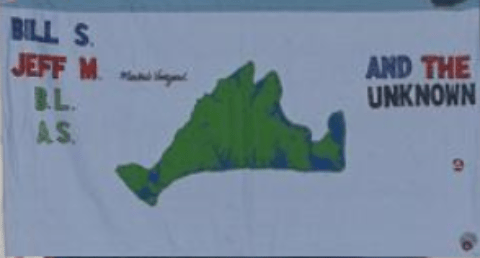
I knew about the Quilt. My friend Nancy Luedeman (1920–2010), a mainstay of Island Theatre Workshop and longtime partner of Mary Payne, had created a panel for four Vineyard men who had died of AIDS. I promised I would find her panel.
I was not prepared for how overwhelmed I felt as I walked down the rows between the blocks of panels. I’ve been deeply moved walking through cemeteries, noting the dates and the connections between people, but this was different: each panel was alive, evoking in color and imagery the life and personality of each person memorialized, each person lost. Finally I knew what it felt like to be in the presence of the sacred.
I did find Nancy’s panel. Two of the four men were identified by first name and last initial, the other two only by initials. This reflected the shame attached to AIDS, and homosexuality, on Martha’s Vineyard and in so many other places at the time. Nancy didn’t volunteer their full names, and I didn’t ask. I think Nancy said they’d all died off-island. Eventually I learned that Bill S. was Bill Spalding, who has another panel in the Quilt, with his full name on it. I don’t know about the others. If you do, please let me know.
Quilt panel created by Nancy Luedeman in memory of four Vineyard men who died of AIDS
The Quilt returned to D.C. a year later, and so did I. It had been on tour that spring and summer of 1988, growing all the while. By October 1988, spread out on the Ellipse, it comprised 8,288 panels. Too many to see all of them in only two or three hours, so I wandered, letting myself be drawn and directed by a name, an image, a thought.
A Red Cross caught my eye. I had worked at Red Cross national headquarters for four years in my D.C. days. That’s where I learned what an editor was, and where I started to become one. When I reached the panel and read the name on it, my knees collapsed under me. It was for my co-worker and friend Thom Higgins, whom I’d seen when I was in D.C. the previous October. He’d seemed fine. He didn’t say anything about being sick. He’d died earlier that year, I think in May.
The image in the middle is for Toastmasters, of which Thom was a dedicated member. IIRC the panel was created by Thom’s friend and my friend and former colleague Brad McMinn. Brad died, also of AIDS, in 1993.
My recollection is that Casselberry and Dupree were singing “Positive Vibration” at the other end of the Mall, but maybe I made that up. Now I can’t hear that song without thinking of Thom. I can’t think of Thom without hearing that song.
Formally the New Mobilization Committee to End the War in Vietnam. The successor to the National Mobilization Committee to End the War in Vietnam, which organized major antiwar events in 1967 and ’68, this was the coalition that organized the gigantic November 15, 1969, march. Frequently confused and/or conflated with it was the Vietnam Moratorium Committee, which organized the October 15 events across the country. It also organized the incredibly moving prelude to the November 15 march: On November 13 and 14, thousands of people walked from Arlington National Cemetery to the White House, each one bearing on a placard the name of someone killed in Vietnam. In front of the White House these placards were deposited into coffins set up for the purpose. I was involved in the housing and feeding operation ongoing at Georgetown and so was unable to participate. ↩︎
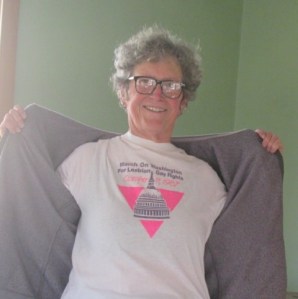
I acquired this shirt when I was around 30. Both the shirt and the poem whose first line graces it were popular with women my age, give or take a decade. This may sound odd but it isn’t: the poet, Jenny Joseph (1932–2018), was 29 when she wrote it, in 1961.
The possibly odd thing is that Jenny Joseph hated purple. It didn’t suit her, she said. I can’t help wondering if that was always the case. She was an accomplished poet, the author of several children’s books, and an all-round interesting person, but the poem became far more famous than she. Once the internet came along, it circulated widely with no name attached, and it has been often “adapted” over the decades — Google “when I am an old cowgirl” if you don’t believe me.
That’s enough to turn anyone against purple even if they loved it to start with. We poem quoters and T-shirt wearers loved purple. Lavender was for lesbians, and what was purple but a deeper shade of lavender? (If a T-shirt came in multiple colors, you could count on the lavender ones selling out first.)
So fast-forward about four decades. My friend Dan Waters — poet, master printer, artist, photographer, and my town’s moderator, among other things — has been photographing Vineyard characters for the Martha’s Vineyard Museum, and he asked if he could photograph me. Hell yes, said I.
Photo by Daniel A. Waters
As the appointed date for the shoot approached, however, I was having second thoughts. It wasn’t that I was nervous about being photographed, it was that I couldn’t decide what T-shirt to wear. As you well know by now, I have a lot of options. Should I pick a Vineyard shirt? one from my horsegirl years? an overtly feminist or blatantly dykey shirt?
I spread the likeliest candidates, at least a dozen of them, out on my bed. When my eye fell on “When I Am an Old Woman,” I knew: That’s the one.
The shirt is purple, of course, though you can’t tell that from the photo. I don’t generally think of myself as an old woman, though, since I was going on 70 when Dan took the picture and am closing in on 71 now, I surely am.
This particular T-shirt seemed right because I was wearing purple then and I’m wearing purple now.
The last three lines of Jenny Joseph’s poem go like this:
But maybe I ought to practise a little now?
So people who know me are not too shocked and surprised
When suddenly I am old, and start to wear purple.
No one, but no one, who knows me at all could be shocked or surprised that I wear purple. It’s probably one of my lesser idiosyncrasies.
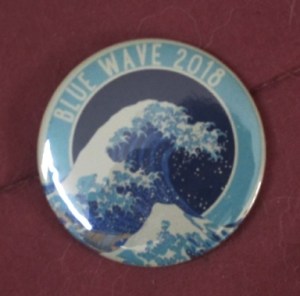
Wave image by Hokusai, button design by Alison Scott
From a visual point of view, I rather wished I hadn’t decided to wear those two buttons, but they do represent important parts of my life. The one on the left is “Blue Wave 2018,” about the midterm elections during what blessedly turned out to be the Trump administration’s only term.
The one on the right — well, that goes back a while. It’s from the October 15, 1969, march to end the war in Vietnam. The D.C. march was my first big demonstration. I was a first-semester freshman at Georgetown University, majoring in Arabic and already minoring in antiwar organizing. The same logo was used on the two-day moratorium that preceded the hugeNovember 15, 1969, national march on Washington. The two-day Moratorium, November 13 and 14, included a long, solemn, single-file march from Arlington National Cemetery to the White House. Each marcher carried a sign bearing the name of a service member or civilian who had died in Southeast Asia. At the White House they deposited their name signs into coffins that had been set up for the purpose.
Dan’s photo of me, blown up to four by five feet, will eventually appear in rotation in the lobby of the Martha’s Vineyard Museum. He’s been at work on this project for a few years now: in 2019, before Covid-19 shut everything down, a selection of the huge photos was displayed at the museum. Who knows, maybe mine will eventually appear in a group show too!
If you don’t see a Leave a Reply block, click on the title of this post and then scroll to the bottom.
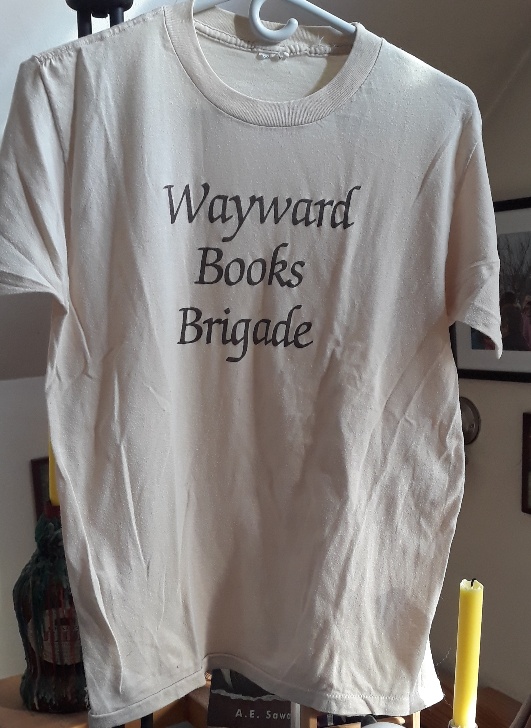
When bookstores move, staffers usually pack the books in boxes, load the boxes in a truck, and drive the truck to the new location. When Wayward Books moved, owners Sybil Pike and Doris Grumbach packed the books in grocery bags and volunteers passed them hand to hand along Pennsylvania Avenue SE to the new shop at 325 7th Street., which was practically next door to Lammas. I was one of the volunteers, and that’s how I got this T-shirt.
True, the distance was only three or four city blocks, and as I recall the brigade didn’t quite stretch the whole distance, so cars were called upon to ferry the books across the gap. But the operation was ingenious and fun, and it worked.
Wayward Books dealt in a carefully curated mix of secondhand and rare works, which meant those books had already been around. They probably took their latest move in stride.
Lammas was well represented in the Wayward Books Brigade, and not only because Wayward Books was moving into the immediate neighborhood. Pike and Grumbach had been a couple since the early 1970s, and Grumbach’s novels were regular sellers at Lammas, notably Chamber Music and The Ladies, which was based on the “Ladies of Llangollen,” two 18th-century Irish women who eloped to Wales, set up housekeeping as a married couple, and whose home became a go-to destination for literary luminaries of the time. Grumbach’s books focused on women’s lives, and often women in relationship with each other, which was not all that common at the time, especially for “mainstream” novelists.
Sybil, a retired research librarian at the Library of Congress, was the on-site manager at Wayward Books — I remember her as a strikingly handsome woman who would have been in her mid-fifties at the time — but Doris was also around when she wasn’t teaching or writing. The two shops complemented each other nicely: their inventories didn’t overlap, but their customers did.
A Washington Post story from April 1990, reporting on Wayward Books’ relocation to Sargentville, Maine, that month, notes that the Wayward Books Brigade comprised 70 volunteers and moved some 3,000 volumes from old location to new. The move to Maine involved three times that many books and was presumably not accomplished hand to hand.
The Post story also says the hand-to-hand move to 7th Street happened in 1985. I would have said a year earlier, because I left D.C. at the end of July 1985 and it seemed Wayward Books and Lammas had been neighbors for more than a few months at that point. But memory is tricky, so maybe not.
I just learned that Sybil passed in March of last year, at the age of 91, but that Doris seems to be alive in her 104th year. It sounds as though, around 2009, they moved together to a retirement community in Pennsylvania, where Sybil died and Doris still lives. Anyone with more information, please respond in the comments. If you don’t want your comment published, say so and it won’t be.
This T-shirt has nothing to do with Wayward Books — except that they both have to do with books, and that Women’s Glib was somewhat wayward in that it had to do with feminist humor, which many continue to swear is an oxymoron. Not for the first or last time, those “many” are so wrong.
Women’s Glib and Women’s Glibber, anthologies edited by Roz Warren, both came out in my bookselling days — I think. Amazon.com gives the early ’90s as pub dates for both books but notes in one case that it’s a second edition. I’m pretty sure I didn’t have anything in either book, although I was the class clown (female) in sixth grade and have been credited with having a pretty good, albeit barbed, sense of humor in all the decades since.
Interestingly enough (to me, at least), this is one of the very few — maybe even only? — Ts I have that features a book. I’ll hedge my bets on that one till I’ve excavated my whole collection. Either few books were featured on Ts or I wasn’t buying (or being given) the ones that were.
My humor tends to be in the moment — I think the word is “situational,” meaning that it arises from circumstances. I’ve never been fond of the other kind, such as stand-up, mainly because stand-up comedy back in the day was so misogynist, even when performed by one of the few women in the trade. Phyllis Diller embarrassed and infuriated me. I could admire Lucille Ball and I Love Lucy while being mortified by her tactics.
As a teenager and young adult I was a huge fan of the Smothers Brothers and Rowan and Martin’s Laugh-In. By the time Saturday Night Live got going, in the mid to late 1970s, I was doing fine without a TV and besides, SNL didn’t seem all that in sync with the lesbian-feminist life I was living.
Humor that was in sync with my life — I loved it. Alison Bechdel’s Dykes to Watch Out For strip and the books compiled from it were huge hits with Lammas customers. So were Nicole Hollander’s Sylvia books. They kept us laughing, and they kept us sane.
The first stand-up comedian who made me sit up, take notice, and even buy at least one of her albums was Kate Clinton. I heard her perform live in the early ’80s. What a revelation! The problem with stand-up comedy wasn’t me, it was the sexist, heterosexist comedy itself!
I’m thrilled to report that Roz Warren and Kate Clinton are still “making light,” as an early Clinton album had it, and you’ve almost certainly heard of Alison Bechdel, if not of Dykes to Watch Out For. I’m not sure if Nicole Hollander is still creating, but it’s not hard to find Sylvia online.
Sylvia — that Sylvia — was one of the namesakes of the TRS-80 that was Lammas’s and my first computer. The other two, as I think I mentioned before, were Sylvia Sherman, my high school history teacher, and Sylvia Abrams, my editorial mentor, without whom I would have had a hard time making a living these last four decades.
Like all feminist bookstores, Lammas was a hub for the feminist and lesbian communities of the D.C. area, but because D.C. itself is a hub for the nation and the world, women from all over sought out Lammas when they were in town for conferences, school trips, vacation, you name it.
The librarians were my favorite. They’d come in from all around the Mid-Atlantic region and beyond, especially from small cities, towns, and rural areas with no feminist bookstore in reach. They’d nearly always have shopping lists, gleaned from feminist publications and word of mouth, and often dropped two or three hundred bucks in a visit.
Where did my T from the 14th Women and the Law conference come from? I didn’t attend, though it was indeed in D.C. An attendee might have given it to me, or it might have been left behind at the shop. I like the design: it illustrates how effective black & white can be.
Was the conference still being held? A Google search turned up several conferences with similar names, but none of them dated back this far. off our backs devoted about half of its May 1983 issue (vol. 13, no. 5) to the 14th conference; you can view it online at JSTOR, but you’ll need a JSTOR subscription to download it.
Searching on the full conference name, in quotes — “National Conference on Women and the Law” — yielded paydirt: a 1994 article by Elizabeth M. Schneider: “Feminist Lawmaking and Historical Consciousness: Bringing the Past into the Future.” (Published in the Virginia Journal of Social Policy & the Law, vol. 2, no. 1, it’s now available as a free PDF download, but the godawful URL is four lines long. Go to BrooklynWorks, “open-access scholarship from Brooklyn Law School,” and you can search for it there.) It’s worth the trip. Schneider writes that the conference, which was held from 1970 through 1992, “played a crucial role in shaping feminist legal history over the last twenty-five years.”
Lammas occasionally went on the road as well, and that’s how I came by “Sisterhood Is Blooming / Spring Will Never Be the Same”: selling books at a women’s conference at West Virginia University in (I’m guessing here) 1983 or 1984. The keynote speaker was Maya Angelou, and my main visual memory of the conference was of being near the back of a vast, packed gymnasium with Angelou onstage at the other end.
I’ve never been comfortable in crowds of mostly strangers, but I did fine when I had a role to play, and it didn’t get much better than selling feminist books and records to women who didn’t have ready access to either except by mail-order. Lammas owner-manager Mary Farmer was far more gregarious than I ever was. As a Ladyslipper distributor, she was often on the road in her big red Olds, visiting record stores or selling records at women’s music concerts. I was just as happy holding the fort at home.
The story behind this one starts way, way back, long before I moved to D.C. the first time.
My family wasn’t especially musical. My maternal grandmother played the piano by ear, which I thought was cool, but unless Granmummie was visiting,[1] what music there was in our household came via records and the radio.
Not to discount the importance of records, however: When I left for college, I absconded with my father’s Joan Baez album, her first. I didn’t need to take his Tom Lehrer LPs — Lehrer’s first, the one whose cover featured a caricature of the pianist as the devil surrounded by the red flames of hell (see below), and That Was the Year That Was — because most of the songs were embedded in my memory.
I’ve still got that Joan album, and the 10 or so of its successors that I acquired legitimately in the following years, and I still know a ridiculous number of Tom Lehrer songs by heart.[2]
See what I mean? Originally released in 1953, when I was 2.
Like many middle-class-and-up suburban kids my siblings and I took piano lessons with varying degrees of enthusiasm. The teacher wasn’t especially inspired or inspiring. I did learn to read music, but I didn’t learn to pick songs out of the air the way my grandmother did. That was disappointing, but what I didn’t really understand was what all that tedious practice could lead to. If I had, maybe I would have persisted.
Or maybe not.
I did, however, like to sing. Singing was the best part of church, where we went almost every Sunday morning as a family: St. Peter’s Episcopal in Weston, Mass. From fifth grade through eighth I sang alto in the junior choir. After eighth grade, when we aged out of both the junior choir and Sunday school, we could join the adult choir, but the adult choir sang at the 11 a.m. service and my family went to the 9:15. That’s when I left the church.
In my eighth-grade year, Becky B., also an eighth-grader, a soprano who’d been in the choir as long as I had, told me that I always sang off-key. To avoid ruining the anthem, she said, I should just pretend to sing.
No one else — not the choir director/organist, not any other member of the choir, not any of my music teachers in school — had ever told me any such thing. Becky B. didn’t like me and I didn’t like her; she was a goody-two-shoes who was always playing up to the adults. But I feared she was right, that I had been found out.
Somehow I made it through the year. Then I stopped singing. Period. When I entered high school in the fall, the music teacher encouraged me more than once to try out for Glee Club. Since she directed the Glee Club, this should have given me confidence, but it didn’t. I was sure I’d fail and confirm beyond any doubt that Becky B. was right: I couldn’t sing.
It was years before I recognized the pattern: I’d pursue a skill, an instrument, a foreign language — then abandon it when I was on the verge of being able to actually use it. At that point you’re bound to make mistakes. In my family making mistakes got you creamed. My very intelligent and well-read father regularly ridiculed my mother for getting the wrong answer or saying anything he considered stupid. I learned to get my facts straight before I opened my mouth. From an early age I’d been good at words, anything to do with words. I stuck to words, spoken and written, but never sung.
I never stopped listening to music, though, or hanging around people who made music or were somehow in the music biz. Gradually, and usually in fits and starts, I got braver, venturing into territories where I didn’t have all the answers and was bound to make mistakes: taking that first editorial job at the American Red Cross, for instance, or becoming the book buyer at Lammas Bookstore. I did well at both, but note that they both had to do with words: in some ways I was pushing the boundaries of what I was already good at.
The D.C. Area Feminist Chorus was founded in 1978, prompted by a singing workshop led by Holly Near during that year’s Gay Pride celebration. In its early months it was leaderless, with members leading warm-ups and teaching each other songs.
At some point, they decided to engage a director/conductor, and after interviewing several candidates, they hired Deb Weiner. Deb either was already or was soon to become one of my housemates, but this did not prompt me to join the chorus. If anything, it was a deterrent: What if it was your housemate who had to tell you that you couldn’t sing on key and were dragging the group down?
I have an indelible memory of Deb conducting the combined D.C. Area Feminist Chorus and Gay Men’s Chorus of Washington at a holiday concert, in either 1981 or 1982. To be the conductor channeling all that massive sound! I was awed.
How did I come to finally join the D.C. Area Feminist Chorus? Well, I have it on good authority — my own words from 36 years ago — that I set out to write a story about the chorus for Hot Wire: The Journal of Women’s Music and Culture “and almost immediately found [my]self singing in the second soprano section.” By then Deb had moved on after several very successful years, Caroline Foty was the chorus director, and I was living on the far northeast fringe of Capitol Hill, subletting a large room from and sharing a kitchen with photographer Joan E. Biren (JEB).
By then, probably in 1984, I had joined the brand-new Gay and Lesbian Chorus of Washington (GLCW). How did I hear about it? I don’t remember. This was a small group, conducted by Tess Garcia, and my most vivid memory was of a performance we gave where Congressman Barney Frank, dressed in a leisure suit, reclined across several chairs in the front row. Most of the homemade cassette tape I have from a June 1985 performance is unplayable, but on the one audible cut, “Johnny, We Hardly Knew Ye,” we sound pretty good. According to the label, the program also included some P.D.Q. Bach, the spiritual “Soon Ah Will Be Done,” and selections from Annie.
I noted the most striking contrast between my two choruses in that Hot Wire story: “Because the GLCW did not choose to specialize in works by gay or lesbian composers, a chorus member could walk into any music store and be overwhelmed by the available selection.” Not so any Feminist Chorus member: all our music consisted of handwritten scores photocopied or similarly duplicated, because none of it had been published. Director Foty did some of the arranging, and fortunately feminist choruses were thriving at the time, and lots of sharing went on among them through the Sistersingers network. We were breaking ground, pioneers, in the forefront, and very aware of it.
We sang at least two songs from the Balkan women’s singing tradition. I can still fake the second soprano part of “Shto Mi e Milo,” which has been widely recorded.
One of my favorites from the chorus repertoire was a four-part setting of Edna St. Vincent Millay’s “Conscientious Objector.” I didn’t realize till about an hour ago not only that Mary Travers had performed it spectacularly, but that she wrote the solo setting and recorded it on her 1972 album Morning Glory.[3] I have a copy of the poem on my fridge: “I shall die / but that is all I shall do for Death . . .” It reminds me of the song.
The chorus made decisions collectively, including decisions about repertoire. “Conscientious Objector” almost didn’t make the cut; that was before I joined, so I don’t know what the objections were. As I recall, a couple of chorus members thought Malvina Reynolds’s “We Don’t Need the Men” was too anti-male. For others among us, this was a plus, not least because it was so tongue-in-cheekily Malvina. It was fun to remind people that Malvina wrote it in 1959.
The most controversial song I remember from my time in the chorus was “Sisters, Spring of Vietnam”; it clearly favored the Vietnamese liberation struggle against the French and the Americans, and that did not sit well with some members. Singing along with Lucha’s version I remember the tune, the harmony, and many of the words, so I’m pretty sure we sang it anyway, but some choristers chose to sit it out.
The back of the 1985 Sisterfire T. The D.C. Area Feminist Chorus is about halfway down.
My last gig with the D.C. Area Feminist Chorus was at Sisterfire, June 22 & 23, 1985. By the end of that summer I was semi-settled on Martha’s Vineyard. Music was much easier to find than feminism, and find it I did, volunteering at Wintertide Coffeehouse starting in 1986.
It took a while to find a way to start singing again. My way in turned out to be the annual Christmas performance of Messiah, sung by a large (and ever growing) pickup chorus of Vineyarders, many of whom sang regularly in various church choirs.
I’d never sung Messiah before, and most of the chorus seemed to know it by heart. More, although I could read music, I couldn’t “sight-sing,” sing from a score on first acquaintance. I still regret not having the nerve to audition for Glee Club in high school, where everybody learned to do stuff like that. I worked hard, I learned, and when, in my third year, I made it through the glorious “Amen” without losing my place, I thought I’d arrived.
The annual Messiah sings eventually grew into the Island Community Chorus, which did several concerts a year and with which I stayed until around 2005. I’ve managed to keep singing since then. In the age of Covid-19, I’ve participated almost weekly in Zoom sings (Zings?) with Susan Robbins of Libana, a women’s ensemble whose music I’ve loved since at least 1980, and a bunch of whose recordings I’ve got.
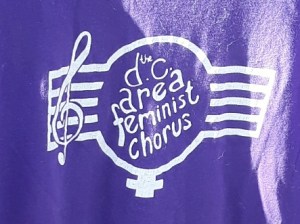
But it was the D.C. Area Feminist Chorus that got me singing again, and though I didn’t sing with it for much more than a year, this shirt is about how I found my (singing) voice again.
If you want to leave a comment and don’t see a Leave a Reply box, click the title of the blog post (above) and then scroll to the bottom.
notes
[1] Which was fairly often, because she lived only eight miles away.
[2] This is so common among the political circles I’ve moved in over the decades that if I sing or even hum a line, often someone in the vicinity will sing the next one back to me. A favorite memory from my freshman year at Georgetown U.: As a marshal for the huge Mobe (Mobilization Against the War) march on Washington on November 15, 1969, I was stationed on Pennsylvania Ave. between 6th and 7th. We were close enough together that we could reach out and touch our neighbors on either side. It was sunny but bloody cold, and my winter gear was still back in Massachusetts: I had this idea that since D.C. was a southern city I wouldn’t need it till after Thanksgiving. Wrong. Anyway, while waiting for the sun to get fully up and the march to start, we did a lot of jogging in place and making coffee runs to the nearest drugstore. Eventually one of us — maybe me, maybe not — started in on a Tom Lehrer song. No idea which one, so many of them would have been appropriate — maybe “The Wild West Is Where I Want to Be,” with its lines “I’ll watch the guided missiles / while the old FBI watches me”? We were sure the FBI and who knew what other intelligence agencies were around.
[3] My source for this is a detailed bio of Edna St. Vincent Millay on, of all things, the website for the ABC Oriental Rug & Cleaning Company in Ithaca, N.Y. There has to be an interesting story here, but I’ll have to save that rabbit hole for another time. The page seems to be updated regularly: it includes a reference to the ongoing pandemic and other events.
Me looking stern in my 1983 Sisterfire T. The blue hat doesn’t quite work with the shirt and shorts, IMO. 2018 selfie.
Sisterfire is the only women’s music festival I ever attended. Both my T-shirts call it “an open-air celebration of women artists,” so it wasn’t just about music, but music was the main event. I was never seriously tempted by other music festivals, which were proliferating in all parts of the country in the 1980s. Partly it was that, working in a feminist bookstore and living in a lesbian community as I did, I didn’t need to travel to hang out with other dykes. Mostly I wasn’t and never have been comfortable in crowds of people I don’t know.
Even crowds of all women.
Back of the 1985 Sisterfire shirt. Pretty impressive lineup, no? The D.C. Area Feminist Chorus is in the middle, right above Diane Lindsay & Sue Fink.
I have, however, been known to enjoy myself in very large groups if I have a role to play. At Sisterfire I was part of the Lammas/Ladyslipper team, selling mostly records but some books as well. In 1985, the D.C. Area Feminist Chorus, in which I was then singing, was one of the street performers, so you’ll find its name on the back of the Sisterfire shirt for that year. Chorus members performed wearing the chorus’s own shirt, and you bet I’ve still got mine. It’s got its own story to tell and will get to tell it soon.
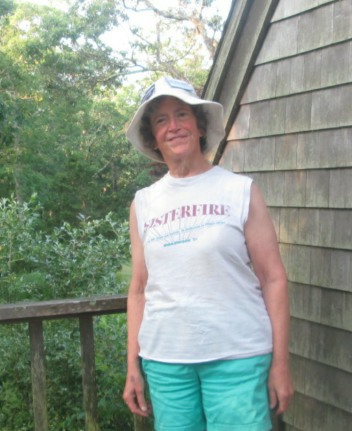
Me looking less stern and more color-coordinated in my 1985 Sisterfire T. 2018 selfie.
Sisterfire’s other compelling attraction was location: it took place in the close-in D.C. suburb of Takoma Park, Maryland. It was founded in 1982 by Amy Horowitz and the D.C.-based production company Roadwork, and the T-shirts testify that I was there in 1983 and 1985.
I left town in a U-Haul truck not long after that year’s Sisterfire, which my T-shirt says was on June 22 & 23, but Sisterfire continued into the late ’80s, not without controversy, not least because men could attend. I don’t remember the male presence being distracting or disruptive. On one hot afternoon, I do remember the announcer asking men to keep their shirts on because thanks to local ordinances and conventions women couldn’t take ours off.*
By the early 1980s, Roadwork was, in community terms, a powerhouse, booking national tours for the likes of Sweet Honey in the Rock and Holly Near and producing such standout concerts as the Varied Voices of Black Women (1978) and Cris Williamson’s appearance at Constitution Hall (1980). Naturally we sometimes snarkily referred to it as Roadhog, and a local graphic artist sported a brilliant parody of the 1983 Sisterfire shirt: it looked just like the official one till you realized the letters spelled out SISTERBLITZ.
Equinox Productions was a grassroots women’s production company — “group” is probably a better word, because they were all volunteers — formed to produce gigs too modest to get Roadwork’s attention.
One major benefit of Equinox and similar groups was the opportunity they gave women to develop skills in areas we’d been generally shut out of, like concert production and sound tech. D.C.-based Woman Sound, owned and managed by audio engineer Boden Sandstrom,[1] was a pioneer in the field and highly professional by the time this article appeared in the June 22, 1981, Washington Post.
By the time I moved back to D.C. in 1977, women’s music’s center of gravity — Olivia Records and the recording artists associated with it — had moved to the West Coast, but D.C. still had a thriving local music scene. Food for Thought, a popular vegetarian restaurant on Connecticut Ave., frequently featured live music; performers got paid by passing the hat. At least once singer-songwriter Casse Culver came down from the upstairs dressing room after her set, bandana masking her face like a Wild West bandit, and conducted pass-the-hat as a stickup. You probably couldn’t get away with that now, but at the time it was hilarious.
My favorite local musicians at the time included singer-songwriter Judy Reagan and the blues duo of Abbe Lyons and Cheryl Jacobs. Church basements and college classrooms[2] were popular year-round venues, and music could regularly be heard at rallies, demonstrations, and Gay & Lesbian Pride Day every June.
Sophie’s Parlor, the women’s radio collective’s show on WPFW-FM, was part of the mix, featuring interviews, books, and more as well as music. I’m pretty sure that this shirt was given to me by my Lammas colleague Deb Morris, who continued in the book biz long after I left and with whom (thanks to Facebook) I’m back in touch.
Sophie’s Parlor still has a weekly show on WPFW-FM. Wow. Its Facebook page says it’s “the oldest continuously running women’s music radio collective in the United States,” which is more than remarkable. The FB page also notes that it was founded at Georgetown University in 1972. I dropped out of GU halfway through my junior year, in December 1971; I remained in D.C. for the next few months, but I wasn’t aware of Sophie’s at that time. Next step is to see if I can livestream their weekly show: Wednesdays @ 3 p.m. EST.
I’ve long had a mild hankering to do a radio show — mild enough that I never sought out an opportunity to actually do it, and no opportunity ever presented itself. The closest I ever came was getting to pick what got played on the Lammas record player whenever I was working the floor. (Often I worked upstairs, keeping inventory on 5×8 file cards, one for each title, and placing orders. This was in the pre-digital age.) This was often how customers first heard the latest Cris Williamson or Holly Near, since they weren’t getting airplay in radioland, and of course we took requests. On Valentine’s Day every year I’d play all the shit-kicking anti-love songs I knew of. Favorites included Therese Edell’s “Winter of ’76,” Judy Reagan’s “Dispose of Properly,” and a whole bunch of Willie Tyson songs. Sample:
This is the back cover photo of Judy Reagan’s album Old Friends. I can name at least three-quarters of the women in it. That’s Judy at the top (you probably guessed this already). Photo by Morgan Gwenwald, used with permission.
If you want to leave a comment and don’t see a Leave a Reply box, click the title of the blog post (above) and then scroll to the bottom.
Notes
Curious fact: These four music shirts, all from the first half of the 1980s, are all muscle shirts, i.e., sleeveless. What makes this noteworthy is that I have maybe ten muscle shirts total in my extensive collection, and the others vary in subject: one’s goddess-related (you can see it at the bottom of the pagans post), one’s a dragon, and one’s from Smedley’s bookshop in Ithaca, N.Y. (that one will be along shortly), etc. So why (1) are so many of my muscle shirts music-related? and (2) did they go out of fashion?
* For more about Sisterfire’s early years, and why it didn’t happen in 1986, see Nancy Seeger, “Sisterfire: Why Did Roadwork Skip 1986,” Hot Wire: The Journal of Women’s Music and Culture, vol. 2, no. 4 (November 1986), p. 28. All of Hot Wire‘s 30 issues are available online as downloadable PDFs. You can find this one here. The story notes that in 1985 a petition opposing Sisterfire circulated in Takoma Park. Reasons included traffic and parking, noise, “the smell of marijuana smoke,” and “some women attending the festival wore no shirts.”
[1] Boden, then going by Barbara, is credited as engineering assistant, to veteran engineer Marilyn Ries, on Casse Culver’s 1976 LP Three Gypsies (Urana Records, founded by Marilyn Ries and K Gardner). The June 1981 WaPo story says that Woman Sound was then coming up on its sixth anniversary, which would have put its founding around the time Three Gypsies was being recorded.
While poking around online (I’ve been doing a lot of that while working on The T-Shirt Chronicles), I came across this tribute by Boden for her friend and mentor Tommy Linthicum, who passed away in 2007. In it she explains how she got into biz: Casse was looking for someone to train to run her sound. They eventually became partners.
[2] Particularly at George Washington University, where Lisa C., the office manager for the Women’s Studies department, was a frequent collaborator for both musical and literary events.
When I wrote in my “Sweet Honey” post that I had “at least 10 T-shirts directly related to music,” I was thinking strictly of my D.C. days. I’ve got a bunch more from after I moved to Martha’s Vineyard, but I haven’t counted them yet.
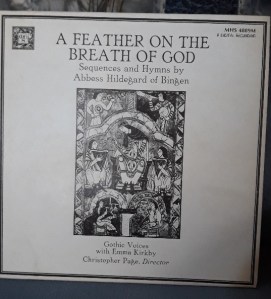
Anyway, this is an odd-shirt-out from my years in Washington: it has nothing to do with women’s music. Well, almost nothing: At the moment I’m playing a Musical Heritage record: A Feather on the Breath of God: Sequences and Hymns by Abbess Hildegard of Bingen, which features soprano Emma Kirkby and the ensemble Gothic Voices, directed by Christopher Page.
I didn’t learn much about classical music growing up, but I liked it. A friend of the family introduced me to the Musical Heritage Society, a subscription service that operated like the Book-of-the-Month Club. Each month a new recording was featured, which you could take or waive, and you could also order from their extensive catalogue. This spared me the angst of browsing the offerings at local shops without knowing what I was doing — although there was a sales clerk at a record shop on Connecticut Ave. who knew I liked early music and usually had a recommendation for me whenever I walked in.1
My tastes were fairly eclectic but I was particularly drawn to music of the medieval period, the Renaissance and Baroque periods, and anything choral. While living in England (1974–75), I even came to enjoy opera. It wasn’t hard to find full-length performances on TV, and all things classical could be found on the radio.2
Back in the States, I became a regular listener of Robert J. Lurtsema’s Morning pro Musica show on public radio. Based in Boston, it was carried by one of the D.C. stations, but I can’t remember which one. WETA-FM? WGMS-FM? I vividly recall waking one morning in the early 1980s to a eureka! moment: Robert J. was playing Sydney Carter’s “Lord of the Dance.” Oh my God, thought I. Someone’s put Jesus in the pagan tradition from whence he came, of the dying god who rises again in the dance.
The singer (you may have guessed this already) was John Langstaff and the recording was from the Christmas Revels, of which up to that moment I knew nothing. This was long before search engines could tell you anything you wanted to know in seconds — I was several years away from even owning my own PC — so it took me a while to put it all together, but Robert J. was crucial: year after year he was a regular performer at the Revels in Cambridge. Before I left town, I managed to see the D.C. Revels company at (IIRC) George Washington University’s Lisner Auditorium and to dance with the rest of the sell-out crowd to “Lord of the Dance.”
At the end of the decade, on Martha’s Vineyard, I got to perform in a local version of the Revels, directed by Mary Payne — to sing those songs and dance the sword dance. Serious thrill, and a connection between my various worlds.
No, the Revels never appeared on a Musical Heritage Society recording, but my Revels collection spans several media, from LP to cassette to CD to MP3. Feel free to blame this digression on Robert J. Lurtsema (1931–2000).
If you want to leave a comment and don’t see a Leave a Reply box, click the title of the blog post (above) and then scroll to the bottom.
notes
1. Memory tells me this record shop was part of Kramerbooks, but I can’t find any confirmation that Kramerbooks ever carried LPs, so it might have been a separate shop in the same block of Conn. Ave., below Dupont Circle.
2. I may have discovered Steeleye Span and the Chieftains during my time in the UK, or I may have been aware of them earlier. What I know for sure is that their earliest LPs in my collection came back with me from England.
I have at least 10 T-shirts directly related to music, but they have different roots and take off in different directions. No surprise that my attempts to corral them into one blog post led to procrastination, so I’m going to do what a long-ago mentor advised: “chunk them down.” Here’s the first chunk.
I like to think that by 2021 everyone knows Sweet Honey in the Rock, but if you don’t, or even if you do, head on over to YouTube and cue up Sweet Honey — All Tracks. That’ll give you a great soundtrack to read this post by and go about the rest of your day.
Sweet Honey was founded in D.C. in 1973 by Dr. Bernice Johnson Reagon, a lifelong activist, cultural historian, and composer as well as Sweet Honey’s leader for three decades until she retired in 2004. (For an intro to her accomplishments, check out her Wikipedia entry and her own website.)
Just about every year I was in D.C., Sweet Honey did an anniversary concert. I went to most of them. The T-shirt on the left in the photo is from the 1983 one and the one next to it is from 1982.
I was definitely at the 1980 edition at All Souls Church, at which the Good News album was recorded. Good News, released in 1981, was Sweet Honey’s third album. The other one in the photo, B’lieve I’ll Run On . . . See What the End’s Gonna Be, was #2; it came out in 1978 on Holly Near’s Redwood label.1 I’m relieved to report that both are in remarkably good shape.
I’ve often said over the decades that I’ve learned plenty of history from music. When I was a young antiwar activist, songs from the civil rights and labor movements started conversations and gave me clues to follow up on. Decades later the songs of Stan Rogers and James Keelaghan, among others, taught me lots about Canadian history and current events that weren’t well covered south of the border. Sweet Honey’s songs often pulled people and events out of the history books or off the front pages and embedded them in mind and heart in ways that the printed page often can’t.
That’s not all they do, of course. These albums, and Sweet Honey concerts, included love songs, songs of celebration, and songs that remind us of the generations that precede us and those that follow, like Ysaye Barnwell’s settings of “Breaths” by Birago Diop and “On Children,” lines from Kahlil Gibran’s The Prophet.
At the concert that became Good News Bernice Johnson Reagon interrupts the singing of the title song to say a few words:
It’s good news when you reject things as they are, when you lay down the world as it is and you take on the responsibility of shaping your own way — that’s good news.
I do believe I remember myself well enough from that time to suspect that this message was aimed at me — not me alone, of course, but me among the white women who looked askance at Christianity and God-talk of any kind. My antiwar years had introduced me to Christian traditions that opposed war and fought for justice, to the role of Jews in every progressive movement I ever heard of, and of course to the importance of the Black church in the civil rights movement. But feminism had given me another take on “God the Father” — hell, Mary Daly’s Gyn/Ecology had come out only two years before and I was very much under the influence.
Bernice’s words gave me a whole other take on it. Decades later, on Martha’s Vineyard, I wound up singing in a spirituals choir and learning more about the spirituals, or slave songs. Many of them had double meanings, one for the white masters, one for the Black enslaved people. They were songs of survival and, often, resistance.
Kimberlé Crenshaw, lawyer, scholar, and activist, coined the term “intersectionality” in 1989.3 It refers to the way that the various aspects of our individual identities — race, sex, class, age, sexuality, etc. — intersect synergistically. These days, I have a hard time explaining to people how intersectional grassroots feminism was in the 1970s and ’80s. Listening to the songs on B’lieve I’ll Run On and Good News gets the point across better than I can, and it takes less time than locating and reading the anthologies that broadened and deepened our understanding of how some of those aspects intersect.
Mama, sister, daughter, lover.4 This song was recorded, and being sung in concert, in 1978, people. Keep that in your mind and heart.
Notes
1.All the songs on Good News, and several more, are on Breaths, released in 1988 on Rounder Records. The track for “Good News” includes the Bernice rap that I quoted above, so I’m guessing the whole thing is from that concert. It’s in the iTunes store, so it’s definitely available. No such luck with B’lieve I’ll Run On. Redwood Records went out of business in the 1990s, before the digital music biz got going, but used copies of the vinyl LP and, apparently, a CD can be found by Googling.
2. The references in these two excerpts: “Chile” refers to the overthrow and death by suicide of Chilean president Salvador Allende in 1973. The military coup was supported by the CIA. “Soweto,” a township near (and now part of) Johannesburg, South Africa, refers to the uprising of Black students in June 1976 who were protesting the introduction of Afrikaans as the language of instruction in the schools. They were met by violent police repression. Official statistics set the number of dead at 176; estimates range as high as 700, and at least 4,000 were injured. The Wilmington 10 were 9 young men and 1 woman wrongfully convicted of arson and conspiracy in 1971. Their convictions were overturned in 1980, after all 10 had served almost a decade in prison. They were not retried, and they were pardoned in 2012, by which time 4 of them had died. Their case was a major rallying point through the 1970s.
3. I’m a serious fan of Kimberlé Crenshaw. Check out her African American Policy Forum. Among others things, it organizes excellent panel discussions on a variety of topics. Important podcasts too. Crenshaw helps keep the focus on Black girls and women with #SayHerName, which refuses to let the Black women killed by police be forgotten, and #BlackGirlsMatter. She’s also an early exponent of Critical Race Theory, which isn’t what Fox News thinks it is — but you already knew that, right? 😉
4. Mother, Sister, Daughter, Lover was the title of a story collection by Jan Clausen, published by Crossing Press in 1980.
During my sojourn in England in 1974–75, I discovered unsliced bread. When I returned to the States in late November 1975, I discovered that sliced bread — at least what was available in the western suburbs of Boston at the time — didn’t measure up. After my Grandma died in February 1976, I moved into her (large) house to take care of it and her Lab, Max. In her big country kitchen I taught myself to make bread. I taught myself out of a paperback book because there were no bakers in my family. As I recall, I caught on quickly. One attempt did turn into the proverbial brick, but that was it.
Apart from almost five years when I was living in an apartment with no oven,1 I have been baking my own bread ever since. Bread is pretty much my only culinary accomplishment. If I don’t bring some form of bread to potlucks, people wonder if I’m OK. For about 25 years in a row I won ribbons for my yeast breads at the annual Martha’s Vineyard Agricultural Society fair. (Full disclosure: The yeast bread categories were nowhere near as competitive as the quick breads, and forget about brownies and cookies.)
Considering how central bread has been to my daily life for so long, it’s surprising that this is my only bread-related T-shirt. Even more surprising, to me anyway, is that I don’t remember how I came by it. I’ve never been to Gladewater, Texas, so someone must have given it to me, but I don’t recall who. A Google search tells me that Glory Bee Baking Co. closed its doors in 2010. Even though I’d never been there, that made me sad.
Independent bakeries have something in common with independent bookstores, and to paraphrase John Donne, the death of any one of them diminishes me and the communities I’m part of. Just up the street from Lammas Bookstore was the Women’s Community Bakery, which (as I just learned from Googling) closed in 1992.
“Just up the street” I say, but Pennsylvania Avenue SE was like a moat and for all the time I spent in the neighborhood I rarely crossed it.2 I had plenty of opportunities to sample their wares, however, with an emphasis on the cookies, muffins, and other non-bread offerings. If the Women’s Community Bakery ever had its own T-shirt, it must have passed me by.
I do still have my copy of Uprisings: The Whole Grain Bakers’ Book, published in 1983, which includes recipes from more than 30 independent bakeries, including the Women’s Community Bakery. It’s a handsome, spiral-bound volume, with each bakery’s section hand-lettered in its own distinctive style, and the introductory pages cover just about everything you need to know about bread baking if you’ve never done it before.
I rarely baked anything from it because so many of the ingredients could not be found in the supermarkets or ethnic groceries near me. Malt syrup? Millet flour? Soy margarine? Turned-down page corners and check marks do indicate that I tried some of them, though. These days exotic ingredients are easier to find, at least on Martha’s Vineyard, and I’m more confident about improvising and substituting than I was four decades ago, so maybe I’ll try again.
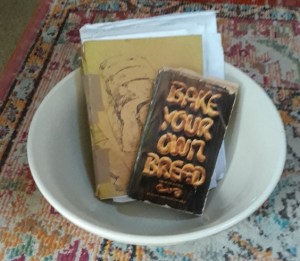
What I lack in bread-related T-shirts, I make up for in items related to bread-baking. Not surprisingly, many of these have been given to me by housemates and others with a vested interest in my continuing to make bread. These include my big bread bowl, my green-marble rolling pin, and my copy of Beard on Bread, which is held together with strapping tape. (See photo. My other most used book, Floss and Stan Dworkin’s Bake Your Own Bread, is in three pieces.)
The largest gift is the table I knead bread on. This was rescued from a Mount Pleasant (D.C.) alley by onetime housemate Beverly, she who also made my Feminism Is a Lesbian Plotshirt. Being handy with tools, she installed dowels to stabilize it, and voilà, the perfect kneading table. It’s accompanied me on all my many moves over more than four decades because most kitchen counters are the wrong height for kneading, at least if you’re very slightly over five-foot-four. In between bakings, it masquerades as an ordinary worktable, barely visible under the stacks of files, notebooks, and loose papers piled upon it.
Bread baker’s corner, with kneaded dough ready to be cut into loaves
If you want to leave a comment and don’t see a Leave a Reply box, click the title of the blog post (above) and then scroll to the bottom.
notes
1. This jumps ahead to Martha’s Vineyard, where affordable year-round housing was in crisis before I arrived in 1985 but denial was epidemic among the comfortably housed and it’s only been in the last few years that most people started to acknowledge that the situation was desperate. Landlords and tenants collude in evading local bylaws on what constitutes an apartment by omitting stoves from the dwelling. I cooked my meals with a hotplate and microwave, which worked fine — but I couldn’t bake bread. This was in the mid-2000s, from 2002 to 2007.
2. Phase 1, aka “the Phase,” one of the few lesbian-friendly bars in D.C. at the time, was also “just up the street,” across Pennsylvania Ave. on Eighth Street, but if I went there more than half a dozen times in my D.C. years I’d be surprised. I’ve never been a bar person. The Phase closed in 2016 (or maybe 2015, according to one website). The area around Lammas was its own self-contained neighborhood, anchored by Eastern Market, which is still there, seems to be thriving in an upscale sort of way, and even has its own website. I was in Eastern Market several times a week, usually looking for either a pulled-pork sandwich or Doris’s hamantaschen.
Stepping back a bit in time here: This is from the Washington Hospital Center nurses’ strike in May–June 1978. I’ve got several shirts from events, causes, and groups that I was at most peripherally involved in, and this is one of them. The strike went on for 31 days, so I might have joined the picket line once or twice, though this seems unlikely: I didn’t have a car and I did have a 9-to-5 job. I might have known someone who worked there, or I might just have wanted to support the strikers by wearing the shirt. In the women’s community we showed up for each other’s rallies, events, picket lines, meetings — if it involved women fighting for justice, we helped pass the word and mobilize support.
This graphic might have been the reason I got the shirt: I love it. The small print says “whc nurses strike 1978.”
A Washington Post story from May 27, 1978, led with this: “The Washington Hospital Center has more than quadrupled its security force in the face of a threatened strike by registered nurses called for this morning.” It quoted the president of the nurses’ union expressing outrage that “the Washington Hospital Center has seen fit to hire 93 additional guards. The Hospital Center’s vicious attempt to intimidate and divide us should be protested by all responsible citizens.”
Sound familiar? Keep in mind that this was two and a half years before the union-busting Reagan administration took office. When I revisit press clips from the late 1970s, it often feels that the ensuing four decades somehow wound up on the cutting-room floor. This is especially striking (sorry!) when it comes to the environmental movement. We knew all this stuff by 1979 but the economic and political powers that be did precious little about it. (See my blog post on the subject: “1979: Three Mile Island, etc.“)
This Flickr site includes a photo of picketing nurses on the first day of the strike, and a good account of the issues involved, starting with this:
The strike by about 300 of the 425 registered nurses by the District of Columbia Nurses Association (DCNA) at the area’s largest private hospital was mainly over schedules and performance evaluations, but also involving benefits and wages.
Prior to the strike, the hospital administration attempted to decertify the union, filing a petition with the National Labor Relations Board challenging its representation of the nurses.
The independent nurses union was only a little over a year old at the time having been certified in December 1976 and obtaining a first contract in May 1977.
When striking nurses attempted to go into the pool at other hospitals, they found that the Hospital Center administration had sought to blackball them. While initially getting hours at Howard Hospital, that administration banned them during the strike.
The strike ended on June 26, when the nurses accepted WHC’s final offer. The results were mixed. The Flickr article notes, “Perhaps the biggest gain of the strike was the nurses preserved their union.”
If you want to leave a comment and don’t see a Leave a Reply box, click the title of this post and then scroll to the bottom.














 The T-Shirt Chronicles