1978: ERA March and the Red Cross Training Office

From the back of the T-shirt

The July 9, 1978, march to extend the deadline for ratification of the Equal Rights Amendment (ERA) was the “largest march for women’s rights in the nation’s history” up to that time. Organizers, led by NOW (the National Organization for Women), were overwhelmed by the unexpectedly large turnout, and the march stepped off an hour and a half late. On short notice, owing to the huge crowd, the police had to close off all of Constitution Avenue, instead of just the anticipated half.

Of course I went. Everyone I knew went. For those of us in the D.C. area, rallies and demonstrations were easy to get to, and get to them we did. We’d often have out-of-towners crashing on our couches and floors. It wasn’t till the Second National March for Lesbian and Gay Rights on October 11, 1987, two years after I’d moved to Martha’s Vineyard, that I actually had to travel to a demo. (Yes, I have the T-shirt, and don’t worry, we’ll get to it eventually.) Massive demonstrations were old hat to me. I had to be reminded how life-changing they could be for first-timers — as indeed the November 1969 March on Washington to End the War had been for me.

The front of the shirt. Is that top stripe violet or purple?

The colors of the women’s suffrage movement, gold, white, and violet (the initial letters of which, I’ve been told, signified “Give Women the Vote”), were much in evidence, on signs and banners as well as the T-shirt. Alice Paul, founder of the National Woman’s Party and a key organizer in the early 20th century suffrage movement, had died exactly one year before, on July 9, 1977. By bringing the militant tactics of the British suffrage movement to the U.S. she had helped revitalize and expand a flagging movement.

The British movement’s colo(u)rs were, by the way, purple, white, and green. For more about the suffragist colors, see this article. It doesn’t mention the “Give Women the Vote” connection, which may have well have been invented post facto by someone who preferred violet to purple.

After the 19th Amendment was ratified in 1920, Alice Paul’s focus turned to securing legal equality for women through the ERA, which she drafted with Crystal Eastman (who was, among other things, a co-founder both of the Congressional Union, forerunner of the National Woman’s Party, and of the ACLU) and first introduced in Congress in 1923. It was widely known then as the Lucretia Mott Amendment, after the pioneering abolitionist and suffragist leader. The original ERA was rewritten in 1943 and has since been widely known as the Alice Paul Amendment. The text: “Equality of rights under the law shall not be denied or abridged by the United States or by any state on account of sex.”

It’s so unassuming, so self-evident and logical, that it’s hard to credit how revolutionary it remains. Forty-two years after that march, the ERA still hasn’t passed. For a brief history of the ERA, and where it stands now, here’s some background and some FAQs.


I didn’t get this T-shirt at the march, however. It was given to me by my boss at the time, Betty O., director of the Office of Personnel Training and Development (OPTD, aka “the training office”) at Red Cross national headquarters. That’s part of the story too.

As a job-hunting fledgling clerical, I’d been terrified by my glimpse of the typing pool at a big Boston insurance company. Oddly enough, my first permanent assignment at the Red Cross was in the Insurance Office. Here nine employees were crammed into a drab office, most of whose floor space was devoted to file cabinets. At one end the clerks spent most of the day following up on and filing insurance claims of all sorts: worker’s comp, unemployment, motor vehicle, medical, and so on. The other end was occupied by the three professional staff and the two secretaries, the junior of whom was me. I worked for the assistant director, a nice guy who wasn’t all that bright, and the insurance specialist, a woman who was very bright and not nice at all, quite possibly because her two superiors were nowhere near as competent as she was.

The big challenge of this job was boredom. I generally finished my typing and filing in barely half the time allotted, which gave me plenty of time to do Women’s Center work. Like most bright kids, in school I’d developed a facility for what wasn’t yet called multi-tasking: I could do math homework in English class and still have the right answer when the English teacher called on me unexpectedly. Gradually this skill carried over into my non-work life, and not in a good way, like I’d be drafting a book review in my head while in a Women’s Center collective meeting and devoting full attention to neither one.

Gossip among Red Cross clericals had it that the Office of Personnel Training and Development was a good place to work, so when an opening for staff assistant (a clerical position one step up from secretary) appeared on the internal help wanted list, I applied and was hired. I had only a vague idea of what they did there, but this was a good move. Elizabeth Olson, known to all as Betty O., the training director, was one of the most remarkable people I’ve ever met. Born in 1914, she’d joined the Red Cross in 1943 and risen through the ranks, a woman who remained committed to her work and her career even as the postwar tide was herding women of her class and color into the home.

The training office developed and implemented internal training courses for a nationwide organization with four regional offices and myriad chapters, some large and others very small. These ranged from time management to effective supervision to training staffers to teach the various courses. It turned out to be interesting stuff. I had a long-running argument with one of the two assistant directors about the term “human resources,” which was replacing “personnel” in the business world at that time.[1] He embraced it; I hated it, maintaining that it reduced people to the status of widgets.

The training office staff, 1978–79. From left: Betty O., me, Thom, Carolyn Moran (who retired while I worked there), Nancy Addcox, and Priscilla whose last name I forget because she got married and changed it.

We were a small staff: director, two assistant directors, two staff assistants, and one secretary. At this time, many educated women were concealing their ability to type in the belief, often well founded, that if they let superiors and colleagues know they could type, they would wind up doing nothing else. Betty O. could type, but she didn’t conceal that fact because she realized that if she did some of her own clerical work, the clerical staff would be free to take on more non-clerical tasks and contribute to the mission of the office. And we did.

Thom Higgins quickly became my best Red Cross buddy. He was the senior staff assistant, a Vietnam vet a few years older than I. We quickly established that he was gay and I was a lesbian. Personal experience was already teaching me that gay men and lesbians were not natural allies: many of the gay men I ran into were unwilling to consider the possibility that they were sexist as hell, which they were. Thom wasn’t, something he attributed to the fact that he had six sisters and no brothers.
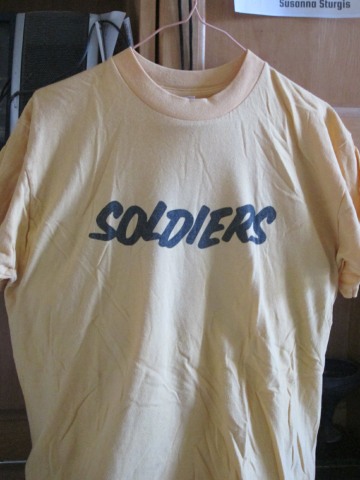
We became the core of a free-floating group that met at the rooftop lounge of the Hotel Washington[2] most Fridays after work to “process the week.” The group included Bruce Bant, an ex of Thom’s with whom he was still close friends, and Charles H., Thom’s current, who was an aide of some sort to some Republican congressman and who could have stepped out of an ad in GQ. Bruce, like Thom, was a Vietnam vet — they’d met in Vietnam, if I remember correctly — but unlike Thom he was career military. He’d recently retired as a sergeant major, having edited Soldiers, the enlisted service members’ magazine, and was now involved in the beginnings of what became USA Today.

I was the radical lesbian anti-militarist feminist in the group. We razzed each other endlessly about politics and the military but were always friendly about it. Although we were in Washington, the belly of the political beast, politics seemed a long way off. One Friday afternoon Bruce produced a Soldiers T-shirt and said he’d give it to me only if I promised to wear it. I promised, and I did, more than once.

Ever since starting the T-Shirt Chronicles, my favorite procrastination research technique has been looking up people, places, and events that my story touches on in some way. Thom died of AIDS in 1988 — I’ve got a story about that, and he comes up again before I learn of his passing — but I had no idea whether Bruce was still on the planet or not. A quick Google search found a LinkedIn entry that had to be him. He was living in Florida. Should I contact him? He probably had no recollection of me, but he might be able to place me if I mentioned the Soldiers T-shirt, the rooftop lounge at the Hotel Washington, and Thom.

Just now I went looking again. His LinkedIn page is still up, as is a Facebook timeline with an entry from February 2020, but near the top of the Google hits was the news that Bruce died in Fort Lauderdale on September 27, 2020. Also among the top hits was a guest column from the March 21, 2010, South Florida Gay News, entitled “Don’t Ask, Don’t Tell Has Been a Complete Failure.” The byline is Bruce Bant, Retired Army Sergeant Major. It’s him for absolute sure. I’m sorry I missed you, Bruce.


Notes

[1] The term itself dated back at least to the early 20th century, but it does seem that it was a hot topic in the 1970s. My tenure in the training office was 1978–79, so it seems plausible that it was a contested term at ARC NHQ at that time.

[2] Now, as far as I can tell, the W Washington, on 15th Street N.W. near Pennsylvania Ave.


If you don’t see a Leave a Reply box, click on the title of this post and scroll down.

The Cost of Comfort

This Washington Area Women’s Center T-shirt was created when I was no longer even tangentially involved with the center, probably after I started working at Lammas in 1981. At that point my center of gravity moved from Northwest D.C. to the southeast and northeast fringes of Capitol Hill. The old Sumner School was no longer within easy walking, biking, or even busing distance. Just as important, the written word was coming to dominate my life — editing, writing, and bookselling — and to draw me into circles and networks of similarly committed women.

This T is more sedate, easier to wear in “polite company” -‑ that is to say, non-feminist, non-lesbian company — than the first WAWC shirt. The labyris symbol is retained but discreetly: only those in the know will recognize it as the head of an ax, or understand what that ax symbolizes.

What catches my eye now is the line under the center’s name: “Creating Unity From Diversity.” Variations of this slogan have become ever more popular in the decades since. It’s conventional wisdom among feminists, liberals, and progressives. It rolls so trippingly off the tongue that we forget how difficult it is.

Part of the Women’s Center’s mission statement declared our intent “to create a space where all women could be comfortable.” My experience taught me that the achievement of this goal was, at best, a long way off. This was my epiphany:

The rap group, of which I was one of the regular leaders, attracted some regulars who came every week and occasional participants who came for the week’s topic. As with other Women’s Center activities, the majority were usually lesbians, but sometimes as many as half the participants were straight women. (Not every woman identified herself, but if someone bent over backwards to avoid giving any clues, the chances were good she wasn’t straight.) Discussions were friendly, everyone seemed comfortable, but it gradually became apparent that the comfort was conditional.

Often several of us would decide to continue the discussion elsewhere after the center closed for the night. There were several reasonably priced options within walking distance where we could get a drink, or coffee, or a bite to eat and talk. Two of them were frequented mostly by gay men but known to be friendly to women (this was not a given with establishments that catered to gay men).

A pattern emerged: When the group mind settled on one of those gay-friendly places, the straight women who’d been ready to come suddenly remembered they had other obligations, or they were just too tired to go out. When we picked one of what we thought of as neighborhood pubs or cafés, everybody went.

These “neighborhood” venues were considered neutral, but of course they weren’t. They were frequented by male-female couples and straight men. At one, the men would be gathered at the bar watching sports on TV and cheering or groaning loudly as the game progressed.

In other words, the lesbians were willing to put up with the discomfort of being in a place where heterosexuality was the norm, and the straight women weren’t willing to do likewise in a place where it wasn’t. This was not surprising, since lesbians and gay men lived most of our lives in places dominated by straight people, starting with our families; they might not be exactly comfortable, but they were certainly familiar. For the straight women, gay-friendly places were anything but.

Women’s Center volunteers talked a fair amount about how to attract more straight women to our activities, like Women’s Nite Out and the rap group and our various classes. How to make straight women more comfortable at the center. I was coming to the conclusion long since reached by some of my sister collective members: that the only way to make most straight women comfortable in a mixed lesbian-straight milieu was for the lesbians to “tone it down”: talk less about our relationships, disguise pronouns when we did, and so on. To make straight women more comfortable, we had to make ourselves less comfortable. Since our comfort options at the time were so limited, this didn’t look like a great alternative.

A few years later, in her great essay “Coalition Politics: Turning the Century” (based on a speech given at the West Coast Women’s Music Festival in 1981; in Home Girls: A Black Feminist Anthology, ed. Barbara Smith [New York: Kitchen Table: Women of Color Press, 1983]), Bernice Johnson Reagon — scholar, activist, and longtime founder-leader of the black women’s a cappella ensemble Sweet Honey in the Rock — nailed the whole matter of comfort and discomfort, extending it to encompass all the power differentials in our culture: black and white, female and male, middle class and working class, and so on and on. And especially how these categories intersect: Kimberlé Crenshaw didn’t coin the word “intersectionality” until the end of the 1980s, but feminists were already working on it, with women of color generally leading the way.

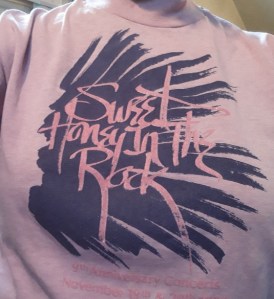
Sweet Honey did an anniversary concert every year. I attended most of the ones when I lived in town. This one has the date on it: November 19 & 20, 1982.

Reagon draws the key distinction between coalition and home: Coalition work, she says, “is some of the most dangerous work you can do. And you shouldn’t look for comfort. . . . In a coalition you have to give, and it is different from your home. You can’t stay there all the time.” We all need some sort of home, a place we can be comfortable enough to recharge before we “go back and coalesce some more.”

Diversity is more abstract than coalition, but it makes some of the same demands. Don’t expect to be comfortable all the time. Pay attention to who does expect to be comfortable, especially if it’s you, and who’s expected to “tone it down.”

This issue has never been more important. If all of us, especially the more privileged among us, aren’t willing to learn to live with some measure of discomfort, I suspect we’re all doomed.

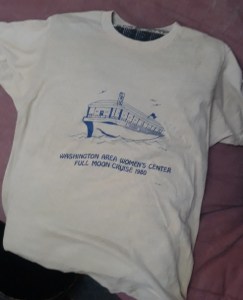
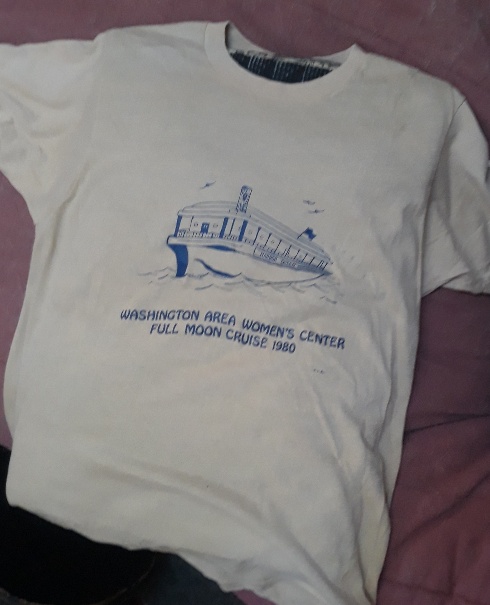
In practice, the Women’s Center created events where all women could be comfortable as long as they were comfortable in women-only spaces. As expected, a significant majority of these women were lesbians, but not all: some identified as bisexual, some as heterosexual, and some were in transition or uncommitted. The Full Moon Cruise in 1980 was more ambitious than the usual Women’s Center event, which is why it got its own T-shirt. Women’s Nite Out happened regularly on the third floor of the Sumner School, and every so often we threw a women’s dance at All Souls Church.

All Souls, the Unitarian Universalist church at 16th and Harvard, N.W., was then as now a hotbed of culturally and politically progressive activity. It was also a stone’s throw from the Mount Pleasant neighborhood, home to multiple lesbian group houses, and easily reached by public transportation. Long before rainbow flags started flying from liberal churches and synagogues, All Souls welcomed our events, at some risk to themselves. D.C.’s human rights act, like many such laws, saw no difference between men excluding women and women excluding men, or white people excluding black people and black people excluding white people: justice may not be blind, but when it comes to power imbalances in society, it certainly is myopic.

The threat of being sued wasn’t strictly hypothetical either. Around this time, I was editing as a freelancer a bimonthly newsletter for a non-smokers’ rights group. Its principal, a George Washington University law professor, brought a sex discrimination suit against a D.C. restaurant for requiring men, but not women, to wear jackets. I had zero doubt that he and other legal eagles would thrill to bring a suit against the Women’s Center for excluding men from a dance, and against All Souls for renting us space to do it.

So we were careful. We created the fiction that these were ticketed events, and tickets had to be purchased in advance. PR was largely by word of mouth or very limited circulation media like In Our Own Write. If a man insisted on coming in, we were supposed to let them in, but I don’t recall this ever happening. What I do recall is our delight in appropriating the men’s room, where there was never a line.

Our best protection was that lesbians weren’t just invisible to the heterosexual world; we were literally unimaginable. Only a few years earlier, after all, I had gone to women’s dances at Penn without registering that most of the women there were, if not lesbians, then not exactly straight. The idea of women voluntarily excluding men from any part of our lives, and especially our events, is still problematic. But the distinction that Bernice Johnson Reagan made between home and coalition is still valid. All of us working in the rough-and-tumble wider world need places to regroup and recharge.

Tellingly, it was in this women-only, mostly lesbian world that I started paying much closer attention to the differences among us, and the other ways we were different from the wider world. We were mostly white in what was then a majority-black city, and the age range from youngest to oldest couldn’t have been more than about 15 years. Class-wise, however, we came from a variety of backgrounds, and some of us had had grueling experiences with the mental health establishment, male violence, and/or the legal system. In this women-only space, we talked about things we had never felt comfortable discussing anywhere else.


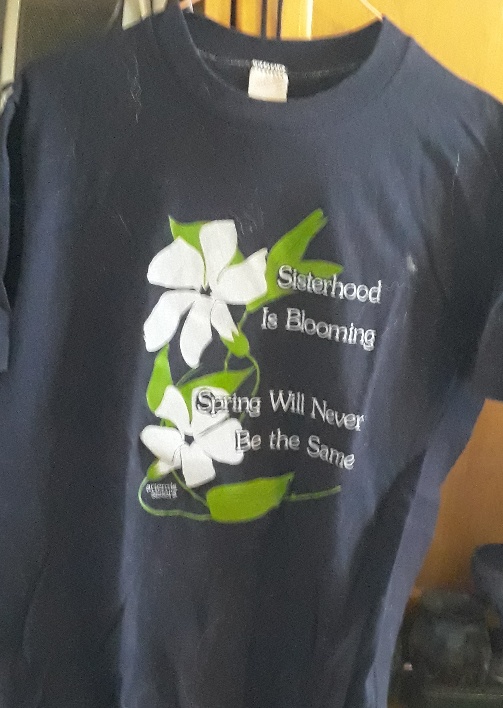
I picked up this T at a women’s conference at West Virginia U., where Lammas was selling books and records. Probably 1983 or 1984. (Maya Angelou was the keynote speaker.) We dreamed of a universal sisterhood, of “unity from diversity,” but making it happen in real time was far harder — and asked more of us — than we often wanted to acknowledge.

1977: Back to Washington

Part-time proofreading and political volunteering were great, but I’d finally caught on that full-time employment prospects for a female liberal arts graduate without clerical skills were not good. Male liberal arts grads without clerical skills seemed to wind up in management training programs, but in those days this generally didn’t happen to women without family connections and/or more chutzpah than I had. My public school friends had all learned to type in high school, but my private school had prided itself on its academic focus, which seemed to preclude all practical skills.

Washington Area Women's Center T-shirt
The labyris, a double-edged Amazon ax, was omnipresent in lesbian-feminist imagery of the 1970s.

So with my proofreading wages I signed up for the Katharine Gibbs secretarial school’s[1] eight-week course for unemployable female college graduates. We learned typing, a basic shorthand, business writing, and what I can only call office comportment: classes met five days a week during more or less office hours, and we were expected to be punctual and to dress accordingly. The white gloves the school had been famous for in its early decades had long since fallen by the wayside, but no pants were allowed. We were told that if one wore size 16 or above, one should wear dresses, not a skirt and blouse. That would be me, but I didn’t own a dress, so I continued to wear skirts. When I showed up in a wrap-around denim skirt, I was told that if I wore it again, I would be sent home, so I must have had some alternatives.

In the small-world department, my typing teacher was Barbara St. Pierre, of the family that ran the St. Pierre camp in Vineyard Haven for decades. In late 2018, after some $31 million in renovations and landscaping, the site opened as the Martha’s Vineyard Museum on March 13, 2019.

At the end of the course I was typing a respectable 70 words per minute with next-to-no errors. Time to start job hunting in earnest.

This did not go well. On one interview, I stumbled into what had to be a circle of hell: the typing pool of a big insurance company. Row after long row of women sat typing, under a low ceiling with fluorescent lights tingeing everyone a sickly green-yellow. I recoiled. I didn’t want to work in such a place, and I didn’t really want to stay in the Boston area either.

So in the early spring of 1977, I headed back to D.C. to look for a job and a place to live. This didn’t take long. I was hired as a clerical at American Red Cross national headquarters, which occupies the block between 17th and 18th, D and E Streets, in Northwest D.C. — right across the street from the DAR’s Constitution Hall. The workaday offices were mostly in the 18th Street building. I would start as a “floater,” a sort of in-house temp who went to whatever office needed an extra secretary, sometimes for a day or two, other times for longer. Sooner or later this would lead to a permanent assignment. Strange but true, my first permanent assignment was in the insurance office.

Somehow I found what would be my home for the next year: a bedsit in a row house in the 1700 block of Q Street, N.W., that had been converted into a rooming house. The location was perfect: within a stone’s throw of Connecticut Ave. and Dupont Circle, the heart of the (white) gay (male) ghetto and a vibrant arts scene, one of whose anchors at the time was Food for Thought, vegetarian restaurant and community hangout.

My Q Street landlord was Larry, a gay guy, and I was the only female out of five or six tenants. (Larry probably recognized what I hadn’t quite figured out yet.) My spacious first-floor room had a big bay window facing the street. This came in handy because visitors could just knock on my window, bypassing the doorbell. A chandelier hung from the high ceiling; it worked on a dimmer, which did wonders for the decor, which was neo-Student Gothic. The bathrooms were on the second and third floors, and a refrigerator on the third, all shared by the tenants. I cooked on a hotplate.

My Grandma’s Wedgwood pitcher. You see why I don’t dare use it?

I returned to Weston, borrowed money from my father to rent a U-Haul, loaded my stuff, and moved to D.C. Since I was moving from Grandma’s house, some of her stuff came with me. Most of it I’ve still got: a small bureau, a cedar chest, four nested blue mixing bowls, a Wedgwood pitcher too beautiful to use (with a note from Grandma inside, bequeathing it to me), and Grandma’s copies of Joy of Cooking and Fannie Farmer.

The Persian carpet from her bedroom survived all my D.C. moves before going missing from my parents’ basement after I moved to Martha’s Vineyard. No one knows what happened to it. My derelict uncle Hugh, my mother’s younger brother, who boarded in my parents’ house for a while, may have pawned it. I have no proof, and he’s dead, so that’s that.

How did I find the Washington Area Women’s Center?[2] Considering what a big part of my life it would be for the next several years, I’m surprised that I don’t recall that either. For sure it wasn’t via the Washington Post or the Washington Star (which was still around in those days), or from a billboard, or from a radio or TV ad. Women’s community organizations were shoestring operations. We did PR on the cheap, by flyers and posters tacked, stapled, or wheat-pasted[3] to walls, telephone poles, and bulletin boards, and of course by word of mouth.

Moving back to D.C. was a sort of Big Bang: my worldview expanded so rapidly in those first months that in most cases I can’t recall when and where and how any particular thing happened. I don’t remember how I found the Women’s Center, but I clearly remember what I found when I got there.

The center occupied a big square room on the ground floor of the Sumner School at 17th and M Streets, N.W. Named for Massachusetts abolitionist Charles Sumner, the school had played an important role in educating African American children and teachers, albeit in a segregated public school system. Wikipedia notes: “By the 1980s the building had fallen into disrepair.” This is an understatement. By the late 1970s it was a wreck. The ground floor, however, was reasonably sound. You entered from the side, off M Street, across the cracked-concrete remains of a small playground, and descended a few concrete steps. The Women’s Center was on your right, the Washington Area Feminist Theater on your left.

The WAWC Full Moon Cruise, out of Annapolis, MD, was so special it had its own T.

Yellow walls helped make the center a cheery place, as did the buzz of activity whenever it was open, which at the time was most weekends and weekday evenings. It housed a hotline, a feminist library — small but growing, thanks to the vitality of feminist presses and publications in that decade — and a cozy corner to sit and read or visit with friends. It hosted classes in women’s history, gay and lesbian history, feminist theory, and various practical how-tos. I quickly became a regular leader of the weekly rap group and (of course) part of the team that published the monthly newsletter, In Our Own Write. My new clerical skills came in handy, as did my facility with presstype, Formaline, and publishing on the cheap before digital technology came of age.

Every month, more or less, we held Women’s Nite Out in a corner former classroom up on Sumner School’s third floor. The room itself was in pretty good shape, but the stairs we climbed to get there were both rickety and dark. Whatever fixtures had once lit that stairwell were mostly non-functional, and Women’s Nite Out happened, as you might guess, at night, when no light came in the windows. The performers were homegrown local musicians and poets, most of them quite good and getting better: this was another area where we were learning by doing, how to perform and how to produce performances.

I don’t think I ever performed at Women’s Nite Out; most of what I was writing at the time was nonfiction for In Our Own Write or, eventually, off our backs and The Blade, later the Washington Blade, D.C.’s gay newspaper. But Women’s Nite Out, and what was going on more generally in D.C. and the women’s movement, helped spark the possibility of writing for a live audience.

It wasn’t till I attended a few meetings aimed at establishing a gay community center that I understood what made the Women’s Center and so many grassroots women’s organizations of the time so, well, revolutionary. The gay organizations, being overwhelmingly white and male, had access to skills, money, and political connections that the feminist organizations, especially the mostly lesbian ones, did not. Need legal or accounting advice? The men usually knew a professional who would volunteer their time. Need some carpentry or wiring done? Hire a carpenter or an electrician.

Lacking connections, expertise, and cash, the Women’s Center collective, like grassroots feminist groups around the world, learned to do things ourselves because otherwise they wouldn’t get done. There were women in the community with professional credentials and other in-demand skills: through the Women’s Center hotline, we connected women with women lawyers, therapists, and tradesfolk (who at the time were scarcer than either lawyers or therapists) who were feminist- and lesbian-friendly and who would accommodate clients with limited incomes.

I met my first girlfriend through the Women’s Center, and together we became the core of my first group house, but the Women’s Center itself was my first serious relationship. I’d been involved in groups before, of course, but never this deeply, this intensely, this day-in, day-out. I almost said that here was where my fascination with group dynamics started, but that’s not true: growing up in an alcoholic family made me an astute observer of others’ moods and interactions. At the Women’s Center, I wanted to belong, but I’d long since learned that safety lay in remaining somewhat aloof. The tension between the two continues to this day.

The Women’s Center was the site of a major milestone in my life: I came out as a lesbian in public for the first time while leading a rap group about “the sexually uncommitted.” This still cracks me up. I don’t believe anyone in the group was surprised.

Notes

[1] “Katy Gibbs” has an interesting and feminist history: it was started in 1911, in Providence, by two sisters, Katharine and Mary, who had to support themselves and Katharine’s two children after Katharine’s husband died in an accident, leaving no will. The Gibbs family sold the school in 1968 but it seemed to be going strong when I attended in the mid-1970s. This New England Historical Society story includes some background on how clerical work evolved after the Civil War and became a mostly female occupation.

[2] I recently learned that the WAWC archives are in the George Washington University library. So now one of my projects is to go through my files and boxes and see if I have anything that they don’t. The description of their holdings is rather sketchy, but it does conjure memories.

[3] Wheatpaste is an ancient, low-tech tool for sticking things together, especially appropriate for affixing posters to walls and other surfaces. A quick web search will turn up many ways to make and use it, but the CrimethInc website ably conveys the spirit of the technique.

1976: Getting Unstuck

1976 was the U.S. Bicentennial year, and that’s the year the T-Shirt Chronicles start, with this blue T from that year’s Festival of American Folklife. The festival started in 1967 and has been held annually ever since (except, need I even say, in 2020), but that may have been the only one I ever attended, even though I lived in D.C. 11 years altogether — and wasn’t living there when I went to the festival. I probably went with one or both of my best buddies from my Georgetown University undergrad days, both of whom lived in the D.C. area.

What prompted me to buy the T-shirt? No idea. I don’t have a single clear memory from that festival: what I saw, what impressed me, nada. I had no clue that 44 years later I would be writing about this T as the first in a very long series.

But what better place to start? It wasn’t the Bicentennial celebrations that took me back to D.C. that summer. In mid-1976 I was trying to reconnect with the city I’d thrived in as a student activist, hoping this would reconnect me with the me who had lived there, the dean’s list student who was passionately involved in antiwar organizing and student politics and who was also getting a crash course in sexism thanks to the unapologetic misogyny of Jesuit-run Georgetown University.

When 1976 began, I was stuck. After graduating as a history major from the University of Pennsylvania in 1974, I’d spent fifteen months in the UK, the first twelve pursuing but not completing a master’s degree and the last three hitchhiking solo around Britain and Ireland. Just before Thanksgiving 1975 I landed back in my suburban hometown of Weston, Massachusetts, in the unhappy home I’d grown up in. I had no idea what to do next, I had no friends in town, and I’d lost contact with my college friends.

In February, Grandma, my paternal grandmother, had a stroke. She died ten days later. Since she lived only a mile away, she was very much a part of my growing up. We weren’t close in the emotional sense — in my quintessentially WASP family, no one was close in that sense — but she introduced me to the two passions of my preteen and teenage years, horses and the Middle East, and I felt closer to her than to anyone else in the family.

After she died, my uncle Neville, who had lived with her for many years in the house he and my father grew up in, committed himself to a psychiatric hospital. Eventually he got his feet on the ground and walked himself into a happier and less isolated life than the one he’d been leading, but his cracking up presented an immediate dilemma: Who would look after Grandma’s house and take care of Max, her red Lab, till her estate could be settled?

The obvious answer was me. Whether this was a good thing or not — on one hand it gave me the literal space and time to get my feet back on the ground, but on the other being stuck under the same roof with my parents might have kicked my butt into gear sooner. Whether I was clinically depressed I can’t say because I never saw a clinician, but depression, alcoholism, and other forms of stasis are endemic on both sides of my family and I’ve got tendencies in all those directions.

That winter and spring I did a lot of walking with Max. When we weren’t out walking, I read Grandma’s letters from her young womanhood, learned that she’d been reluctant to enter into a marriage that eventually ended in divorce, explored her house (which I already knew pretty well), played a lot of solitaire, and taught myself to bake bread. In England I’d gotten hooked on unsliced bread from neighborhood bakeries; the cellophane-wrapped loaves then available in suburban supermarkets no longer satisfied. Neither my mother nor either of my grandmothers ever baked bread, at least not in my lifetime; none of them were cooks either. My teacher was a mass-market paperback. I’ve been baking all my own bread ever since.

Not long after I moved into Grandma’s house, Linda, my father’s girlfriend (he was still married to and living with my mother, an active alcoholic), recruited me as research assistant on a project she was working on, about what was going on in England at the time of the American Revolution. This involved reading period sources at Harvard’s Widener Library — which got me out of house and hometown and reconnected me with something I enjoyed and was good at. Linda was the only adult around who realized I was not in good shape; her intentions must have been at least partially therapeutic. It helped.

So did going back to D.C. that July. My D.C. years had drifted so far from me that it felt like they’d happened to someone else. Hooking up with friends from my activist student days pulled those days back within reach. I was on the right track, but because I was improvising the track I was trying to follow, it took a while.

Here’s where my memories of 1976 diverge from the facts of the matter. Time was fluid that year, with few dates to use as signposts, and contrary to popular belief you can’t find everything on the internet. Non-famous people who lived and died before news went digital can be elusive: I knew Grandma had died in February but had forgotten the date, and Googling didn’t refresh my memory. My sister, however, has been maintaining the family tree on Ancestry.com and she had it: February 17.

Easier to verify online — and disorienting when I did — was the date of a benefit concert I attended at Boston’s grand old Orpheum Theater for U.S. Senator Fred Harris, Democrat from Oklahoma, who was running in the Democratic presidential primary. Arlo Guthrie was the headliner, and my sister and I were sitting in the first or second balcony way over at house right, looking down at the brightly lit stage with its glittering mics, amps, and guitars.[1]

This is one of my most vivid memories from that year, and I’d already slotted it into my chronology. In an early draft of this post I wrote: “Thanks to the state ERA campaign I paid more attention to electoral politics in 1976 than I ever had, or that I would for the next 40 years.” But it didn’t take long to turn up incontrovertible evidence online that the Harris-Guthrie concert-rally had taken place months before I started volunteering for the ERA campaign, on February 26.[2] Harris’s run for the Democratic presidential nomination, always a long shot, was over by the end of April.

Harris was an antiwar, pro-racial-and-economic-justice populist who inspired the kind of enthusiasm that Senator Eugene McCarthy had in the previous decade and Jesse Jackson would in the next. His was exactly the kind of campaign that would have attracted me with my grassroots activist background, which had largely ignored electoral politics.[3] Could it even have been the Harris benefit concert that put the state ERA campaign on my radar?

The state ERA, Question #1 on the ballot, passed on November 2, election day 1976. By then it had brought three T-shirts into the collection I didn’t realize was a collection. More about that in my next post.

To leave a comment, click on the title of the post and scroll down to the Leave Reply box.

Notes


[1] I could go on and on and on, but seriously, if you weren’t around in the 1960s and 1970s, or don’t remember much about it, look up Fred Harris and his then wife, Comanche Native American rights activist LaDonna Harris. They divorced in 1982. As of this writing, they’re both alive at the age of 89. Fred was elected to the U.S. Senate from Oklahoma in 1964, the year of the LBJ landslide and the last year a Democratic presidential candidate carried Oklahoma. He was an active member of the Democratic majority that implemented the Great Society legislation, and he was part of the Kerner Commission, officially the National Advisory Commission on Civil Disorders, commissioned to investigate the causes of the rioting and urban unrest that swept the country in 1967. The report was issued in 1968. Harris is the last surviving member of the commission. Arlo Guthrie did a 30-stop fundraising tour for the Harris campaign. According to a 2001 story, the campaign gave Arlo the wheels to travel in. He paid off the lease when the campaign ended and the Guthrie family spent years on the road in that bus.

[2] I’d also forgotten that Tom Paxton, well on the way to being a folkie legend, was the opening act. Both his set list and Arlo’s can be found online, and a couple dozen attendees seem to have made bootleg tapes of the show.

[3] However, the first — and until January 2017 the only — political party I ever belonged to was the D.C. Statehood Party, which I signed up for when I first registered to vote as a Georgetown University freshman. In those days the only municipal office D.C. residents could vote for was school committee. Electoral politics were only a big deal in presidential election years. Statehood for D.C. Now!