1987?–1993: Martha’s Vineyard Times

Two of the best jobs I’ve ever had fell into my lap. The first was book buyer for Lammas, D.C.’s feminist bookstore. The other was working for the Martha’s Vineyard Times. I wouldn’t have had the nerve to apply for either of them.

As my savings dwindled toward the end of my first year on the Vineyard, I started running a classified ad hiring out as a freelance typist. That got me a few short not-very-interesting gigs. More productive was my connection, through theater, with the Tisbury Printer. This led to several book-length editing jobs and editing and typesetting at least two catalogues for the Nathan Mayhew Seminars, a local nonprofit offering a variety of adult ed courses.

With my PC — Morgana, the first of five desktops that would bear that name — I could do pretty good cut-rate typesetting. I’d do the typing and formatting at home then take the disk (a 5 1/4 inch floppy) down to EduComp,[1] which was renting out time on its laser printers, and print out the copy. My girlfriend at the time, a talented graphic artist, did the paste-up. Before long, EduComp stopped offering this service because too many customers either messed things up or required too much hand-holding, but they made exceptions for me and a couple of others because we knew what we were doing. I was undeniably proud of being an exception.

Word got around that I was a competent typist with editorial capabilities. At a West Tisbury town meeting, the woman in front of me turned around and asked if I did freelance typing. I said I did. She turned out to be Eileen Maley, the Calendar/Community, i.e., features, editor of the Martha’s Vineyard Times. Their editorial typesetter was scheduled to have surgery soon and would be out for a few weeks. Would I be interested in filling in?

When I said yes, I probably sounded self-assured and confident. I wasn’t. Other than Eileen, whom I’d just met, I didn’t know anyone who worked at the Times or anything about their typesetting software. True to form, my imagination conjured a scenario where I’d be out of my depth and make a fool of myself. However, I’d made a similar leap of faith when I ventured into Katharine Cornell Theatre that first time, and that had turned out well. Maybe this would too?

The Times at that point was the upstart paper, having been founded in 1984 by five Vineyard businessmen as an alternative to the venerable (established in 1846) Vineyard Gazette. Reading only the Gazette, one might conclude that the year-round working island barely existed and that bad things never happened on Martha’s Vineyard; its subscriber base was mostly off-island from Labor Day to Memorial Day. Its coverage was so focused on its home base in Edgartown that Times people took to calling it “an Edgartown weekly.” Gazette staffers got back by referring to the Times as “the other paper.”

This not-always-good-natured rivalry went on for years. The Times was delivered free to every island post office or mailbox, a huge attraction for advertisers targeting a year-round audience. Naturally the Gazette retaliated with a full-page house ad featuring a trash can overflowing with discarded copies of the Times.

The Times office was nowhere near as elegant as the wood-shingled building that still houses the Gazette. When I first showed up to work, it was located behind Woodland Market on State Road in Vineyard Haven, in a long, low building that no longer exists. It once housed the Spaghetti Pot restaurant. The Spaghetti Pot was before my time, but rumor had it that the astonishingly red-orange carpeting in the newsroom was part of its legacy: had it perhaps been dyed with, or to resemble, spaghetti sauce?
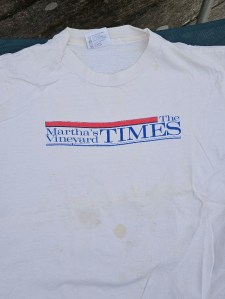
Sorry about the stains. If I ever learn to use bleach, I could probably make them go away, but that hasn’t happened yet.

The building’s midsection was the newsroom, with reporters’ and editors’ desks lined up along the windows, which commanded a view of the dusty parking lot. Eileen’s desk was at the front of the row, and mine, as the pinch-hit typesetter and eventually the on-staff proofreader, was at the end. The three desks between us were occupied by all but one of the reporters. The exception was Gerry Kelly, who held court in an executive-type chair at an oversize desk next to the wall at one end of the newsroom.

Dubbed by a journalist admirer “the greatest one-man band in the history of journalism,” Gerry was the Times’ lead reporter and also a mainstay of the Calendar section: every week he wrote the food column, often featuring island restaurants, plus a book review, plus, from Memorial Day till well into the fall, a couple of art gallery reviews. He turned out copy like yard goods — a wonder to me because I’m on the slow side: I can’t turn the internal editor off when I’m writing. My only way around this is to write in longhand. This works because my handwriting is so hard to read that the internal editor gives up and goes along for the ride.

Times baseball cap, front . . .

Sure, Gerry’s copy invariably needed at least some editing and/or fact-checking, but that was a small price to pay. When an ad was cancelled at the last minute, he could fill the hole. When an ad came in late, he could cut two or three or four inches out of a story that was already pasted up. He’d head into Production, non-repro-blue pen in hand, swearing “Not one word!” and do what had to be done.
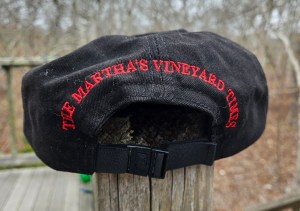
. . . and back. I’ve never been a baseball cap wearer, but I’ve still got mine.

A few years later, when I left the Times (for the first time) in the fall of 1993, Gerry paid me the supreme compliment: on my staff farewell card, he wrote “You saved me a year’s wear and tear on my dictionary.”

I customarily worked with my own copy of the American Heritage Dictionary open in my lap. The office Merriam-Webster’s was readily accessible on top of the long bookshelf in the middle of the newsroom but it was rarely consulted. Instead staffers would call out “Susanna, how do you spell . . . ?” or “What’s another word for . . . ?” and I would answer, usually without looking it up. Over the years more than one person remarked that I always had the dictionary open although I was the only person on staff who didn’t need one. My response: “That’s why I don’t need one.”

Behind me at the old office, in a rectangular room barely large enough for a desk and file cabinets, dwelt editor in chief Doug Cabral. A perk of this mini-office was that it had a door to the outside. Its door into the newsroom, which was almost always open, was barely an arm’s length away from where I sat. Since Doug could and did slip in and out with no one but me the wiser, one of my unofficial tasks was to relay news of his arrivals and departures to the rest of the staff.

Doug had his own wastebasket, of course, but he often dropped his candy wrappers in mine so his wife, who was monitoring his diet, wouldn’t see them.

After the Times moved to its current quarters at Five Corners in the fall of 1991, Doug’s office was on the second floor. He could leave the building through a rear door without passing through the large front room that housed the editorial, production, and advertising staff. So we rarely knew whether he was in the building or not, what he was doing when he was upstairs or where he went when he left.

At both the old building and the new, Wednesday was all-hands-on-deck deadline day. For many years, Joni Merry, a production staffer and also the West Tisbury town news columnist, would make lunch — all takers chipped in to pay for the groceries (usually $2 each) — then we’d all gather to eat around tables set up in the middle of the newsroom.[2]

At one of these sit-down lunches in the late ’80s, Don Lyons, former minister, current ad sales rep, sports editor, and by then Joni’s husband, leaned back in his chair and asked “Does anyone know the five rarest license plates on Martha’s Vineyard?” I can’t remember what five we came up with, or what Don’s five actually were. Now I could hazard you a good guess about Don’s five — they almost certainly included Hawaii, Nebraska, and North Dakota — because his question turned me into a license plate spotter. I’ve been playing ever since and have the annotated U.S. maps to prove it.

I’ve spotted North Dakota three years running at the Martha’s Vineyard Hospital Don would be amazed.

For many years, Don and I traded sightings. One summer we tag-teamed to track down a tour bus bearing a North Dakota plate that Joni had seen headed this way on the ferry: North Dakota was the rarest of the rare.[3] We figured it would be leaving by the end of the afternoon, but we couldn’t find out if it would be from Vineyard Haven or Oak Bluffs. So we stalked both docks whenever a boat would start loading for departure. Don finally spotted the bus in Vineyard Haven. By the time I arrived, Don had spoken with the bus driver — and learned that though the bus was registered in North Dakota, the tour group was from New Jersey. It counted nonetheless.[4]

Unlike the Gazette, the Times was printed off-island. Until digital transmission became possible toward the end of the ’90s, this meant that “the boards” — the pasted-up pages — had to be on the 5 o’clock ferry from Vineyard Haven. Since the Steamship dock was literally around the corner from the Times office, Doug was often out the door with barely minutes to spare, the big black portfolio case under his arm.[5]

This is from my last day of my first stint at the Times, in October 1993. It’ll give you an idea of what “the boards” looked like before the paper went completely digital by the end of the decade. (P.S. I did not usually wear dangly earrings to work.)

1991 was a big year for the Vineyard, the Times, and me. In the spring, Eileen Maley retired as the paper’s first Calendar/Community editor. Having been her unofficial apprentice and understudy for almost three years, I put in for the job. I’d been doing it for more than a week before Doug confirmed that I was now indeed the Calendar/Community editor and put my name on the masthead. He never put me on salary, however: I continued to submit a time sheet every week and get paid by the hour. Since I wasn’t full-time, I got no benefits. The upside was that when I was ready to move on, I didn’t have to worry about losing health insurance because I was already paying for my own major medical policy.

To be fair, the Times in those days was operating on something not much wider than a shoestring. Each Thursday morning the staff would meet to postmortem the issue just published and start planning the next week’s. At the end of the meeting, Doug would pass out paychecks, whereupon we’d extricate ourselves as gracefully as possible from whatever we were doing and race to our respective banks to deposit our checks. Not infrequently the late arrivals would learn that there were insufficient funds in the Times account to cover the checks. They were always covered eventually, but if you were on the brink of overdrawn yourself, the suspense was real.

Hurricane Bob arrived on August 19 of that year, and despite the many impressive storms that have followed, more than 32 years later it remains the last full-fledged hurricane to hit New England. Unlike most big tropical storms, Bob arrived at the height of “the season,” on Monday, August 19. The annual Agricultural Fair had just finished its three-day run at the old Ag Hall.[6] The summer hordes were still here.

Bob was a huge deal. Hurricane winds took out trees that hadn’t been seriously challenged since the nameless hurricane of 1938. The sound of chainsaws was heard throughout the land. Living up-island on a dirt road back in the woods, I was lucky: a nurse at Martha’s Vineyard Hospital lived nearby, so volunteer EMTs and firefighters came to clear the road so she could get to work.

The flip side was that our little area didn’t get its power back for almost 10 days. The Times office, however, was on a major trunk line and got its power back within hours. Those of us without power at home brought our perishables to work and we feasted for a couple of days. I washed my hair in the office sink more than once. Bees whose hives had been destroyed were everywhere. Outdoor cafés hung improvised bee catchers from hooks on the wall: plastic soft drink containers with sweet stuff inside. Buzzing bees sounded a lot like distant chainsaws.

Labor Day came and went, life returned to more-or-less normal, but 1991 wasn’t done with us yet: the No-Name Nor’easter[7] arrived at the end of October. The Times was just about to move into its new office at Five Corners, but Five Corners flooded even worse than usual and the just-laid floor of the newsroom was underwater and had to be replaced. Fortunately, the electric sockets and wiring had all been installed a foot above the floor so they weren’t affected. My main memory of the move: I was helping move a desk into place when Trip Barnes, whose trucking company was handling the Times relocation, apparently decided that women couldn’t hold up half a desk and tried to wrest my end away from me. The result was that it fell on my foot. No lasting harm was done to my foot, but my opinion of Trip took a hit.

The Times move to Five Corners put it right around the corner from Wintertide Coffeehouse, which had moved into its year-round home the previous January. The traffic back and forth was non-stop: Wintertide manager Tony Lombardi was in the Times office almost as often as I was at Wintertide. Wintertide had no advertising budget to speak of; I could put pretty much anything I wanted in the Calendar section, and assign freelancers to write profiles, previews, and reviews that I couldn’t do myself. I saw advocating for the island’s grassroots music, theater, and general creative scene as part of my job.

The high point of my Times career was almost certainly the Martha’s Vineyard Singer-Songwriter Retreats of 1992 and 1993, masterminded by Christine Lavin and brought to life by a cast of dozens, if not hundreds. The resulting recordings — Big Times in a Small Town from ’92 and Follow That Road from ’93 — are still available and still wonderful.

I resigned as Calendar editor in the fall of 1993, mainly due to burnout: after I left, what I’d been doing was divvied up two and a half ways. I’d never entirely stopped being the lead proofreader or a pinch-hit typesetter either. But it was still one of the best jobs I ever had.

. . . . .

Postscript: I returned to the Times toward the end of 1996 as a one-woman copy desk. I pitched the job — something I’d never done before and haven’t done since — because (1) they needed the help, and (2) the freelance book packager who had been responsible for about 3/4 of my income decided to pack it in and move to New Hampshire. I was slowly building up my freelance client base, but I couldn’t live on that income yet. I left again in mid-1999, having established enough publisher connections to have a reasonably steady income. I had also, however, bought myself a horse, which wouldn’t have been in anyone’s How to Make Ends Meet on Martha’s Vineyard guide. Much more about that later.

NOTES

[1] EduComp, the indispensable art and office supply and computer store at the head of Main Street, Vineyard Haven, closed for good in the fall of 2020. Sales had been declining thanks to online competition, and the onset of COVID-19 finished it off. Founder and proprietor Pat Gregory was murdered while hiking in California in 2014, but his family carried on in the years following.

[2] After the move to Five Corners, we actually had a lunch/break room, but it wasn’t big enough to hold everybody. The lunch custom continued, but more of us ate at our desks.

[3] In my first 30+ years of the game, I spotted North Dakota maybe twice, including that tour bus. It’s now showed up three years running, 2022, 2023, and 2024, always in the same place — behind the Martha’s Vineyard Hospital — and for several months in a row. Evidently a North Dakota resident is a travel nurse or doctor at MVH.

[4]  Don passed in August 2021, age 94. His obituary doesn’t mention the license plate game, but it’s still a fascinating picture of a remarkable man.

[5] Infrequently the boards would travel by air instead of sea. Doug usually made the drive to the airport, but I remember pinch-hitting once or twice. The airport was six miles from the office, so we couldn’t be quite so last-minute about finishing the last page or two.

[6] In 1991, the fair was still three days long, Thursday through Saturday, and took place at the “old Ag Hall,” now known at the Grange. It moved to the brand-new Ag Hall in 1995. In 1997 the first day of the Fair was drowned out by torrential rain, so Sunday was added to compensate. Sunday at the Fair proved so popular that the Fair has been a four-day affair ever since.

[7] The No-Name Nor’easter is better known as the Perfect Storm, after Sebastian Junger’s book of that title. The Perfect Storm (W. W. Norton, 1997) focused on the loss of the Andrea Gail, a commercial fishing boat out of Gloucester, with all six hands during the storm.
1985–1986 (etc.): Adult Child of Theater

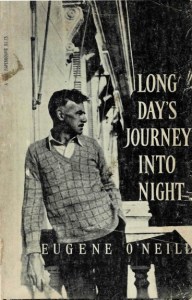
Where to begin? The family I grew up in had upper-crusty antecedents on both sides — New England on my father’s side, Virginia/Maryland/New England on my mother’s — but we looked middle/upper-middle class. My father was an architect. My mother didn’t work outside the home while my brothers, sister, and I were growing up. She talked with such evident longing about having done summer stock theater after WWII (during which she was in the SPARs, the women’s unit of the Coast Guard Reserve) that when I first read Eugene O’Neill’s Long Day’s Journey into Night my senior year of high school, I connected her instantly with Mary Tyrone, who clings to a belief that she could have been a concert pianist if only she hadn’t got married.

I’ve carried this copy with me since my senior year of high school.

That was not the only connection between my mother and Mary Tyrone: the latter was addicted to morphine, while my mother’s drug of choice was alcohol. She didn’t stop drinking till after a family intervention when I was in my mid-40s. As a teenager I was deep down convinced that if I drank, I would become an alcoholic too. So I didn’t drink.

In my mid-teens, however, I started eating compulsively. Between the beginning and end of junior year I gained 40 pounds and was totally oblivious till spring weigh-in in gym class. It took several years before I intuited the connection. Nancy Friday’s book My Mother, My Self came out in 1977, the same year I did, in case I needed any encouragement.

Alcoholism was no secret in lesbian and gay communities. For many years, lesbian and gay life had revolved around bars, but even in the late ’70s, when we were conscientiously creating “chem-free” spaces and events, it was impossible to avoid. By the early ’80s we were arguing about ways to deal with it. In the feminist and lesbian circles I moved in by then, the 12-Step program of Alcoholics Anonymous (AA) and Al-Anon was suspect from the get-go for its heavily patriarchal Christian God orientation. I didn’t know how to go about finding meetings that welcomed gay men, lesbians, and/or feminists. Coming up with effective alternatives, however, was a challenge.[1]

Among the first things I did when I landed on Martha’s Vineyard was go looking for a 12-Step program. They weren’t hard to find: both weekly papers included lists of meetings for several programs, mainly AA, Al-Anon, Narcotics Anonymous (NA), and Overeaters Anonymous (OA). That first fall I attended a couple of Al-Anon meetings. Most of the attendees were women with alcoholic husbands or ex-husbands. I was a lesbian who had grown up with an alcoholic mother but had left home a long time ago. They were dealing with day-in-day-out reality; I was dealing with patterns rooted in the past.

Since food was obviously my drug of choice, I tried a couple of OA meetings. At the time the few OA options on the Vineyard followed the “Grey Sheet” plan, which looked like, and indeed was, a diet. Not what I was looking for. I wanted to deal with the compulsion part, not control the calories I was taking in.

Then I found an Adult Children of Alcoholics (ACA) 12-Step meeting in the doctors’ wing of Martha’s Vineyard Hospital. There I found my tribe. I kept coming back. I was asked to lead the fourth meeting I ever attended. I didn’t realize at the time that this was highly unusual. Leading the meeting was Mary Payne, who was sure not only that the newcomer was, like her, a lesbian but that she would come out if she had to introduce herself. She had my number: I was and I did. On the Vineyard in the mid to late ’80s, gay men and lesbians lived mostly under the public radar. We knew each other, but no one was, as they say, “flaunting it.” This was my invitation. A door opened up. I walked through it, not knowing what the reaction would be. The reaction in that ACA meeting was pretty much “No big deal” and “Keep coming back.”

Along with being the chair of that particular meeting, Mary (1932–1996), the founding director of Island Theatre Workshop (ITW), was frequently described as “a dynamo.” This is 100% accurate. She was under five feet tall but had the presence and impact of a six-footer. AA’s 11th Tradition says that “our public relations policy is based on attraction rather than promotion.” Mary’s PR policy was the exact opposite: she was a tireless promoter, and in her worldview the overlap between theater and recovery was significant. Come by the theater — Katharine Cornell Theatre, “KC” as I soon learned to call it — during a rehearsal, said Mary. ITW was rehearsing Molière’s The Miser. I could help with PR. (This was probably my introduction to the Tisbury Printer, which printed all of ITW’s posters and programs.)

This T isn’t a T at all — it’s got a collar — and it predates my involvement with ITW, but it’s the only ITW shirt I’ve got.

I hadn’t done theater since high school, but over the years I’d often been at least on the peripheries of the performing arts, especially music. Hallowmas, my D.C. writers’ group, had given public readings. I was tempted, but I was also terrified. I envisioned the theater as a cavernous space with tiny figures at the far end, none of whom I recognized and none of whom noticed me.

When I finally mustered the nerve to walk up the outside stairs and open the door for real, what I saw was a cozy, even intimate space, flooded with light from tall multi-paned windows on both sides. Between the windows were four giant murals, two on each wall, depicting scenes from island history and island life.[2] In the mid-1980s the seats were covered in a green vinyl that could emit a sound like flatulence if you changed position. They’ve long since been replaced by a textured blue fabric that remains blessedly silent.

The front of the house, just in front of the proscenium stage, was bustling with activity. Rehearsals usually had two or three dogs in attendance: Mary’s Schipperke, Jenny; Nancy Luedeman’s Lhasa Apso, Featherbell; and Lee Fierro’s Meggie, who was larger than the other two but not by much. Dogs were of course verboten in KC, and equally of course Mary and company ignored the prohibition.

You’ve seen this shirt before, but some shirts keep coming back.

I was quickly hooked. Mary was impossible to say no to, but the reasons for “yes” were compelling. I was still getting my bearings on the Vineyard, still half thinking that I was just here for a year, and here, abracadabra, was a ready-made multigenerational circle of interesting friends and acquaintances, quite a few of whom were lesbian or gay. I got included in potlucks, holiday gatherings, and birthday parties. I got part-time jobs and house-sitting gigs through theater connections. On solstices, equinoxes, and cross-quarter days — the sacred days between the solstices and equinoxes: Samhain (Hallowmas), Brigid (Candlemas), Beltane (May Eve), and Lammas — Mary often hosted witchy celebrations in her living room.

Not surprisingly, all this theatrical ferment affected my writing. I set aside the novel I thought I’d come to the Vineyard to write. What came out of my pen and my brand-new computer was poetry, along with reviews and occasional essays for the lesbian and feminist publications I hadn’t quite left behind. My two first stage-managing gigs, first of Shakespeare’s Scottish Play and then of Medea, inspired work that I’m still proud of, including “The Assistant Stage Manager Addresses Her Broom After a Performance of Macbeth” (see below). I was giving readings and sometimes hosting an open-mic poetry night at Wintertide Coffeehouse (you’ll hear more about Wintertide in a future post). “MacPoem,” as I came to call it, was my favorite performance piece.

Step 2 of the 12-Step Program: “Came to believe that a Power greater than ourselves could restore us to sanity.” Theater was part of that power for me. While growing up, I had associated theater with addiction, so it was wildly appropriate that it become part of my recovery. Mary’s approach was, to say the least, unorthodox, but it worked.

Notes

[1] This was what prompted me in the early 1990s to write a series of columns for the feminist wiccan journal Of a Like Mind, on working the steps from a pagan/feminist perspective. In keeping with the 11th and 12th Traditions, these were bylined “A Pagan Twelve-Stepper.” They were popular enough to be collected into a pamphlet, which I’ve still got a copy of.

[2] Before long I learned they’d been painted by Stan Murphy (1922–2003), the eminent Vineyard artist.

* * * * *

the assistant stage manager addresses her broom after a performance of “macbeth”

Who am I? Let me tell you what I do.
Within these walls I manage time and space,
make sure the pitcher’s on its hook before
its bearer wants it, warn the messenger
he’s on soon, check to see his torch is lit
and that the backstage lights are out. Right now
I’m cleaning up debris from this night’s show.
Is this a dagger I see before me?
It is, but split in pieces. I’m the one
who tapes it back together after hours.
Tomorrow night this plastic dagger turns
to steel, honed sharp enough to pierce a haunch
of gristly meat — or Duncan’s royal breast.
Before each show I sweep the stage. I see
green needles strewn where Birnam Wood has come
to rest the night before. I shiver, chilled,
as if I’d slept and woken centuries hence
with all my friends and family dead. And then
I sweep them all away. “Out, out, damn trees!”
I cry, “You haven’t come here yet! Begone!”

Here, separate ages stream like shimmering strands
in one great waterfall, and time dissolves.
Mere mortals we, what havoc do we wreak?
Elizabethan Shakespeare conjured up
Macbeth, medieval Scottish thane, and we
invoke them both, in nineteen eighty-six.
I watch the people enter, choose their seats,
and rustle through their programs. Normal folk,
it seems, and yet this gentle summer night
they’ve purchased tickets to a barren heath,
a draughty castle primed for treachery.
Right now the lights are up, the theatre walls
are strong, the windows fixed within their frames.
At eight o’clock the howling winds begin,
the wolves close in, the sturdy walls are gone.
These common folk, I wonder, have they bought
enough insurance? Have they changed their bills
for gold and silver coin? If challenged by
a kilted swordsman, how would they explain
their strangely tailored clothes?

                   No loyal lord
or rebel threatens me. Between the worlds,
or through this velvet curtain, I can move
at will. I warn the sound technician, “Ten
more minutes,” then I pass backstage to say,
“The house is filling up.” The Scottish king
is drinking ginger ale; a prince-to-be
in chino slacks is looking for his plaid.
The Thane of Glamis is pacing back and forth,
preoccupied with schemes to win the crown,
or trouble with his car. I prowl backstage,
alert for things and people out of place.
Last night I found a missing messenger
outside the theatre, smoking cigarettes.
I called him back in time: Macbeth’s bold wife
demanded news — What is your tidings?; he
was there to gasp, The king comes here tonight!

No phone lines run to Inverness, no news
at six o’clock. (Walter MacCronkite’s face
appears and says that base Macdonwald’s head
was nailed upon the wall, that Cawdor’s fled
and Glamis has been promoted; polls predict
he might go higher still.) The kingdom’s nerves
are messengers who run from king to thane
to lady. Take the Thane of Ross, who comes
to tell his cousin that her husband’s flown
to England, leaving her unguarded; then
he takes himself abroad, to where Macduff
and other rebel lords are planning war.
Macduff’s unguarded lady fares less well.
A breathless runner pleads, “Be not found here;
hence, with your little ones!” but on his heels
come murderers, death-arrows from the king.
Two sons, a daughter, and their mother die
with piercing shrieks that vibrate in my spine.

With piercing shrieks vibrating in my spine,
I contemplate a different line of work;
this sending harmless people to their deaths
is bad for my digestion, and what’s more,
it’s happening much too often. First I let
King Duncan in, and he gets killed in bed.
Could I have known so soon that Cawdor’s heart
was rotten? No. But shortly after, I
send scoundrels to the banquet hall; Macbeth
himself has called them. Not the kind of guest
that Duncan entertained! And then I tell
Macbeth’s friend Banquo and his son it’s time
to join the party. What about the thieves
I know are lurking on the gate road, dressed
to kill? But Banquo is a fighting man,
well-armed, and Fleance does escape. Not so
Macduff’s fair lady, and her kids. Could I
prevent their deaths? What if I plied the brutes
with Scotch? They might get drunk enough to lose
their maps, or drop their knives, or fall asleep.
What if I whispered in the lady’s ear,
“Don’t go outside today — and bar the doors.”

I doubt she’d pay attention. Each one goes
to meet the dagger destined for his breast.
Perhaps I’d get my point across if I
could speak in rhyme and paradox, the way
the witches do, with fair is foul, and foul
is fair. The witches manage time and space
like me; you could call me the unseen witch.
I wonder, are they working from a script?
You’ll see: the second sister sweeps the stage
as I do, clearing them the space they need
to cast their circles. We both summon kings
and apparitions out of time, although
our methods differ some. “You enter soon,”
I warn, “stage right.” Mundane, compared to how
my sisters work, with Double, double, toil
and trouble, cauldron, fire, and lengthy list
of weird ingredients — the eye of newt
and toe of frog, the blood of sow that ate
her piglets — but we get the same results.
Our audience is moved to awe, and then
proceeds along its merry way to rendez-vous
with fate, or Birnam Wood, or man not born
of woman. They get blamed for it. I don’t.

The witches disappear, and one last time
prince Malcolm calls his kin to see him crowned
at Scone. The set is struck, costumes returned
to cardboard boxes, wooden banquet bowls
and Scottish flag to rightful owners; kings
go home to mow the lawn or fix the car.
Where did the blasted heath go off to? I
am leaning on my broom again. What stays
when all the parts spin off? Just memories
of daggers, prophecies, and anguished screams?
The air still tingles here. The gates remain
but smaller, well concealed. I might reach in
and conjure back that knife, that messenger.
“There’s knocking at the gate,” the lady says,
“Give me your hand! What’s done cannot be undone.”  
To bed,
she says. To bed, to bed, to bed.

1985–86: Transition to M.V.

I don’t remember how I found my first winter rental — Linda, my father’s former girlfriend, probably had something to do with it — but it couldn’t have been more perfect. It was a walk-up a stone’s throw from Five Corners, the heart of Vineyard Haven, and the main room’s picture window looked out on Vineyard Haven harbor. I could tell time by the arrival and departure of the ferries.

My apartment had no lock on the outside door so there were no keys. It didn’t lock from the inside either. This was so unimaginably different from my D.C. life that I wrote a sestina about it. You’ll find it at the end of this post.

My end of the little parking area was dominated by the busy Gannon & Benjamin Marine Railway next door. It was hard to park anywhere without blocking someone in. Since everyone’s keys were invariably in the ignition, getting unblocked usually didn’t take long.

The Beach Road end of the parking area belonged to the health food store next door (where the Martha’s Vineyard Times has been located since the fall of 1991 — much more about that later). The owner would place a flyer on the windshield of any vehicle that blocked one of his customers: offenders were threatened with being beaten with a carrot.

My apartment came with one parking space, at the foot of the semi-enclosed outside stairs. Parking space, you ask? What use had carless I for a parking space? Linda had a hand in that too. She lived in England during the off-season, so she gave me the use of her 1980 Subaru. All I had to do was take care of basic maintenance and let her grown kids, who all lived Stateside, use it when they were on the island. For someone who for years had gotten around by bike, bus, or subway or on foot, this was a windfall.

It was also a learning experience. The very first morning in my new digs, I came out to discover that one of my gift car’s tires was flat. I’d never changed a tire in my life. OK, I thought, the car can just sit there till Linda comes back in the spring.

Fortunately Courtesy Motors was then located right across the street. Owner Larry Conroy did not treat me like an idiot female, which is what I was feeling like. He lent me an air can, showed me how to use it, and, when I’d inflated the flat and driven round to the back of the shop, put the spare on. He’s been my mechanic ever since. Well, OK, his son Jesse is now running the shop, which relocated quite a few years ago to the outskirts of town.

I hadn’t realized how hard it would be to start from scratch in a new place. I’d saved enough to live on for a year if I was frugal, so I didn’t even have a job to organize my new life around. The only year-round Vineyarder I knew lived up-island and wasn’t especially social.

By the early 1990s, this very, very old Black Dog T had been supplanted by the ubiquitous, iconic Black Dog shirt (and sweatshirt and mug, etc.). I don’t have one of those, but I do have two parodies. They’ll be along later. This shirt claims to be a large. That’s a crock. I’m not sure I’ve ever been able to fit into it.

Being an early riser, I took to walking around the corner to the Black Dog Bakery each morning for coffee and a raisin bran muffin. After a few days or maybe weeks of this, a bakery worker would recognize me in line, bring me my usual, and take my money. Maybe I belonged here after all?

But what to do after I’d finished my coffee? Before I left D.C., I had started writing what I thought would be a novel about a woman, roughly my age but a graphic designer, who on impulse had moved from D.C. to Martha’s Vineyard to manage a small horse farm that belonged to a family friend. I planned to work on that, but writing 24/7 was not in the cards, and though I do pretty well with solitude, I am not a hermit.

Once I was actually living on the Vineyard, I realized I didn’t know half enough about the place to write a novel about it. What I wrote those first few years was mostly poetry, and book reviews and other nonfiction for feminist publications I already had a connection with: Sojourner, off our backs, Hot Wire, Feminist Bookstore News . . .

I went looking for connections to my D.C. life: singing, bookselling, and, of course, women. If I wanted to keep singing, it seemed I had to join a church choir. No way was I going to attend a church service every Sunday: I put singing on hold.

I struck out with bookselling too: Bunch of Grapes was interested, but only if I would sign on full-time — and they only paid $4/hour, which would go up to $4.25 after a trial period. At Lammas, a comparatively shoestring operation, I’d been making $5/hour, my health insurance was paid for, and the owner paid herself the same amount she paid me. This was clearly not the case at Bunch of Grapes. Eventually I was going to have to buy a car, and I couldn’t see that happening on $4.25 an hour.

I like this shirt a lot even though I had no connection with the original shop. I am a longtime fantasy & science fiction nut, however, and this is one of only two brown T-shirts in my 200+ collection. Why is brown so rare?

Unicorn Tales, which had recently changed hands and would soon be renamed Bickerton & Ripley, never responded to my application, even though my résumé made it clear that I had serious bookselling experience. The new owners were a lesbian couple who may have thought they were in the closet (no one else did). Did they pass over my résumé because “feminist” and “lesbian” were all over it? Maybe they just mislaid it, or weren’t looking for help.

In my D.C. world, “feminist” and “lesbian” overlapped so often I thought they were practically synonymous. Martha’s Vineyard showed me that they weren’t. Women of all ages dressed casual, often in jeans and flannel shirts. To my urban eye, they looked like dykes — until I noticed the wedding rings. I made the connection: many of the lesbians I knew in D.C. and elsewhere, including me, had emigrated from small towns and rural areas because coming out in our hometowns was difficult if not dangerous. Maybe all the Vineyard dykes had left town.

In my wanderings I paid particular attention to bulletin boards, which is how almost everything from special events to Help Wanted got advertised. Here’s my recollection of how I made the connection that played a huge role in my decision to stay on the Vineyard, or at least my decision not to leave just yet. It rings true enough, but is it?

What I spotted was a small announcement that some women were organizing a program on women’s rights for a meeting of the M.V. League of Women Voters. The League was barely on my radar, voting wasn’t a priority, but women? That was a serious draw. I called the number and got roped into the planning of what turned out to be a panel discussion at Katharine Cornell Theatre (remember that name — it will come up again).

Of what we said or how it was received I have zero recollection, but it turned out that the core organizers were not only League members; they were also part of an informal women’s group that had been meeting regularly for some time. As far as they were concerned, the two of us “outsiders” who’d helped with the planning were now part of the group. They asked us to join them. Both of us did.

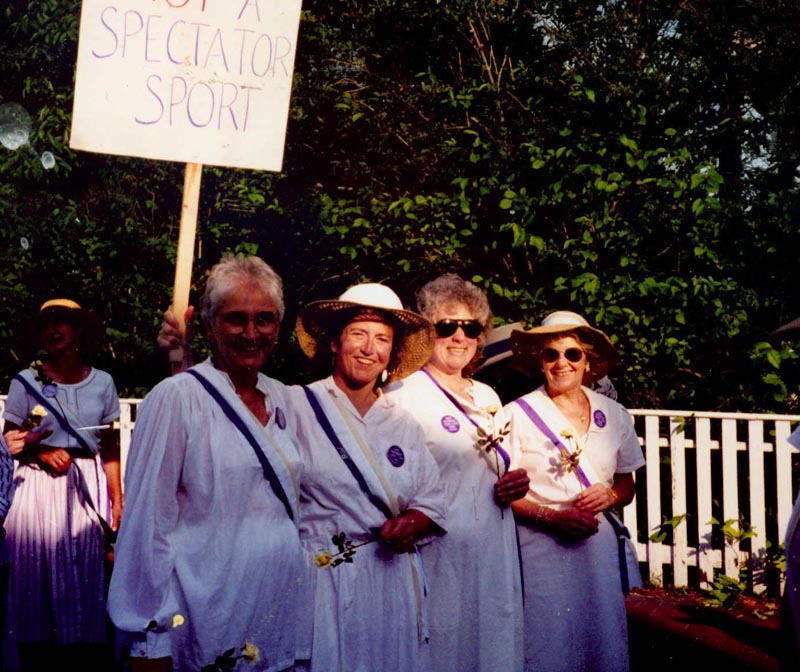
This is from 1995, but it includes several members of the women’s group that I became part of in (I think) 1986.1995 was the League of Women Voters’ 75th birthday year. We marched as part of the League contingent in the Fourth of July parade. From left: Carol Koury, me, Patty Blakesley, and Ann Hollister.

This, I came to realize, was what feminist organizing looked like on Martha’s Vineyard. All of the other women were straight, several were divorced, and the husbands of those who had them were generally in the background. For about ten years they were my Vineyard lifeline. Two of the group were full-time teachers, another was a therapist, yet another worked for one of the island towns. Year-round island life was far more complex than I’d realized as an occasional summer visitor.


The Key Sestina

My city apartment needed four keys,
the mailbox a fifth. Two for each of two
jobs, and a tenth for my bicycle chain.
A fine rattle they made, a heavy weight
in my pocket. There was one key whose lock
I’d forgotten. I would not throw it out.

My island friend spends the whole day out,
leaves her door open, needs only the keys
to her car. My new apartment won’t lock
from the inside; I still sleep well. Here too
my ten-speed bike leans against the wall, wait-
ing for me, sheltered from rain, but not chained.

It’s strange at first, leaving padlock and chain
behind, stopping by my friend’s when she’s out
to use her phone. I miss the clanking weight
in my pack, the rattling of all those keys.
Each of them meant commitment, access to
home, store, office, women’s center, all locked

against the untrusted. I knew that locks
won’t stop everybody. The severed chain
remains; the bike is gone. In less than two
months my house was robbed three times. We were out
at work, we’d locked the doors, we had our keys;
the burglar had none but he didn’t wait

for us. Perhaps it’s only custom’s weight
that makes a barrier of a door that’s locked.
When my mother drank, I’d hide her car keys,
not knowing she had a duplicate chain.
Once in a muted rage I put them out
in plain sight. Did I want her dead? or to

end my responsibility? These two
options nag twenty years later, their weight
unsettled. I visit, after years out
of New England, her house, whose door is locked
always. My mother from her extra chain
detaches and gives me a front door key.

Says the keeper’s jangling chain, “Just wait,
I can split the world in two: danger
locked out, comfort kept in — or vice versa.”

November(?) 1985

When I Am an Old Woman

I acquired this shirt when I was around 30. Both the shirt and the poem whose first line graces it were popular with women my age, give or take a decade. This may sound odd but it isn’t: the poet, Jenny Joseph (1932–2018), was 29 when she wrote it, in 1961.

The possibly odd thing is that Jenny Joseph hated purple. It didn’t suit her, she said. I can’t help wondering if that was always the case. She was an accomplished poet, the author of several children’s books, and an all-round interesting person, but the poem became far more famous than she. Once the internet came along, it circulated widely with no name attached, and it has been often “adapted” over the decades — Google “when I am an old cowgirl” if you don’t believe me.

That’s enough to turn anyone against purple even if they loved it to start with. We poem quoters and T-shirt wearers loved purple. Lavender was for lesbians, and what was purple but a deeper shade of lavender? (If a T-shirt came in multiple colors, you could count on the lavender ones selling out first.)

So fast-forward about four decades. My friend Dan Waters — poet, master printer, artist, photographer, and my town’s moderator, among other things — has been photographing Vineyard characters for the Martha’s Vineyard Museum, and he asked if he could photograph me. Hell yes, said I.

Photo by Daniel A. Waters

As the appointed date for the shoot approached, however, I was having second thoughts. It wasn’t that I was nervous about being photographed, it was that I couldn’t decide what T-shirt to wear. As you well know by now, I have a lot of options. Should I pick a Vineyard shirt? one from my horsegirl years? an overtly feminist or blatantly dykey shirt?

I spread the likeliest candidates, at least a dozen of them, out on my bed. When my eye fell on “When I Am an Old Woman,” I knew: That’s the one.

The shirt is purple, of course, though you can’t tell that from the photo. I don’t generally think of myself as an old woman, though, since I was going on 70 when Dan took the picture and am closing in on 71 now, I surely am.

This particular T-shirt seemed right because I was wearing purple then and I’m wearing purple now.

The last three lines of Jenny Joseph’s poem go like this:

But maybe I ought to practise a little now?
So people who know me are not too shocked and surprised
When suddenly I am old, and start to wear purple.

No one, but no one, who knows me at all could be shocked or surprised that I wear purple. It’s probably one of my lesser idiosyncrasies.

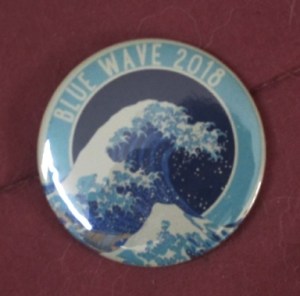
Wave image by Hokusai, button design by Alison Scott

From a visual point of view, I rather wished I hadn’t decided to wear those two buttons, but they do represent important parts of my life. The one on the left is “Blue Wave 2018,” about the midterm elections during what blessedly turned out to be the Trump administration’s only term.

The one on the right — well, that goes back a while. It’s from the October 15, 1969, march to end the war in Vietnam. The D.C. march was my first big demonstration. I was a first-semester freshman at Georgetown University, majoring in Arabic and already minoring in antiwar organizing. The same logo was used on the two-day moratorium that preceded the huge November 15, 1969, national march on Washington. The two-day Moratorium, November 13 and 14, included a long, solemn, single-file march from Arlington National Cemetery to the White House. Each marcher carried a sign bearing the name of a service member or civilian who had died in Southeast Asia. At the White House they deposited their name signs into coffins that had been set up for the purpose.

Dan’s photo of me, blown up to four by five feet, will eventually appear in rotation in the lobby of the Martha’s Vineyard Museum. He’s been at work on this project for a few years now: in 2019, before Covid-19 shut everything down, a selection of the huge photos was displayed at the museum. Who knows, maybe mine will eventually appear in a group show too!

If you don’t see a Leave a Reply block, click on the title of this post and then scroll to the bottom.

Wayward Books & Women’s Glib

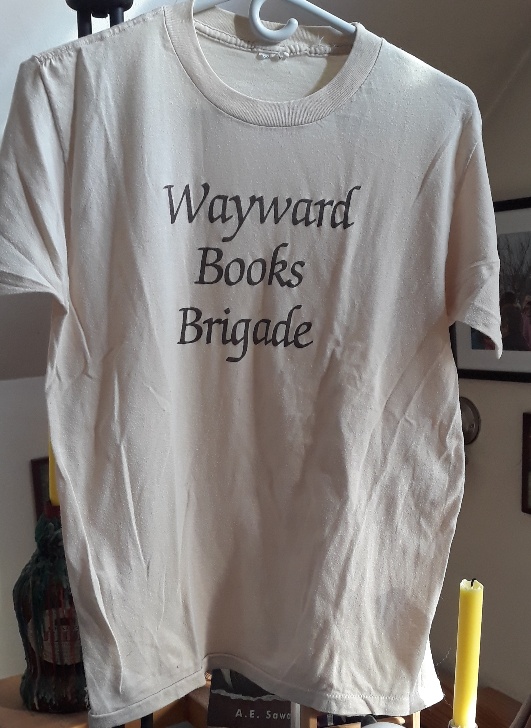
When bookstores move, staffers usually pack the books in boxes, load the boxes in a truck, and drive the truck to the new location. When Wayward Books moved, owners Sybil Pike and Doris Grumbach packed the books in grocery bags and volunteers passed them hand to hand along Pennsylvania Avenue SE to the new shop at 325 7th Street., which was practically next door to Lammas. I was one of the volunteers, and that’s how I got this T-shirt.

True, the distance was only three or four city blocks, and as I recall the brigade didn’t quite stretch the whole distance, so cars were called upon to ferry the books across the gap. But the operation was ingenious and fun, and it worked.

Wayward Books dealt in a carefully curated mix of secondhand and rare works, which meant those books had already been around. They probably took their latest move in stride.

Lammas was well represented in the Wayward Books Brigade, and not only because Wayward Books was moving into the immediate neighborhood. Pike and Grumbach had been a couple since the early 1970s, and Grumbach’s novels were regular sellers at Lammas, notably Chamber Music and The Ladies, which was based on the “Ladies of Llangollen,” two 18th-century Irish women who eloped to Wales, set up housekeeping as a married couple, and whose home became a go-to destination for literary luminaries of the time. Grumbach’s books focused on women’s lives, and often women in relationship with each other, which was not all that common at the time, especially for “mainstream” novelists.

Sybil, a retired research librarian at the Library of Congress, was the on-site manager at Wayward Books — I remember her as a strikingly handsome woman who would have been in her mid-fifties at the time — but Doris was also around when she wasn’t teaching or writing. The two shops complemented each other nicely: their inventories didn’t overlap, but their customers did.

A Washington Post story from April 1990, reporting on Wayward Books’ relocation to Sargentville, Maine, that month, notes that the Wayward Books Brigade comprised 70 volunteers and moved some 3,000 volumes from old location to new. The move to Maine involved three times that many books and was presumably not accomplished hand to hand.

The Post story also says the hand-to-hand move to 7th Street happened in 1985. I would have said a year earlier, because I left D.C. at the end of July 1985 and it seemed Wayward Books and Lammas had been neighbors for more than a few months at that point. But memory is tricky, so maybe not.

I just learned that Sybil passed in March of last year, at the age of 91, but that Doris seems to be alive in her 104th year. It sounds as though, around 2009, they moved together to a retirement community in Pennsylvania, where Sybil died and Doris still lives. Anyone with more information, please respond in the comments. If you don’t want your comment published, say so and it won’t be.


This T-shirt has nothing to do with Wayward Books — except that they both have to do with books, and that Women’s Glib was somewhat wayward in that it had to do with feminist humor, which many continue to swear is an oxymoron. Not for the first or last time, those “many” are so wrong.

Women’s Glib and Women’s Glibber, anthologies edited by Roz Warren, both came out in my bookselling days — I think. Amazon.com gives the early ’90s as pub dates for both books but notes in one case that it’s a second edition. I’m pretty sure I didn’t have anything in either book, although I was the class clown (female) in sixth grade and have been credited with having a pretty good, albeit barbed, sense of humor in all the decades since.

Interestingly enough (to me, at least), this is one of the very few — maybe even only? — Ts I have that features a book. I’ll hedge my bets on that one till I’ve excavated my whole collection. Either few books were featured on Ts or I wasn’t buying (or being given) the ones that were.

My humor tends to be in the moment — I think the word is “situational,” meaning that it arises from circumstances. I’ve never been fond of the other kind, such as stand-up, mainly because stand-up comedy back in the day was so misogynist, even when performed by one of the few women in the trade. Phyllis Diller embarrassed and infuriated me. I could admire Lucille Ball and I Love Lucy while being mortified by her tactics.

As a teenager and young adult I was a huge fan of the Smothers Brothers and Rowan and Martin’s Laugh-In. By the time Saturday Night Live got going, in the mid to late 1970s, I was doing fine without a TV and besides, SNL didn’t seem all that in sync with the lesbian-feminist life I was living.

Humor that was in sync with my life — I loved it. Alison Bechdel’s Dykes to Watch Out For strip and the books compiled from it were huge hits with Lammas customers. So were Nicole Hollander’s Sylvia books. They kept us laughing, and they kept us sane.

The first stand-up comedian who made me sit up, take notice, and even buy at least one of her albums was Kate Clinton. I heard her perform live in the early ’80s. What a revelation! The problem with stand-up comedy wasn’t me, it was the sexist, heterosexist comedy itself!

I’m thrilled to report that Roz Warren and Kate Clinton are still “making light,” as an early Clinton album had it, and you’ve almost certainly heard of Alison Bechdel, if not of Dykes to Watch Out For. I’m not sure if Nicole Hollander is still creating, but it’s not hard to find Sylvia online.

Sylvia — that Sylvia — was one of the namesakes of the TRS-80 that was Lammas’s and my first computer. The other two, as I think I mentioned before, were Sylvia Sherman, my high school history teacher, and Sylvia Abrams, my editorial mentor, without whom I would have had a hard time making a living these last four decades.

Hot Wire & Ladyslipper

December got away from me, as it often does, but I’m back! My last few posts have focused on music, and this one does too.

I was down to the last two music-related T-shirts from my D.C. days and couldn’t figure out how to tie them together. Should each one maybe get its own short post?

Me in my Ladyslipper T in 2021. This design was “vintage” by the time I acquired it, probably after I started working at Lammas.. It’s unusual in my collection both for its long sleeves and its French cut. The long sleeves mean it gets worn regularly in spring and fall.

Then I got it: These two Ts, one from Ladyslipper Music and one from Hot Wire: The Journal of Women’s Music & Culture, both represent the national and international aspect of women’s music, but I had an up-close-and-personal relationship with both of them. I contributed a couple of articles to Hot Wire, including the one about the D.C. Area Feminist Chorus. At Lammas, I shared the upstairs office with Flo Hollis, a full-time Ladyslipper staffer, Lammas owner-manager Mary Farmer was a Ladyslipper distributor, and the code for the Lammas alarm system was Ladyslipper’s PO box number: 3124.

Turns out there was another close connection. Hot Wire has made all 30 of the issues it published between November 1984 and September 1995 available for free as downloadable PDFs, but rather than search each one for articles about Ladyslipper — I was 100% certain they had to have published at least one — I Googled. Imagine my surprise when the story I turned up had been written by me.

OMG. Turned out the date in that citation, May 1985, was wrong — Hot Wire didn’t publish an issue that month — but another reference to the same article had the correct date, March 1985. I downloaded the whole issue and read my own words from almost 37 years ago.

From Hot Wire, vol. 1, no. 2 (March 1985)

No question, it sounds like me. Many of the details came roaring back from my memory; others I’d never forgotten. Some of it I had no recollection of at all. What impresses me the most going on four decades later is the account of how the Ladyslippers dealt with a complete communications breakdown among the three full-time staff members in the winter of 1982–83. “What often happens in such situations,” I wrote, “is that one person leaves, and the level of tension drops for a while.” But at Ladyslipper, as staffer Sue Brown noted, “everyone was too stubborn to leave.”

So they went into counseling as a group. As I wrote, “They were not prepared for the speed and intensity with which issues came to the surface.” In retrospect, Liz Snow described the experience as “shocking.” They continued in counseling for “about ten months.” No one abandoned ship. Ladyslipper did not fall apart; it continued to develop as a major force in the women’s music and culture scene for as long as there was one.

By then I’d had plenty of experience with groups that foundered on their inability and/or unwillingness to work things through. I’d left the Women’s Center collective because the group dynamics were driving me crazy and I had no idea what to do about it. So Ladyslipper’s example was an inspiration: with hard work and, most likely, some help from the outside, we could get through the rough places.*

Fans of Dykes To Watch Out For will immediately recognize the image as the work of Alison Bechdel, who went on to international fame as the author of the graphic memoir Fun Home and other works. We really did know her when.

Which brings me back to those 30 issues of Hot Wire, all available for free download. What a treasure! They’re indispensable, sure, for anyone interested in the stars and rising stars of the women’s music scene of the 1980s and ’90s, but note how many articles are devoted to how-tos and behind-the-scenes movement building. We were starting from scratch in those days, pretty much building the plane as we were flying it, because there were so few experts to learn from.

At the same time, we knew we hadn’t come out of nowhere. Enough others had tended enough fires to leave sparks. It’s a relief to know that the fires are still being tended, and the sparks are still out there, like fireflies on a summer night.

If you want to leave a comment and don’t see a Leave a Reply box, click the title of the blog post (above) and then scroll to the bottom.

notes

* I don’t need to say (do I?) that these problems are not unique to feminist groups. After I moved to Martha’s Vineyard, I found no shortage of examples of groups that either fell apart or drove some of their most valuable members out. Not infrequently those who left would start a new group whose purpose duplicated or overlapped with the old. When the Vineyard finally discovered AIDS, around 1990, it became apparent that various complementary organizations either weren’t aware of or weren’t on speaking terms with each other. More about that later.

1984–85: D.C. Area Feminist Chorus

The story behind this one starts way, way back, long before I moved to D.C. the first time.

My family wasn’t especially musical. My maternal grandmother played the piano by ear, which I thought was cool, but unless Granmummie was visiting,[1] what music there was in our household came via records and the radio.

Not to discount the importance of records, however: When I left for college, I absconded with my father’s Joan Baez album, her first. I didn’t need to take his Tom Lehrer LPs — Lehrer’s first, the one whose cover featured a caricature of the pianist as the devil surrounded by the red flames of hell (see below), and That Was the Year That Was — because most of the songs were embedded in my memory.

I’ve still got that Joan album, and the 10 or so of its successors that I acquired legitimately in the following years, and I still know a ridiculous number of Tom Lehrer songs by heart.[2]

See what I mean? Originally released in 1953, when I was 2.

Like many middle-class-and-up suburban kids my siblings and I took piano lessons with varying degrees of enthusiasm. The teacher wasn’t especially inspired or inspiring. I did learn to read music, but I didn’t learn to pick songs out of the air the way my grandmother did. That was disappointing, but what I didn’t really understand was what all that tedious practice could lead to. If I had, maybe I would have persisted.

Or maybe not.

I did, however, like to sing. Singing was the best part of church, where we went almost every Sunday morning as a family: St. Peter’s Episcopal in Weston, Mass. From fifth grade through eighth I sang alto in the junior choir. After eighth grade, when we aged out of both the junior choir and Sunday school, we could join the adult choir, but the adult choir sang at the 11 a.m. service and my family went to the 9:15. That’s when I left the church.

In my eighth-grade year, Becky B., also an eighth-grader, a soprano who’d been in the choir as long as I had, told me that I always sang off-key. To avoid ruining the anthem, she said, I should just pretend to sing.

No one else — not the choir director/organist, not any other member of the choir, not any of my music teachers in school — had ever told me any such thing. Becky B. didn’t like me and I didn’t like her; she was a goody-two-shoes who was always playing up to the adults. But I feared she was right, that I had been found out.

Somehow I made it through the year. Then I stopped singing. Period. When I entered high school in the fall, the music teacher encouraged me more than once to try out for Glee Club. Since she directed the Glee Club, this should have given me confidence, but it didn’t. I was sure I’d fail and confirm beyond any doubt that Becky B. was right: I couldn’t sing.

It was years before I recognized the pattern: I’d pursue a skill, an instrument, a foreign language — then abandon it when I was on the verge of being able to actually use it. At that point you’re bound to make mistakes. In my family making mistakes got you creamed. My very intelligent and well-read father regularly ridiculed my mother for getting the wrong answer or saying anything he considered stupid. I learned to get my facts straight before I opened my mouth. From an early age I’d been good at words, anything to do with words. I stuck to words, spoken and written, but never sung.

I never stopped listening to music, though, or hanging around people who made music or were somehow in the music biz. Gradually, and usually in fits and starts, I got braver, venturing into territories where I didn’t have all the answers and was bound to make mistakes: taking that first editorial job at the American Red Cross, for instance, or becoming the book buyer at Lammas Bookstore. I did well at both, but note that they both had to do with words: in some ways I was pushing the boundaries of what I was already good at.

The D.C. Area Feminist Chorus was founded in 1978, prompted by a singing workshop led by Holly Near during that year’s Gay Pride celebration. In its early months it was leaderless, with members leading warm-ups and teaching each other songs.

At some point, they decided to engage a director/conductor, and after interviewing several candidates, they hired Deb Weiner. Deb either was already or was soon to become one of my housemates, but this did not prompt me to join the chorus. If anything, it was a deterrent: What if it was your housemate who had to tell you that you couldn’t sing on key and were dragging the group down?

I have an indelible memory of Deb conducting the combined D.C. Area Feminist Chorus and Gay Men’s Chorus of Washington at a holiday concert, in either 1981 or 1982. To be the conductor channeling all that massive sound! I was awed.

How did I come to finally join the D.C. Area Feminist Chorus? Well, I have it on good authority — my own words from 36 years ago — that I set out to write a story about the chorus for Hot Wire: The Journal of Women’s Music and Culture “and almost immediately found [my]self singing in the second soprano section.” By then Deb had moved on after several very successful years, Caroline Foty was the chorus director, and I was living on the far northeast fringe of Capitol Hill, subletting a large room from and sharing a kitchen with photographer Joan E. Biren (JEB).

By then, probably in 1984, I had joined the brand-new Gay and Lesbian Chorus of Washington (GLCW). How did I hear about it? I don’t remember. This was a small group, conducted by Tess Garcia, and my most vivid memory was of a performance we gave where Congressman Barney Frank, dressed in a leisure suit, reclined across several chairs in the front row. Most of the homemade cassette tape I have from a June 1985 performance is unplayable, but on the one audible cut, “Johnny, We Hardly Knew Ye,” we sound pretty good. According to the label, the program also included some P.D.Q. Bach, the spiritual “Soon Ah Will Be Done,” and selections from Annie.

I noted the most striking contrast between my two choruses in that Hot Wire story: “Because the GLCW did not choose to specialize in works by gay or lesbian composers, a chorus member could walk into any music store and be overwhelmed by the available selection.” Not so any Feminist Chorus member: all our music consisted of handwritten scores photocopied or similarly duplicated, because none of it had been published. Director Foty did some of the arranging, and fortunately feminist choruses were thriving at the time, and lots of sharing went on among them through the Sistersingers network. We were breaking ground, pioneers, in the forefront, and very aware of it.

We sang at least two songs from the Balkan women’s singing tradition. I can still fake the second soprano part of “Shto Mi e Milo,” which has been widely recorded.

One of my favorites from the chorus repertoire was a four-part setting of Edna St. Vincent Millay’s “Conscientious Objector.” I didn’t realize till about an hour ago not only that Mary Travers had performed it spectacularly, but that she wrote the solo setting and recorded it on her 1972 album Morning Glory.[3] I have a copy of the poem on my fridge: “I shall die / but that is all I shall do for Death . . .” It reminds me of the song.

The chorus made decisions collectively, including decisions about repertoire. “Conscientious Objector” almost didn’t make the cut; that was before I joined, so I don’t know what the objections were. As I recall, a couple of chorus members thought Malvina Reynolds’s “We Don’t Need the Men” was too anti-male. For others among us, this was a plus, not least because it was so tongue-in-cheekily Malvina. It was fun to remind people that Malvina wrote it in 1959.

The most controversial song I remember from my time in the chorus was “Sisters, Spring of Vietnam”; it clearly favored the Vietnamese liberation struggle against the French and the Americans, and that did not sit well with some members. Singing along with Lucha’s version I remember the tune, the harmony, and many of the words, so I’m pretty sure we sang it anyway, but some choristers chose to sit it out.

The back of the 1985 Sisterfire T. The D.C. Area Feminist Chorus is about halfway down.

My last gig with the D.C. Area Feminist Chorus was at Sisterfire, June 22 & 23, 1985. By the end of that summer I was semi-settled on Martha’s Vineyard. Music was much easier to find than feminism, and find it I did, volunteering at Wintertide Coffeehouse starting in 1986.

It took a while to find a way to start singing again. My way in turned out to be the annual Christmas performance of Messiah, sung by a large (and ever growing) pickup chorus of Vineyarders, many of whom sang regularly in various church choirs.

I’d never sung Messiah before, and most of the chorus seemed to know it by heart. More, although I could read music, I couldn’t “sight-sing,” sing from a score on first acquaintance. I still regret not having the nerve to audition for Glee Club in high school, where everybody learned to do stuff like that. I worked hard, I learned, and when, in my third year, I made it through the glorious “Amen” without losing my place, I thought I’d arrived.

The annual Messiah sings eventually grew into the Island Community Chorus, which did several concerts a year and with which I stayed until around 2005. I’ve managed to keep singing since then. In the age of Covid-19, I’ve participated almost weekly in Zoom sings (Zings?) with Susan Robbins of Libana, a women’s ensemble whose music I’ve loved since at least 1980, and a bunch of whose recordings I’ve got.

But it was the D.C. Area Feminist Chorus that got me singing again, and though I didn’t sing with it for much more than a year, this shirt is about how I found my (singing) voice again.

If you want to leave a comment and don’t see a Leave a Reply box, click the title of the blog post (above) and then scroll to the bottom.

notes

[1] Which was fairly often, because she lived only eight miles away.

[2] This is so common among the political circles I’ve moved in over the decades that if I sing or even hum a line, often someone in the vicinity will sing the next one back to me. A favorite memory from my freshman year at Georgetown U.: As a marshal for the huge Mobe (Mobilization Against the War) march on Washington on November 15, 1969, I was stationed on Pennsylvania Ave. between 6th and 7th. We were close enough together that we could reach out and touch our neighbors on either side. It was sunny but bloody cold, and my winter gear was still back in Massachusetts: I had this idea that since D.C. was a southern city I wouldn’t need it till after Thanksgiving. Wrong. Anyway, while waiting for the sun to get fully up and the march to start, we did a lot of jogging in place and making coffee runs to the nearest drugstore. Eventually one of us — maybe me, maybe not — started in on a Tom Lehrer song. No idea which one, so many of them would have been appropriate — maybe “The Wild West Is Where I Want to Be,” with its lines “I’ll watch the guided missiles / while the old FBI watches me”? We were sure the FBI and who knew what other intelligence agencies were around.

[3] My source for this is a detailed bio of Edna St. Vincent Millay on, of all things, the website for the ABC Oriental Rug & Cleaning Company in Ithaca, N.Y. There has to be an interesting story here, but I’ll have to save that rabbit hole for another time. The page seems to be updated regularly: it includes a reference to the ongoing pandemic and other events.

Persephone Press (1976–1983)

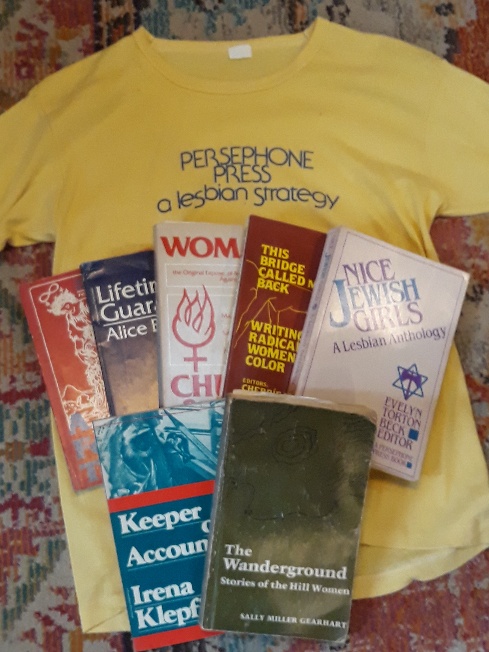
Persephone Press died in May 1983. Social media was decades in the future, but word spread through the feminist print network almost that fast. I still remember standing stock-still when I heard the news, unable to take it in. I was at Lammas, surrounded by the Persephone books that I sold every day, crucial, path-breaking books in the feminist and lesbian world. Lesbian Fiction, Lesbian Poetry, Nice Jewish Girls, This Bridge Called My Back, The Coming Out Stories, The Wanderground . . . Gone? Just like that?

The Persephone Press titles that are on my shelves today.

Well, no, not quite. By then I was well aware of the economic tightrope that a small, undercapitalized bookstore had to walk day in, day out, to keep books on the shelves. I had some idea of the similar constraints that publishers operated under, but somehow I’d assumed that Persephone was exempt. No matter how well you know the technical details, magical thinking has a way of working its way into mind and heart when you need to believe.[1]

I couldn’t imagine a world in which Persephone didn’t exist, but the unimaginable had happened. Persephone was gone.

Persephone Press was brilliant. It didn’t invent the anthology format, but it recognized how perfectly suited it was to feminist publishing at that particular time. So many women were moved — inspired, compelled, driven — to write because so little of what was out there reflected our lives or answered our questions. We wrote what we wanted and needed to read.

But most of us had to work our writing time in around our jobs, our political and other volunteer activities, and our family responsibilities. Sometimes we were learning our craft almost from scratch, which meant struggling to overcome everything we’d learned along the way about what good writing was and who was entitled to write. It helped to find sisters on the same journey so we could assure each other that we weren’t crazy, we could do it, and what we had to say was important.

Novels and other book-length works can be written under such conditions, but shorter ones are easier not only to finish but to get out into the world in print and/or in performance. Not surprisingly, the most accomplished writing emerging from the grassroots feminist movement from the late 1960s into the ’80s consisted of poetry, short stories and essays, and novels, more or less in that order.

Unfortunately, that was pretty much the opposite of what most readers wanted to buy, and bookstores specialized in, well, books. We carried newspapers and journals, of course, and they published short-form writing of all sorts, but they also had a short shelf life. Anthologies combined the best of both forms. They brought together important new, recent, and sometimes not-so-recent writing that was otherwise scattered across time and multiple journals of limited circulation. They could combine poems, stories, and essays between the same two covers. They took longer to produce, but they stuck around a lot longer. In addition, the works collected into a well-edited anthology communicate with each other simply because they’re in the same place at the same time. The whole, in other words, is even greater than the sum of its parts.[2]

Persephone’s anthologies had no precedents. At the time, most of their contributors were known, if they had published at all, only in limited circles, but many of them went on to become widely known and read far beyond the feminist print world. After the crash, most Persephone titles were picked up by other publishers and remained in print for years if not decades. The fourth edition of This Bridge Called My Back: Writings by Radical Women of Color — “a work which by the mere fact of its existence changed the face of feminism in the United States”[3] — was brought out in 2015 by SUNY Press.

Now I look at the numbers — four titles published in 1980, and four in 1981 — and wonder What were they thinking? Most of these were physically big books. Several were going to take a while to reach their audience, like the reprint of Matilda Joslyn Gage’s amazing Woman, Church & State (1893). Anything with “lesbian” in the title and the lesbian romance Choices were going to sell well in the feminist, lesbian, and gay worlds, but those worlds were were not large.

Not to mention — for an undercapitalized publishing company “selling well” could turn into a curse. Invoices were supposed to be paid in 30 days, but undercapitalized bookstores were often doing well to pay in 60. The printing bills, in other words, were going to come due long before they could be paid out of cash flow.

And they did.

What were they thinking?

The recriminations that followed Persephone’s demise were so widespread and so bitter that Persephone’s existence seems to have been erased except for those who know where to look. I wasn’t privy to any of the dealings between press and authors, and I’m not going to repeat what I heard second, third, and fourth hand, but a short article that appeared in the November 1983 off our backs provides some insight. Three significant points:

  1. “Because their books were selling well, they were constantly back on the press. This tied up $40,000 to $50,000 in printing and production costs, which added to the cost of overhead, and bringing out new titles was more than Persephone could handle.”
  2. Cofounders Pat McGloin and Gloria Greenfield “[decided] to consistently operate their press according to feminist ideals. They paid royalties to their authors twice the standard paid by the publishing industry, and refused to allocate a lion’s share of their promotions budget to one best seller and and distribute what was left to the other books.”
  3. Greenfield and McGloin expressed disappointment with the lack of support from the feminist community.[4]

Short version: Persephone’s business plan played fast and loose with real-world economic realities, and the “feminist community” didn’t step up to close the gap. In addition, the scheduled books that never got published, like Barbara Smith’s Home Girls: A Black Feminist Anthology, and the published books that didn’t get adequately supported, like Audre Lorde’s Zami: A New Spelling of My Name, were by women of color, whose publishing options at the time were the most limited.[5]

Plenty of anger was directed at Pat and Gloria, and Pat and Gloria seem to have directed at least some of theirs at “the feminist community,” but I suspect that deep down much of rage and frustration was directed at the economic system that thwarted our needs and our expectations as women, as feminists, as lesbians. Persephone’s 15-book list made it so clear what we were capable of, had given us so much to hope for, and capitalist economics, coupled with lack of organizational and individual support, had cut us off at the knees.[6]

Gazing now at my Persephone Press T-shirt, I’m tempted to take “A Lesbian Strategy” as a cruel, unintentional joke. Had our strategy, if that’s what it was, come to a dead end? Then I remember all the writers and works that Persephone encouraged, and the effects they’ve had on the world we live in now. Most of those whose lives have been enriched by Persephone’s legacy probably don’t know her name, and for those who do the legacy is tinged with understandable bitterness and regret.

After Persephone died, I tried to write a eulogy. It was a poem, three or four pages long; I wasn’t satisfied with it, and I’ve long since lost track of the whole thing, but I liked part of it so much I put it on a postcard:

She comes back indeed.

notes

[1] The dangers of magical thinking carried to extremes were laid out brilliantly by James Tiptree Jr. (Alice Sheldon) in her 1976 story “Your Faces, O My Sisters! Your Faces Filled of Light!” Its protagonist believes she’s living in a city where misogyny doesn’t exist and it’s safe to be on the road at night. Spoiler alert: it’s not.

[2] Here are some of the anthologies on my shelves that were published in the 1980s, almost all by feminist presses. To keep it relatively brief, I haven’t included strictly fiction anthos.

  • For Lesbians Only: A Separatist Anthology, ed. Sarah Lucia Hoagland and Julia Penelope, Onlywomen Press, 1988
  • Out from Under: Sober Dykes & Our Friends, ed. Jean Swallow, Spinsters, Ink, 1983
  • Sex Work: Writings by Women in the Sex Industry, ed. Frédérique Delacoste and Priscilla Alexander, Cleis Press, 1987
  • Shadow on a Tightrope: Writings by Women on Fat Oppression, ed. Lisa Schoenfielder and Barb Wieser, Aunt Lute Books, 1983
  • That’s What She Said: Contemporary Poetry and Fiction by Native American Women, ed. Rayna Green, Indiana University Press, 1984
  • The Tribe of Dina: A Jewish Women’s Anthology, ed. Melanie Kaye/Kantrowitz and Irena Klepfisz, Sinister Wisdom 29/30, 1986
  • With the Power of Each Breath: A Disabled Women’s Anthology, ed. Susan E. Browne, Debra Connors, and Nanci Stern, Cleis Press, 1985
  • Women-Identifed Women, ed. Trudy Darty and Sandee Potter, Mayfield, 1984.

[3] Feminist Collections, vol. 5, no. 1 (fall 1983). This is one of the best contemporary Persephone post-mortems I’ve found yet. Feminist Collections was an indispensable quarterly review of women’s studies resources out of the University of Wisconsin, then edited by Susan Searing and Catherine Loeb. In 2018 it morphed into Resources for Gender and Women’s Studies: A Feminist Review.

[4] Mary Kay Lefevour, “Persephone Press Folds,” off our backs (November 1983), p. 17.

[5] I read Zami as soon as it came out, but my original copy went wandering. I almost certainly brought it with me to Martha’s Vineyard, but probably I lent it to someone and — well, it went wandering. The copy I have now was reprinted by Crossing Press after it was acquired by Ten Speed Press in 2002. The cover is new, but “Text design by Pat McGloin” on the copyright page clearly indicates that the text itself is from the first edition. There’s no indication anywhere that Audre Lorde died in 1992. At least one edition has appeared since with a different cover, but it too seems to use the text from the first edition. I just found this excellent 2014 assessment of Audre Lorde’s importance — and who kept her words alive till the wider world was ready to “discover” her. The author is Nancy K. Bereano, editor of Crossing Press’s Feminist Series until she left to found Firebrand Books. Several publishers continued the work of Persephone Press, but if I had to single out two of them, they’d be Firebrand and Kitchen Table: Women of Color Press.

[6] See note 1.


This note was tucked into my well-worn copy of The Wanderground. Dated 13 Dec. [1979], it’s addressed to Carol Anne [Douglas] and off our backs women: “Here is the Sally Gearhart interview with photo. If it’s okay, I’d like to type it Sunday a.m. – as early as you open! Could someone let me know? Thanks.” My interview with Sally appears in the January 1980 off our backs.

1979–1980: Take Back the Night (and the Clinic, and the Newspaper)

We’d been warned all our lives: Don’t go out at night, and most especially don’t go out alone at night. “Alone” implied “unaccompanied by a man.” When I was a student at Georgetown University, a series of rapes and assaults on campus prompted male students to organize an escort service to see female students safely home from the library at night.[1] The Take Back the Night movement that arose in the 1970s believed that women should be able to walk anywhere we wanted any time of day, alone or with others, in safety. Women shouldn’t have to depend on men to protect us from — it was understood, if often not spoken aloud — other men.

I’ve got three Take Back the Night T-shirts, two from particular events (the ones with dates on them), one more general. The 1981 march in D.C. I must have attended. I’m not sure in what city the 1979 event took place, or how I came by the T-shirt. In 1979, there was a Take Back the Night march in D.C. I definitely attended and it definitely had a T-shirt, but not long after the event I donated mine to the Lesbian Herstory Archives.

Nevertheless, I can see it in my mind’s eye: a big black women’s symbol set on the diagonal, with words clustered around it, all on an orange background. Halloween colors. I don’t remember what the words said. They probably included the date, but I don’t remember that either. The event left such a bad taste in my mouth that I was never going to wear the shirt, so I gave it away.

If you have any info on where this march took place, please let me know! Text: “Women Unite! Take Back the Night, August 18, 1979.”

The organizers had bitterly debated what role men should play in the march. I and most of my lesbian-feminist friends opposed male participation: didn’t it send a message that women needed male support to “take back the night”? The counterargument was that straight women wouldn’t participate if men were excluded. Those opposed to male participation were generally white, lesbian and/or radical feminist, and relatively new to D.C. Those advocating for it were generally black and straight and had deeper roots in the community. The upshot was that men were welcome to join in.

At the event itself, a contingent of black men either worked or pushed their way to the head of the march: after-the-fact reports varied, and I was too far back in the line to see what was happening. However it happened, men wound up leading a march that was supposed to be about women empowering ourselves.

In the next few years I came to realize that what happened that night had its roots in the planning process, and even deeper roots in the explosive mix of racism, sexism, and heterosexism that few of us paid enough attention to and none of us knew how to deal with. Would things have worked out differently if all the lesbians hadn’t been white and all the black women hadn’t been straight?

I wish now that I had kept that T-shirt. If I wore it today, people might say, “Cool shirt! Where did you get it?” None of them would likely know the backstory, and if anyone did — well, I’d want to know what they remembered and what their perspective on the whole thing was, then and in retrospect. What side they were on wouldn’t matter much. If I could teleport back to 1979 with my 2021 consciousness intact, I wouldn’t be standing in exactly the same place either.

That 1979 march taught me plenty, though it took a few years for the lessons to sink in. It’s possible to give something away without letting it go.[2]


I was learning that it wasn’t just the night that we needed to take back, or, more accurately, claim for the first time. Around that time I was volunteering with the Lesbian Resource and Counseling Center (LRCC), the only woman-specific program of the Whitman-Walker Clinic.[3] In these pre-AIDS days, the clinic was one step up from a shoestring operation. Its flagship program was the Gay Men’s VD Clinic, and the vibe was overwhelmingly male.

The LRCC did peer counseling, provided referrals, and hosted a rap group. The clinic administration had agreed that on LRCC nights the clinic space would be women-only, but it was not unusual for the rap group to be interrupted by men lugging in tables and other supplies from that night’s VD clinic, which rotated among the various men’s bars and baths. When confronted about this, one guy’s surly response was typical: “Don’t forget who brings in the money around here.”

Text: “Women Unite / Stop Violence Against Women / Take Back the Night / Washington, DC 1981”

At the LRCC I did pretty much what I’d done at the Washington Area Women’s Center: staff the phone and lead rap groups. I wasn’t involved all that long, however, although I enjoyed the work. More and more I was focusing on the written word, writing and editing; other interests were falling by the wayside. I was contributing fairly regularly to off our backs and the Washington Blade, the D.C.-Baltimore area’s gay newspaper. At the Blade it gradually became apparent who was in charge and whose inclusion was strictly conditional.

Donna J. Harrington and I recounted our experiences in “The Dulling of the Blade,” a lengthy story published in the December 1980 off our backs.[4] Donna had been the Blade’s office manager and a contributing writer for about a year. I had been a contributing writer during roughly the same period, recruited at a time when the gay-male-run paper seemed eager to include lesbians.[5] Over the months, this eagerness deteriorated into hostility that was often blatantly sexist. In researching the story, Donna and I learned that our experiences were not unusual among lesbians working in gay-male-dominated organizations. These outfits had a lot in common with those run by straight men.

The opening two paragraphs from “The Dulling of the Blade”

The editor in chief denied that sexism was an issue; he attributed all problems to “individual personality clashes.” Donna and I disagreed. We concluded “that the gay men who run the Blade have serious problems with lesbian-feminists, and we have come to suspect that they do not believe that lesbian-feminists have enough ‘clout’ to make working with them worth precious male time. Their common response is to get rid of the women who make them uncomfortable. Donna and her predecessor at the Blade and D–– S–– when she was at Philadelphia Gay News had a common experience: as they became more radical, more assertive about feminist issues, and more closely identified with the women’s community, their relationships with their gay male colleagues disintegrated. Their competence and commitment abruptly came under attack.”

Clearly it wasn’t just the night that women needed to take back, and it wasn’t just straight men who were the problem. I didn’t have the patience to deal with them, or much interest in developing the skills necessary to do so. (Many years later, a girlfriend said, with a hint of exasperation, that I had “a complete absence of gush.” I was, and still am, rather pleased with this, but sometimes it does get in the way.)

Before “The Dulling of the Blade” appeared, I was getting more and more frustrated with my job as an editor in the Red Cross publications office. I loved the work. I loved the commute. I loved most of my colleagues and how well we worked together — with one exception. Go back to “1979: I Become an Editor” and you’ll recognize him immediately: Frank. Except it wasn’t so much Frank the individual: in small doses and with the right light, he provided plenty of roll-your-eyes hilarity to compensate somewhat for his incompetence. What grated on me was that he was getting away with it because the American Red Cross was letting him get away with it. Friends who worked in comparably big bureaucracies had comparable stories about incompetent, invariably male co-workers. Big bureaucracies and I were not made for each other. In the spring of 1981 I gave notice; my last day was in late May.

I planned to take a few weeks off, focus on my writing, and then decide what next. “What next” appeared sooner than expected, at my 30th birthday in early June. Watch this space: it’s coming.

If you want to leave a comment and don’t see a Leave a Reply box, click the title of the post and then scroll to the bottom.

Notes

[1] The women’s dorms were on the campus periphery, much closer to Georgetown University Hospital than to the library, classroom buildings, and other centers of student life. Why? You guessed it: because until very recently the overwhelming majority of female Georgetown undergrads were in the nursing school. At night, the walkways were mostly deserted. Co-ed dorms were late coming to conservative, Jesuit-run Georgetown. One argument in their favor was that the two isolated women’s dorms made female students easy targets for predators.

[2] It would be another decade before Kimberlé Crenshaw introduced the word intersectionality, to underscore how our identities are multiple, and how the various components can both complement and contradict each other in myriad ways. However, the concept had been out there for years, and not surprisingly it was feminists of color who were in the forefront of developing it. See for instance the classic “Combahee River Collective Statement,” written by a Boston-based collective of Black feminists in 1977, first published the following year, and never more important than it is today.

[3] In the decades since, the clinic has gone big-time as Whitman-Walker Health. In the 1980s the HIV/AIDS crisis pushed other issues — and lesbians — to the periphery, but it seems that from about 1990 onward Whitman-Walker recommitted itself to “close that gap by providing comprehensive and inclusive care for the lesbian, bi, and queer women’s community” by instituting its Lesbian Services program. By the way, the Whitman in the organization’s name honors, you guessed it, Walt Whitman. The Walker is for Dr. Mary Walker, who wasn’t as far as I know a lesbian or even especially woman-identified but who was a woman pioneer in the medical field.

[4] “The Dulling of the Blade” is archived on JSTOR, along with all of oob’s back issues. “Independent researchers” can read up to 100 articles a month on JSTOR if you sign up for a free account. The access URL for the article is http://www.jstor.org/stable/25773405.

[5] I’ve heard this attributed to the vulnerability gay men were feeling in the late 1970s. Anita Bryant’s Save Our Children was in full cry, with white evangelicals at the forefront. A Dade County (FL) ordinance offering some protection on the basis of sexual orientation was overwhelmingly overturned by voters in a June 1977 referendum. In November 1978, Harvey Milk, the first openly gay elected official in California, was assassinated, along with San Francisco mayor George Moscone. By 1980, though, at least in D.C., mainstream (straight) politicians were showing up at gay (male) events, so white gay men felt more secure and hence, it seems, less in need of lesbian support. When AIDS (first known as GRID, Gay-Related Immune Deficiency) surfaced in 1981 and quickly became an epidemic, gay men pushed lesbian interests even further to the peripheries — while across the country and around the world many, many lesbians threw themselves into advocating for and taking care of their gay male friends and colleagues.

Reviewing Gyn/Ecology for off our backs

Mary Daly’s Gyn/Ecology: The Metaethics of Radical Feminism (Boston: Beacon Press, 1978) was bigger than a bombshell in the feminist world. It was more like an asteroid crashing into the ocean, creating a tsunami. I was a newcomer in the D.C. community, and not yet well grounded in feminist theory, never mind feminist theology, so it’s a bit of a wonder that I got to review Gyn/Ecology for off our backs.

off our backs, known to its friends as oob, was the hometown newspaper of D.C.’s feminist and lesbian communities, but it was also a national and even international publication. It was run by a collective, but every month the two-room walk-up office off Connecticut Ave. NW, opened up for layout weekend. By that point most of the writing and editing had been done and it was all hands on deck, supporters as well as collective members, to do the typing and paste-up necessary to produce the next issue. The rush to deadline made comrades and colleagues of us all. Everyone who helped out was listed among the Friends on the staff block for that issue.

My visual memory of the oob office is of a crowded, no-frills workspace whose walls were papered with posters from recent feminist history and covers from previous issues. I remember picking up the phone once — when the phone rang during layout, whoever was closest grabbed it — and it turned out to be someone I knew from Martha’s Vineyard who was involved in the women’s health movement. My worlds sometimes collided in interesting ways.

I did the typing and probably the layout for my Gyn/Ecology review, and for most of the articles I contributed to oob over the years, mostly interviews and book reviews. My typing ability came in handy, as did my facility with presstype. Here is what the layout looked like:

Apart from ads that came in camera-ready, all copy was produced on IBM Selectric typewriters. Veteran typists of the era will recognize the typeface as Letter Gothic, a popular Selectric sans serif option. Note that book titles are underscored, not italicized, even though we clearly had access to an italic typeball. Swapping typeballs in and out slowed you way down and often got ink on your fingers, so italics were only used for larger chunks of text — in this case quotes from the book being reviewed.

In those days, oob always put bylines at the end of stories, a characteristically feminist strategy to keep readers’ focus on the text instead of the author. I wasn’t the only one who would sometimes read the first few lines of a long story then skip to the end before deciding to continue.

Headings were done with presstype. This one is pretty good, but it’s hard not to notice that the baseline wobbles a little and that the space between “of” and “radical” is twice what it ought to be.

Typing was done on ordinary bond paper with margins set to the paper’s column width. If you caught a typo while you were typing, you fixed it with correction tape, which was preferable to correction fluid (like Liquid Paper or Wite-Out) because it didn’t have to dry. The newer Correcting Selectrics had a correction ribbon built in, parallel to the ink ribbon. I can’t remember if off our backs had any of them when I was involved.

Once completed, the typescript was sprayed with silicone to keep the ink from smearing, then cut with X-acto knives, waxed with a hand waxer, and pasted up on layout boards. The boards from the previous issue would have been stripped for reuse; they were reused until they wore out. Once in a while a page would go to print with the folio (running head) from the previous issue, meaning the date at the top of the page was wrong, but considering the intense, barely controlled chaos of layout weekend and the fact that most of us were amateurs, the gaffes were remarkably few.


Reading the first paragraph of my Gyn/Ecology review for the first time in at least 35 years confirms my memory: while writing it, I was terrified that I couldn’t do the book justice:

“I have been living with Gyn/Ecology: The Metaethics of Radical Feminism for about four months now–reading, rereading, reflecting, rejoicing, growing impatient with my fear of taking on such a magnificent, vast and tightly-woven book. Gyn/Ecology is written to us, for us, from our experience, about us, the untamed, the Hags, the “women reluctant to yield to wooing”. It is a process that aims to transcend the limits of writing, to break down the walls between the writer and reader and the  usual distinction between the creating and the product. Gyn/Ecology is breath-taking in its reach, astonishing in its power–yet it is also intensely personal and has exacted from me an intensely personal response. I write, therefore, to review not the book alone but the part it has played on my own journey into woman-defined space.”

Gyn/Ecology is grim in its exploration of misogyny across cultures and across the centuries, but when it comes to language it’s also immensely playful. As its title suggests, it breaks words apart and prompts one to look at them in unexpected ways. Does “recover,” for instance, mean to regain or to cover up again? Or maybe both at the same time?

From my copy of Gyn/Ecology

In the last paragraph, I write that “Gyn/Ecology, this wonderful, brilliant amazing Hysterical book, spins itself beyond the words that Mary Daly wrote.” It spun me well beyond writing the review. Though then as now I was happier playing first lieutenant than instigator, I led an ad hoc group — we called ourselves, of course, the D.C. Hags — to bring Mary to town. The SRO event was held in a lecture hall at George Washington University on March 23, 1979, with a book signing at Lammas the next day (I know that because the dates appear at the end of the review).

Then, in early April, a friend and I took the Night Owl train from D.C. to Boston to attend “We Have Done with Your Education,” a rally supporting Mary in one of her frequent battles with Boston College. Since BC, like Georgetown U., is Jesuit-run, I found it borderline miraculous that she got tenure and thrived there as long as she did. Not till 1999 was she forced to take early retirement because she insisted on keeping her advanced women’s studies courses women-only. (She would tutor privately any men who wanted to take the course.) The rally, held at Boston University, was held on April 8, 1979 — I know that because it’s on the T-shirt. Its title was based on a quote from Virginia Woolf’s Three Guineas (Daly embraced Woolf as a foremother):

“And let the daughters of educated men dance round the fire and heap armful upon armful of dead leaves upon the flames. And let their mothers lean from the upper windows and cry, ‘Let it blaze! Let it blaze! For we have done with this “education”!’”

As a daughter of educated men, I might well have been dancing round the fire. The less predictable part is that my mother, Chiquita Mitchell Sturgis, might actually have been leaning from the upper windows. At the time, she was a clerical at Beacon Press, Unitarian Universalist–affiliated publisher of Mary Daly and many other essential feminist, liberal, and progressive writers, so requesting a Beacon book or contacting a Beacon author often meant working with my mother. What she made of Mary’s books I’ll never know, but she liked Mary and we both liked having something in common that had nothing to do with family or hometown.

Mary died on January 3, 2010. My obituary for her was published in the May/June 2010 Women’s Review of Books. Unfortunately it’s not available online, but fortunately (wonder of wonders) I still have the print version. Rather than focus on (obsess about?) Mary’s forced retirement from Boston College, which the mainstream media were covering ad nauseam, I started off by summarizing the “far more intriguing . . . story of how a nice Catholic girl from Schenectady, New York . . . transformed herself into a ‘revolting hag’ whose advice to posterity is ‘sin big.’”[1]

“Daly’s searchings were wild, exhilarating, infuriating, inspiring,” I wrote. “But I didn’t become a Daly groupie. As a reader, a writer, and a thinker, I’ve always been a pick-and-choose synthesizer. A few of Daly’s protégées, including Janice Raymond,[2] took her insights and tools and created powerful work with them. In less able hands, though, those insights and tools became little more than parlor tricks.”

My mother worked at Beacon Press, publisher of Mary Daly and other essential feminist writers, from the mid-1970s to the late ’80s.

When I wrote that obit for Mary Daly, I’d been an editor for more than 30 years, so it’s not all that surprising that I contributed to the Women’s Review of Books blog a post titled “Beyond God the Style Guide: Me? Edit Mary Daly?” Could I have done it? The mere thought was daunting, “even though,” I noted, “I’m the kind of copyeditor who argues with the dictionary, cheerfully makes exceptions to Chicago, and lets my authors do pretty much what they want as long as it makes sense and will (probably) pass muster with the publisher.”

Being a writer and a feminist as well as an editor, I went on: “From Church and the Second Sex onward, Mary Daly was continually improvising words and imagery to convey what hadn’t been conveyed before, and to examine ideas taken for granted for so long that they actively resisted exploration. Breaking trail is demanding and exhausting work. Being among the first to follow in a freshly broken trail isn’t exactly like traveling a paved road either.”

And that’s what editing Mary Daly would have been like: “following in a freshly broken trail.” Would I have been up to it? At the time Gyn/Ecology came out, almost certainly not. A few years later, fully fledged as an editor and more flexible than I’d been as an apprentice, I think I could have done it, though not without the terror that gripped me while I was writing that review.

notes

[1] Sources were Mary’s Outercourse: The Be-Dazzling Voyage (New York: HarperSanFrancisco, 1992) and “Sin Big,” in The New Yorker, February 26, 1996. To explore, or revisit, Mary’s work, check out The Mary Daly Reader, edited by Jennifer Rycenga and Linda Barufaldi (New York University Press, 2017).

[2] My interview with Jan Raymond appeared in off our backs for October 1979.

If you don’t see a Leave a Reply box, click the title of the blog post (above) and then scroll to the bottom.

This is the photo that appeared with my obituary for Mary. No credit was given, but if you know who the photographer was, please let me know and I’ll add it in. I can’t tell you how much I love this picture.