1991–1994, etc.: ILGA, the Island Lesbian & Gay Association

The early ’90s get slippery for dates especially where the lesbian and gay awakening on Martha’s Vineyard is concerned. Complicating the chronology is that no one seems to have kept copies of Stone Walls, the handsome newsletter put out by Dan Waters and Hal Garneau for the fledgling Island Lesbian & Gay Association. I need to pay a visit to the Vineyard Gazette’s archives and also to find out what the Martha’s Vineyard Museum has in its files, but these things aren’t likely to happen till the worst of summer is over.

In late 2014, I was reminded of the importance of getting this history down where other people can find it. That summer, The Yard, a seasonal dance colony in Chilmark, claimed to have held the first public gay pride event on Martha’s Vineyard. I heard nothing about it through the usual channels, which is to say Facebook, word-of-mouth, or the bulletin board at up-island Cronig’s. No one else I know did either.

This was not surprising. A strange barrier stands between the summer island and the year-round island. It’s porous enough to see through, but only in one direction: we can see it, but it can’t see us. In June 2015 I blogged “Gay on MV” to get some of the history out there. Exactly seven years later, I had an opportunity to do it again, at the ceremonial raising of the “Progress Pride” flag in Ocean Park. “Pride Flag Flying,” another blog post, includes the remarks I prepared for that event.

So please consider this a work in progress.

When I moved back to D.C. in the spring of 1977, I knew where to find the lesbians and the feminists: through Lammas, the feminist bookstore, and through the Washington Area Women’s Center, then housed in the basement of the abandoned-and-falling-into-disrepair Sumner School at 17th and M Streets N.W.

Moving to Martha’s Vineyard in 1985 — for a year, mind you, just for a year — it was a different story. Where were the lesbians? I read every poster on every bulletin board and telephone pole and skimmed every story in both newspapers, looking for signs of lesbian, gay, and/or feminist activity. Nothing. Most startling was that no one seemed to be talking about AIDS, which by 1985 was a huge issue in D.C.

As recounted in “1985–86 (etc.): Adult Child of Theater,” it was much easier to find a 12-step program for adult children of alcoholics. And through that I found lesbians, gay men, and the island’s vibrant theater scene. As I wrote in “Gay on MV,” the Vineyard’s theater community was “like theater in most other places: a veritable hotbed of misfits and nonconformists, gay, lesbian, straight, both/and, and neither/nor. My people.”

But no one said “gay” or “lesbian” out loud in public. Oh no! If you did, it was assumed you were one, and that was risky. So we said “the L-word” (almost two decades later this commonly used closet phrase was appropriated for a TV series) or used the ASL sign for “L” or (gods help us) substituted “Lebanese” for “lesbian.” The island was just discovering AIDS, but to hear health-care professionals talk, you’d have assumed that HIV could only be contracted from dirty needles and blood transfusions.

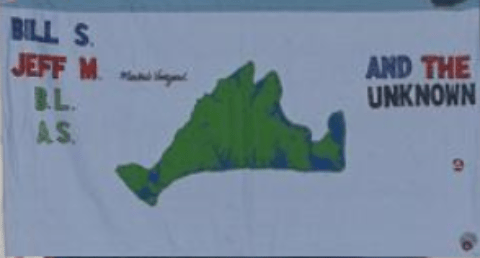
The island’s lesbians and gay men knew better. Nancy Luedeman (1920–2010), theater mainstay and recovering alcoholic, created a panel for the AIDS Quilt that was included in the Quilt’s first national display in October 1987. Two of the four Vineyard men it memorialized were identified only by first name and last initial, the other two by initials only.

Around 1990 that began to change. See “Visiting the AIDS Quilt with My Mother” for what I currently recall (and have to further research) about this period. Many island gay men and lesbians realized that the time had come to go public, in part to help clear up the widespread misconceptions about gay people but also so we could find and support each other.
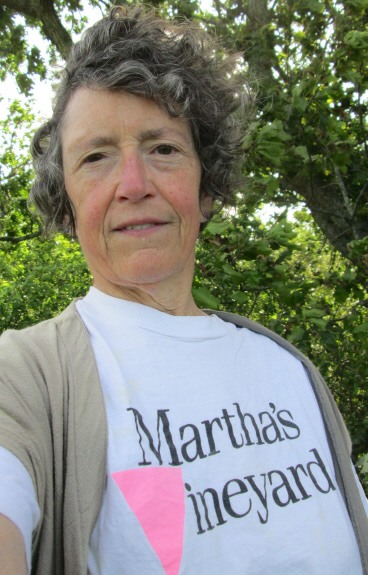
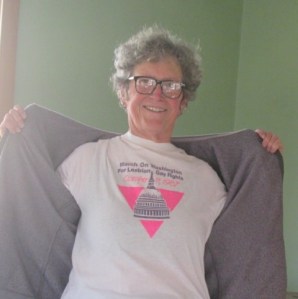
Me and the more discreet of ILGA’s two T-shirts in July 2014. In the early ’90s you could wear this one anywhere and hardly anyone knew what it meant.

The first meeting of what became ILGA, the Island Lesbian and Gay Association, took place in the big room at the Wooden Tent on State Road, Vineyard Haven, which was then owned by Edie Yoder and Kathy Rose. I was there, along with some 25 other Vineyarders, about half of them women and half of them men, nearly all of whom I knew at least by sight. Sitting in a big circle, we went round and introduced ourselves. When the third Kathy introduced herself, people were starting to chuckle, then when Lansing Bailey — a burly gent who was older than most of us — introduced himself as Kathy, we all lost it completely. No one there will ever forget it.

What neither I nor anyone I’ve spoken with so far can remember is exactly when this meeting took place. My best guess is 1991, either spring or fall (because no one has time for organizational meetings in the summer, and what’s more, that was the summer of Hurricane Bob).[2] Fairly early in 1992 I moved into the guest house at the Wooden Tent, and I’m 99% sure that at the time of that meeting I was still living up-island.

You could only wear this one out in public if you were willing to stop people in their tracks. Photo from July 2014.

ILGA’s primary purpose was social — our potlucks were amazing! — but it had a powerful impact on gay and lesbian visibility on Martha’s Vineyard. In the early ’90s you could wear the pink triangle shirt down Main Street, Vineyard Haven, without getting any double-takes or snotty remarks: the only people who recognized the pink triangle were friendly and everyone else thought it was just another Vineyard T-shirt. It took considerably more chutzpah to sport the “No Man Is an Island Lesbian” shirt in mixed company.

For the first time a newcomer or someone just coming out could find the words “Lesbian” and “Gay” in the organizations listing of the Vineyard phone book. Two of us, Robert Cropper and me, were out enough to have our names and phone numbers listed. (I don’t recall ever getting a crank call from that listing.)

Around this time — 1992 and ’93 — a homophobic politician, Ron Beaty Jr.[3] by name, on the Cape took to writing nasty letters to the editor equating gay people with immorality and AIDS, and pushing Gay Rights, Special Rights (1993), a video promoted by the Traditional Values Coalition.[4] A lesbian couple wrote a letter to the Martha’s Vineyard Times rebutting such fallacious fear-mongering. The editor said he’d publish it but only if their names were included. Since this couple had several kids in the school system, this was outrageous and several of us (I was the Times features editor at this point) said so, but it was the editor’s wife who got through to him: “Of course you should withhold their names,” she said, and that was that. The letter was published with the writers’ names withheld.

In the fall of 1993 two Oak Bluffs town fathers tried to get two of the earliest kids’ books about gay/lesbian families pulled from the Oak Bluffs School library: Heather Has Two Mommies (1989) and How Would You Feel If Your Dad Was Gay? (1991). This spawned several contentious meetings and letters to the editor. I remember one meeting in particular where the town fathers were joined by a fundamentalist minister and a former marine known for striding around town in his red satin Marine Corps jacket. At one point the minister claimed that AIDS was God’s scourge of the homosexuals (IIRC he used that exact phrase), to which ILGA regular Michele Lazerow pointed out that lesbians had the lowest incidence of HIV/AIDS of any group. This was greeted with much laughter and applause, so I don’t know whether the minister responded.

The heroes of the meeting were the school librarian, Jan Buhrman, and the eighth-grade member of the school committee, Jay Borselle.[5] Their eloquence helped turn the tide, and it reassured me and others that we had allies willing to step up. At the same time, the Martha’s Vineyard Library Association was the only organization that spoke out against the attempted book banning. As a former bookseller, I expected no less — librarians are the best! — but the silence in other quarters was disappointing.

In response I took the lead in organizing a Banned Books reading at Wintertide Coffeehouse in January 1994. I read from Heather Has Two Mommies, Robert read from How Would You Feel If Your Dad Was Gay?, and 18 or so volunteers picked a book from the American Library Association’s Banned Books list and read a short excerpt from it. The Rev. Ken Miner (d. 1997), pastor of Trinity United Methodist in Oak Bluffs, read the David and Jonathan story from the Bible. The place was packed, and we all went home invigorated.

That spring, the short-play festival at the Vineyard Playhouse included Susan Miller’s “It’s Our Town Too,” a poignant riff on Thornton Wilder’s classic Our Town in which the parents of the young people who grow up to marry are a gay couple and a lesbian couple.

Several ILGA members marched in Boston’s Gay and Lesbian Pride parade that June, behind a banner created by signmaker (and musician) Tom Hodgson. I don’t remember why I didn’t join them, maybe because I’d ODed on Gay Pride in my D.C. days, but I did get to a “Celebrate Gay Cod” event on the Cape that month. That’s where the button at the beginning of this piece comes from.

NOTES


[1] The AIDS Alliance sponsored the first Crossover Ball on New Year’s Eve 1994. Boys dressed as girls, girls dressed as boys, and everyone had a blast. These continued more or less biennially till 2005. Can you imagine such a thing happening on Martha’s Vineyard in the ’80s? I can’t either.

[2] Late October of that year brought the equally memorable No-Name Nor’easter, known elsewhere as the Perfect Storm. It delayed the move of the Martha’s Vineyard Times, whose features editor I then was, from Woodland Market to Five Corners. This makes me think that the first ILGA meeting happened earlier in the year, but we shall see!

[3] Gadfly Beaty is nothing if not persistent. For a summary of his antics, see this 2018 call for his removal from his seat on the Barnstable County Council. He wasn’t removed then — the BCC doesn’t have a removal mechanism — but he was eventually defeated for re-election. Now in 2024 he seems to be running again. He has referred to himself as the “Donald Trump of Cape Cod” and once referred to activist David Hogg as a “self-promoting opportunistic rat.”

[4] I procured a copy of this so several of us could see it firsthand. This got me on some pretty disgusting right-wing mailing lists, but eventually the appeals and alerts stopped coming.

[5] By the end of the decade, Jan Buhrman had begun an ever expanding and deepening career as a cook and advocate for locally sourced ingredients: https://www.janbuhrman.com/. Jay Borselle became a journalist and is now the news director for WBZ NewsRadio in Boston.

1990: Visiting the AIDS Quilt with My Mother

I’d already seen the whole AIDS Quilt twice, but my mother hadn’t seen any of it ever. I think going to see this display of a small part of it was her idea, but I was up for it. I also think she bought me the T-shirt, but I was up for that too.1

For the record, although the T-shirt says “Boston,” the display we went to was at MIT in Cambridge.

1990 stands out in my memory as the year Martha’s Vineyard discovered AIDS. Since HIV/AIDS was already looming large in the gay community, and increasingly in the lesbian community, when I left D.C. in 1985, this caused some cognitive dissonance, to put it mildly.

In D.C., since I was immersed in “the community” and worked at the feminist bookstore, I was generally and accurately assumed to be a lesbian. I never had to come out. When I got to the Vineyard, I realized I didn’t know how. Life was further complicated by the fact that at the time, most women dressed like the dykes I knew in D.C. — jeans, flannel or button-down shirts, shoes you could walk in. I learned to surreptitiously check for the presence or absence of a ring on the ring finger of any new acquaintance, though this could be misleading.

Me in my Common Threads shirt, 34 years later.

Life was even further complicated by the fact that if you said the word “lesbian” out loud everyone would (a) turn to look at you, and (b) assume you were one. This was OK with me but it wasn’t OK with others.2 So people really did use the American Sign Language sign for “L” or say (I’m not kidding about this) “Lebanese” when they meant “lesbian.”

As related in “1985–1986 (etc.): Adult Child of Theater,” I lucked out early. I’d arrived on the Vineyard in search of a 12-step program, and in finding ACA (Adult Children of Alcoholics) meetings, I also found lesbians — one lesbian in particular, the late Mary Payne, founder and artistic director of Island Theatre Workshop. She lured me into theater, and through theater I found my tribe(s).3

Is it fair to say that the island in general was less welcoming, less friendly? Since little if anything made it into the public eye, e.g., the newspapers or the island’s bulletin boards, it’s hard to know what people “in general” were thinking. I do remember attending a public meeting about HIV/AIDS in the very late 1980s where one of the main speakers, a locally prominent mental-health professional, implied that HIV/AIDS could only be contracted through blood transfusions and dirty needles.

This was beginning to change, however. Around that time, or maybe a little later, a proposal to install condom dispensers at the high school sparked controversy. Naturally some people disapproved because it was seen to condone students being sexually active, but the tide seemed to be moving in a more practical direction: if/when students were sexually active, they should be safely sexually active. Condoms helped avoid pregnancy, yes, but they also helped prevent the spread of STDs (sexually transmitted diseases), and the scariest STD at that time was HIV/AIDS.

Here’s where chronology gets a little fuzzy. My memory is clear, but so far I’ve found nothing to confirm or correct what I remember. What I remember is that a youngish Vineyard man named Joel Counsell died in a house fire in Vineyard Haven. The backstory, which I knew through word of mouth, mainly through 12-step connections, was that Joel, an addict and/or alcoholic who was also HIV-positive, had been trying to get help, but the island’s health-care options were too fragmented. The only support he found was in AA meetings that included gay or lesbian members.

After Joel’s death, and at least partly in response to it, the AIDS Alliance of Martha’s Vineyard was formed, both to coordinate and publicize the services available to people with HIV/AIDS, from testing to counseling to treatment, and to educate the public about the disease.4 (Rumors and misinformation about HIV/AIDS spread much more readily than the disease itself.)

Around this time, and related at least indirectly, the Island Lesbian & Gay Association (ILGA) was formed. I was one of the 26 Vineyarders at the first meeting, which was held in the big room at the Wooden Tent, then owned by a lesbian couple.5 More about ILGA in the next installment of The T-Shirt Chronicles.

NOTES

  1. In my defense, I’m pretty sure this was at least a decade before I swore “No more T-shirts!” ↩︎
  2. It took me a while to fully understand how small towns were different from big cities. Once words came out of your mouth, they couldn’t be taken back — and they traveled. Fast. Depending on the subject, you wouldn’t believe how fast. Many of my D.C. friends had moved there from, you guessed it, the small or smallish towns they’d grown up in and, often, where their families lived. So had I. Going in the opposite direction taught me a few things. ↩︎
  3. This included Wintertide Coffeehouse, which until January 1991 happened only on winter weekends. Music, theater, and the grassroots arts more generally tend to be where we outsiders and misfits find each other. ↩︎
  4. AZT was available at this point, but its effectiveness was limited and it was very expensive. Treatment options began to increase and improve in the early 1990s. Here’s a brief summary of how they advanced. ↩︎
  5. A couple of years later, in 1992, I became their tenant, moving into the separate guest house on the property. I lived there till the fall of 2001, which at that point was by far the longest I’d lived anywhere on the Vineyard. ↩︎

1987: March on D.C. for Lesbian & Gay Rights

The 1987 March on Washington for Lesbian & Gay Rights wasn’t my first national march, not by a long shot. Barely a month into my freshman year of college, I participated in the first Vietnam Moratorium march on October 15, 1969, then exactly one month later, on November 15, I was a marshal at the huge New Mobilization1 (aka “New Mobe”) march. From my station between 6th and 7th Streets NW, I got to watch hundreds of thousands of people pouring down Pennsylvania Ave. ten or twelve abreast. I’d never seen anything like it.

I still have visceral memories of that one. It was sunny, but it was chilly and I was underdressed: In my innocence I thought my winter duds could wait till I went home for Thanksgiving. Wrong. I wasn’t the only one either. Those who’d worn jackets hadn’t brought gloves, so we took turns making coffee runs to the nearest drugstore then warmed our hands by wrapping them around the cup. Several of us entertained the others, and the police officers stationed on the same block, singing Tom Lehrer songs. I could go on . . .

So the 1987 March for Lesbian & Gay Rights wasn’t my first national march, but it was the first I’d had to travel to. I’d moved back to Massachusetts in the summer of ’85, and by now into my third year, it looked like I was going to stay there.

I’d marched in the the first national March for Lesbian & Gay Rights in 1979, of course, but I don’t remember who I marched with. Maybe the off our backs contingent, or the Washington Area Women’s Center? I do remember passing along the back side of the White House grounds chanting with a whole bunch of other dykes “Two, four, six, eight, how do you know that Amy’s straight?” Amy Carter, daughter of then-president Jimmy Carter, was all of 12 at the time. We were, of course, giving her the benefit of the doubt, but — I just looked her up — she’s been heterosexually married twice and has two kids, so straight she seems to be.

The AIDS Quilt, officially the NAMES Project AIDS Memorial Quilt, was displayed for the first time during that march. Established almost exactly two years earlier, in November 1985, the Quilt at that point included 1,920 panels. Each panel was three by six feet; they were stitched into square blocks of eight panels each.

I knew about the Quilt. My friend Nancy Luedeman (1920–2010), a mainstay of Island Theatre Workshop and longtime partner of Mary Payne, had created a panel for four Vineyard men who had died of AIDS. I promised I would find her panel.

I was not prepared for how overwhelmed I felt as I walked down the rows between the blocks of panels. I’ve been deeply moved walking through cemeteries, noting the dates and the connections between people, but this was different: each panel was alive, evoking in color and imagery the life and personality of each person memorialized, each person lost. Finally I knew what it felt like to be in the presence of the sacred.

I did find Nancy’s panel. Two of the four men were identified by first name and last initial, the other two only by initials. This reflected the shame attached to AIDS, and homosexuality, on Martha’s Vineyard and in so many other places at the time. Nancy didn’t volunteer their full names, and I didn’t ask. I think Nancy said they’d all died off-island. Eventually I learned that Bill S. was Bill Spalding, who has another panel in the Quilt, with his full name on it. I don’t know about the others. If you do, please let me know.

Quilt panel created by Nancy Luedeman in memory of four Vineyard men who died of AIDS

The Quilt returned to D.C. a year later, and so did I. It had been on tour that spring and summer of 1988, growing all the while. By October 1988, spread out on the Ellipse, it comprised 8,288 panels. Too many to see all of them in only two or three hours, so I wandered, letting myself be drawn and directed by a name, an image, a thought.

A Red Cross caught my eye. I had worked at Red Cross national headquarters for four years in my D.C. days. That’s where I learned what an editor was, and where I started to become one. When I reached the panel and read the name on it, my knees collapsed under me. It was for my co-worker and friend Thom Higgins, whom I’d seen when I was in D.C. the previous October. He’d seemed fine. He didn’t say anything about being sick. He’d died earlier that year, I think in May.

The image in the middle is for Toastmasters, of which Thom was a dedicated member. IIRC the panel was created by Thom’s friend and my friend and former colleague Brad McMinn. Brad died, also of AIDS, in 1993.

My recollection is that Casselberry and Dupree were singing “Positive Vibration” at the other end of the Mall, but maybe I made that up. Now I can’t hear that song without thinking of Thom. I can’t think of Thom without hearing that song.

More about Thom in “1978: ERA March and the Red Cross Training Office.” He gave me my EDITOR shirt and my WHEN IN DOUBT TURN LEFT shirt. I still have both of them. I remember you, Thom.


NOTE

  1. Formally the New Mobilization Committee to End the War in Vietnam. The successor to the National Mobilization Committee to End the War in Vietnam, which organized major antiwar events in 1967 and ’68, this was the coalition that organized the gigantic November 15, 1969, march. Frequently confused and/or conflated with it was the Vietnam Moratorium Committee, which organized the October 15 events across the country. It also organized the incredibly moving prelude to the November 15 march: On November 13 and 14, thousands of people walked from Arlington National Cemetery to the White House, each one bearing on a placard the name of someone killed in Vietnam. In front of the White House these placards were deposited into coffins set up for the purpose. I was involved in the housing and feeding operation ongoing at Georgetown and so was unable to participate. ↩︎

1979–1980: Take Back the Night (and the Clinic, and the Newspaper)

We’d been warned all our lives: Don’t go out at night, and most especially don’t go out alone at night. “Alone” implied “unaccompanied by a man.” When I was a student at Georgetown University, a series of rapes and assaults on campus prompted male students to organize an escort service to see female students safely home from the library at night.[1] The Take Back the Night movement that arose in the 1970s believed that women should be able to walk anywhere we wanted any time of day, alone or with others, in safety. Women shouldn’t have to depend on men to protect us from — it was understood, if often not spoken aloud — other men.

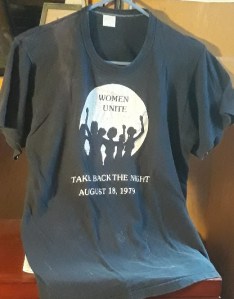
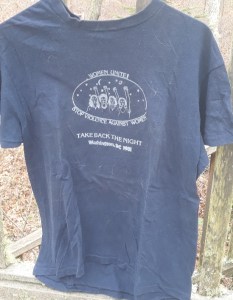
I’ve got three Take Back the Night T-shirts, two from particular events (the ones with dates on them), one more general. The 1981 march in D.C. I must have attended. I’m not sure in what city the 1979 event took place, or how I came by the T-shirt. In 1979, there was a Take Back the Night march in D.C. I definitely attended and it definitely had a T-shirt, but not long after the event I donated mine to the Lesbian Herstory Archives.

Nevertheless, I can see it in my mind’s eye: a big black women’s symbol set on the diagonal, with words clustered around it, all on an orange background. Halloween colors. I don’t remember what the words said. They probably included the date, but I don’t remember that either. The event left such a bad taste in my mouth that I was never going to wear the shirt, so I gave it away.

If you have any info on where this march took place, please let me know! Text: “Women Unite! Take Back the Night, August 18, 1979.”

The organizers had bitterly debated what role men should play in the march. I and most of my lesbian-feminist friends opposed male participation: didn’t it send a message that women needed male support to “take back the night”? The counterargument was that straight women wouldn’t participate if men were excluded. Those opposed to male participation were generally white, lesbian and/or radical feminist, and relatively new to D.C. Those advocating for it were generally black and straight and had deeper roots in the community. The upshot was that men were welcome to join in.

At the event itself, a contingent of black men either worked or pushed their way to the head of the march: after-the-fact reports varied, and I was too far back in the line to see what was happening. However it happened, men wound up leading a march that was supposed to be about women empowering ourselves.

In the next few years I came to realize that what happened that night had its roots in the planning process, and even deeper roots in the explosive mix of racism, sexism, and heterosexism that few of us paid enough attention to and none of us knew how to deal with. Would things have worked out differently if all the lesbians hadn’t been white and all the black women hadn’t been straight?

I wish now that I had kept that T-shirt. If I wore it today, people might say, “Cool shirt! Where did you get it?” None of them would likely know the backstory, and if anyone did — well, I’d want to know what they remembered and what their perspective on the whole thing was, then and in retrospect. What side they were on wouldn’t matter much. If I could teleport back to 1979 with my 2021 consciousness intact, I wouldn’t be standing in exactly the same place either.

That 1979 march taught me plenty, though it took a few years for the lessons to sink in. It’s possible to give something away without letting it go.[2]


I was learning that it wasn’t just the night that we needed to take back, or, more accurately, claim for the first time. Around that time I was volunteering with the Lesbian Resource and Counseling Center (LRCC), the only woman-specific program of the Whitman-Walker Clinic.[3] In these pre-AIDS days, the clinic was one step up from a shoestring operation. Its flagship program was the Gay Men’s VD Clinic, and the vibe was overwhelmingly male.

The LRCC did peer counseling, provided referrals, and hosted a rap group. The clinic administration had agreed that on LRCC nights the clinic space would be women-only, but it was not unusual for the rap group to be interrupted by men lugging in tables and other supplies from that night’s VD clinic, which rotated among the various men’s bars and baths. When confronted about this, one guy’s surly response was typical: “Don’t forget who brings in the money around here.”

Text: “Women Unite / Stop Violence Against Women / Take Back the Night / Washington, DC 1981”

At the LRCC I did pretty much what I’d done at the Washington Area Women’s Center: staff the phone and lead rap groups. I wasn’t involved all that long, however, although I enjoyed the work. More and more I was focusing on the written word, writing and editing; other interests were falling by the wayside. I was contributing fairly regularly to off our backs and the Washington Blade, the D.C.-Baltimore area’s gay newspaper. At the Blade it gradually became apparent who was in charge and whose inclusion was strictly conditional.

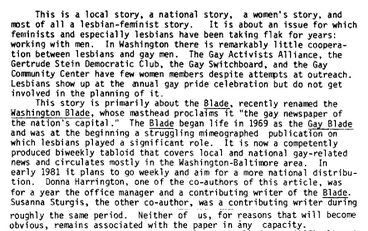
Donna J. Harrington and I recounted our experiences in “The Dulling of the Blade,” a lengthy story published in the December 1980 off our backs.[4] Donna had been the Blade’s office manager and a contributing writer for about a year. I had been a contributing writer during roughly the same period, recruited at a time when the gay-male-run paper seemed eager to include lesbians.[5] Over the months, this eagerness deteriorated into hostility that was often blatantly sexist. In researching the story, Donna and I learned that our experiences were not unusual among lesbians working in gay-male-dominated organizations. These outfits had a lot in common with those run by straight men.

The opening two paragraphs from “The Dulling of the Blade”

The editor in chief denied that sexism was an issue; he attributed all problems to “individual personality clashes.” Donna and I disagreed. We concluded “that the gay men who run the Blade have serious problems with lesbian-feminists, and we have come to suspect that they do not believe that lesbian-feminists have enough ‘clout’ to make working with them worth precious male time. Their common response is to get rid of the women who make them uncomfortable. Donna and her predecessor at the Blade and D–– S–– when she was at Philadelphia Gay News had a common experience: as they became more radical, more assertive about feminist issues, and more closely identified with the women’s community, their relationships with their gay male colleagues disintegrated. Their competence and commitment abruptly came under attack.”

Clearly it wasn’t just the night that women needed to take back, and it wasn’t just straight men who were the problem. I didn’t have the patience to deal with them, or much interest in developing the skills necessary to do so. (Many years later, a girlfriend said, with a hint of exasperation, that I had “a complete absence of gush.” I was, and still am, rather pleased with this, but sometimes it does get in the way.)

Before “The Dulling of the Blade” appeared, I was getting more and more frustrated with my job as an editor in the Red Cross publications office. I loved the work. I loved the commute. I loved most of my colleagues and how well we worked together — with one exception. Go back to “1979: I Become an Editor” and you’ll recognize him immediately: Frank. Except it wasn’t so much Frank the individual: in small doses and with the right light, he provided plenty of roll-your-eyes hilarity to compensate somewhat for his incompetence. What grated on me was that he was getting away with it because the American Red Cross was letting him get away with it. Friends who worked in comparably big bureaucracies had comparable stories about incompetent, invariably male co-workers. Big bureaucracies and I were not made for each other. In the spring of 1981 I gave notice; my last day was in late May.

I planned to take a few weeks off, focus on my writing, and then decide what next. “What next” appeared sooner than expected, at my 30th birthday in early June. Watch this space: it’s coming.

If you want to leave a comment and don’t see a Leave a Reply box, click the title of the post and then scroll to the bottom.

Notes

[1] The women’s dorms were on the campus periphery, much closer to Georgetown University Hospital than to the library, classroom buildings, and other centers of student life. Why? You guessed it: because until very recently the overwhelming majority of female Georgetown undergrads were in the nursing school. At night, the walkways were mostly deserted. Co-ed dorms were late coming to conservative, Jesuit-run Georgetown. One argument in their favor was that the two isolated women’s dorms made female students easy targets for predators.

[2] It would be another decade before Kimberlé Crenshaw introduced the word intersectionality, to underscore how our identities are multiple, and how the various components can both complement and contradict each other in myriad ways. However, the concept had been out there for years, and not surprisingly it was feminists of color who were in the forefront of developing it. See for instance the classic “Combahee River Collective Statement,” written by a Boston-based collective of Black feminists in 1977, first published the following year, and never more important than it is today.

[3] In the decades since, the clinic has gone big-time as Whitman-Walker Health. In the 1980s the HIV/AIDS crisis pushed other issues — and lesbians — to the periphery, but it seems that from about 1990 onward Whitman-Walker recommitted itself to “close that gap by providing comprehensive and inclusive care for the lesbian, bi, and queer women’s community” by instituting its Lesbian Services program. By the way, the Whitman in the organization’s name honors, you guessed it, Walt Whitman. The Walker is for Dr. Mary Walker, who wasn’t as far as I know a lesbian or even especially woman-identified but who was a woman pioneer in the medical field.

[4] “The Dulling of the Blade” is archived on JSTOR, along with all of oob’s back issues. “Independent researchers” can read up to 100 articles a month on JSTOR if you sign up for a free account. The access URL for the article is http://www.jstor.org/stable/25773405.

[5] I’ve heard this attributed to the vulnerability gay men were feeling in the late 1970s. Anita Bryant’s Save Our Children was in full cry, with white evangelicals at the forefront. A Dade County (FL) ordinance offering some protection on the basis of sexual orientation was overwhelmingly overturned by voters in a June 1977 referendum. In November 1978, Harvey Milk, the first openly gay elected official in California, was assassinated, along with San Francisco mayor George Moscone. By 1980, though, at least in D.C., mainstream (straight) politicians were showing up at gay (male) events, so white gay men felt more secure and hence, it seems, less in need of lesbian support. When AIDS (first known as GRID, Gay-Related Immune Deficiency) surfaced in 1981 and quickly became an epidemic, gay men pushed lesbian interests even further to the peripheries — while across the country and around the world many, many lesbians threw themselves into advocating for and taking care of their gay male friends and colleagues.