1993: Clinton Comes to Visit

Vineyard people like to pretend we don’t notice when a celebritywell-known person passes us on Main Street, shows up at the same movie, or is eating two tables over at the same café. We’re sure the ones who gawk and point are all day-trippers or clueless summer people. To some extent this is still true, at least among longtimers.

But it totally went to hell when the First Family first vacationed on Martha’s Vineyard in August 1993.

The back side of Basement Design’s shirt. Doesn’t it look like it could be a tour shirt from your favorite band?

Some of my chronically unimpressed friends who’d lived on MV much longer than I — I was then at the very beginning of my ninth year-round year — were among the crowds at the airport when the Clintons first arrived.

Since I was at the time the features editor for the Martha’s Vineyard Times, I had a front-row seat for some of the crazy. The Times office at Five Corners was easy to find if you’d just got off the boat. Much easier than the Vineyard Gazette office, which is in the heart of Edgartown. The ferry that docks nearby only goes to Chappaquiddick and back, a distance of some 527 feet.1

I hadn’t seen “pack journalism” in action before. Did these reporters have nothing else to do? We in the Times office fielded questions, by phone, fax, or in person (this was a few years before email), many of which were unanswerable. The Clintons stayed at a summer home on the south shore owned by former defense secretary Robert McNamara. It was not readily accessible, and needless to say, the Secret Service and law enforcement were everywhere.

My favorite was the guy who blew in, he said, from London to track down some rumor or another. I can’t remember what the rumor was. I do remember he was wearing what looked like an Australian bush hat. Do journalists routinely jump on planes and cross oceans to track down rumors? It was a glimpse into a whole other world.

The Clintons did show up at the Ag Fair and various other places. The president played golf at Farm Neck. Mostly the family enjoyed their R&R on the south shore. Clearly they enjoyed their stay, because they came back several more summers while Bill was president. Unlike the Obamas, I don’t think they ever bought property here, but I could be wrong about that.

Here’s the front side of the Basement Designs shirt:

Note the self-promotional reference to the Dead Dog T-shirt.

The “Ernie” referred to is New England car magnate Ernie Boch, who died in 2003. His huge house on Edgartown harbor was a bit of a scandal when it was built in the early 1980s. He turned out to be a pretty good, philanthropically minded neighbor, and likewise his son, Ernie Jr., who’s still around.


NOTE

  1. That Chappaquiddick story was 24 years old by this point. Passé. Very, very old news. Anyone who showed interest in it was almost certainly a right-wing crank. Then as now right-wing cranks are scarce on Martha’s Vineyard. These days they’re more easily found on Nantucket. ↩︎
Black Hog, Dead Dog

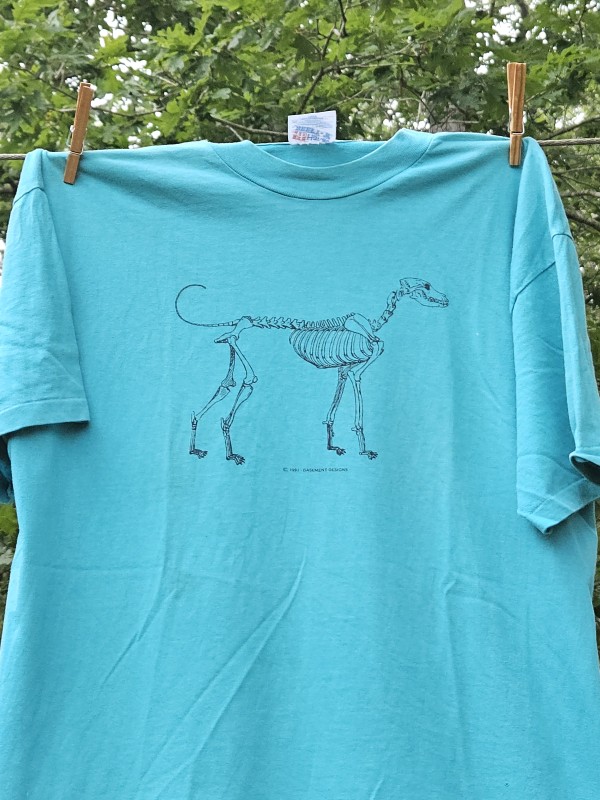
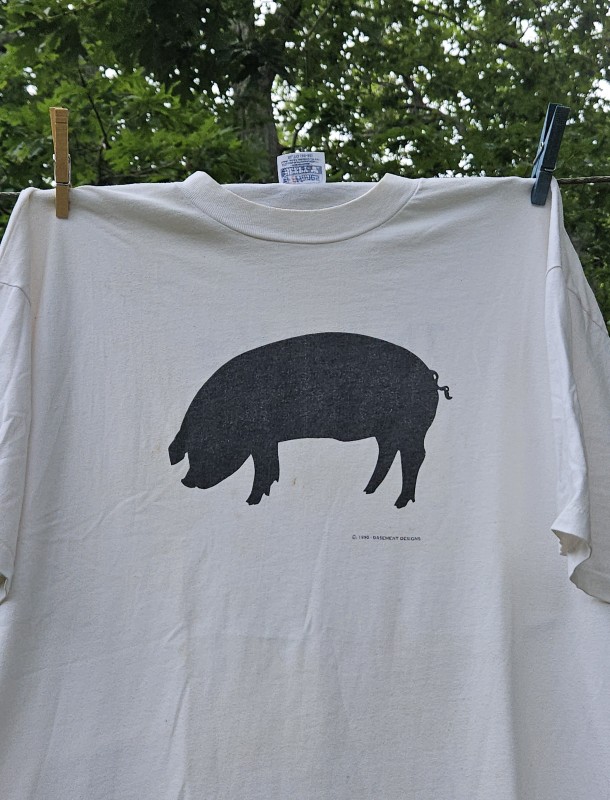
If you’ve ever spent time on Martha’s Vineyard, or know someone who has, you’ve almost certainly seen a Black Dog T-shirt. The Black Dog T is, in a word I’m coming to hate, iconic. I do not own one of those Black Dog T-shirts. I do own these parodies, the Black Hog and the Dead Dog, created by Vineyard artisan Peter Hall around 1990. And thereon hang several tales.

Around 1990, before the Black Dog Tavern turned into an empire but when its signature T-shirt was well on the way to becoming a terrible cliché, Peter Hall created a T with the black dog logo upside down. Threatened with legal action, Hall took the upside-down dog shirts off the market. One of the great regrets of my life is that I didn’t move fast enough to get one.

Above: the Dead Dog (2nd edition). Right: the Black Hog.

Shortly thereafter, Hall’s Basement Designs released two more shirts: the Black Hog and the Dead Dog. This time I moved fast enough to get one of each. The Black Dog sued for, among other offenses, trademark infringement, unfair competition, and unfair and deceptive trade practices. In a June 1993 decision, the U.S. District Court for Massachusetts pretty much supported Hall:

“For all of the foregoing reasons, this court finds that defendant’s use of his Black Hog and Dead Dog marks is a parody of plaintiff’s Black Dog marks having the intention and effect of amusing, rather than confusing, the public. Plaintiff’s claims of infringement, unfair competition, dilution and deceptive trade practices, therefore, are dismissed.”

You can read the whole decision here.

One of the delicious side effects of the brouhaha was that it came to light that in the mid or late 1970s the Black Dog owner had paid only $25 to the woman who designed the logo that was now helping the company make millions. I believe the artist got more money.

The backsides of the Dead Dog and the Black Hog. You’ll notice the similarity of the font to that used on the Black Dog shirts. The 1993 court ruling suggests that this is consistent with parody as long as there’s no intent to fool customers into thinking this is the real thing.

The owner, Robert S. Douglas, was not a struggling entrepreneur. When he died earlier this year, age 93, both Vineyard newspapers, the Vineyard Gazette and the Martha’s Vineyard Times, published extensive obituaries, but neither one mentioned his grandfather, James Henderson Douglas Sr., who was a founder of Quaker Oats.1 Robert Douglas’s influence on the Vineyard, especially Vineyard Haven and the maritime community, is a significant legacy, but it didn’t come out of nowhere either.

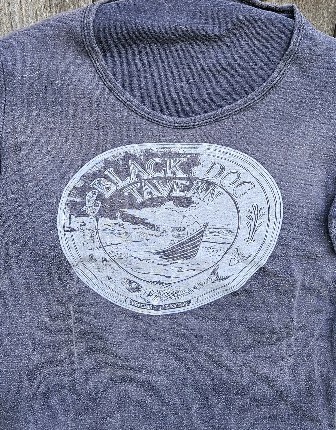
This is my one and only Black Dog shirt. I don’t know how I came by it, and there’s no indication of when it was made. It predates the iconic solo dog design. Early or mid 1980s? Late ’70s?

NOTE

  1. The Douglas Archive, a genealogical site based in the UK, has entries for Robert S. Douglas and his father, James Henderson Douglas Jr. The latter refers to James Sr. as a Quaker Oats co-founder, but he doesn’t seem to have his own entry. ↩︎