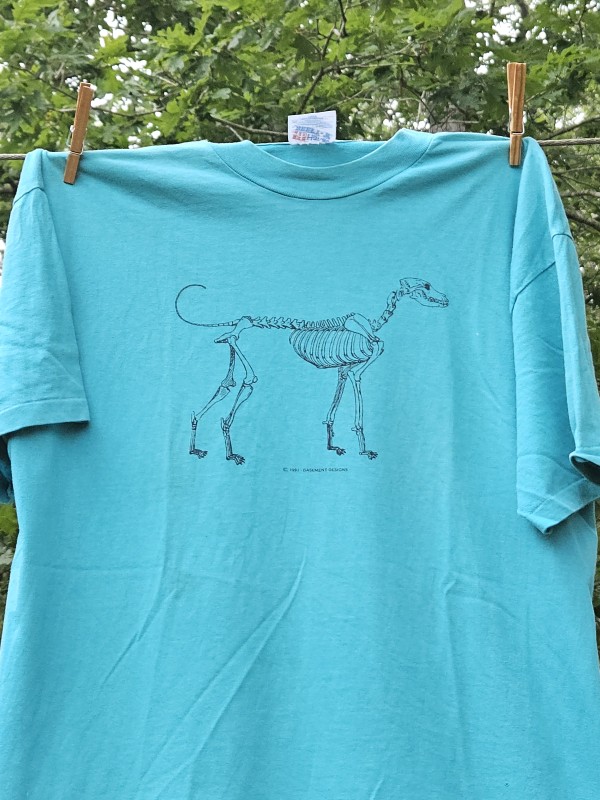
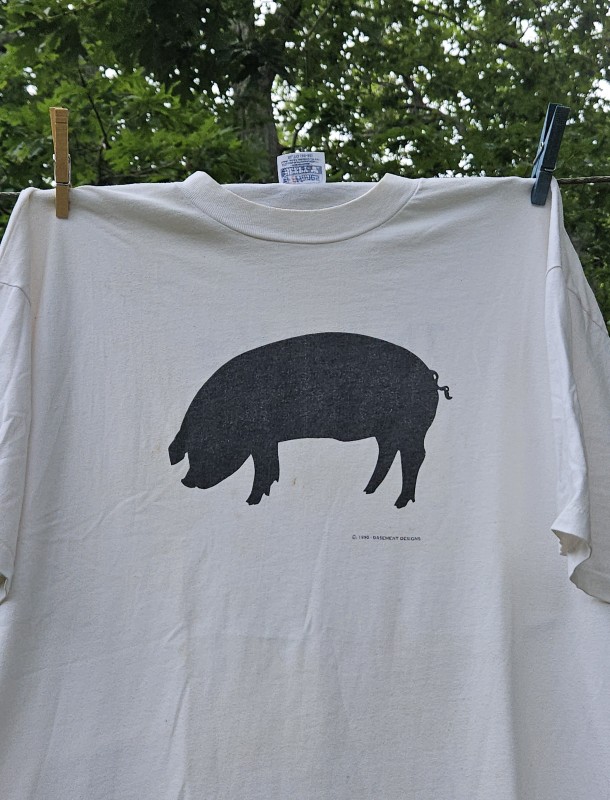
If you’ve ever spent time on Martha’s Vineyard, or know someone who has, you’ve almost certainly seen a Black Dog T-shirt. The Black Dog T is, in a word I’m coming to hate, iconic. I do not own one of those Black Dog T-shirts. I do own these parodies, the Black Hog and the Dead Dog, created by Vineyard artisan Peter Hall around 1990. And thereon hang several tales.
Around 1990, before the Black Dog Tavern turned into an empire but when its signature T-shirt was well on the way to becoming a terrible cliché, Peter Hall created a T with the black dog logo upside down. Threatened with legal action, Hall took the upside-down dog shirts off the market. One of the great regrets of my life is that I didn’t move fast enough to get one.
Above: the Dead Dog (2nd edition). Right: the Black Hog.
Shortly thereafter, Hall’s Basement Designs released two more shirts: the Black Hog and the Dead Dog. This time I moved fast enough to get one of each. The Black Dog sued for, among other offenses, trademark infringement, unfair competition, and unfair and deceptive trade practices. In a June 1993 decision, the U.S. District Court for Massachusetts pretty much supported Hall:
“For all of the foregoing reasons, this court finds that defendant’s use of his Black Hog and Dead Dog marks is a parody of plaintiff’s Black Dog marks having the intention and effect of amusing, rather than confusing, the public. Plaintiff’s claims of infringement, unfair competition, dilution and deceptive trade practices, therefore, are dismissed.”
One of the delicious side effects of the brouhaha was that it came to light that in the mid or late 1970s the Black Dog owner had paid only $25 to the woman who designed the logo that was now helping the company make millions. I believe the artist got more money.
The backsides of the Dead Dog and the Black Hog. You’ll notice the similarity of the font to that used on the Black Dog shirts. The 1993 court ruling suggests that this is consistent with parody as long as there’s no intent to fool customers into thinking this is the real thing.
The owner, Robert S. Douglas, was not a struggling entrepreneur. When he died earlier this year, age 93, both Vineyard newspapers, the Vineyard Gazette and the Martha’s Vineyard Times, published extensive obituaries, but neither one mentioned his grandfather, James Henderson Douglas Sr., who was a founder of Quaker Oats.1 Robert Douglas’s influence on the Vineyard, especially Vineyard Haven and the maritime community, is a significant legacy, but it didn’t come out of nowhere either.
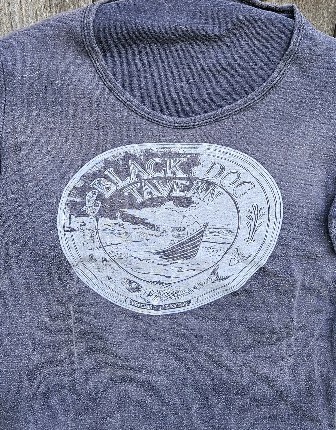
This is my one and only Black Dog shirt. I don’t know how I came by it, and there’s no indication of when it was made. It predates the iconic solo dog design. Early or mid 1980s? Late ’70s?
NOTE
The Douglas Archive, a genealogical site based in the UK, has entries for Robert S. Douglas and his father, James Henderson Douglas Jr. The latter refers to James Sr. as a Quaker Oats co-founder, but he doesn’t seem to have his own entry. ↩︎
I don’t remember how I found my first winter rental — Linda, my father’s former girlfriend, probably had something to do with it — but it couldn’t have been more perfect. It was a walk-up a stone’s throw from Five Corners, the heart of Vineyard Haven, and the main room’s picture window looked out on Vineyard Haven harbor. I could tell time by the arrival and departure of the ferries.
My apartment had no lock on the outside door so there were no keys. It didn’t lock from the inside either. This was so unimaginably different from my D.C. life that I wrote a sestina about it. You’ll find it at the end of this post.
My end of the little parking area was dominated by the busy Gannon & Benjamin Marine Railway next door. It was hard to park anywhere without blocking someone in. Since everyone’s keys were invariably in the ignition, getting unblocked usually didn’t take long.
The Beach Road end of the parking area belonged to the health food store next door (where the Martha’s Vineyard Times has been located since the fall of 1991 — much more about that later). The owner would place a flyer on the windshield of any vehicle that blocked one of his customers: offenders were threatened with being beaten with a carrot.
My apartment came with one parking space, at the foot of the semi-enclosed outside stairs. Parking space, you ask? What use had carless I for a parking space? Linda had a hand in that too. She lived in England during the off-season, so she gave me the use of her 1980 Subaru. All I had to do was take care of basic maintenance and let her grown kids, who all lived Stateside, use it when they were on the island. For someone who for years had gotten around by bike, bus, or subway or on foot, this was a windfall.
It was also a learning experience. The very first morning in my new digs, I came out to discover that one of my gift car’s tires was flat. I’d never changed a tire in my life. OK, I thought, the car can just sit there till Linda comes back in the spring.
Fortunately Courtesy Motors was then located right across the street. Owner Larry Conroy did not treat me like an idiot female, which is what I was feeling like. He lent me an air can, showed me how to use it, and, when I’d inflated the flat and driven round to the back of the shop, put the spare on. He’s been my mechanic ever since. Well, OK, his son Jesse is now running the shop, which relocated quite a few years ago to the outskirts of town.
I hadn’t realized how hard it would be to start from scratch in a new place. I’d saved enough to live on for a year if I was frugal, so I didn’t even have a job to organize my new life around. The only year-round Vineyarder I knew lived up-island and wasn’t especially social.
By the early 1990s, this very, very old Black Dog T had been supplanted by the ubiquitous, iconic Black Dog shirt (and sweatshirt and mug, etc.). I don’t have one of those, but I do have two parodies. They’ll be along later. This shirt claims to be a large. That’s a crock. I’m not sure I’ve ever been able to fit into it.
Being an early riser, I took to walking around the corner to the Black Dog Bakery each morning for coffee and a raisin bran muffin. After a few days or maybe weeks of this, a bakery worker would recognize me in line, bring me my usual, and take my money. Maybe I belonged here after all?
But what to do after I’d finished my coffee? Before I left D.C., I had started writing what I thought would be a novel about a woman, roughly my age but a graphic designer, who on impulse had moved from D.C. to Martha’s Vineyard to manage a small horse farm that belonged to a family friend. I planned to work on that, but writing 24/7 was not in the cards, and though I do pretty well with solitude, I am not a hermit.
Once I was actually living on the Vineyard, I realized I didn’t know half enough about the place to write a novel about it. What I wrote those first few years was mostly poetry, and book reviews and other nonfiction for feminist publications I already had a connection with: Sojourner, off our backs, Hot Wire, Feminist Bookstore News . . .
I went looking for connections to my D.C. life: singing, bookselling, and, of course, women. If I wanted to keep singing, it seemed I had to join a church choir. No way was I going to attend a church service every Sunday: I put singing on hold.
I struck out with bookselling too: Bunch of Grapes was interested, but only if I would sign on full-time — and they only paid $4/hour, which would go up to $4.25 after a trial period. At Lammas, a comparatively shoestring operation, I’d been making $5/hour, my health insurance was paid for, and the owner paid herself the same amount she paid me. This was clearly not the case at Bunch of Grapes. Eventually I was going to have to buy a car, and I couldn’t see that happening on $4.25 an hour.
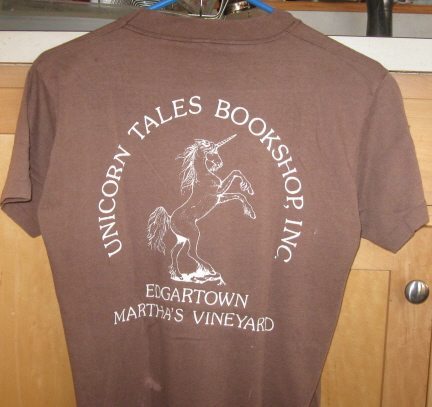
I like this shirt a lot even though I had no connection with the original shop. I am a longtime fantasy & science fiction nut, however, and this is one of only two brown T-shirts in my 200+ collection. Why is brown so rare?
Unicorn Tales, which had recently changed hands and would soon be renamed Bickerton & Ripley, never responded to my application, even though my résumé made it clear that I had serious bookselling experience. The new owners were a lesbian couple who may have thought they were in the closet (no one else did). Did they pass over my résumé because “feminist” and “lesbian” were all over it? Maybe they just mislaid it, or weren’t looking for help.
In my D.C. world, “feminist” and “lesbian” overlapped so often I thought they were practically synonymous. Martha’s Vineyard showed me that they weren’t. Women of all ages dressed casual, often in jeans and flannel shirts. To my urban eye, they looked like dykes — until I noticed the wedding rings. I made the connection: many of the lesbians I knew in D.C. and elsewhere, including me, had emigrated from small towns and rural areas because coming out in our hometowns was difficult if not dangerous. Maybe all the Vineyard dykes had left town.
In my wanderings I paid particular attention to bulletin boards, which is how almost everything from special events to Help Wanted got advertised. Here’s my recollection of how I made the connection that played a huge role in my decision to stay on the Vineyard, or at least my decision not to leave just yet. It rings true enough, but is it?
What I spotted was a small announcement that some women were organizing a program on women’s rights for a meeting of the M.V. League of Women Voters. The League was barely on my radar, voting wasn’t a priority, but women? That was a serious draw. I called the number and got roped into the planning of what turned out to be a panel discussion at Katharine Cornell Theatre (remember that name — it will come up again).
Of what we said or how it was received I have zero recollection, but it turned out that the core organizers were not only League members; they were also part of an informal women’s group that had been meeting regularly for some time. As far as they were concerned, the two of us “outsiders” who’d helped with the planning were now part of the group. They asked us to join them. Both of us did.
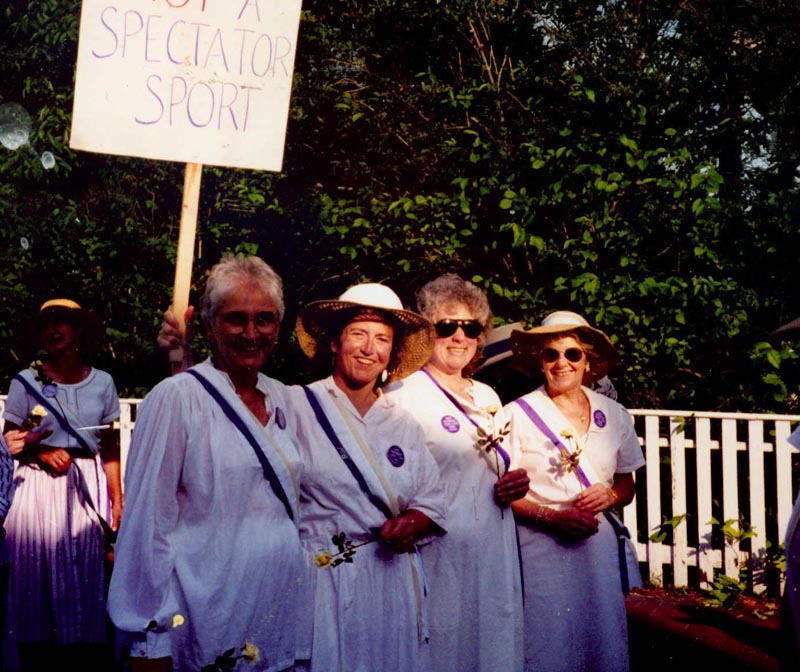
This is from 1995, but it includes several members of the women’s group that I became part of in (I think) 1986.1995 was the League of Women Voters’ 75th birthday year. We marched as part of the League contingent in the Fourth of July parade. From left: Carol Koury, me, Patty Blakesley, and Ann Hollister.
This, I came to realize, was what feminist organizing looked like on Martha’s Vineyard. All of the other women were straight, several were divorced, and the husbands of those who had them were generally in the background. For about ten years they were my Vineyard lifeline. Two of the group were full-time teachers, another was a therapist, yet another worked for one of the island towns. Year-round island life was far more complex than I’d realized as an occasional summer visitor.
The Key Sestina
My city apartment needed four keys, the mailbox a fifth. Two for each of two jobs, and a tenth for my bicycle chain. A fine rattle they made, a heavy weight in my pocket. There was one key whose lock I’d forgotten. I would not throw it out.
My island friend spends the whole day out, leaves her door open, needs only the keys to her car. My new apartment won’t lock from the inside; I still sleep well. Here too my ten-speed bike leans against the wall, wait- ing for me, sheltered from rain, but not chained.
It’s strange at first, leaving padlock and chain behind, stopping by my friend’s when she’s out to use her phone. I miss the clanking weight in my pack, the rattling of all those keys. Each of them meant commitment, access to home, store, office, women’s center, all locked
against the untrusted. I knew that locks won’t stop everybody. The severed chain remains; the bike is gone. In less than two months my house was robbed three times. We were out at work, we’d locked the doors, we had our keys; the burglar had none but he didn’t wait
for us. Perhaps it’s only custom’s weight that makes a barrier of a door that’s locked. When my mother drank, I’d hide her car keys, not knowing she had a duplicate chain. Once in a muted rage I put them out in plain sight. Did I want her dead? or to
end my responsibility? These two options nag twenty years later, their weight unsettled. I visit, after years out of New England, her house, whose door is locked always. My mother from her extra chain detaches and gives me a front door key.
Says the keeper’s jangling chain, “Just wait, I can split the world in two: danger locked out, comfort kept in — or vice versa.”


 The T-Shirt Chronicles