WisCon, the world’s first and probably only fantasy/science fiction convention that focuses on feminist speculative fiction, was born in 1977 in Madison, Wisconsin. Thanks to Joan Nestle at the Lesbian Herstory Archives, an avid f/sf fan, I learned about it and f/sf fandom, including feminist f/sf fandom, before too many years had passed; see “I Discover Women Writing F/SF” for details.
But it wasn’t till February 1990 that I attended my first WisCon, WisCon 14. I got there by a circuitous route, which looks something like this:
I could have sworn this T said “WISCON 14” on it but obviously it doesn’t. Hal Davis gave it to me @ WisCon 14. I’d never met Hal before, and I know all that stuff about not accepting gifts from strangers, but I’m glad I accepted this one. Hal and I are still in touch 34 years later, though my last WisCon was in 2006. That’s some kind of record.
In the late 1970s, having got wind of the wealth of fantasy and science fiction being written by women, I started haunting Moonstone Bookcellar, the f/sf bookstore on Connecticut Ave., near Washington Circle. After a skim through the pages, I’d buy almost anything with a woman’s name on the cover.
While several of us were prepping for my 30th birthday party, in June 1981, Mary Farmer, owner and manager of Lammas, D.C.’s feminist bookstore, asked me to sign on as Lammas’s book buyer. Once I got my bearings, surprise, surprise, I started building up the store’s f/sf collection.
In 1984, Carol Seajay, founder, editor, and publisher of Feminist Bookstore News, invited me to become FBN’s first columnist. “Susanna Sturgis on Science Fiction” debuted shortly thereafter. Big perk was that I could now get free review copies from publishers.1
Also in 1984, I attended the Feminist Women’s Writing Workshops for the first time. FW3 in those years was held at Wells College in tiny Aurora, N.Y., but was based in Ithaca, 30 miles away. I got to meet Irene “Zee” Zahava, proprietor of Smedley’s, Ithaca’s feminist bookstore, and Nancy Bereano, then the editor of Crossing Press’s great feminist series and about to establish her own trail-blazing Firebrand Books.
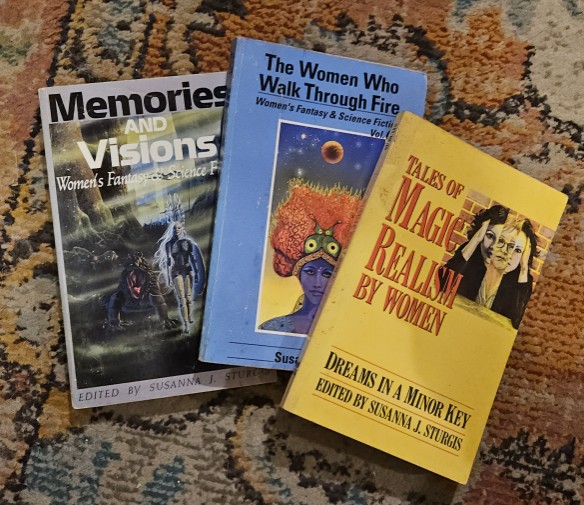
Zee was just starting to edit anthologies, often of women’s writing; by now she has edited a gazillion and branched out into offering writers’ workshops. Back then, however, she opened the way for me to edit three anthologies of women’s f/sf for Crossing: Memories and Visions (1989), The Women Who Walk Through Fire (1990), and Tales of Magic Realism by Women (Dreams in a Minor Key) (1991).
My three women’s f/sf anthologies
By the time Tales of Magic Realism came out, my relationship with Crossing had frayed so that was my last anthology. Personalities aside, the real underlying problem was the structural disconnect between feminist publishing and feminist f/sf readers. Feminist publishing and bookselling emphasized the trade paperback format; f/sf was overwhelmingly a mass-market world. Feminist f/sf fans could find their favorite women authors in f/sf bookstores. Only a handful of feminist booksellers knew f/sf well enough to build a feminist f/sf section, notably Karen Axness at Room of One’s Own in Madison and Paula Wallace at Full Circle in Albuquerque.
While at Lammas I had stocked a fine feminist f/sf section, which f/sf fans appreciated but was a hard sell to other fans of fiction by women. The widespread conviction that f/sf was only about spaceships and elves resisted all my attempts to unseat it.2 But my work at Lammas and especially my Feminist Bookstore News column did catch the attention of Crossing Press and others.
Among those who noticed my FBN column was the archivist/librarian for the Boston chapter of Daughters of Bilitis (DOB), who was also the East Coast half of fantasy writer J. F. Rivkin. In those days female protagonists had become more common in f/sf, but often they were the only woman in a team of men. If a novel had two significant female characters, they tended to be rivals, not allies. So J. F. Rivkin’s first novel, Silverglass (1986), was right up my alley: sword & sorcery featuring lesbian partners who had adventures together.
J. F. Rivkin/East was also well connected with the women writers in the New England f/sf scene, which is how I came to be included in a group signing at Glad Day, Boston’s gay bookstore, then located on Boylston Street near Copley Square. I’m pretty sure the year was 1990, after The Women Who Walk Through Fire came out that spring and after I had attended my first WisCon in February. There for the first time I met Ellen Kushner, Delia Sherman, Melissa Scott, Lisa A. Barnett, and “J.F./East” herself. Wow.
With WisCon and that momentous Glad Day signing, a whole world opened up, one I’d been only dimly aware of in my feminist bookselling days. Not only did it keep me busy for most of the 1990s, it greatly expanded my T-shirt collection, thanks in particular to the wonderful Ts created by Freddie Baer for the James Tiptree Jr. Award. The Tiptree, for speculative fiction that explores and expands our understanding of gender, was launched by authors Pat Murphy and Karen Joy Fowler at WisCon 15, my second WisCon, and I chaired the Tiptree jury in 1994. More about that later.
NOTES
I continued writing the f/sf column till 1996, 11 years after I left D.C., so the freebies continued to arrive. Since I was only interested in the ones by women, I’d take the rest down to Book Den East, which sold used and rare books, and sell them. Bookseller Cindy Meisner [1944–2023] told me these were snatched up by young male sf fans who loved getting brand-new books for cheap. ↩︎
Genre fiction per se was never the problem. Mysteries have been huge in the feminist press since they were introduced, and don’t get me started about lesbian romance. Lammas customers would tell me they found fantasy or science fiction too unbelievable then come to the check-out counter with a lesbian romance about a nice lesbian on vacation who falls in love with a slightly older woman who turns out to be independently wealthy and they live happily ever after. ↩︎
I don’t remember how I found my first winter rental — Linda, my father’s former girlfriend, probably had something to do with it — but it couldn’t have been more perfect. It was a walk-up a stone’s throw from Five Corners, the heart of Vineyard Haven, and the main room’s picture window looked out on Vineyard Haven harbor. I could tell time by the arrival and departure of the ferries.
My apartment had no lock on the outside door so there were no keys. It didn’t lock from the inside either. This was so unimaginably different from my D.C. life that I wrote a sestina about it. You’ll find it at the end of this post.
My end of the little parking area was dominated by the busy Gannon & Benjamin Marine Railway next door. It was hard to park anywhere without blocking someone in. Since everyone’s keys were invariably in the ignition, getting unblocked usually didn’t take long.
The Beach Road end of the parking area belonged to the health food store next door (where the Martha’s Vineyard Times has been located since the fall of 1991 — much more about that later). The owner would place a flyer on the windshield of any vehicle that blocked one of his customers: offenders were threatened with being beaten with a carrot.
My apartment came with one parking space, at the foot of the semi-enclosed outside stairs. Parking space, you ask? What use had carless I for a parking space? Linda had a hand in that too. She lived in England during the off-season, so she gave me the use of her 1980 Subaru. All I had to do was take care of basic maintenance and let her grown kids, who all lived Stateside, use it when they were on the island. For someone who for years had gotten around by bike, bus, or subway or on foot, this was a windfall.
It was also a learning experience. The very first morning in my new digs, I came out to discover that one of my gift car’s tires was flat. I’d never changed a tire in my life. OK, I thought, the car can just sit there till Linda comes back in the spring.
Fortunately Courtesy Motors was then located right across the street. Owner Larry Conroy did not treat me like an idiot female, which is what I was feeling like. He lent me an air can, showed me how to use it, and, when I’d inflated the flat and driven round to the back of the shop, put the spare on. He’s been my mechanic ever since. Well, OK, his son Jesse is now running the shop, which relocated quite a few years ago to the outskirts of town.
I hadn’t realized how hard it would be to start from scratch in a new place. I’d saved enough to live on for a year if I was frugal, so I didn’t even have a job to organize my new life around. The only year-round Vineyarder I knew lived up-island and wasn’t especially social.
By the early 1990s, this very, very old Black Dog T had been supplanted by the ubiquitous, iconic Black Dog shirt (and sweatshirt and mug, etc.). I don’t have one of those, but I do have two parodies. They’ll be along later. This shirt claims to be a large. That’s a crock. I’m not sure I’ve ever been able to fit into it.
Being an early riser, I took to walking around the corner to the Black Dog Bakery each morning for coffee and a raisin bran muffin. After a few days or maybe weeks of this, a bakery worker would recognize me in line, bring me my usual, and take my money. Maybe I belonged here after all?
But what to do after I’d finished my coffee? Before I left D.C., I had started writing what I thought would be a novel about a woman, roughly my age but a graphic designer, who on impulse had moved from D.C. to Martha’s Vineyard to manage a small horse farm that belonged to a family friend. I planned to work on that, but writing 24/7 was not in the cards, and though I do pretty well with solitude, I am not a hermit.
Once I was actually living on the Vineyard, I realized I didn’t know half enough about the place to write a novel about it. What I wrote those first few years was mostly poetry, and book reviews and other nonfiction for feminist publications I already had a connection with: Sojourner, off our backs, Hot Wire, Feminist Bookstore News . . .
I went looking for connections to my D.C. life: singing, bookselling, and, of course, women. If I wanted to keep singing, it seemed I had to join a church choir. No way was I going to attend a church service every Sunday: I put singing on hold.
I struck out with bookselling too: Bunch of Grapes was interested, but only if I would sign on full-time — and they only paid $4/hour, which would go up to $4.25 after a trial period. At Lammas, a comparatively shoestring operation, I’d been making $5/hour, my health insurance was paid for, and the owner paid herself the same amount she paid me. This was clearly not the case at Bunch of Grapes. Eventually I was going to have to buy a car, and I couldn’t see that happening on $4.25 an hour.
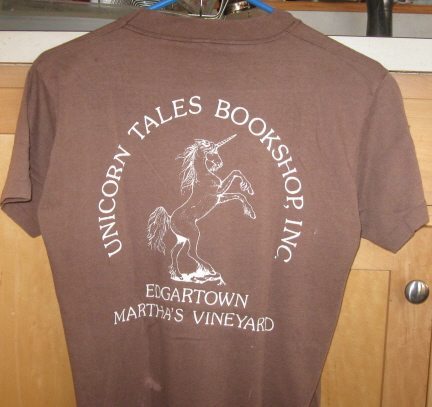
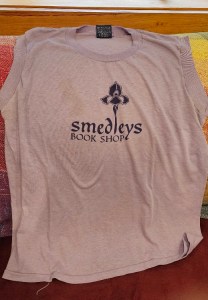
I like this shirt a lot even though I had no connection with the original shop. I am a longtime fantasy & science fiction nut, however, and this is one of only two brown T-shirts in my 200+ collection. Why is brown so rare?
Unicorn Tales, which had recently changed hands and would soon be renamed Bickerton & Ripley, never responded to my application, even though my résumé made it clear that I had serious bookselling experience. The new owners were a lesbian couple who may have thought they were in the closet (no one else did). Did they pass over my résumé because “feminist” and “lesbian” were all over it? Maybe they just mislaid it, or weren’t looking for help.
In my D.C. world, “feminist” and “lesbian” overlapped so often I thought they were practically synonymous. Martha’s Vineyard showed me that they weren’t. Women of all ages dressed casual, often in jeans and flannel shirts. To my urban eye, they looked like dykes — until I noticed the wedding rings. I made the connection: many of the lesbians I knew in D.C. and elsewhere, including me, had emigrated from small towns and rural areas because coming out in our hometowns was difficult if not dangerous. Maybe all the Vineyard dykes had left town.
In my wanderings I paid particular attention to bulletin boards, which is how almost everything from special events to Help Wanted got advertised. Here’s my recollection of how I made the connection that played a huge role in my decision to stay on the Vineyard, or at least my decision not to leave just yet. It rings true enough, but is it?
What I spotted was a small announcement that some women were organizing a program on women’s rights for a meeting of the M.V. League of Women Voters. The League was barely on my radar, voting wasn’t a priority, but women? That was a serious draw. I called the number and got roped into the planning of what turned out to be a panel discussion at Katharine Cornell Theatre (remember that name — it will come up again).
Of what we said or how it was received I have zero recollection, but it turned out that the core organizers were not only League members; they were also part of an informal women’s group that had been meeting regularly for some time. As far as they were concerned, the two of us “outsiders” who’d helped with the planning were now part of the group. They asked us to join them. Both of us did.
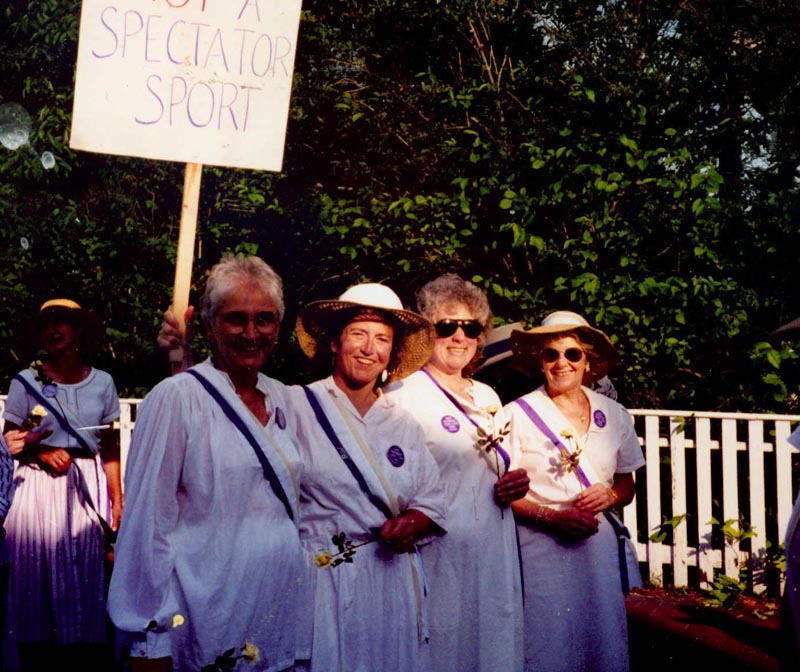
This is from 1995, but it includes several members of the women’s group that I became part of in (I think) 1986.1995 was the League of Women Voters’ 75th birthday year. We marched as part of the League contingent in the Fourth of July parade. From left: Carol Koury, me, Patty Blakesley, and Ann Hollister.
This, I came to realize, was what feminist organizing looked like on Martha’s Vineyard. All of the other women were straight, several were divorced, and the husbands of those who had them were generally in the background. For about ten years they were my Vineyard lifeline. Two of the group were full-time teachers, another was a therapist, yet another worked for one of the island towns. Year-round island life was far more complex than I’d realized as an occasional summer visitor.
The Key Sestina
My city apartment needed four keys, the mailbox a fifth. Two for each of two jobs, and a tenth for my bicycle chain. A fine rattle they made, a heavy weight in my pocket. There was one key whose lock I’d forgotten. I would not throw it out.
My island friend spends the whole day out, leaves her door open, needs only the keys to her car. My new apartment won’t lock from the inside; I still sleep well. Here too my ten-speed bike leans against the wall, wait- ing for me, sheltered from rain, but not chained.
It’s strange at first, leaving padlock and chain behind, stopping by my friend’s when she’s out to use her phone. I miss the clanking weight in my pack, the rattling of all those keys. Each of them meant commitment, access to home, store, office, women’s center, all locked
against the untrusted. I knew that locks won’t stop everybody. The severed chain remains; the bike is gone. In less than two months my house was robbed three times. We were out at work, we’d locked the doors, we had our keys; the burglar had none but he didn’t wait
for us. Perhaps it’s only custom’s weight that makes a barrier of a door that’s locked. When my mother drank, I’d hide her car keys, not knowing she had a duplicate chain. Once in a muted rage I put them out in plain sight. Did I want her dead? or to
end my responsibility? These two options nag twenty years later, their weight unsettled. I visit, after years out of New England, her house, whose door is locked always. My mother from her extra chain detaches and gives me a front door key.
Says the keeper’s jangling chain, “Just wait, I can split the world in two: danger locked out, comfort kept in — or vice versa.”
I’d been writing for publication for several years before I decided that I needed something more. I was well enough educated, but as a writer I was largely self-taught. I belonged to Hallowmas Women Writers, a group of D.C. poets and writers that I’d helped form. It was a lifeline to my writer self, its members were doing interesting work, but all of us were engaged in other activities and I was discontented with the feedback I was giving as well as getting. As a fledgling editor, I’d benefited tremendously from working alongside someone who knew a lot more than I did and was willing to share. Were there comparable opportunities out there for women writers?
off our backs carried ads for the Feminist Women’s Writing Workshops (FW3), a 10-day live-in workshop held every summer in upstate New York. Founder-director Beverly Tanenhaus’s book about the workshops, To Know Each Other and Be Known (Motheroot Publications), came out in 1982. Lammas must have carried it, I must have noticed it, but I don’t think I’d actually read it. My copy has “July 1986” written under my name on the title page, which suggests I acquired it at the workshop that year.
I sent for the workshop brochure on February 5, 1984. Tuition, room, and board was $475, $425 if you applied by March 15. Could I afford it? Could I get 10 days off from Lammas in the middle of July? Where the hell was Ithaca, and how would I get there? I didn’t own a car, and my grasp of upstate New York geography was hazy.
Scariest of all, was I really ready? I didn’t know anyone who’d attended the workshop and could assure me that I wouldn’t be in over my head. The biggest risks I’d taken, like moving back to D.C., applying for that editorial job at the Red Cross, and becoming the book buyer at Lammas, had all turned out well. What if this one didn’t?
I sent in my deposit in time to get the early bird discount. My welcome letter from the director was dated March 16. The stars aligned, the logistics worked out, and I arrived by bus in Ithaca on July 15.
To say that the workshop was life-changing is both a cliché and an understatement. Our introductory session that first night opened with a recording from the first FW3 in 1975, of Adrienne Rich’s prose poem “Women and Honor: Some Notes on Lying.” This was already, and has been ever since, the closest thing I have to a bible. It’s about the importance of telling the truth to each other (and, by extension, to ourselves). What better way to challenge us as writers?
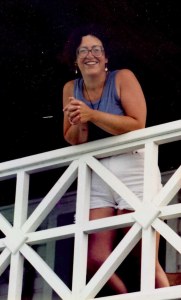
Me on the boathouse balcony just outside our meeting room. Probably 1987.
Our morning class sessions were held in the second floor of the Wells College boathouse, with Cayuga Lake glittering out the window and lapping gently at the shoreline. Each morning, an hour was devoted to the work of each of two participants. Copies had been distributed the previous day, and all of us came prepared. The guidelines: Comments were to be directed to the director, or to each other — not to the writer. The writer’s job was to listen until everyone had spoken, then respond at the end of the discussion. The power of 18 women focusing entirely on my work, taking it seriously for a solid, animated hour, was a revelation. So was the challenge of being one of the 18 women giving feedback to another writer, overriding the voices in my head whispering things like What if I’m wrong? What if I’m missing something? What if this isn’t all that important?
The rest of the day was open. Most of us gathered for meals in the cafeteria — the luxury of not having to prepare our own meals wasn’t lost on any of us — but the rest of the time we went our own occasionally intersecting ways in ones, twos, and threes, walking in the woods, swimming in the lake, writing in our rooms, sitting under a tree or by the lake to write or read.
During the week groups of us took field trips to the National Women’s Rights Historical Park at Seneca Falls, which had opened only two years before, and the National Women’s Hall of Fame, or into Ithaca, to hang out at Smedley’s, the feminist bookstore (proprietor Irene Zahava had been a workshop participant in the past and has edited many, many anthologies of women’s writing over the years), and of course to eat at least once at Moosewood Restaurant.
Poet-novelist Marge Piercy was the guest writer that year, in residence for a couple of days. We also heard from Elaine Gill, co-principal of Crossing Press, then located in nearby Trumansburg, and Nancy Bereano, who had edited Crossing’s Feminist Series and was just then establishing her own Firebrand Books, which quickly became a major player in the feminist print world.
As the re-entry meeting began on the last night of the workshop, I was feeling sad and euphoric, hopeful and apprehensive all at once. We had created magic; would I ever see these women again? As a writer I felt validated and capable; could I maintain my momentum when I got back to D.C.? We went round the circle, each woman sharing what she was going back to and what she was taking home with her. All of us had taken to heart the words of Adrienne Rich at our very first meeting: “When a woman tells the truth she is creating the possibility for more truth around her.”
Almost all of us, as it turned out. About two-thirds of the way around the circle, the workshop blew up. There were four lesbians at the workshop that year, of whom I was one. At the re-entry meeting, the other three charged the rest of us with making them feel unwelcome. They didn’t target me specifically — they didn’t target anyone, and were rather short on specific examples — but I was undeniably on the wrong side of a lesbian-straight split.
After the instigators left the room, most of the rest of us came together to talk about what had happened. We shared our immediate reactions. Most of us tried to identify what we had done to make the three women feel unwelcome. As the only lesbian in the circle at that point, I said I hadn’t felt unwelcome at all. I was a little surprised by this, because I was no stranger to the tensions that sometimes arose between lesbians and straight women in feminist spaces.
The D.C. lesbian feminist community and the national Women in Print network had become my home in a way that my growing-up home wasn’t. They were where and how and why I became a writer: developing my skills, giving me no end of things to observe and think and write about, seeing my words in print, and providing an audience (which I was also part of). So though I did spend time with the other lesbians at the workshop, hanging out with them wasn’t a priority. Connecting with sister writers was. Being taken seriously as a writer was.
Our shared effort that night to come to grips with what had just happened, speaking first-person and from the heart, was rare in my experience — so rare that in the months that followed I wrote a 6,000-word essay (never published) about the workshop experience. I still have the copy I shared with another workshop participant, with her extensive and thoughtful comments on it: she agreed with some of my points, challenged others (sometimes strenuously), and expanded my perceptions of what had happened.
I was willing then, and I’m willing now, to believe that the other three lesbians had experienced lesbophobia at the workshop, even though I had not. My problem then and now was with how they chose to bring it up, starting with the timing. The second-to-last night of the workshop had been devoted to a “creative bitching” session. We talked about what worked at the workshop and what could be improved in the future. Rather than bring their issues up then, the three chose to bring up their complaints at the re-entry session, our last time together as a group. Everyone would be leaving the next day. The three timed their confrontation so they wouldn’t have to deal with its consequences, or even see any of us face-to-face again. Then they walked away from the possibility of expanding truth to include all of us.
In an article about FW3 1986 for Hot Wire, the women’s music and culture journal, I wrote: “Perhaps the hardest lesson to learn is that inclusion in community here depends largely on a willingness to risk telling and hearing the truth — a willingness that is, not coincidentally, essential for feminist writing” (Hot Wire, March 1987).
I learned later that the main instigator of the confrontation had lobbied for a position as an assistant workshop director for the following year and been turned down. Was revenge at least part of her motive? I suspect so. As it turned out, the director asked me to be one of her assistants the next year, which enabled me to attend the workshop free of charge. Of course I accepted, and continued as an assistant through 1987. By the summer of 1988 I’d been hired as proofreader at the Martha’s Vineyard Times so taking 10 days off in the middle of July was out of the question.
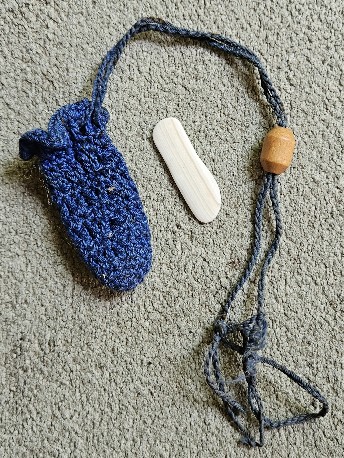
I still have that amulet bag, but my amulet has long since lost its purple. Tina M., if you read this, I remember you!
Before I left for my annual end-of-summer visit to the Vineyard in 1984, my first workshop year, a crafty (in more ways than one) member of Hallowmas Women Writers gave me an amulet bag she’d crocheted for me. For a while I wore that amulet bag around my neck with nothing in it. Then while I was walking on South Beach one afternoon an oblong bit of white-and-purple clam shell caught my eye. Into the amulet bag it went. When I returned to D.C., I wore it everywhere.
For a long time I liked to attribute my decision to move to Martha’s Vineyard to that amulet. There was, need I say, more to it. For years the lesbian feminist community and my writing had fed each other, confirmed each other, formed a dynamic whole. In the early ’80s fissures were growing just below the surface. In the early to mid 1980s AIDS, a barely identified syndrome with a dismal prognosis, was devastating the gay male community. Meanwhile, the lesbian community was polarizing around the so-called sex wars. The front lines included pornography and s/m, which one side saw as irredeemably misogynist and the other as liberating. Women I knew and admired were on both sides; the accusations were ugly and loud. As a writer I felt caught in a middle that was critical of both factions and wasn’t being heard. Did that middle even exist?
My experience at the 1984 Feminist Women’s Writing Workshop helped clarify and focus my uneasiness. If the community of lesbians and the community of writers diverged, my path would lie with the writers.
Looking back later, I realized that my urge to “get out of Dodge” had plenty to do with the Reagan administration, which altered the feel of D.C. whether you had any connection to the federal government or not. In July 1985, I left D.C. with all my belongings in a rental truck, deposited them in the basement of my parents’ home in the Boston suburbs, returned to the Feminist Women’s Writing Workshops for my first year as an assistant director, and by the end of the month was more or less living on Martha’s Vineyard.
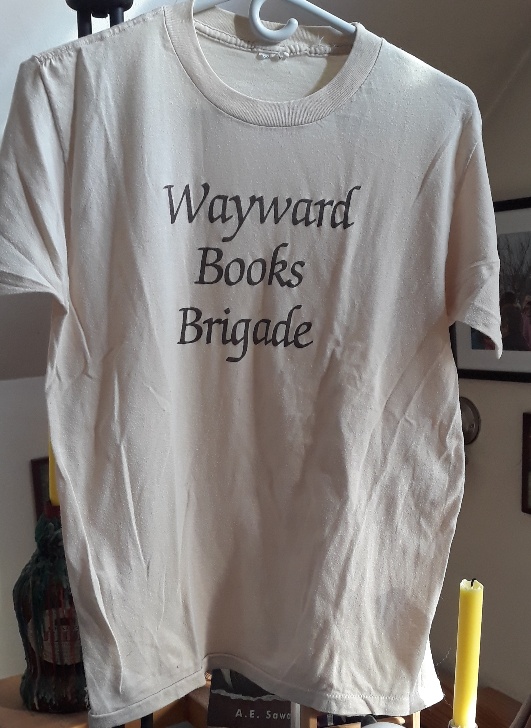
When bookstores move, staffers usually pack the books in boxes, load the boxes in a truck, and drive the truck to the new location. When Wayward Books moved, owners Sybil Pike and Doris Grumbach packed the books in grocery bags and volunteers passed them hand to hand along Pennsylvania Avenue SE to the new shop at 325 7th Street., which was practically next door to Lammas. I was one of the volunteers, and that’s how I got this T-shirt.
True, the distance was only three or four city blocks, and as I recall the brigade didn’t quite stretch the whole distance, so cars were called upon to ferry the books across the gap. But the operation was ingenious and fun, and it worked.
Wayward Books dealt in a carefully curated mix of secondhand and rare works, which meant those books had already been around. They probably took their latest move in stride.
Lammas was well represented in the Wayward Books Brigade, and not only because Wayward Books was moving into the immediate neighborhood. Pike and Grumbach had been a couple since the early 1970s, and Grumbach’s novels were regular sellers at Lammas, notably Chamber Music and The Ladies, which was based on the “Ladies of Llangollen,” two 18th-century Irish women who eloped to Wales, set up housekeeping as a married couple, and whose home became a go-to destination for literary luminaries of the time. Grumbach’s books focused on women’s lives, and often women in relationship with each other, which was not all that common at the time, especially for “mainstream” novelists.
Sybil, a retired research librarian at the Library of Congress, was the on-site manager at Wayward Books — I remember her as a strikingly handsome woman who would have been in her mid-fifties at the time — but Doris was also around when she wasn’t teaching or writing. The two shops complemented each other nicely: their inventories didn’t overlap, but their customers did.
A Washington Post story from April 1990, reporting on Wayward Books’ relocation to Sargentville, Maine, that month, notes that the Wayward Books Brigade comprised 70 volunteers and moved some 3,000 volumes from old location to new. The move to Maine involved three times that many books and was presumably not accomplished hand to hand.
The Post story also says the hand-to-hand move to 7th Street happened in 1985. I would have said a year earlier, because I left D.C. at the end of July 1985 and it seemed Wayward Books and Lammas had been neighbors for more than a few months at that point. But memory is tricky, so maybe not.
I just learned that Sybil passed in March of last year, at the age of 91, but that Doris seems to be alive in her 104th year. It sounds as though, around 2009, they moved together to a retirement community in Pennsylvania, where Sybil died and Doris still lives. Anyone with more information, please respond in the comments. If you don’t want your comment published, say so and it won’t be.
This T-shirt has nothing to do with Wayward Books — except that they both have to do with books, and that Women’s Glib was somewhat wayward in that it had to do with feminist humor, which many continue to swear is an oxymoron. Not for the first or last time, those “many” are so wrong.
Women’s Glib and Women’s Glibber, anthologies edited by Roz Warren, both came out in my bookselling days — I think. Amazon.com gives the early ’90s as pub dates for both books but notes in one case that it’s a second edition. I’m pretty sure I didn’t have anything in either book, although I was the class clown (female) in sixth grade and have been credited with having a pretty good, albeit barbed, sense of humor in all the decades since.
Interestingly enough (to me, at least), this is one of the very few — maybe even only? — Ts I have that features a book. I’ll hedge my bets on that one till I’ve excavated my whole collection. Either few books were featured on Ts or I wasn’t buying (or being given) the ones that were.
My humor tends to be in the moment — I think the word is “situational,” meaning that it arises from circumstances. I’ve never been fond of the other kind, such as stand-up, mainly because stand-up comedy back in the day was so misogynist, even when performed by one of the few women in the trade. Phyllis Diller embarrassed and infuriated me. I could admire Lucille Ball and I Love Lucy while being mortified by her tactics.
As a teenager and young adult I was a huge fan of the Smothers Brothers and Rowan and Martin’s Laugh-In. By the time Saturday Night Live got going, in the mid to late 1970s, I was doing fine without a TV and besides, SNL didn’t seem all that in sync with the lesbian-feminist life I was living.
Humor that was in sync with my life — I loved it. Alison Bechdel’s Dykes to Watch Out For strip and the books compiled from it were huge hits with Lammas customers. So were Nicole Hollander’s Sylvia books. They kept us laughing, and they kept us sane.
The first stand-up comedian who made me sit up, take notice, and even buy at least one of her albums was Kate Clinton. I heard her perform live in the early ’80s. What a revelation! The problem with stand-up comedy wasn’t me, it was the sexist, heterosexist comedy itself!
I’m thrilled to report that Roz Warren and Kate Clinton are still “making light,” as an early Clinton album had it, and you’ve almost certainly heard of Alison Bechdel, if not of Dykes to Watch Out For. I’m not sure if Nicole Hollander is still creating, but it’s not hard to find Sylvia online.
Sylvia — that Sylvia — was one of the namesakes of the TRS-80 that was Lammas’s and my first computer. The other two, as I think I mentioned before, were Sylvia Sherman, my high school history teacher, and Sylvia Abrams, my editorial mentor, without whom I would have had a hard time making a living these last four decades.
Like all feminist bookstores, Lammas was a hub for the feminist and lesbian communities of the D.C. area, but because D.C. itself is a hub for the nation and the world, women from all over sought out Lammas when they were in town for conferences, school trips, vacation, you name it.
The librarians were my favorite. They’d come in from all around the Mid-Atlantic region and beyond, especially from small cities, towns, and rural areas with no feminist bookstore in reach. They’d nearly always have shopping lists, gleaned from feminist publications and word of mouth, and often dropped two or three hundred bucks in a visit.
Where did my T from the 14th Women and the Law conference come from? I didn’t attend, though it was indeed in D.C. An attendee might have given it to me, or it might have been left behind at the shop. I like the design: it illustrates how effective black & white can be.
Was the conference still being held? A Google search turned up several conferences with similar names, but none of them dated back this far. off our backs devoted about half of its May 1983 issue (vol. 13, no. 5) to the 14th conference; you can view it online at JSTOR, but you’ll need a JSTOR subscription to download it.
Searching on the full conference name, in quotes — “National Conference on Women and the Law” — yielded paydirt: a 1994 article by Elizabeth M. Schneider: “Feminist Lawmaking and Historical Consciousness: Bringing the Past into the Future.” (Published in the Virginia Journal of Social Policy & the Law, vol. 2, no. 1, it’s now available as a free PDF download, but the godawful URL is four lines long. Go to BrooklynWorks, “open-access scholarship from Brooklyn Law School,” and you can search for it there.) It’s worth the trip. Schneider writes that the conference, which was held from 1970 through 1992, “played a crucial role in shaping feminist legal history over the last twenty-five years.”
Lammas occasionally went on the road as well, and that’s how I came by “Sisterhood Is Blooming / Spring Will Never Be the Same”: selling books at a women’s conference at West Virginia University in (I’m guessing here) 1983 or 1984. The keynote speaker was Maya Angelou, and my main visual memory of the conference was of being near the back of a vast, packed gymnasium with Angelou onstage at the other end.
I’ve never been comfortable in crowds of mostly strangers, but I did fine when I had a role to play, and it didn’t get much better than selling feminist books and records to women who didn’t have ready access to either except by mail-order. Lammas owner-manager Mary Farmer was far more gregarious than I ever was. As a Ladyslipper distributor, she was often on the road in her big red Olds, visiting record stores or selling records at women’s music concerts. I was just as happy holding the fort at home.
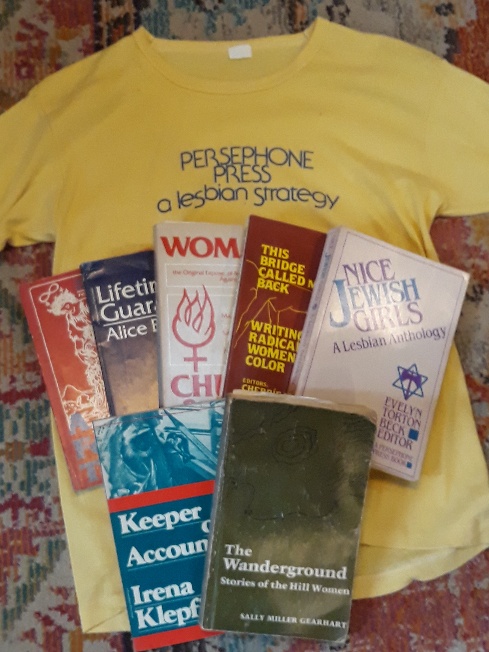
Persephone Press died in May 1983. Social media was decades in the future, but word spread through the feminist print network almost that fast. I still remember standing stock-still when I heard the news, unable to take it in. I was at Lammas, surrounded by the Persephone books that I sold every day, crucial, path-breaking books in the feminist and lesbian world. Lesbian Fiction, Lesbian Poetry, Nice Jewish Girls, This Bridge Called My Back, The Coming Out Stories, The Wanderground . . . Gone? Just like that?
The Persephone Press titles that are on my shelves today.
Well, no, not quite. By then I was well aware of the economic tightrope that a small, undercapitalized bookstore had to walk day in, day out, to keep books on the shelves. I had some idea of the similar constraints that publishers operated under, but somehow I’d assumed that Persephone was exempt. No matter how well you know the technical details, magical thinking has a way of working its way into mind and heart when you need to believe.[1]
I couldn’t imagine a world in which Persephone didn’t exist, but the unimaginable had happened. Persephone was gone.
Persephone Press was brilliant. It didn’t invent the anthology format, but it recognized how perfectly suited it was to feminist publishing at that particular time. So many women were moved — inspired, compelled, driven — to write because so little of what was out there reflected our lives or answered our questions. We wrote what we wanted and needed to read.
But most of us had to work our writing time in around our jobs, our political and other volunteer activities, and our family responsibilities. Sometimes we were learning our craft almost from scratch, which meant struggling to overcome everything we’d learned along the way about what good writing was and who was entitled to write. It helped to find sisters on the same journey so we could assure each other that we weren’t crazy, we could do it, and what we had to say was important.
Novels and other book-length works can be written under such conditions, but shorter ones are easier not only to finish but to get out into the world in print and/or in performance. Not surprisingly, the most accomplished writing emerging from the grassroots feminist movement from the late 1960s into the ’80s consisted of poetry, short stories and essays, and novels, more or less in that order.
Unfortunately, that was pretty much the opposite of what most readers wanted to buy, and bookstores specialized in, well, books. We carried newspapers and journals, of course, and they published short-form writing of all sorts, but they also had a short shelf life. Anthologies combined the best of both forms. They brought together important new, recent, and sometimes not-so-recent writing that was otherwise scattered across time and multiple journals of limited circulation. They could combine poems, stories, and essays between the same two covers. They took longer to produce, but they stuck around a lot longer. In addition, the works collected into a well-edited anthology communicate with each other simply because they’re in the same place at the same time. The whole, in other words, is even greater than the sum of its parts.[2]
Persephone’s anthologies had no precedents. At the time, most of their contributors were known, if they had published at all, only in limited circles, but many of them went on to become widely known and read far beyond the feminist print world. After the crash, most Persephone titles were picked up by other publishers and remained in print for years if not decades. The fourth edition of This Bridge Called My Back: Writings by Radical Women of Color — “a work which by the mere fact of its existence changed the face of feminism in the United States”[3] — was brought out in 2015 by SUNY Press.
Now I look at the numbers — four titles published in 1980, and four in 1981 — and wonder What were they thinking? Most of these were physically big books. Several were going to take a while to reach their audience, like the reprint of Matilda Joslyn Gage’s amazing Woman, Church & State (1893). Anything with “lesbian” in the title and the lesbian romance Choices were going to sell well in the feminist, lesbian, and gay worlds, but those worlds were were not large.
Not to mention — for an undercapitalized publishing company “selling well” could turn into a curse. Invoices were supposed to be paid in 30 days, but undercapitalized bookstores were often doing well to pay in 60. The printing bills, in other words, were going to come due long before they could be paid out of cash flow.
And they did.
What were they thinking?
The recriminations that followed Persephone’s demise were so widespread and so bitter that Persephone’s existence seems to have been erased except for those who know where to look. I wasn’t privy to any of the dealings between press and authors, and I’m not going to repeat what I heard second, third, and fourth hand, but a short article that appeared in the November 1983 off our backs provides some insight. Three significant points:
“Because their books were selling well, they were constantly back on the press. This tied up $40,000 to $50,000 in printing and production costs, which added to the cost of overhead, and bringing out new titles was more than Persephone could handle.”
Cofounders Pat McGloin and Gloria Greenfield “[decided] to consistently operate their press according to feminist ideals. They paid royalties to their authors twice the standard paid by the publishing industry, and refused to allocate a lion’s share of their promotions budget to one best seller and and distribute what was left to the other books.”
Greenfield and McGloin expressed disappointment with the lack of support from the feminist community.[4]
Short version: Persephone’s business plan played fast and loose with real-world economic realities, and the “feminist community” didn’t step up to close the gap. In addition, the scheduled books that never got published, like Barbara Smith’s Home Girls: A Black Feminist Anthology, and the published books that didn’t get adequately supported, like Audre Lorde’s Zami: A New Spelling of My Name, were by women of color, whose publishing options at the time were the most limited.[5]
Plenty of anger was directed at Pat and Gloria, and Pat and Gloria seem to have directed at least some of theirs at “the feminist community,” but I suspect that deep down much of rage and frustration was directed at the economic system that thwarted our needs and our expectations as women, as feminists, as lesbians. Persephone’s 15-book list made it so clear what we were capable of, had given us so much to hope for, and capitalist economics, coupled with lack of organizational and individual support, had cut us off at the knees.[6]
Gazing now at my Persephone Press T-shirt, I’m tempted to take “A Lesbian Strategy” as a cruel, unintentional joke. Had our strategy, if that’s what it was, come to a dead end? Then I remember all the writers and works that Persephone encouraged, and the effects they’ve had on the world we live in now. Most of those whose lives have been enriched by Persephone’s legacy probably don’t know her name, and for those who do the legacy is tinged with understandable bitterness and regret.
After Persephone died, I tried to write a eulogy. It was a poem, three or four pages long; I wasn’t satisfied with it, and I’ve long since lost track of the whole thing, but I liked part of it so much I put it on a postcard:
She comes back indeed.
notes
[1] The dangers of magical thinking carried to extremes were laid out brilliantly by James Tiptree Jr. (Alice Sheldon) in her 1976 story “Your Faces, O My Sisters! Your Faces Filled of Light!” Its protagonist believes she’s living in a city where misogyny doesn’t exist and it’s safe to be on the road at night. Spoiler alert: it’s not.
[2] Here are some of the anthologies on my shelves that were published in the 1980s, almost all by feminist presses. To keep it relatively brief, I haven’t included strictly fiction anthos.
For Lesbians Only: A Separatist Anthology, ed. Sarah Lucia Hoagland and Julia Penelope, Onlywomen Press, 1988
Out from Under: Sober Dykes & Our Friends, ed. Jean Swallow, Spinsters, Ink, 1983
Sex Work: Writings by Women in the Sex Industry, ed. Frédérique Delacoste and Priscilla Alexander, Cleis Press, 1987
Shadow on a Tightrope: Writings by Women on Fat Oppression, ed. Lisa Schoenfielder and Barb Wieser, Aunt Lute Books, 1983
That’s What She Said: Contemporary Poetry and Fiction by Native American Women, ed. Rayna Green, Indiana University Press, 1984
The Tribe of Dina: A Jewish Women’s Anthology, ed. Melanie Kaye/Kantrowitz and Irena Klepfisz, Sinister Wisdom 29/30, 1986
With the Power of Each Breath: A Disabled Women’s Anthology, ed. Susan E. Browne, Debra Connors, and Nanci Stern, Cleis Press, 1985
Women-Identifed Women, ed. Trudy Darty and Sandee Potter, Mayfield, 1984.
[3]Feminist Collections, vol. 5, no. 1 (fall 1983).This is one of the best contemporary Persephone post-mortems I’ve found yet. Feminist Collections was an indispensable quarterly review of women’s studies resources out of the University of Wisconsin, then edited by Susan Searing and Catherine Loeb. In 2018 it morphed into Resources for Gender and Women’s Studies: A Feminist Review.
[4] Mary Kay Lefevour, “Persephone Press Folds,” off our backs (November 1983), p. 17.
[5] I read Zami as soon as it came out, but my original copy went wandering. I almost certainly brought it with me to Martha’s Vineyard, but probably I lent it to someone and — well, it went wandering. The copy I have now was reprinted by Crossing Press after it was acquired by Ten Speed Press in 2002. The cover is new, but “Text design by Pat McGloin” on the copyright page clearly indicates that the text itself is from the first edition. There’s no indication anywhere that Audre Lorde died in 1992. At least one edition has appeared since with a different cover, but it too seems to use the text from the first edition. I just found this excellent 2014 assessment of Audre Lorde’s importance — and who kept her words alive till the wider world was ready to “discover” her. The author is Nancy K. Bereano, editor of Crossing Press’s Feminist Series until she left to found Firebrand Books. Several publishers continued the work of Persephone Press, but if I had to single out two of them, they’d be Firebrand and Kitchen Table: Women of Color Press.
[6] See note 1.
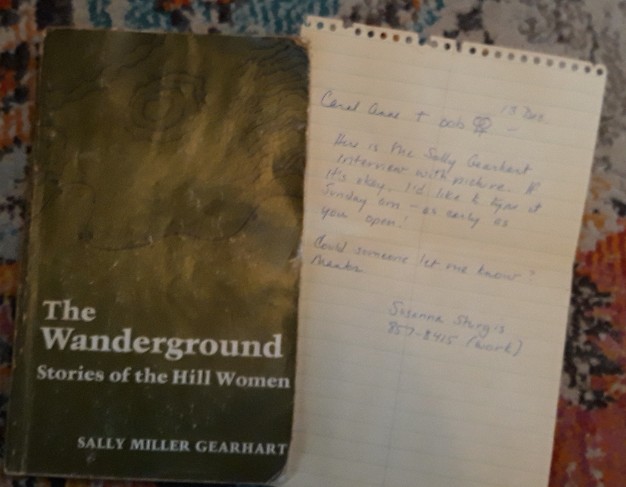
This note was tucked into my well-worn copy of The Wanderground. Dated 13 Dec. [1979], it’s addressed to Carol Anne [Douglas] and off our backs women: “Here is the Sally Gearhart interview with photo. If it’s okay, I’d like to type it Sunday a.m. – as early as you open! Could someone let me know? Thanks.” My interview with Sally appears in the January 1980 off our backs.
Two of the best jobs I’ve ever had fell into my lap.[1] I wouldn’t have had the nerve to apply for either of them. Conventional wisdom for decades has held that women apply for jobs we’re sure we can do, while men apply for jobs they think they can learn to do. I fit the female stereotype, but my caution wasn’t just due to my sex. The message I internalized over the years from watching my perfectionist father ridicule my mother for getting her facts wrong was that it wasn’t safe to not have the right answer. It’s pretty much impossible to venture into new territory without making mistakes and asking questions that reveal that you don’t know everything. In addition, plenty of people were likely to write me off on the basis of my physical appearance, so I had to be hyper-qualified before I even thought of applying for anything.
In the spring of 1981, I quit my first editorial job (see “1979: I Become an Editor” for how I got that job and why I left) intending to take some time to focus on my writing. That’s not the way it worked out. About a month later, Mary Farmer, owner-manager of Lammas Bookstore, asked me to become the store’s book buyer. We were at my group house in Mount Pleasant prepping for my 30th birthday party; Mary was seeing one of my housemates at the time. I’d assigned her to halve cranberries for cranberry bread. The cranberries were squishy because, though I was already modestly renowned for my cranberry bread,[2] I hadn’t yet figured out that cranberries are much easier to cut in half if you freeze them first.
I’d bet good money that my face at the time didn’t show how astonished I was when Mary asked if I’d come work for her: Mary and Lammas were at the center of the D.C. women’s community, and I was way off on the peripheries somewhere. I had no idea she even knew who I was.
As it turned out, Lammas’s current buyer was leaving, and both she and Mary had noticed from my frequent forays into the store that not only was I an avid reader, but my tastes ran from history to feminist theory to poetry to fiction. Mary herself claimed not to be a reader, which wasn’t quite true, but she had her hands full as the regional music distributor for Ladyslipper. In addition to managing the store’s finances (enough in itself to bring on ulcers — read on!), she bought the records, jewelry, crafts, and cards. Wisely enough, she hired a co-worker to handle books and periodicals.[3]
How to convey how much that job changed my life? Let me try to re/count the ways.
The Lammas softball team on the cover of Willie Tyson’s Full Count (1974). Mary Farmer is 2nd from right in the back row, Willie is in the middle of that row with Ginny Berson (co-founder of Olivia Records) to her left and sound engineer Boden Sandstrom of Woman Sound at far left. I did not play softball but I did go to a bunch of games. (Cover photo by JEB.)
Back then I was at best dimly aware of how goods reached the shelves of retail outlets — which were all “brick and mortar” at the time, though we didn’t call them that because what else was there? I learned. When a title ran out, it had to be reordered. If it was new and/or selling briskly, it had to be reordered before the last copy sold.
There were two options: order from the publisher or from a distributor. When you ordered direct from the publisher, the discount was better — meaning we paid a smaller percentage of the retail price, which meant we got to keep more of the cash when the book was sold — but you had to order a larger quantity, possibly more than you could sell in several months. With a distributor it was possible to order two of this title and five of that. Distributors came in two flavors: those focusing on independent presses, including the feminist ones, and those who dealt with “the majors,” like Random House and Norton.[4]
Books, like other retail goods, have to be paid for before they sell, but you can’t sell a book that isn’t on the shelf. Most (all? virtually all?) feminist businesses were seriously undercapitalized. This meant that bills had to be paid out of revenue, and cash flow was always an issue. We couldn’t stock everything we wanted, but we had to stock what we needed, i.e., anything that was in demand and selling well.
Publishers’ invoices were supposed to be paid in 30 days. They virtually never got paid in 30 days, but when 60 days started stretching toward 90, you risked getting put on hold. If you were on hold with a publisher and needed one of its titles, you ordered from a distributor — and put that publisher on the priority to-be-paid list.
Lammas, at the beginning of August, is the cross-quarter day between the summer solstice and the fall equinox — and also Lammas Bookstore’s birthday. We celebrated every year with champagne and a sale. From left: Liz Snow of Ladyslipper Music, owner Mary Farmer (a Ladyslipper distributor), me, The Printer Tina Lunson, and staffer Deb Morris, who went on to Politics & Prose Bookstore in D.C. She’s wearing the 10th anniversary shirt, so this was probably 1983. I’ve got the old one on.
Feminist publishers were always on the priority to-be-paid list. They were in the same undercapitalized boat we were, except that their burden was even worse: the costs of publishing a book have to be paid up-front, and it can be six months after publication date before the income even starts to roll in. The independent distributors were next, particularly Inland Book Company. We couldn’t afford to be on hold with them. (See note 4 below for the why of this.)
What I learned in those days keeps coming up, most recently not long after the Covid-19 shutdown started, when huge gaps began to appear on grocery-store shelves that were usually crammed full. Supply chains, usually invisible to the consumer, were in the news. In April 2020, I blogged about them — and traced my awareness of their importance to my experience at Lammas.
Serendipitously the second Women in Print conference was held in suburban Maryland in October 1981, a few months after I’d started my new job.[5] As a writer, an activist, an amateur local historian, I already knew I was part of something far greater than myself. Seeing that “something greater” in the flesh, meeting women I’d only known from seeing their names in print and reading their words — well, it was something else. This neophyte bookseller couldn’t have asked for a better training program. At one plenary session I found myself sitting next to Adrienne Rich, who told me how much she’d liked a review of mine she’d just accepted for the lesbian journal Sinister Wisdom[6](of which she and her partner, Michelle Cliff, were then the editors).
At Women in Print I had a crash course in how it all fit together: publishers, bookstores, periodicals, print shops, designers, editors . . . The birth of Kitchen Table: Women of Color Press was announced at that conference. It was historic in so many ways.
In my early months at Lammas I learned the details of ordering, stocking, interacting with customers, explaining the challenges of acquiring a title to women who were as clueless about the mechanics as I had been a few weeks earlier. For instance, in the early 1980s much work in feminist theory and history was published by university presses. Few university-press books were carried by any distributors, in large part because those presses only offered a 20% discount — which meant that for distributors there was no profit to be made whatsoever. Ordinarily, when a customer special-ordered a book, it was something we were out of temporarily and could restock on our next regular order. Not so with university-press books: in those cases I really had to order a single copy, knowing that between the short discount and the postage the store might actually lose money on the transaction.
For a regular customer I would do it, no question: I knew for certain that they’d return to pick up and pay for the book. For someone I’d never seen before, I learned to request a deposit on the retail price.
Over time I also learned to make a distinction between customers — and feminists in general — who understood the economics of running a small, economically fragile feminist business (or were willing to learn) and those who seemed to think we all lived in a utopian world where economic considerations did not apply. Mary, Lammas’s owner-manager, regularly ran into women who were surprised to find her doing her own laundry at the local laundromat. This often willful cluelessness was all too common in the women’s community, and 40 years later I keep running into it on Martha’s Vineyard too.[7] My patience with this crap left town a long time ago.
The 10th anniversary T from 1983. Our celebration concert (at All Souls Church, IIRC) featured pioneer Jewish lesbian singer-songwriter Maxine Feldman and local favorite Judy Reagan.
Meanwhile — well, I got to work in the heart of D.C.’s women’s community, which meant I got to meet and talk with so many women I wouldn’t have met otherwise. I knew just about everything that was going on, in town, in the book biz, and in the women’s music biz, across the country and even around the world, usually before most other people did. I got to talk continuously about books and call it work, because it was. I got to build up a women’s fantasy/science fiction collection; partly as a result, in 1984 I became Feminist Bookstore News’s first columnist, reviewing (you guessed it) fantasy and science fiction. This continued till 1996, long after I left D.C., and got me lots of free books.
The most lasting impact on me as a writer was the ongoing one-on-one contact with women to whom the printed word mattered. Books and articles opened new vistas for their readers, and the remarkable thing was that you couldn’t predict what book or story or newspaper article was going to make a decisive difference in someone’s life. And yes, I got to call customers’ attention to the works that had made a big difference in mine.
You’ll be hearing more about Lammas, the book biz, and why I eventually left town if you keep following this blog. I’m still trying to make sense of it all myself.
If you want to leave a comment and don’t see a Leave a Reply box, click the title of this post and then scroll to the bottom.
notes
[1] The other was working for the Martha’s Vineyard Times, where I started as a part-time temp proofreader at the end of the decade. More about that later.
[2] My recipe came from Jean Stewart Wexler and Louise Tate King’s Martha’s Vineyard Cookbook, with minor modifications (less sugar, more orange juice). Forty years later I still make it regularly. That’s why a third of the space in the freezer of my small fridge is devoted to frozen cranberries. Cranberries are only available in the fall, so if you want cranberry bread year-round you stock up then and freeze them.
[3] The store was founded in 1973 by two lesbian jewelers as Lammas Women’s Shop. Feminist and lesbian books were scarce at that point, so they only occupied a shelf or two. That changed rapidly in the following years. IIRC Mary started off as their manager but within a year or two bought the store. The jewelers continued to make jewelry under the name Lielin, which was made up of syllables from their first names, LesLIE and LINda. I’m spacing their surnames but will probably rediscover or remember them in my (virtual) travels.
[4] In the early 1980s, the main trade distributors were Baker & Taylor and Ingram. The main indie-press distributors were Bookpeople and Inland Book Company. Since Bookpeople was on the West Coast and Inland was in Connecticut, freight charges were less from Inland, so I ordered more from them. Without getting down in the weeds about book pricing — all you have to know is that (1) books are heavy, (2) the bookstore pays the freight, and (3) since the retail price was generally printed on the book, a store couldn’t increase it to compensate for freight costs, not without being accused of ripping people off. By this time Women in Distribution (WinD), which specialized in feminist-press books, had folded, but Helaine Harris, one of WinD’s principals along with Cynthia Gair and Lee Schwing, was working for Daedalus, which dealt in books “remaindered” by the big trade publishers. Daedalus was based in nearby Maryland, so when a remaindered title was of interest to us (as often happened), Helaine would deliver it in person, saving us a bunch of money in freight charges. Helaine, incidentally, was a veteran of the Furies collective, as was Lee Schwing.
[6]Sinister Wisdom still exists. Not only is it still a journal of lesbian writing, it’s been publishing works that would otherwise get lost, such as The Complete Works of Pat Parker, edited by Julie R. Enszer, and Sister Love: The Letters of Audre Lorde and Pat Parker, 1974–1989. If this thrills you half as much as it does me, or even if you’re just curious, visit www.sinisterwisdom.org, email sinisterwisdom@gmail.com, or write Sinister Wisdom, 2333 Mcintosh Rd., Dover, FL 33527. P.S. I had work published in SW 14, 17, 28, and 35. I also know that “Sinister Wisdom” came from a line in Joanna Russ’s The Female Man. You see the challenge here? All it takes is a name to send me off on a dozen tangents, in part to remind me that my life really happened and that some of what I remember might be useful to others.
[7] More about that later. Much more. Remind me if I forget.













 The T-Shirt Chronicles