I’d already seen the whole AIDS Quilt twice, but my mother hadn’t seen any of it ever. I think going to see this display of a small part of it was her idea, but I was up for it. I also think she bought me the T-shirt, but I was up for that too.1
For the record, although the T-shirt says “Boston,” the display we went to was at MIT in Cambridge.
1990 stands out in my memory as the year Martha’s Vineyard discovered AIDS. Since HIV/AIDS was already looming large in the gay community, and increasingly in the lesbian community, when I left D.C. in 1985, this caused some cognitive dissonance, to put it mildly.
In D.C., since I was immersed in “the community” and worked at the feminist bookstore, I was generally and accurately assumed to be a lesbian. I never had to come out. When I got to the Vineyard, I realized I didn’t know how. Life was further complicated by the fact that at the time, most women dressed like the dykes I knew in D.C. — jeans, flannel or button-down shirts, shoes you could walk in. I learned to surreptitiously check for the presence or absence of a ring on the ring finger of any new acquaintance, though this could be misleading.
Me in my Common Threads shirt, 34 years later.
Life was even further complicated by the fact that if you said the word “lesbian” out loud everyone would (a) turn to look at you, and (b) assume you were one. This was OK with me but it wasn’t OK with others.2 So people really did use the American Sign Language sign for “L” or say (I’m not kidding about this) “Lebanese” when they meant “lesbian.”
As related in “1985–1986 (etc.): Adult Child of Theater,” I lucked out early. I’d arrived on the Vineyard in search of a 12-step program, and in finding ACA (Adult Children of Alcoholics) meetings, I also found lesbians — one lesbian in particular, the late Mary Payne, founder and artistic director of Island Theatre Workshop. She lured me into theater, and through theater I found my tribe(s).3
Is it fair to say that the island in general was less welcoming, less friendly? Since little if anything made it into the public eye, e.g., the newspapers or the island’s bulletin boards, it’s hard to know what people “in general” were thinking. I do remember attending a public meeting about HIV/AIDS in the very late 1980s where one of the main speakers, a locally prominent mental-health professional, implied that HIV/AIDS could only be contracted through blood transfusions and dirty needles.
This was beginning to change, however. Around that time, or maybe a little later, a proposal to install condom dispensers at the high school sparked controversy. Naturally some people disapproved because it was seen to condone students being sexually active, but the tide seemed to be moving in a more practical direction: if/when students were sexually active, they should be safely sexually active. Condoms helped avoid pregnancy, yes, but they also helped prevent the spread of STDs (sexually transmitted diseases), and the scariest STD at that time was HIV/AIDS.
Here’s where chronology gets a little fuzzy. My memory is clear, but so far I’ve found nothing to confirm or correct what I remember. What I remember is that a youngish Vineyard man named Joel Counsell died in a house fire in Vineyard Haven. The backstory, which I knew through word of mouth, mainly through 12-step connections, was that Joel, an addict and/or alcoholic who was also HIV-positive, had been trying to get help, but the island’s health-care options were too fragmented. The only support he found was in AA meetings that included gay or lesbian members.
After Joel’s death, and at least partly in response to it, the AIDS Alliance of Martha’s Vineyard was formed, both to coordinate and publicize the services available to people with HIV/AIDS, from testing to counseling to treatment, and to educate the public about the disease.4 (Rumors and misinformation about HIV/AIDS spread much more readily than the disease itself.)
Around this time, and related at least indirectly, the Island Lesbian & Gay Association (ILGA) was formed. I was one of the 26 Vineyarders at the first meeting, which was held in the big room at the Wooden Tent, then owned by a lesbian couple.5 More about ILGA in the next installment of The T-Shirt Chronicles.
NOTES
In my defense, I’m pretty sure this was at least a decade before I swore “No more T-shirts!” ↩︎
It took me a while to fully understand how small towns were different from big cities. Once words came out of your mouth, they couldn’t be taken back — and they traveled. Fast. Depending on the subject, you wouldn’t believe how fast. Many of my D.C. friends had moved there from, you guessed it, the small or smallish towns they’d grown up in and, often, where their families lived. So had I. Going in the opposite direction taught me a few things. ↩︎
This included Wintertide Coffeehouse, which until January 1991 happened only on winter weekends. Music, theater, and the grassroots arts more generally tend to be where we outsiders and misfits find each other. ↩︎
AZT was available at this point, but its effectiveness was limited and it was very expensive. Treatment options began to increase and improve in the early 1990s. Here’s a brief summary of how they advanced. ↩︎
A couple of years later, in 1992, I became their tenant, moving into the separate guest house on the property. I lived there till the fall of 2001, which at that point was by far the longest I’d lived anywhere on the Vineyard. ↩︎
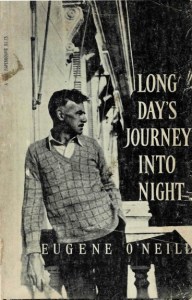
Where to begin? The family I grew up in had upper-crusty antecedents on both sides — New England on my father’s side, Virginia/Maryland/New England on my mother’s — but we looked middle/upper-middle class. My father was an architect. My mother didn’t work outside the home while my brothers, sister, and I were growing up. She talked with such evident longing about having done summer stock theater after WWII (during which she was in the SPARs, the women’s unit of the Coast Guard Reserve) that when I first read Eugene O’Neill’s Long Day’s Journey into Night my senior year of high school, I connected her instantly with Mary Tyrone, who clings to a belief that she could have been a concert pianist if only she hadn’t got married.
I’ve carried this copy with me since my senior year of high school.
That was not the only connection between my mother and Mary Tyrone: the latter was addicted to morphine, while my mother’s drug of choice was alcohol. She didn’t stop drinking till after a family intervention when I was in my mid-40s. As a teenager I was deep down convinced that if I drank, I would become an alcoholic too. So I didn’t drink.
In my mid-teens, however, I started eating compulsively. Between the beginning and end of junior year I gained 40 pounds and was totally oblivious till spring weigh-in in gym class. It took several years before I intuited the connection. Nancy Friday’s book My Mother, My Self came out in 1977, the same year I did, in case I needed any encouragement.
Alcoholism was no secret in lesbian and gay communities. For many years, lesbian and gay life had revolved around bars, but even in the late ’70s, when we were conscientiously creating “chem-free” spaces and events, it was impossible to avoid. By the early ’80s we were arguing about ways to deal with it. In the feminist and lesbian circles I moved in by then, the 12-Step program of Alcoholics Anonymous (AA) and Al-Anon was suspect from the get-go for its heavily patriarchal Christian God orientation. I didn’t know how to go about finding meetings that welcomed gay men, lesbians, and/or feminists. Coming up with effective alternatives, however, was a challenge.[1]
Among the first things I did when I landed on Martha’s Vineyard was go looking for a 12-Step program. They weren’t hard to find: both weekly papers included lists of meetings for several programs, mainly AA, Al-Anon, Narcotics Anonymous (NA), and Overeaters Anonymous (OA). That first fall I attended a couple of Al-Anon meetings. Most of the attendees were women with alcoholic husbands or ex-husbands. I was a lesbian who had grown up with an alcoholic mother but had left home a long time ago. They were dealing with day-in-day-out reality; I was dealing with patterns rooted in the past.
Since food was obviously my drug of choice, I tried a couple of OA meetings. At the time the few OA options on the Vineyard followed the “Grey Sheet” plan, which looked like, and indeed was, a diet. Not what I was looking for. I wanted to deal with the compulsion part, not control the calories I was taking in.
Then I found an Adult Children of Alcoholics (ACA) 12-Step meeting in the doctors’ wing of Martha’s Vineyard Hospital. There I found my tribe. I kept coming back. I was asked to lead the fourth meeting I ever attended. I didn’t realize at the time that this was highly unusual. Leading the meeting was Mary Payne, who was sure not only that the newcomer was, like her, a lesbian but that she would come out if she had to introduce herself. She had my number: I was and I did. On the Vineyard in the mid to late ’80s, gay men and lesbians lived mostly under the public radar. We knew each other, but no one was, as they say, “flaunting it.” This was my invitation. A door opened up. I walked through it, not knowing what the reaction would be. The reaction in that ACA meeting was pretty much “No big deal” and “Keep coming back.”
Along with being the chair of that particular meeting, Mary (1932–1996), the founding director of Island Theatre Workshop (ITW), was frequently described as “a dynamo.” This is 100% accurate. She was under five feet tall but had the presence and impact of a six-footer. AA’s 11th Tradition says that “our public relations policy is based on attraction rather than promotion.” Mary’s PR policy was the exact opposite: she was a tireless promoter, and in her worldview the overlap between theater and recovery was significant. Come by the theater — Katharine Cornell Theatre, “KC” as I soon learned to call it — during a rehearsal, said Mary. ITW was rehearsing Molière’s The Miser. I could help with PR. (This was probably my introduction to the Tisbury Printer, which printed all of ITW’s posters and programs.)
This T isn’t a T at all — it’s got a collar — and it predates my involvement with ITW, but it’s the only ITW shirt I’ve got.
I hadn’t done theater since high school, but over the years I’d often been at least on the peripheries of the performing arts, especially music. Hallowmas, my D.C. writers’ group, had given public readings. I was tempted, but I was also terrified. I envisioned the theater as a cavernous space with tiny figures at the far end, none of whom I recognized and none of whom noticed me.
When I finally mustered the nerve to walk up the outside stairs and open the door for real, what I saw was a cozy, even intimate space, flooded with light from tall multi-paned windows on both sides. Between the windows were four giant murals, two on each wall, depicting scenes from island history and island life.[2] In the mid-1980s the seats were covered in a green vinyl that could emit a sound like flatulence if you changed position. They’ve long since been replaced by a textured blue fabric that remains blessedly silent.
The front of the house, just in front of the proscenium stage, was bustling with activity. Rehearsals usually had two or three dogs in attendance: Mary’s Schipperke, Jenny; Nancy Luedeman’s Lhasa Apso, Featherbell; and Lee Fierro’s Meggie, who was larger than the other two but not by much. Dogs were of course verboten in KC, and equally of course Mary and company ignored the prohibition.
You’ve seen this shirt before, but some shirts keep coming back.
I was quickly hooked. Mary was impossible to say no to, but the reasons for “yes” were compelling. I was still getting my bearings on the Vineyard, still half thinking that I was just here for a year, and here, abracadabra, was a ready-made multigenerational circle of interesting friends and acquaintances, quite a few of whom were lesbian or gay. I got included in potlucks, holiday gatherings, and birthday parties. I got part-time jobs and house-sitting gigs through theater connections. On solstices, equinoxes, and cross-quarter days — the sacred days between the solstices and equinoxes: Samhain (Hallowmas), Brigid (Candlemas), Beltane (May Eve), and Lammas — Mary often hosted witchy celebrations in her living room.
Not surprisingly, all this theatrical ferment affected my writing. I set aside the novel I thought I’d come to the Vineyard to write. What came out of my pen and my brand-new computer was poetry, along with reviews and occasional essays for the lesbian and feminist publications I hadn’t quite left behind. My two first stage-managing gigs, first of Shakespeare’s Scottish Play and then of Medea, inspired work that I’m still proud of, including “The Assistant Stage Manager Addresses Her Broom After a Performance of Macbeth” (see below). I was giving readings and sometimes hosting an open-mic poetry night at Wintertide Coffeehouse (you’ll hear more about Wintertide in a future post). “MacPoem,” as I came to call it, was my favorite performance piece.
Step 2 of the 12-Step Program: “Came to believe that a Power greater than ourselves could restore us to sanity.” Theater was part of that power for me. While growing up, I had associated theater with addiction, so it was wildly appropriate that it become part of my recovery. Mary’s approach was, to say the least, unorthodox, but it worked.
Notes
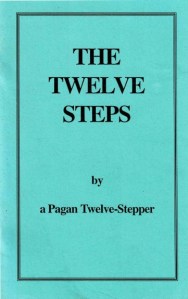
[1] This was what prompted me in the early 1990s to write a series of columns for the feminist wiccan journal Of a Like Mind, on working the steps from a pagan/feminist perspective. In keeping with the 11th and 12th Traditions, these were bylined “A Pagan Twelve-Stepper.” They were popular enough to be collected into a pamphlet, which I’ve still got a copy of.
[2] Before long I learned they’d been painted by Stan Murphy (1922–2003), the eminent Vineyard artist.
* * * * *
the assistant stage manager addresses her broom after a performance of “macbeth”
Who am I? Let me tell you what I do. Within these walls I manage time and space, make sure the pitcher’s on its hook before its bearer wants it, warn the messenger he’s on soon, check to see his torch is lit and that the backstage lights are out. Right now I’m cleaning up debris from this night’s show. Is this a dagger I see before me? It is, but split in pieces. I’m the one who tapes it back together after hours. Tomorrow night this plastic dagger turns to steel, honed sharp enough to pierce a haunch of gristly meat — or Duncan’s royal breast. Before each show I sweep the stage. I see green needles strewn where Birnam Wood has come to rest the night before. I shiver, chilled, as if I’d slept and woken centuries hence with all my friends and family dead. And then I sweep them all away. “Out, out, damn trees!” I cry, “You haven’t come here yet! Begone!”
Here, separate ages stream like shimmering strands in one great waterfall, and time dissolves. Mere mortals we, what havoc do we wreak? Elizabethan Shakespeare conjured up Macbeth, medieval Scottish thane, and we invoke them both, in nineteen eighty-six. I watch the people enter, choose their seats, and rustle through their programs. Normal folk, it seems, and yet this gentle summer night they’ve purchased tickets to a barren heath, a draughty castle primed for treachery. Right now the lights are up, the theatre walls are strong, the windows fixed within their frames. At eight o’clock the howling winds begin, the wolves close in, the sturdy walls are gone. These common folk, I wonder, have they bought enough insurance? Have they changed their bills for gold and silver coin? If challenged by a kilted swordsman, how would they explain their strangely tailored clothes?
No loyal lord or rebel threatens me. Between the worlds, or through this velvet curtain, I can move at will. I warn the sound technician, “Ten more minutes,” then I pass backstage to say, “The house is filling up.” The Scottish king is drinking ginger ale; a prince-to-be in chino slacks is looking for his plaid. The Thane of Glamis is pacing back and forth, preoccupied with schemes to win the crown, or trouble with his car. I prowl backstage, alert for things and people out of place. Last night I found a missing messenger outside the theatre, smoking cigarettes. I called him back in time: Macbeth’s bold wife demanded news — What is your tidings?; he was there to gasp, The king comes here tonight!
No phone lines run to Inverness, no news at six o’clock. (Walter MacCronkite’s face appears and says that base Macdonwald’s head was nailed upon the wall, that Cawdor’s fled and Glamis has been promoted; polls predict he might go higher still.) The kingdom’s nerves are messengers who run from king to thane to lady. Take the Thane of Ross, who comes to tell his cousin that her husband’s flown to England, leaving her unguarded; then he takes himself abroad, to where Macduff and other rebel lords are planning war. Macduff’s unguarded lady fares less well. A breathless runner pleads, “Be not found here; hence, with your little ones!” but on his heels come murderers, death-arrows from the king. Two sons, a daughter, and their mother die with piercing shrieks that vibrate in my spine.
With piercing shrieks vibrating in my spine, I contemplate a different line of work; this sending harmless people to their deaths is bad for my digestion, and what’s more, it’s happening much too often. First I let King Duncan in, and he gets killed in bed. Could I have known so soon that Cawdor’s heart was rotten? No. But shortly after, I send scoundrels to the banquet hall; Macbeth himself has called them. Not the kind of guest that Duncan entertained! And then I tell Macbeth’s friend Banquo and his son it’s time to join the party. What about the thieves I know are lurking on the gate road, dressed to kill? But Banquo is a fighting man, well-armed, and Fleance does escape. Not so Macduff’s fair lady, and her kids. Could I prevent their deaths? What if I plied the brutes with Scotch? They might get drunk enough to lose their maps, or drop their knives, or fall asleep. What if I whispered in the lady’s ear, “Don’t go outside today — and bar the doors.”
I doubt she’d pay attention. Each one goes to meet the dagger destined for his breast. Perhaps I’d get my point across if I could speak in rhyme and paradox, the way the witches do, with fair is foul, and foul is fair. The witches manage time and space like me; you could call me the unseen witch. I wonder, are they working from a script? You’ll see: the second sister sweeps the stage as I do, clearing them the space they need to cast their circles. We both summon kings and apparitions out of time, although our methods differ some. “You enter soon,” I warn, “stage right.” Mundane, compared to how my sisters work, with Double, double, toil and trouble, cauldron, fire, and lengthy list of weird ingredients — the eye of newt and toe of frog, the blood of sow that ate her piglets — but we get the same results. Our audience is moved to awe, and then proceeds along its merry way to rendez-vous with fate, or Birnam Wood, or man not born of woman. They get blamed for it. I don’t.
The witches disappear, and one last time prince Malcolm calls his kin to see him crowned at Scone. The set is struck, costumes returned to cardboard boxes, wooden banquet bowls and Scottish flag to rightful owners; kings go home to mow the lawn or fix the car. Where did the blasted heath go off to? I am leaning on my broom again. What stays when all the parts spin off? Just memories of daggers, prophecies, and anguished screams? The air still tingles here. The gates remain but smaller, well concealed. I might reach in and conjure back that knife, that messenger. “There’s knocking at the gate,” the lady says, “Give me your hand! What’s done cannot be undone.” To bed, she says. To bed, to bed, to bed.
The story behind this one starts way, way back, long before I moved to D.C. the first time.
My family wasn’t especially musical. My maternal grandmother played the piano by ear, which I thought was cool, but unless Granmummie was visiting,[1] what music there was in our household came via records and the radio.
Not to discount the importance of records, however: When I left for college, I absconded with my father’s Joan Baez album, her first. I didn’t need to take his Tom Lehrer LPs — Lehrer’s first, the one whose cover featured a caricature of the pianist as the devil surrounded by the red flames of hell (see below), and That Was the Year That Was — because most of the songs were embedded in my memory.
I’ve still got that Joan album, and the 10 or so of its successors that I acquired legitimately in the following years, and I still know a ridiculous number of Tom Lehrer songs by heart.[2]
See what I mean? Originally released in 1953, when I was 2.
Like many middle-class-and-up suburban kids my siblings and I took piano lessons with varying degrees of enthusiasm. The teacher wasn’t especially inspired or inspiring. I did learn to read music, but I didn’t learn to pick songs out of the air the way my grandmother did. That was disappointing, but what I didn’t really understand was what all that tedious practice could lead to. If I had, maybe I would have persisted.
Or maybe not.
I did, however, like to sing. Singing was the best part of church, where we went almost every Sunday morning as a family: St. Peter’s Episcopal in Weston, Mass. From fifth grade through eighth I sang alto in the junior choir. After eighth grade, when we aged out of both the junior choir and Sunday school, we could join the adult choir, but the adult choir sang at the 11 a.m. service and my family went to the 9:15. That’s when I left the church.
In my eighth-grade year, Becky B., also an eighth-grader, a soprano who’d been in the choir as long as I had, told me that I always sang off-key. To avoid ruining the anthem, she said, I should just pretend to sing.
No one else — not the choir director/organist, not any other member of the choir, not any of my music teachers in school — had ever told me any such thing. Becky B. didn’t like me and I didn’t like her; she was a goody-two-shoes who was always playing up to the adults. But I feared she was right, that I had been found out.
Somehow I made it through the year. Then I stopped singing. Period. When I entered high school in the fall, the music teacher encouraged me more than once to try out for Glee Club. Since she directed the Glee Club, this should have given me confidence, but it didn’t. I was sure I’d fail and confirm beyond any doubt that Becky B. was right: I couldn’t sing.
It was years before I recognized the pattern: I’d pursue a skill, an instrument, a foreign language — then abandon it when I was on the verge of being able to actually use it. At that point you’re bound to make mistakes. In my family making mistakes got you creamed. My very intelligent and well-read father regularly ridiculed my mother for getting the wrong answer or saying anything he considered stupid. I learned to get my facts straight before I opened my mouth. From an early age I’d been good at words, anything to do with words. I stuck to words, spoken and written, but never sung.
I never stopped listening to music, though, or hanging around people who made music or were somehow in the music biz. Gradually, and usually in fits and starts, I got braver, venturing into territories where I didn’t have all the answers and was bound to make mistakes: taking that first editorial job at the American Red Cross, for instance, or becoming the book buyer at Lammas Bookstore. I did well at both, but note that they both had to do with words: in some ways I was pushing the boundaries of what I was already good at.
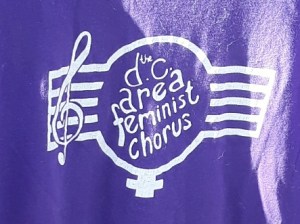
The D.C. Area Feminist Chorus was founded in 1978, prompted by a singing workshop led by Holly Near during that year’s Gay Pride celebration. In its early months it was leaderless, with members leading warm-ups and teaching each other songs.
At some point, they decided to engage a director/conductor, and after interviewing several candidates, they hired Deb Weiner. Deb either was already or was soon to become one of my housemates, but this did not prompt me to join the chorus. If anything, it was a deterrent: What if it was your housemate who had to tell you that you couldn’t sing on key and were dragging the group down?
I have an indelible memory of Deb conducting the combined D.C. Area Feminist Chorus and Gay Men’s Chorus of Washington at a holiday concert, in either 1981 or 1982. To be the conductor channeling all that massive sound! I was awed.
How did I come to finally join the D.C. Area Feminist Chorus? Well, I have it on good authority — my own words from 36 years ago — that I set out to write a story about the chorus for Hot Wire: The Journal of Women’s Music and Culture “and almost immediately found [my]self singing in the second soprano section.” By then Deb had moved on after several very successful years, Caroline Foty was the chorus director, and I was living on the far northeast fringe of Capitol Hill, subletting a large room from and sharing a kitchen with photographer Joan E. Biren (JEB).
By then, probably in 1984, I had joined the brand-new Gay and Lesbian Chorus of Washington (GLCW). How did I hear about it? I don’t remember. This was a small group, conducted by Tess Garcia, and my most vivid memory was of a performance we gave where Congressman Barney Frank, dressed in a leisure suit, reclined across several chairs in the front row. Most of the homemade cassette tape I have from a June 1985 performance is unplayable, but on the one audible cut, “Johnny, We Hardly Knew Ye,” we sound pretty good. According to the label, the program also included some P.D.Q. Bach, the spiritual “Soon Ah Will Be Done,” and selections from Annie.
I noted the most striking contrast between my two choruses in that Hot Wire story: “Because the GLCW did not choose to specialize in works by gay or lesbian composers, a chorus member could walk into any music store and be overwhelmed by the available selection.” Not so any Feminist Chorus member: all our music consisted of handwritten scores photocopied or similarly duplicated, because none of it had been published. Director Foty did some of the arranging, and fortunately feminist choruses were thriving at the time, and lots of sharing went on among them through the Sistersingers network. We were breaking ground, pioneers, in the forefront, and very aware of it.
We sang at least two songs from the Balkan women’s singing tradition. I can still fake the second soprano part of “Shto Mi e Milo,” which has been widely recorded.
One of my favorites from the chorus repertoire was a four-part setting of Edna St. Vincent Millay’s “Conscientious Objector.” I didn’t realize till about an hour ago not only that Mary Travers had performed it spectacularly, but that she wrote the solo setting and recorded it on her 1972 album Morning Glory.[3] I have a copy of the poem on my fridge: “I shall die / but that is all I shall do for Death . . .” It reminds me of the song.
The chorus made decisions collectively, including decisions about repertoire. “Conscientious Objector” almost didn’t make the cut; that was before I joined, so I don’t know what the objections were. As I recall, a couple of chorus members thought Malvina Reynolds’s “We Don’t Need the Men” was too anti-male. For others among us, this was a plus, not least because it was so tongue-in-cheekily Malvina. It was fun to remind people that Malvina wrote it in 1959.
The most controversial song I remember from my time in the chorus was “Sisters, Spring of Vietnam”; it clearly favored the Vietnamese liberation struggle against the French and the Americans, and that did not sit well with some members. Singing along with Lucha’s version I remember the tune, the harmony, and many of the words, so I’m pretty sure we sang it anyway, but some choristers chose to sit it out.
The back of the 1985 Sisterfire T. The D.C. Area Feminist Chorus is about halfway down.
My last gig with the D.C. Area Feminist Chorus was at Sisterfire, June 22 & 23, 1985. By the end of that summer I was semi-settled on Martha’s Vineyard. Music was much easier to find than feminism, and find it I did, volunteering at Wintertide Coffeehouse starting in 1986.
It took a while to find a way to start singing again. My way in turned out to be the annual Christmas performance of Messiah, sung by a large (and ever growing) pickup chorus of Vineyarders, many of whom sang regularly in various church choirs.
I’d never sung Messiah before, and most of the chorus seemed to know it by heart. More, although I could read music, I couldn’t “sight-sing,” sing from a score on first acquaintance. I still regret not having the nerve to audition for Glee Club in high school, where everybody learned to do stuff like that. I worked hard, I learned, and when, in my third year, I made it through the glorious “Amen” without losing my place, I thought I’d arrived.
The annual Messiah sings eventually grew into the Island Community Chorus, which did several concerts a year and with which I stayed until around 2005. I’ve managed to keep singing since then. In the age of Covid-19, I’ve participated almost weekly in Zoom sings (Zings?) with Susan Robbins of Libana, a women’s ensemble whose music I’ve loved since at least 1980, and a bunch of whose recordings I’ve got.
But it was the D.C. Area Feminist Chorus that got me singing again, and though I didn’t sing with it for much more than a year, this shirt is about how I found my (singing) voice again.
If you want to leave a comment and don’t see a Leave a Reply box, click the title of the blog post (above) and then scroll to the bottom.
notes
[1] Which was fairly often, because she lived only eight miles away.
[2] This is so common among the political circles I’ve moved in over the decades that if I sing or even hum a line, often someone in the vicinity will sing the next one back to me. A favorite memory from my freshman year at Georgetown U.: As a marshal for the huge Mobe (Mobilization Against the War) march on Washington on November 15, 1969, I was stationed on Pennsylvania Ave. between 6th and 7th. We were close enough together that we could reach out and touch our neighbors on either side. It was sunny but bloody cold, and my winter gear was still back in Massachusetts: I had this idea that since D.C. was a southern city I wouldn’t need it till after Thanksgiving. Wrong. Anyway, while waiting for the sun to get fully up and the march to start, we did a lot of jogging in place and making coffee runs to the nearest drugstore. Eventually one of us — maybe me, maybe not — started in on a Tom Lehrer song. No idea which one, so many of them would have been appropriate — maybe “The Wild West Is Where I Want to Be,” with its lines “I’ll watch the guided missiles / while the old FBI watches me”? We were sure the FBI and who knew what other intelligence agencies were around.
[3] My source for this is a detailed bio of Edna St. Vincent Millay on, of all things, the website for the ABC Oriental Rug & Cleaning Company in Ithaca, N.Y. There has to be an interesting story here, but I’ll have to save that rabbit hole for another time. The page seems to be updated regularly: it includes a reference to the ongoing pandemic and other events.
Two of the best jobs I’ve ever had fell into my lap.[1] I wouldn’t have had the nerve to apply for either of them. Conventional wisdom for decades has held that women apply for jobs we’re sure we can do, while men apply for jobs they think they can learn to do. I fit the female stereotype, but my caution wasn’t just due to my sex. The message I internalized over the years from watching my perfectionist father ridicule my mother for getting her facts wrong was that it wasn’t safe to not have the right answer. It’s pretty much impossible to venture into new territory without making mistakes and asking questions that reveal that you don’t know everything. In addition, plenty of people were likely to write me off on the basis of my physical appearance, so I had to be hyper-qualified before I even thought of applying for anything.
In the spring of 1981, I quit my first editorial job (see “1979: I Become an Editor” for how I got that job and why I left) intending to take some time to focus on my writing. That’s not the way it worked out. About a month later, Mary Farmer, owner-manager of Lammas Bookstore, asked me to become the store’s book buyer. We were at my group house in Mount Pleasant prepping for my 30th birthday party; Mary was seeing one of my housemates at the time. I’d assigned her to halve cranberries for cranberry bread. The cranberries were squishy because, though I was already modestly renowned for my cranberry bread,[2] I hadn’t yet figured out that cranberries are much easier to cut in half if you freeze them first.
I’d bet good money that my face at the time didn’t show how astonished I was when Mary asked if I’d come work for her: Mary and Lammas were at the center of the D.C. women’s community, and I was way off on the peripheries somewhere. I had no idea she even knew who I was.
As it turned out, Lammas’s current buyer was leaving, and both she and Mary had noticed from my frequent forays into the store that not only was I an avid reader, but my tastes ran from history to feminist theory to poetry to fiction. Mary herself claimed not to be a reader, which wasn’t quite true, but she had her hands full as the regional music distributor for Ladyslipper. In addition to managing the store’s finances (enough in itself to bring on ulcers — read on!), she bought the records, jewelry, crafts, and cards. Wisely enough, she hired a co-worker to handle books and periodicals.[3]
How to convey how much that job changed my life? Let me try to re/count the ways.
The Lammas softball team on the cover of Willie Tyson’s Full Count (1974). Mary Farmer is 2nd from right in the back row, Willie is in the middle of that row with Ginny Berson (co-founder of Olivia Records) to her left and sound engineer Boden Sandstrom of Woman Sound at far left. I did not play softball but I did go to a bunch of games. (Cover photo by JEB.)
Back then I was at best dimly aware of how goods reached the shelves of retail outlets — which were all “brick and mortar” at the time, though we didn’t call them that because what else was there? I learned. When a title ran out, it had to be reordered. If it was new and/or selling briskly, it had to be reordered before the last copy sold.
There were two options: order from the publisher or from a distributor. When you ordered direct from the publisher, the discount was better — meaning we paid a smaller percentage of the retail price, which meant we got to keep more of the cash when the book was sold — but you had to order a larger quantity, possibly more than you could sell in several months. With a distributor it was possible to order two of this title and five of that. Distributors came in two flavors: those focusing on independent presses, including the feminist ones, and those who dealt with “the majors,” like Random House and Norton.[4]
Books, like other retail goods, have to be paid for before they sell, but you can’t sell a book that isn’t on the shelf. Most (all? virtually all?) feminist businesses were seriously undercapitalized. This meant that bills had to be paid out of revenue, and cash flow was always an issue. We couldn’t stock everything we wanted, but we had to stock what we needed, i.e., anything that was in demand and selling well.
Publishers’ invoices were supposed to be paid in 30 days. They virtually never got paid in 30 days, but when 60 days started stretching toward 90, you risked getting put on hold. If you were on hold with a publisher and needed one of its titles, you ordered from a distributor — and put that publisher on the priority to-be-paid list.
Lammas, at the beginning of August, is the cross-quarter day between the summer solstice and the fall equinox — and also Lammas Bookstore’s birthday. We celebrated every year with champagne and a sale. From left: Liz Snow of Ladyslipper Music, owner Mary Farmer (a Ladyslipper distributor), me, The Printer Tina Lunson, and staffer Deb Morris, who went on to Politics & Prose Bookstore in D.C. She’s wearing the 10th anniversary shirt, so this was probably 1983. I’ve got the old one on.
Feminist publishers were always on the priority to-be-paid list. They were in the same undercapitalized boat we were, except that their burden was even worse: the costs of publishing a book have to be paid up-front, and it can be six months after publication date before the income even starts to roll in. The independent distributors were next, particularly Inland Book Company. We couldn’t afford to be on hold with them. (See note 4 below for the why of this.)
What I learned in those days keeps coming up, most recently not long after the Covid-19 shutdown started, when huge gaps began to appear on grocery-store shelves that were usually crammed full. Supply chains, usually invisible to the consumer, were in the news. In April 2020, I blogged about them — and traced my awareness of their importance to my experience at Lammas.
Serendipitously the second Women in Print conference was held in suburban Maryland in October 1981, a few months after I’d started my new job.[5] As a writer, an activist, an amateur local historian, I already knew I was part of something far greater than myself. Seeing that “something greater” in the flesh, meeting women I’d only known from seeing their names in print and reading their words — well, it was something else. This neophyte bookseller couldn’t have asked for a better training program. At one plenary session I found myself sitting next to Adrienne Rich, who told me how much she’d liked a review of mine she’d just accepted for the lesbian journal Sinister Wisdom[6](of which she and her partner, Michelle Cliff, were then the editors).
At Women in Print I had a crash course in how it all fit together: publishers, bookstores, periodicals, print shops, designers, editors . . . The birth of Kitchen Table: Women of Color Press was announced at that conference. It was historic in so many ways.
In my early months at Lammas I learned the details of ordering, stocking, interacting with customers, explaining the challenges of acquiring a title to women who were as clueless about the mechanics as I had been a few weeks earlier. For instance, in the early 1980s much work in feminist theory and history was published by university presses. Few university-press books were carried by any distributors, in large part because those presses only offered a 20% discount — which meant that for distributors there was no profit to be made whatsoever. Ordinarily, when a customer special-ordered a book, it was something we were out of temporarily and could restock on our next regular order. Not so with university-press books: in those cases I really had to order a single copy, knowing that between the short discount and the postage the store might actually lose money on the transaction.
For a regular customer I would do it, no question: I knew for certain that they’d return to pick up and pay for the book. For someone I’d never seen before, I learned to request a deposit on the retail price.
Over time I also learned to make a distinction between customers — and feminists in general — who understood the economics of running a small, economically fragile feminist business (or were willing to learn) and those who seemed to think we all lived in a utopian world where economic considerations did not apply. Mary, Lammas’s owner-manager, regularly ran into women who were surprised to find her doing her own laundry at the local laundromat. This often willful cluelessness was all too common in the women’s community, and 40 years later I keep running into it on Martha’s Vineyard too.[7] My patience with this crap left town a long time ago.
The 10th anniversary T from 1983. Our celebration concert (at All Souls Church, IIRC) featured pioneer Jewish lesbian singer-songwriter Maxine Feldman and local favorite Judy Reagan.
Meanwhile — well, I got to work in the heart of D.C.’s women’s community, which meant I got to meet and talk with so many women I wouldn’t have met otherwise. I knew just about everything that was going on, in town, in the book biz, and in the women’s music biz, across the country and even around the world, usually before most other people did. I got to talk continuously about books and call it work, because it was. I got to build up a women’s fantasy/science fiction collection; partly as a result, in 1984 I became Feminist Bookstore News’s first columnist, reviewing (you guessed it) fantasy and science fiction. This continued till 1996, long after I left D.C., and got me lots of free books.
The most lasting impact on me as a writer was the ongoing one-on-one contact with women to whom the printed word mattered. Books and articles opened new vistas for their readers, and the remarkable thing was that you couldn’t predict what book or story or newspaper article was going to make a decisive difference in someone’s life. And yes, I got to call customers’ attention to the works that had made a big difference in mine.
You’ll be hearing more about Lammas, the book biz, and why I eventually left town if you keep following this blog. I’m still trying to make sense of it all myself.
If you want to leave a comment and don’t see a Leave a Reply box, click the title of this post and then scroll to the bottom.
notes
[1] The other was working for the Martha’s Vineyard Times, where I started as a part-time temp proofreader at the end of the decade. More about that later.
[2] My recipe came from Jean Stewart Wexler and Louise Tate King’s Martha’s Vineyard Cookbook, with minor modifications (less sugar, more orange juice). Forty years later I still make it regularly. That’s why a third of the space in the freezer of my small fridge is devoted to frozen cranberries. Cranberries are only available in the fall, so if you want cranberry bread year-round you stock up then and freeze them.
[3] The store was founded in 1973 by two lesbian jewelers as Lammas Women’s Shop. Feminist and lesbian books were scarce at that point, so they only occupied a shelf or two. That changed rapidly in the following years. IIRC Mary started off as their manager but within a year or two bought the store. The jewelers continued to make jewelry under the name Lielin, which was made up of syllables from their first names, LesLIE and LINda. I’m spacing their surnames but will probably rediscover or remember them in my (virtual) travels.
[4] In the early 1980s, the main trade distributors were Baker & Taylor and Ingram. The main indie-press distributors were Bookpeople and Inland Book Company. Since Bookpeople was on the West Coast and Inland was in Connecticut, freight charges were less from Inland, so I ordered more from them. Without getting down in the weeds about book pricing — all you have to know is that (1) books are heavy, (2) the bookstore pays the freight, and (3) since the retail price was generally printed on the book, a store couldn’t increase it to compensate for freight costs, not without being accused of ripping people off. By this time Women in Distribution (WinD), which specialized in feminist-press books, had folded, but Helaine Harris, one of WinD’s principals along with Cynthia Gair and Lee Schwing, was working for Daedalus, which dealt in books “remaindered” by the big trade publishers. Daedalus was based in nearby Maryland, so when a remaindered title was of interest to us (as often happened), Helaine would deliver it in person, saving us a bunch of money in freight charges. Helaine, incidentally, was a veteran of the Furies collective, as was Lee Schwing.
[6]Sinister Wisdom still exists. Not only is it still a journal of lesbian writing, it’s been publishing works that would otherwise get lost, such as The Complete Works of Pat Parker, edited by Julie R. Enszer, and Sister Love: The Letters of Audre Lorde and Pat Parker, 1974–1989. If this thrills you half as much as it does me, or even if you’re just curious, visit www.sinisterwisdom.org, email sinisterwisdom@gmail.com, or write Sinister Wisdom, 2333 Mcintosh Rd., Dover, FL 33527. P.S. I had work published in SW 14, 17, 28, and 35. I also know that “Sinister Wisdom” came from a line in Joanna Russ’s The Female Man. You see the challenge here? All it takes is a name to send me off on a dozen tangents, in part to remind me that my life really happened and that some of what I remember might be useful to others.
[7] More about that later. Much more. Remind me if I forget.
Mary Daly’s Gyn/Ecology: The Metaethics of Radical Feminism (Boston: Beacon Press, 1978) was bigger than a bombshell in the feminist world. It was more like an asteroid crashing into the ocean, creating a tsunami. I was a newcomer in the D.C. community, and not yet well grounded in feminist theory, never mind feminist theology, so it’s a bit of a wonder that I got to review Gyn/Ecology for off our backs.
off our backs, known to its friends as oob, was the hometown newspaper of D.C.’s feminist and lesbian communities, but it was also a national and even international publication. It was run by a collective, but every month the two-room walk-up office off Connecticut Ave. NW, opened up for layout weekend. By that point most of the writing and editing had been done and it was all hands on deck, supporters as well as collective members, to do the typing and paste-up necessary to produce the next issue. The rush to deadline made comrades and colleagues of us all. Everyone who helped out was listed among the Friends on the staff block for that issue.
My visual memory of the oob office is of a crowded, no-frills workspace whose walls were papered with posters from recent feminist history and covers from previous issues. I remember picking up the phone once — when the phone rang during layout, whoever was closest grabbed it — and it turned out to be someone I knew from Martha’s Vineyard who was involved in the women’s health movement. My worlds sometimes collided in interesting ways.
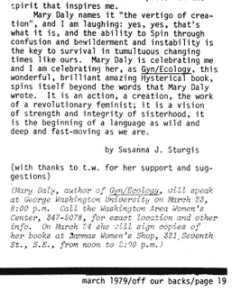
I did the typing and probably the layout for my Gyn/Ecology review, and for most of the articles I contributed to oob over the years, mostly interviews and book reviews. My typing ability came in handy, as did my facility with presstype. Here is what the layout looked like:
Apart from ads that came in camera-ready, all copy was produced on IBM Selectric typewriters. Veteran typists of the era will recognize the typeface as Letter Gothic, a popular Selectric sans serif option. Note that book titles are underscored, not italicized, even though we clearly had access to an italic typeball. Swapping typeballs in and out slowed you way down and often got ink on your fingers, so italics were only used for larger chunks of text — in this case quotes from the book being reviewed.
In those days, oob always put bylines at the end of stories, a characteristically feminist strategy to keep readers’ focus on the text instead of the author. I wasn’t the only one who would sometimes read the first few lines of a long story then skip to the end before deciding to continue.
Headings were done with presstype. This one is pretty good, but it’s hard not to notice that the baseline wobbles a little and that the space between “of” and “radical” is twice what it ought to be.
Typing was done on ordinary bond paper with margins set to the paper’s column width. If you caught a typo while you were typing, you fixed it with correction tape, which was preferable to correction fluid (like Liquid Paper or Wite-Out) because it didn’t have to dry. The newer Correcting Selectrics had a correction ribbon built in, parallel to the ink ribbon. I can’t remember if off our backs had any of them when I was involved.
Once completed, the typescript was sprayed with silicone to keep the ink from smearing, then cut with X-acto knives, waxed with a hand waxer, and pasted up on layout boards. The boards from the previous issue would have been stripped for reuse; they were reused until they wore out. Once in a while a page would go to print with the folio (running head) from the previous issue, meaning the date at the top of the page was wrong, but considering the intense, barely controlled chaos of layout weekend and the fact that most of us were amateurs, the gaffes were remarkably few.
Reading the first paragraph of my Gyn/Ecology review for the first time in at least 35 years confirms my memory: while writing it, I was terrified that I couldn’t do the book justice:
“I have been living with Gyn/Ecology: The Metaethics of Radical Feminism for about four months now–reading, rereading, reflecting, rejoicing, growing impatient with my fear of taking on such a magnificent, vast and tightly-woven book. Gyn/Ecology is written to us, for us, from our experience, about us, the untamed, the Hags, the “women reluctant to yield to wooing”. It is a process that aims to transcend the limits of writing, to break down the walls between the writer and reader and the usual distinction between the creating and the product. Gyn/Ecology is breath-taking in its reach, astonishing in its power–yet it is also intensely personal and has exacted from me an intensely personal response. I write, therefore, to review not the book alone but the part it has played on my own journey into woman-defined space.”
Gyn/Ecology is grim in its exploration of misogyny across cultures and across the centuries, but when it comes to language it’s also immensely playful. As its title suggests, it breaks words apart and prompts one to look at them in unexpected ways. Does “recover,” for instance, mean to regain or to cover up again? Or maybe both at the same time?
From my copy of Gyn/Ecology
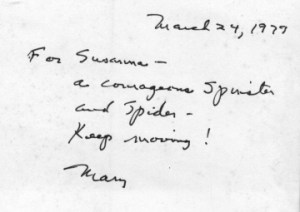
In the last paragraph, I write that “Gyn/Ecology, this wonderful, brilliant amazing Hysterical book, spins itself beyond the words that Mary Daly wrote.” It spun me well beyond writing the review. Though then as now I was happier playing first lieutenant than instigator, I led an ad hoc group — we called ourselves, of course, the D.C. Hags — to bring Mary to town. The SRO event was held in a lecture hall at George Washington University on March 23, 1979, with a book signing at Lammas the next day (I know that because the dates appear at the end of the review).
Then, in early April, a friend and I took the Night Owl train from D.C. to Boston to attend “We Have Done with Your Education,” a rally supporting Mary in one of her frequent battles with Boston College. Since BC, like Georgetown U., is Jesuit-run, I found it borderline miraculous that she got tenure and thrived there as long as she did. Not till 1999 was she forced to take early retirement because she insisted on keeping her advanced women’s studies courses women-only. (She would tutor privately any men who wanted to take the course.) The rally, held at Boston University, was held on April 8, 1979 — I know that because it’s on the T-shirt. Its title was based on a quote from Virginia Woolf’s Three Guineas (Daly embraced Woolf as a foremother):
“And let the daughters of educated men dance round the fire and heap armful upon armful of dead leaves upon the flames. And let their mothers lean from the upper windows and cry, ‘Let it blaze! Let it blaze! For we have done with this “education”!’”
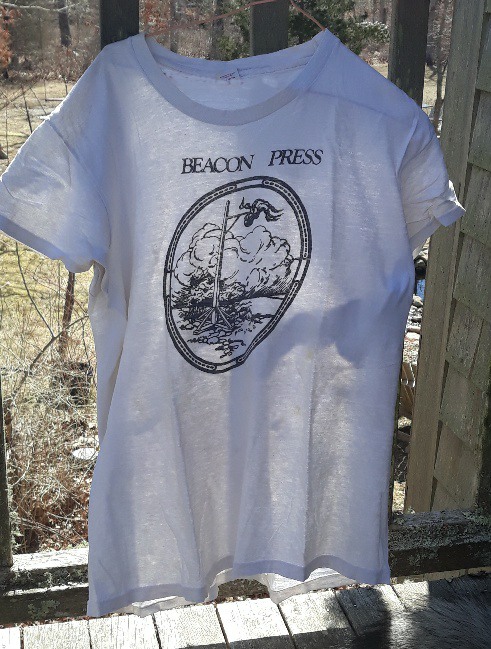
As a daughter of educated men, I might well have been dancing round the fire. The less predictable part is that my mother, Chiquita Mitchell Sturgis, might actually have been leaning from the upper windows. At the time, she was a clerical at Beacon Press, Unitarian Universalist–affiliated publisher of Mary Daly and many other essential feminist, liberal, and progressive writers, so requesting a Beacon book or contacting a Beacon author often meant working with my mother. What she made of Mary’s books I’ll never know, but she liked Mary and we both liked having something in common that had nothing to do with family or hometown.
Mary died on January 3, 2010. My obituary for her was published in the May/June 2010 Women’s Review of Books. Unfortunately it’s not available online, but fortunately (wonder of wonders) I still have the print version. Rather than focus on (obsess about?) Mary’s forced retirement from Boston College, which the mainstream media were covering ad nauseam, I started off by summarizing the “far more intriguing . . . story of how a nice Catholic girl from Schenectady, New York . . . transformed herself into a ‘revolting hag’ whose advice to posterity is ‘sin big.’”[1]
“Daly’s searchings were wild, exhilarating, infuriating, inspiring,” I wrote. “But I didn’t become a Daly groupie. As a reader, a writer, and a thinker, I’ve always been a pick-and-choose synthesizer. A few of Daly’s protégées, including Janice Raymond,[2] took her insights and tools and created powerful work with them. In less able hands, though, those insights and tools became little more than parlor tricks.”
My mother worked at Beacon Press, publisher of Mary Daly and other essential feminist writers, from the mid-1970s to the late ’80s.
When I wrote that obit for Mary Daly, I’d been an editor for more than 30 years, so it’s not all that surprising that I contributed to the Women’s Review of Books blog a post titled “Beyond God the Style Guide: Me? Edit Mary Daly?” Could I have done it? The mere thought was daunting, “even though,” I noted, “I’m the kind of copyeditor who argues with the dictionary, cheerfully makes exceptions to Chicago, and lets my authors do pretty much what they want as long as it makes sense and will (probably) pass muster with the publisher.”
Being a writer and a feminist as well as an editor, I went on: “From Church and the Second Sex onward, Mary Daly was continually improvising words and imagery to convey what hadn’t been conveyed before, and to examine ideas taken for granted for so long that they actively resisted exploration. Breaking trail is demanding and exhausting work. Being among the first to follow in a freshly broken trail isn’t exactly like traveling a paved road either.”
And that’s what editing Mary Daly would have been like: “following in a freshly broken trail.” Would I have been up to it? At the time Gyn/Ecology came out, almost certainly not. A few years later, fully fledged as an editor and more flexible than I’d been as an apprentice, I think I could have done it, though not without the terror that gripped me while I was writing that review.
notes
[1] Sources were Mary’s Outercourse: The Be-Dazzling Voyage (New York: HarperSanFrancisco, 1992) and “Sin Big,” in The New Yorker, February 26, 1996. To explore, or revisit, Mary’s work, check out The Mary Daly Reader, edited by Jennifer Rycenga and Linda Barufaldi (New York University Press, 2017).
[2] My interview with Jan Raymond appeared in off our backs for October 1979.
If you don’t see a Leave a Reply box, click the title of the blog post (above) and then scroll to the bottom.
This is the photo that appeared with my obituary for Mary. No credit was given, but if you know who the photographer was, please let me know and I’ll add it in. I can’t tell you how much I love this picture.
It wasn’t till I started seeing things as a woman that I realized how much was missing from history.
Me wearing my Lesbian Heritage T at a D.C. Gay & Lesbian Pride Day, ca. 1983. Photo by Jim Marks.
As a kid I felt included in the history I learned in school. I grew up WASP in the Boston area. The place-names in the history books were names I knew and places I’d been: Boston! Concord! Lexington! Old North Church! My fifth-grade class made a field trip to Old Sturbridge Village, which I thought was very cool, and not just because we got to put the teacher in the pillory.
Also in fifth grade I adapted for the stage a young readers’ biography, Patrick Henry: Firebrand of the Revolution. Patrick Henry may not have been a relative (but who knows?), but the author, Nardi Reeder Campion, definitely was connected close-up on my paternal grandmother’s side. My class produced the play and I got to play the lead. My only distinct memory of the production is that Thomas Jefferson was about twice as tall as I was.
History, especially family history, was important to both my grandmothers, both of whom lived in the Boston area — we could, and often did, walk a mile through the woods to my paternal grandmother’s house — so they were very much part of my life. Both were members of the DAR. Grandma, my father’s mother, was also a Mayflower Descendant. Gran’mummie, my mother’s mother, was a born and bred Virginian — if Patrick Henry was a relative, it would have been through her — who also belonged to the Colonial Dames and (I think) to the United Daughters of the Confederacy.
For Gran’mummie, I’m pretty sure this was largely a matter of family and regional heritage — not a celebration of the Lost Cause. She lived in Brookline, Massachusetts, for the last 50 years or so of her very long life. (Born in 1892, she died in 1997, a week shy of her 105th birthday.) Only within the last 15 years or so have I become fully aware of what those Confederate statues meant, both to the United Daughters who erected many of them and to the Black people who have had to live with them day in, day out.
Still, above the mantel in Gran’mummie’s dining room was the Confederate battle flag. When I visited her as an adult, I was always surprised by how small it was: the longer I was away, the larger it loomed in my imagination, till it dominated the entire wall. Beside her writing desk in the same room was an imposing recruiting poster from World War I. It depicted an avuncular Robert E. Lee, gray-haired, gray-bearded, and gray-uniformed. I FOUGHT FOR VIRGINIA, it said. NOW IT’S YOUR TURN.
To this day it encapsulates for me what “states’ rights” is essentially about.
Gran’mummie’s middle name before she married was Washington; she was descended from Custises and Lees.
The Yankee heritage on my father’s side was less problematic. My Grandma’s original name was Rosamond Thomas Bennett. When she married, and eventually divorced and remarried, she dropped the Bennett and kept the Thomas. That was for Isaiah Thomas (1749–1831), from whom she was descended: printer, Revolutionary, and (I like this part) founder of the American Antiquarian Society.
The Bennett wasn’t entirely lost, however. One of my brothers was baptised Roger Bennett Sturgis, after Grandma’s brother the Rev. Roger Williams Bennett, and yeah, he was named for that Roger Williams. I don’t know how the line of descent works out, but if I can’t be descended from Anne Hutchinson, Roger Williams will definitely do. Hutchinson, by the way, had a daughter named Susanna, one of the few survivors of the attack in which her mother and much of her family was killed.
Growing up, I assumed I was part of U.S. history. It was a jolt to realize I wasn’t, or at least not to the extent I’d assumed I was. In the antiwar movement I met veterans of the civil rights movement and survivors of the McCarthy witch hunts. These were nowhere represented in my family tree. Ditto what I learned from union members and labor organizers there and in subsequent years. In fact, men close to if not actually part of my family tree were often clearly on the wrong side: in Charlie King’s great song “Two Good Arms,” about Sacco and Vanzetti, the villain of the piece, Judge Webster Thayer, could well have been a third or fourth cousin a few times removed.
At Penn, where I arrived as a transfer student in the fall of 1972, I took one of the first-ever women’s history courses, offered by women’s studies pioneer Carroll Smith-Rosenberg. But it wasn’t till I got to D.C. a few years later that I became seriously immersed. Those who ridiculed the whole idea of women’s liberation loved to ask where the great female thinkers, scientists, historians, etc., etc., etc., were. One famous poster posed the question “Where is your Shakespeare?” and answered it: “She was a woman, and you burned her books.”
This turned out to be not far from the truth, except that burning, either of books or of women, was not necessary to obliterate women’s achievements and contributions. They weren’t being recorded in the first place, because they weren’t considered important and/or women weren’t doing the recording. When they were recorded, they were trivialized, pushed to the margins, and/or forgotten. What women often were doing was making the achievements of their fathers, brothers, husbands, and sons possible. Judy Brady Syfers’s essay “I Want a Wife,” published in 1971, circulated widely for years, even though most women I know got the point as soon as they read the title.
Feminism had been very much in the air I breathed as a Georgetown University undergrad, from 1969 to 1972. I was introduced to Betty Friedan’s Feminine Mystique (published in 1963 and already a classic), which gave me much-needed insight into my mother’s life; Kate Millett’s Sexual Politics; Germaine Greer’s Female Eunuch; Ingrid Bengis’s Combat in the Erogenous Zone; and Robin Morgan’s anthology Sisterhood Is Powerful, nearly all of which was new to me. I was the lead writer on an op-ed that appeared in The Hoya, the student newspaper, over the byline “Georgetown Women’s Liberation.” I later reviewed the premier issue of Ms. (January 1972) for the same paper.
After moving back to D.C. in 1977, I learned how much I had missed the first time around.
A major catalyst was Judith Schwarz’s courses in lesbian history, offered through the Washington Area Women’s Center. Judith had an MA in women’s studies from San Jose State and had taught a similar course there. Her focus was on the lives and achievements of women whose primary commitment was to other women.
Artwork by Sudie Rakusin. This is one of the very few baseball-style T-shirts in my wardrobe.
Lesbian Heritage/D.C., devoted to uncovering and preserving D.C.’s lesbian history, grew out of those courses (which IIRC included lesbian literature as well as history). As a result, I learned that, totally unbeknownst to me as a Georgetown U. undergrad, a whole other feminist world had been thriving elsewhere in the city. The feminist newsjournal off our backs got started in early 1970, but I didn’t see my first issue till I moved back to town in 1977. (Oob, as it was usually called, played an important role in my life, and yes, I have a T-shirt to prove it. Coming up soon!)
I had never heard of the lesbian-feminist Furies collective either. Though it lasted only a couple of years, the Furies cast a very long shadow into the future, both for the lesbian feminist theory and culture articulated in its newspaper and for the future accomplishments of its members. Rita Mae Brown is likely the best known to the general public:[1] Her Rubyfruit Jungle (Daughters, 1973; Bantam, 1977) may have been the first mainstream-published novel whose lesbian protagonist didn’t either go straight or die. She’s since become known for some high-profile relationships and many best-selling mystery novels.
For those of us involved in the emerging women’s culture of the 1970s and ’80s, several other former Furies were household names: Coletta Reid, a co-founder of off our backs who went on to establish Diana Press; activist and academic Charlotte Bunch, who started Quest: A Feminist Quarterly; Helaine Harris, co-founder of Women in Distribution (WIND); photographer and author JEB (Joan E. Biren); and Ginny Z Berson, co-founder of Olivia Records, which had its roots in D.C. but relocated to the West Coast in March 1975.
Once a Fury, a documentary about the Furies collective based on interviews with several collective members, was released in the fall of 2020. So was Ginny Berson’s Olivia on the Record, about Olivia Records and the women’s music scene of the 1970s; chapter 2 is a lively account of how the Furies evolved and eventually went their separate ways.
Naturally, drafting this post sent me into the past looking for dates to hang my fuzzy chronology on. The Lesbian Herstory Archives newsletter #6 (June 1980) reprints Judith Schwarz’s introductory letter to the Archives women, dated October 27, 1977. It includes this passage:
“Finally, I am about to start teaching a lesbian history seminar at the Washington Area Women’s Center, which is based on a similar class I taught last spring in San Jose, California. The response has been nothing less than tremendous, and it seems many of us are tired of getting our history from second-hand sources or biographies about famous writers. I am very pleased to see this massive interest and one of the things that I hope will come out of this seminar will be an interest in a regional lesbian archive here in Washington, perhaps affiliated with the Women’s Center.”
So there you are: that’s what happened. Judith soon became part of the Lesbian Herstory Archives collective, and we made at least a couple of field trips to New York City to visit the Archives, then located in the Upper West Side apartment of its co-founders, Joan Nestle and Deb Edel. I count it among the sacred spaces I’ve been able to visit in my life. Browsing the bookshelves, handling the periodicals, looking at the photos, I could hear the voices of the women who created these artifacts. From time to time I could almost hear the voices of the silenced, “the voices we have lost,” to whose memory the Archives is dedicated.
The Archives women made a trip to D.C. in the spring of 1978 and gave their slide presentation at Women’s Nite Out, at the Washington Area Women’s Center. How do I know this? Is my memory that good? No, it’s not. But my story about the event from the WAWC newsletter, In Our Own Write, for June 1978 is reprinted in the LHA newsletter #5 (Spring 1979). Here’s a paragraph from it:
“While watching the immense variety of lesbian works illustrated by the slides, I was especially struck by the ephemeral nature of our publications and organizations. This and their frequently local orientation make it too easy for them to be lost forever. Patriarchal institutions have suppressed and denied the culture of all women in the past. Now it is essential that we do not by our carelessness cooperate in their efforts. When the womenenergy that sustains a newsletter or a collective dissipates, the recorded evidence of their work must be preserved. The Archives are the instrument by which this can be done.”
I was 27 years old at the time, but I couldn’t have said it better today.
notes
[1] Or so I thought, until my writers’ group members told me that they didn’t recognize the name.
If you don’t see a Leave a Reply block, click on the title of this post and then scroll to the bottom.
1976 was the U.S. Bicentennial year, and that’s the year the T-Shirt Chronicles start, with this blue T from that year’s Festival of American Folklife. The festival started in 1967 and has been held annually ever since (except, need I even say, in 2020), but that may have been the only one I ever attended, even though I lived in D.C. 11 years altogether — and wasn’t living there when I went to the festival. I probably went with one or both of my best buddies from my Georgetown University undergrad days, both of whom lived in the D.C. area.
What prompted me to buy the T-shirt? No idea. I don’t have a single clear memory from that festival: what I saw, what impressed me, nada. I had no clue that 44 years later I would be writing about this T as the first in a very long series.
But what better place to start? It wasn’t the Bicentennial celebrations that took me back to D.C. that summer. In mid-1976 I was trying to reconnect with the city I’d thrived in as a student activist, hoping this would reconnect me with the me who had lived there, the dean’s list student who was passionately involved in antiwar organizing and student politics and who was also getting a crash course in sexism thanks to the unapologetic misogyny of Jesuit-run Georgetown University.
When 1976 began, I was stuck. After graduating as a history major from the University of Pennsylvania in 1974, I’d spent fifteen months in the UK, the first twelve pursuing but not completing a master’s degree and the last three hitchhiking solo around Britain and Ireland. Just before Thanksgiving 1975 I landed back in my suburban hometown of Weston, Massachusetts, in the unhappy home I’d grown up in. I had no idea what to do next, I had no friends in town, and I’d lost contact with my college friends.
In February, Grandma, my paternal grandmother, had a stroke. She died ten days later. Since she lived only a mile away, she was very much a part of my growing up. We weren’t close in the emotional sense — in my quintessentially WASP family, no one was close in that sense — but she introduced me to the two passions of my preteen and teenage years, horses and the Middle East, and I felt closer to her than to anyone else in the family.
After she died, my uncle Neville, who had lived with her for many years in the house he and my father grew up in, committed himself to a psychiatric hospital. Eventually he got his feet on the ground and walked himself into a happier and less isolated life than the one he’d been leading, but his cracking up presented an immediate dilemma: Who would look after Grandma’s house and take care of Max, her red Lab, till her estate could be settled?
The obvious answer was me. Whether this was a good thing or not — on one hand it gave me the literal space and time to get my feet back on the ground, but on the other being stuck under the same roof with my parents might have kicked my butt into gear sooner. Whether I was clinically depressed I can’t say because I never saw a clinician, but depression, alcoholism, and other forms of stasis are endemic on both sides of my family and I’ve got tendencies in all those directions.
That winter and spring I did a lot of walking with Max. When we weren’t out walking, I read Grandma’s letters from her young womanhood, learned that she’d been reluctant to enter into a marriage that eventually ended in divorce, explored her house (which I already knew pretty well), played a lot of solitaire, and taught myself to bake bread. In England I’d gotten hooked on unsliced bread from neighborhood bakeries; the cellophane-wrapped loaves then available in suburban supermarkets no longer satisfied. Neither my mother nor either of my grandmothers ever baked bread, at least not in my lifetime; none of them were cooks either. My teacher was a mass-market paperback. I’ve been baking all my own bread ever since.
Not long after I moved into Grandma’s house, Linda, my father’s girlfriend (he was still married to and living with my mother, an active alcoholic), recruited me as research assistant on a project she was working on, about what was going on in England at the time of the American Revolution. This involved reading period sources at Harvard’s Widener Library — which got me out of house and hometown and reconnected me with something I enjoyed and was good at. Linda was the only adult around who realized I was not in good shape; her intentions must have been at least partially therapeutic. It helped.
So did going back to D.C. that July. My D.C. years had drifted so far from me that it felt like they’d happened to someone else. Hooking up with friends from my activist student days pulled those days back within reach. I was on the right track, but because I was improvising the track I was trying to follow, it took a while.
Here’s where my memories of 1976 diverge from the facts of the matter. Time was fluid that year, with few dates to use as signposts, and contrary to popular belief you can’t find everything on the internet. Non-famous people who lived and died before news went digital can be elusive: I knew Grandma had died in February but had forgotten the date, and Googling didn’t refresh my memory. My sister, however, has been maintaining the family tree on Ancestry.com and she had it: February 17.
Easier to verify online — and disorienting when I did — was the date of a benefit concert I attended at Boston’s grand old Orpheum Theater for U.S. Senator Fred Harris, Democrat from Oklahoma, who was running in the Democratic presidential primary. Arlo Guthrie was the headliner, and my sister and I were sitting in the first or second balcony way over at house right, looking down at the brightly lit stage with its glittering mics, amps, and guitars.[1]
This is one of my most vivid memories from that year, and I’d already slotted it into my chronology. In an early draft of this post I wrote: “Thanks to the state ERA campaign I paid more attention to electoral politics in 1976 than I ever had, or that I would for the next 40 years.” But it didn’t take long to turn up incontrovertible evidence online that the Harris-Guthrie concert-rally had taken place months before I started volunteering for the ERA campaign, on February 26.[2] Harris’s run for the Democratic presidential nomination, always a long shot, was over by the end of April.
Harris was an antiwar, pro-racial-and-economic-justice populist who inspired the kind of enthusiasm that Senator Eugene McCarthy had in the previous decade and Jesse Jackson would in the next. His was exactly the kind of campaign that would have attracted me with my grassroots activist background, which had largely ignored electoral politics.[3] Could it even have been the Harris benefit concert that put the state ERA campaign on my radar?
The state ERA, Question #1 on the ballot, passed on November 2, election day 1976. By then it had brought three T-shirts into the collection I didn’t realize was a collection. More about that in my next post.
To leave a comment, click on the title of the post and scroll down to the Leave Reply box.
Notes
[1] I could go on and on and on, but seriously, if you weren’t around in the 1960s and 1970s, or don’t remember much about it, look up Fred Harris and his then wife, Comanche Native American rights activist LaDonna Harris. They divorced in 1982. As of this writing, they’re both alive at the age of 89. Fred was elected to the U.S. Senate from Oklahoma in 1964, the year of the LBJ landslide and the last year a Democratic presidential candidate carried Oklahoma. He was an active member of the Democratic majority that implemented the Great Society legislation, and he was part of the Kerner Commission, officially the National Advisory Commission on Civil Disorders, commissioned to investigate the causes of the rioting and urban unrest that swept the country in 1967. The report was issued in 1968. Harris is the last surviving member of the commission. Arlo Guthrie did a 30-stop fundraising tour for the Harris campaign. According to a 2001 story, the campaign gave Arlo the wheels to travel in. He paid off the lease when the campaign ended and the Guthrie family spent years on the road in that bus.
[2] I’d also forgotten that Tom Paxton, well on the way to being a folkie legend, was the opening act. Both his set list and Arlo’s can be found online, and a couple dozen attendees seem to have made bootleg tapes of the show.
[3] However, the first — and until January 2017 the only — political party I ever belonged to was the D.C. Statehood Party, which I signed up for when I first registered to vote as a Georgetown University freshman. In those days the only municipal office D.C. residents could vote for was school committee. Electoral politics were only a big deal in presidential election years. Statehood for D.C. Now!












 The T-Shirt Chronicles