The Road to WisCon 14 (1990)

WisCon, the world’s first and probably only fantasy/science fiction convention that focuses on feminist speculative fiction, was born in 1977 in Madison, Wisconsin. Thanks to Joan Nestle at the Lesbian Herstory Archives, an avid f/sf fan, I learned about it and f/sf fandom, including feminist f/sf fandom, before too many years had passed; see “I Discover Women Writing F/SF” for details.

But it wasn’t till February 1990 that I attended my first WisCon, WisCon 14. I got there by a circuitous route, which looks something like this:

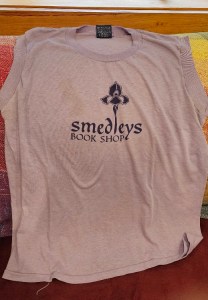
I could have sworn this T said “WISCON 14” on it but obviously it doesn’t. Hal Davis gave it to me @ WisCon 14. I’d never met Hal before, and I know all that stuff about not accepting gifts from strangers, but I’m glad I accepted this one. Hal and I are still in touch 34 years later, though my last WisCon was in 2006. That’s some kind of record.

In the late 1970s, having got wind of the wealth of fantasy and science fiction being written by women, I started haunting Moonstone Bookcellar, the f/sf bookstore on Connecticut Ave., near Washington Circle. After a skim through the pages, I’d buy almost anything with a woman’s name on the cover.

While several of us were prepping for my 30th birthday party, in June 1981, Mary Farmer, owner and manager of Lammas, D.C.’s feminist bookstore, asked me to sign on as Lammas’s book buyer. Once I got my bearings, surprise, surprise, I started building up the store’s f/sf collection.

In 1984, Carol Seajay, founder, editor, and publisher of Feminist Bookstore News, invited me to become FBN’s first columnist. “Susanna Sturgis on Science Fiction” debuted shortly thereafter. Big perk was that I could now get free review copies from publishers.1

Also in 1984, I attended the Feminist Women’s Writing Workshops for the first time. FW3 in those years was held at Wells College in tiny Aurora, N.Y., but was based in Ithaca, 30 miles away. I got to meet Irene “Zee” Zahava, proprietor of Smedley’s, Ithaca’s feminist bookstore, and Nancy Bereano, then the editor of Crossing Press’s great feminist series and about to establish her own trail-blazing Firebrand Books.

Zee was just starting to edit anthologies, often of women’s writing; by now she has edited a gazillion and branched out into offering writers’ workshops. Back then, however, she opened the way for me to edit three anthologies of women’s f/sf for Crossing: Memories and Visions (1989), The Women Who Walk Through Fire (1990), and Tales of Magic Realism by Women (Dreams in a Minor Key) (1991).
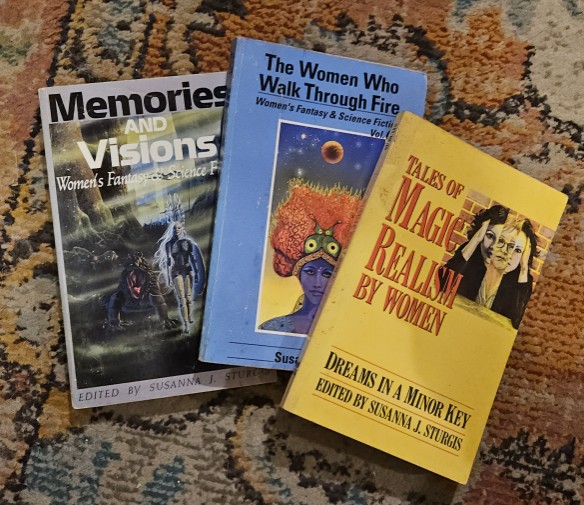
My three women’s f/sf anthologies

By the time Tales of Magic Realism came out, my relationship with Crossing had frayed so that was my last anthology. Personalities aside, the real underlying problem was the structural disconnect between feminist publishing and feminist f/sf readers. Feminist publishing and bookselling emphasized the trade paperback format; f/sf was overwhelmingly a mass-market world. Feminist f/sf fans could find their favorite women authors in f/sf bookstores. Only a handful of feminist booksellers knew f/sf well enough to build a feminist f/sf section, notably Karen Axness at Room of One’s Own in Madison and Paula Wallace at Full Circle in Albuquerque.

While at Lammas I had stocked a fine feminist f/sf section, which f/sf fans appreciated but was a hard sell to other fans of fiction by women. The widespread conviction that f/sf was only about spaceships and elves resisted all my attempts to unseat it.2 But my work at Lammas and especially my Feminist Bookstore News column did catch the attention of Crossing Press and others.

Among those who noticed my FBN column was the archivist/librarian for the Boston chapter of Daughters of Bilitis (DOB), who was also the East Coast half of fantasy writer J. F. Rivkin. In those days female protagonists had become more common in f/sf, but often they were the only woman in a team of men. If a novel had two significant female characters, they tended to be rivals, not allies. So J. F. Rivkin’s first novel, Silverglass (1986), was right up my alley: sword & sorcery featuring lesbian partners who had adventures together.

J. F. Rivkin/East was also well connected with the women writers in the New England f/sf scene, which is how I came to be included in a group signing at Glad Day, Boston’s gay bookstore, then located on Boylston Street near Copley Square. I’m pretty sure the year was 1990, after The Women Who Walk Through Fire came out that spring and after I had attended my first WisCon in February. There for the first time I met Ellen Kushner, Delia Sherman, Melissa Scott, Lisa A. Barnett, and “J.F./East” herself. Wow.

With WisCon and that momentous Glad Day signing, a whole world opened up, one I’d been only dimly aware of in my feminist bookselling days. Not only did it keep me busy for most of the 1990s, it greatly expanded my T-shirt collection, thanks in particular to the wonderful Ts created by Freddie Baer for the James Tiptree Jr. Award. The Tiptree, for speculative fiction that explores and expands our understanding of gender, was launched by authors Pat Murphy and Karen Joy Fowler at WisCon 15, my second WisCon, and I chaired the Tiptree jury in 1994. More about that later.

NOTES

  1. I continued writing the f/sf column till 1996, 11 years after I left D.C., so the freebies continued to arrive. Since I was only interested in the ones by women, I’d take the rest down to Book Den East, which sold used and rare books, and sell them. Bookseller Cindy Meisner [1944–2023] told me these were snatched up by young male sf fans who loved getting brand-new books for cheap. ↩︎
  2. Genre fiction per se was never the problem. Mysteries have been huge in the feminist press since they were introduced, and don’t get me started about lesbian romance. Lammas customers would tell me they found fantasy or science fiction too unbelievable then come to the check-out counter with a lesbian romance about a nice lesbian on vacation who falls in love with a slightly older woman who turns out to be independently wealthy and they live happily ever after. ↩︎

1985–1986: Morgana Comes on Board

The several seeds planted my first off-season on Martha’s Vineyard sent out tendrils that kept growing for years, often tangling with each other. Where to start, where to start?

It probably doesn’t really matter where I start because I’ll get to where I’m going no matter what, but let’s start with computers.

I acquired this T several years later, almost certainly in my science-fiction-con-going years (roughly the ’90s), but it’s the only computer-related shirt I’ve got so here it is.

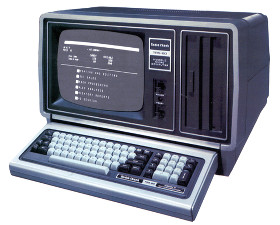
My first serious computer relationship was with the TRS-80 that Lammas Bookstore acquired while I was working there, around 1983. The TRS-80 (the T in TRS is for Tandy, the main inventor, and the RS stands for Radio Shack, which produced and marketed it) was a wildly popular workhorse that introduced hundreds of thousands (millions?) of people to what IIRC were then called microcomputers, to distinguish them from the hulking machines that occupied whole rooms at universities and big businesses.

For the first few weeks I was terrified that I’d hit the wrong key and blow something up. It was a little like learning to drive. In both cases, the terror passed. I didn’t have my first real computer disaster till several years later, when I accidentally erased a client’s current accounts receivable file. Fortunately it was only March so it wasn’t hard to reconstruct it from bank statements and paper invoices. And by then my relationship with computers was so solid that one screw-up didn’t do it any damage.

This TRS-80 Model II looks like my memory of Sylvia, except Sylvia’s case was white.

Once that TRS-80 and I got through our shakedown cruise, we became good buddies. I named her Sylvia after my editorial mentor, Sylvia Abrams; my brilliant high school history teacher, Sylvia Sherman; and Nicole Hollander’s Sylvia character. Sylvia had two 8-inch floppy drives in the same unit as the monitor, a separate keyboard, and a word processor called Scripsit. She was connected to a dot-matrix printer.

When I left Lammas and D.C., I was accompanied by the venerable red IBM Selectric I’d bought from a friend some years earlier, but I was ready for a computer of my own. Most participants at the Feminist Women’s Writing Workshops that summer of 1985 were still using typewriters, but at mealtimes we talked as much about computers as we did about food.

That fall, I found my way to EduComp, which was then located in a little house set back from the sidewalk on Main Street. Proprietor Pat Gregory introduced me to hard drives. I was an instant convert: with a 10MB (!!) hard drive and one floppy drive, instead of two floppy drives like Sylvia, you didn’t have to keep swapping program disks in and out. This option would add $500 to the cost of a basic system, but even to this chronically frugal New Englander it was hands-down worth it.

I bought my first computer on an off-island foray to Framingham: a Leading Edge Model D (an IBM clone). A Wikipedia article supports my memory of the cost: in addition to the $500 for the optional hard drive, I paid $1,500 for the computer itself (it also had a 5 1/4” floppy drive), $500 for WordPerfect 4.1, and $500 for an Epson LX-80 dot matrix printer. $3,000 was the most money I’d ever spent on anything.

Setting it up I was on my own, but in those days software came with manuals, hardware instructions weren’t hard to follow, and you could actually reach a real person by calling tech support. Once the tech guys (all the ones I spoke with were guys) ascertained that you had plugged the computer in, connected the cables, and turned the thing on, they treated you like someone who was capable of understanding and following directions.

Morgana was named for the Celtic goddess the Morrigan, for Fata Morgana (Morgan le Fay); and for the hero of C. J. Cherryh’s Morgaine novels. Her equine namesake was the Morgan horse. The Morgan horse stamp was released that September. I stuck one on Morgana’s case. As the first Morgana was succeeded by Morganas II, III, IV, and V, the stamp migrated to each one as a sign of continuity.

Since in September 1985 first-class postage was 22¢, it was also a reminder that while the price of computers kept coming down, the cost of mailing a letter kept going up. Believe it or not, I’ve still got that stamp, much the worse for wear (see right). After Morgana V, around 2010, I switched from desktops to laptops and started a new naming convention, so since then the stamp has been stuck to a cupboard door above what used to be my computer desk.

Me in my vintage Tisbury Printer T-shirt

As my savings dwindled, I entered the Vineyard workforce as a freelance typist, running an occasional “situation wanted” ad in the Martha’s Vineyard Times classifieds. The Tisbury Printer — with whom I’d established a connection doing PR and other print-related tasks for Island Theatre Workshop (more about that to come), and which I’m pleased to note still exists — referred me to people who wanted cut-rate typesetting for lengthy documents, booklets and even books. I’d type the manuscript on Morgana, then take the floppy disk down to EduComp (which unfortunately no longer exists, and which I miss a lot), which by then was located in the big building at the head of Main Street.

At first EduComp rented out time on its laser printers to the public, but it turned out that most customers needed so much hands-on support and supervision that it was taking up too much staff time. They made an exception for me and a couple of others who were capable of sitting down with a disk unsupervised and getting the job done. My girlfriend in the late ’80s was a graphic artist: she did the layout using my typescript. We produced a couple of books and at least two Nathan Mayhew Seminars course catalogues that way.

Come to think of it, seat-of-the-pants on-the-cheap publishing has been a theme through my adult life, from my antiwar movement days to my evening job proofreading that law weekly, to off our backs and Lammas Bookstore, on to the Vineyard, and right up to the present day. 1980s publishing technology was strictly horse-and-buggy compared to what we’ve got now, but hey, it got us where we wanted to go.

1984–87: Feminist Women’s Writing Workshops

I’d been writing for publication for several years before I decided that I needed something more. I was well enough educated, but as a writer I was largely self-taught. I belonged to Hallowmas Women Writers, a group of D.C. poets and writers that I’d helped form. It was a lifeline to my writer self, its members were doing interesting work, but all of us were engaged in other activities and I was discontented with the feedback I was giving as well as getting. As a fledgling editor, I’d benefited tremendously from working alongside someone who knew a lot more than I did and was willing to share. Were there comparable opportunities out there for women writers?

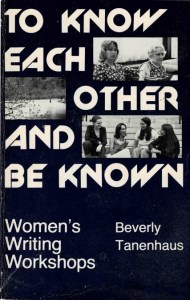
book cover

off our backs carried ads for the Feminist Women’s Writing Workshops (FW3), a 10-day live-in workshop held every summer in upstate New York. Founder-director Beverly Tanenhaus’s book about the workshops, To Know Each Other and Be Known (Motheroot Publications), came out in 1982. Lammas must have carried it, I must have noticed it, but I don’t think I’d actually read it. My copy has “July 1986” written under my name on the title page, which suggests I acquired it at the workshop that year.

I sent for the workshop brochure on February 5, 1984. Tuition, room, and board was $475, $425 if you applied by March 15. Could I afford it? Could I get 10 days off from Lammas in the middle of July? Where the hell was Ithaca, and how would I get there? I didn’t own a car, and my grasp of upstate New York geography was hazy.

Scariest of all, was I really ready? I didn’t know anyone who’d attended the workshop and could assure me that I wouldn’t be in over my head. The biggest risks I’d taken, like moving back to D.C., applying for that editorial job at the Red Cross, and becoming the book buyer at Lammas, had all turned out well. What if this one didn’t?

I sent in my deposit in time to get the early bird discount. My welcome letter from the director was dated March 16. The stars aligned, the logistics worked out, and I arrived by bus in Ithaca on July 15.

To say that the workshop was life-changing is both a cliché and an understatement. Our introductory session that first night opened with a recording from the first FW3 in 1975, of Adrienne Rich’s prose poem “Women and Honor: Some Notes on Lying.” This was already, and has been ever since, the closest thing I have to a bible. It’s about the importance of telling the truth to each other (and, by extension, to ourselves). What better way to challenge us as writers?

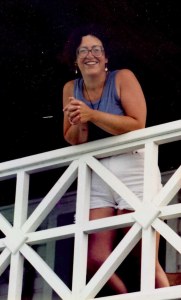
Me on the boathouse balcony just outside our meeting room. Probably 1987.

Our morning class sessions were held in the second floor of the Wells College boathouse, with Cayuga Lake glittering out the window and lapping gently at the shoreline. Each morning, an hour was devoted to the work of each of two participants. Copies had been distributed the previous day, and all of us came prepared. The guidelines: Comments were to be directed to the director, or to each other — not to the writer. The writer’s job was to listen until everyone had spoken, then respond at the end of the discussion. The power of 18 women focusing entirely on my work, taking it seriously for a solid, animated hour, was a revelation. So was the challenge of being one of the 18 women giving feedback to another writer, overriding the voices in my head whispering things like What if I’m wrong? What if I’m missing something? What if this isn’t all that important?

The rest of the day was open. Most of us gathered for meals in the cafeteria — the luxury of not having to prepare our own meals wasn’t lost on any of us — but the rest of the time we went our own occasionally intersecting ways in ones, twos, and threes, walking in the woods, swimming in the lake, writing in our rooms, sitting under a tree or by the lake to write or read.

During the week groups of us took field trips to the National Women’s Rights Historical Park at Seneca Falls, which had opened only two years before, and the National Women’s Hall of Fame, or into Ithaca, to hang out at Smedley’s, the feminist bookstore (proprietor Irene Zahava had been a workshop participant in the past and has edited many, many anthologies of women’s writing over the years), and of course to eat at least once at Moosewood Restaurant.

Poet-novelist Marge Piercy was the guest writer that year, in residence for a couple of days. We also heard from Elaine Gill, co-principal of Crossing Press, then located in nearby Trumansburg, and Nancy Bereano, who had edited Crossing’s Feminist Series and was just then establishing her own Firebrand Books, which quickly became a major player in the feminist print world.

As the re-entry meeting began on the last night of the workshop, I was feeling sad and euphoric, hopeful and apprehensive all at once. We had created magic; would I ever see these women again? As a writer I felt validated and capable; could I maintain my momentum when I got back to D.C.? We went round the circle, each woman sharing what she was going back to and what she was taking home with her. All of us had taken to heart the words of Adrienne Rich at our very first meeting: “When a woman tells the truth she is creating the possibility for more truth around her.”

Almost all of us, as it turned out. About two-thirds of the way around the circle, the workshop blew up. There were four lesbians at the workshop that year, of whom I was one. At the re-entry meeting, the other three charged the rest of us with making them feel unwelcome. They didn’t target me specifically — they didn’t target anyone, and were rather short on specific examples — but I was undeniably on the wrong side of a lesbian-straight split.

After the instigators left the room, most of the rest of us came together to talk about what had happened. We shared our immediate reactions. Most of us tried to identify what we had done to make the three women feel unwelcome. As the only lesbian in the circle at that point, I said I hadn’t felt unwelcome at all. I was a little surprised by this, because I was no stranger to the tensions that sometimes arose between lesbians and straight women in feminist spaces.

The D.C. lesbian feminist community and the national Women in Print network had become my home in a way that my growing-up home wasn’t. They were where and how and why I became a writer: developing my skills, giving me no end of things to observe and think and write about, seeing my words in print, and providing an audience (which I was also part of). So though I did spend time with the other lesbians at the workshop, hanging out with them wasn’t a priority. Connecting with sister writers was. Being taken seriously as a writer was.

Our shared effort that night to come to grips with what had just happened, speaking first-person and from the heart, was rare in my experience — so rare that in the months that followed I wrote a 6,000-word essay (never published) about the workshop experience. I still have the copy I shared with another workshop participant, with her extensive and thoughtful comments on it: she agreed with some of my points, challenged others (sometimes strenuously), and expanded my perceptions of what had happened.

I was willing then, and I’m willing now, to believe that the other three lesbians had experienced lesbophobia at the workshop, even though I had not. My problem then and now was with how they chose to bring it up, starting with the timing. The second-to-last night of the workshop had been devoted to a “creative bitching” session. We talked about what worked at the workshop and what could be improved in the future. Rather than bring their issues up then, the three chose to bring up their complaints at the re-entry session, our last time together as a group. Everyone would be leaving the next day. The three timed their confrontation so they wouldn’t have to deal with its consequences, or even see any of us face-to-face again. Then they walked away from the possibility of expanding truth to include all of us.

In an article about FW3 1986 for Hot Wire, the women’s music and culture journal, I wrote: “Perhaps the hardest lesson to learn is that inclusion in community here depends largely on a willingness to risk telling and hearing the truth — a willingness that is, not coincidentally, essential for feminist writing” (Hot Wire, March 1987).

I learned later that the main instigator of the confrontation had lobbied for a position as an assistant workshop director for the following year and been turned down. Was revenge at least part of her motive? I suspect so. As it turned out, the director asked me to be one of her assistants the next year, which enabled me to attend the workshop free of charge. Of course I accepted, and continued as an assistant through 1987. By the summer of 1988 I’d been hired as proofreader at the Martha’s Vineyard Times so taking 10 days off in the middle of July was out of the question.

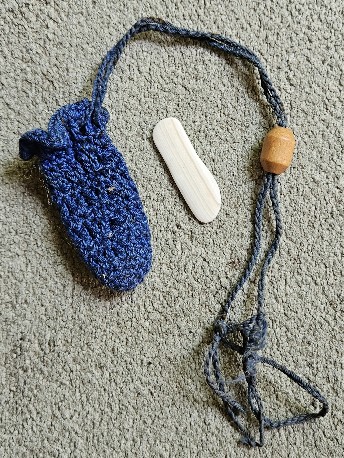
I still have that amulet bag, but my amulet has long since lost its purple. Tina M., if you read this, I remember you!

Before I left for my annual end-of-summer visit to the Vineyard in 1984, my first workshop year, a crafty (in more ways than one) member of Hallowmas Women Writers gave me an amulet bag she’d crocheted for me. For a while I wore that amulet bag around my neck with nothing in it. Then while I was walking on South Beach one afternoon an oblong bit of white-and-purple clam shell caught my eye. Into the amulet bag it went. When I returned to D.C., I wore it everywhere.

For a long time I liked to attribute my decision to move to Martha’s Vineyard to that amulet. There was, need I say, more to it. For years the lesbian feminist community and my writing had fed each other, confirmed each other, formed a dynamic whole. In the early ’80s fissures were growing just below the surface. In the early to mid 1980s AIDS, a barely identified syndrome with a dismal prognosis, was devastating the gay male community. Meanwhile, the lesbian community was polarizing around the so-called sex wars. The front lines included pornography and s/m, which one side saw as irredeemably misogynist and the other as liberating. Women I knew and admired were on both sides; the accusations were ugly and loud. As a writer I felt caught in a middle that was critical of both factions and wasn’t being heard. Did that middle even exist?

My experience at the 1984 Feminist Women’s Writing Workshop helped clarify and focus my uneasiness. If the community of lesbians and the community of writers diverged, my path would lie with the writers.

Looking back later, I realized that my urge to “get out of Dodge” had plenty to do with the Reagan administration, which altered the feel of D.C. whether you had any connection to the federal government or not. In July 1985, I left D.C. with all my belongings in a rental truck, deposited them in the basement of my parents’ home in the Boston suburbs, returned to the Feminist Women’s Writing Workshops for my first year as an assistant director, and by the end of the month was more or less living on Martha’s Vineyard.