1987: March on D.C. for Lesbian & Gay Rights

The 1987 March on Washington for Lesbian & Gay Rights wasn’t my first national march, not by a long shot. Barely a month into my freshman year of college, I participated in the first Vietnam Moratorium march on October 15, 1969, then exactly one month later, on November 15, I was a marshal at the huge New Mobilization1 (aka “New Mobe”) march. From my station between 6th and 7th Streets NW, I got to watch hundreds of thousands of people pouring down Pennsylvania Ave. ten or twelve abreast. I’d never seen anything like it.

I still have visceral memories of that one. It was sunny, but it was chilly and I was underdressed: In my innocence I thought my winter duds could wait till I went home for Thanksgiving. Wrong. I wasn’t the only one either. Those who’d worn jackets hadn’t brought gloves, so we took turns making coffee runs to the nearest drugstore then warmed our hands by wrapping them around the cup. Several of us entertained the others, and the police officers stationed on the same block, singing Tom Lehrer songs. I could go on . . .
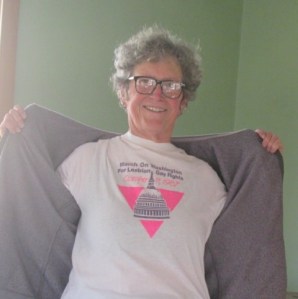
So the 1987 March for Lesbian & Gay Rights wasn’t my first national march, but it was the first I’d had to travel to. I’d moved back to Massachusetts in the summer of ’85, and by now into my third year, it looked like I was going to stay there.

I’d marched in the the first national March for Lesbian & Gay Rights in 1979, of course, but I don’t remember who I marched with. Maybe the off our backs contingent, or the Washington Area Women’s Center? I do remember passing along the back side of the White House grounds chanting with a whole bunch of other dykes “Two, four, six, eight, how do you know that Amy’s straight?” Amy Carter, daughter of then-president Jimmy Carter, was all of 12 at the time. We were, of course, giving her the benefit of the doubt, but — I just looked her up — she’s been heterosexually married twice and has two kids, so straight she seems to be.

The AIDS Quilt, officially the NAMES Project AIDS Memorial Quilt, was displayed for the first time during that march. Established almost exactly two years earlier, in November 1985, the Quilt at that point included 1,920 panels. Each panel was three by six feet; they were stitched into square blocks of eight panels each.

I knew about the Quilt. My friend Nancy Luedeman (1920–2010), a mainstay of Island Theatre Workshop and longtime partner of Mary Payne, had created a panel for four Vineyard men who had died of AIDS. I promised I would find her panel.

I was not prepared for how overwhelmed I felt as I walked down the rows between the blocks of panels. I’ve been deeply moved walking through cemeteries, noting the dates and the connections between people, but this was different: each panel was alive, evoking in color and imagery the life and personality of each person memorialized, each person lost. Finally I knew what it felt like to be in the presence of the sacred.

I did find Nancy’s panel. Two of the four men were identified by first name and last initial, the other two only by initials. This reflected the shame attached to AIDS, and homosexuality, on Martha’s Vineyard and in so many other places at the time. Nancy didn’t volunteer their full names, and I didn’t ask. I think Nancy said they’d all died off-island. Eventually I learned that Bill S. was Bill Spalding, who has another panel in the Quilt, with his full name on it. I don’t know about the others. If you do, please let me know.
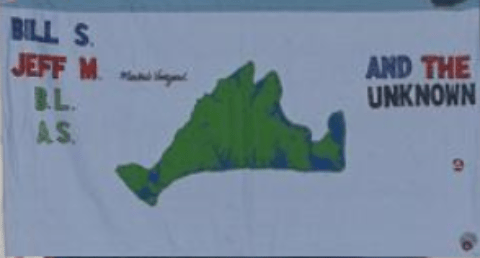
Quilt panel created by Nancy Luedeman in memory of four Vineyard men who died of AIDS

The Quilt returned to D.C. a year later, and so did I. It had been on tour that spring and summer of 1988, growing all the while. By October 1988, spread out on the Ellipse, it comprised 8,288 panels. Too many to see all of them in only two or three hours, so I wandered, letting myself be drawn and directed by a name, an image, a thought.

A Red Cross caught my eye. I had worked at Red Cross national headquarters for four years in my D.C. days. That’s where I learned what an editor was, and where I started to become one. When I reached the panel and read the name on it, my knees collapsed under me. It was for my co-worker and friend Thom Higgins, whom I’d seen when I was in D.C. the previous October. He’d seemed fine. He didn’t say anything about being sick. He’d died earlier that year, I think in May.

The image in the middle is for Toastmasters, of which Thom was a dedicated member. IIRC the panel was created by Thom’s friend and my friend and former colleague Brad McMinn. Brad died, also of AIDS, in 1993.

My recollection is that Casselberry and Dupree were singing “Positive Vibration” at the other end of the Mall, but maybe I made that up. Now I can’t hear that song without thinking of Thom. I can’t think of Thom without hearing that song.

More about Thom in “1978: ERA March and the Red Cross Training Office.” He gave me my EDITOR shirt and my WHEN IN DOUBT TURN LEFT shirt. I still have both of them. I remember you, Thom.


NOTE

  1. Formally the New Mobilization Committee to End the War in Vietnam. The successor to the National Mobilization Committee to End the War in Vietnam, which organized major antiwar events in 1967 and ’68, this was the coalition that organized the gigantic November 15, 1969, march. Frequently confused and/or conflated with it was the Vietnam Moratorium Committee, which organized the October 15 events across the country. It also organized the incredibly moving prelude to the November 15 march: On November 13 and 14, thousands of people walked from Arlington National Cemetery to the White House, each one bearing on a placard the name of someone killed in Vietnam. In front of the White House these placards were deposited into coffins set up for the purpose. I was involved in the housing and feeding operation ongoing at Georgetown and so was unable to participate. ↩︎
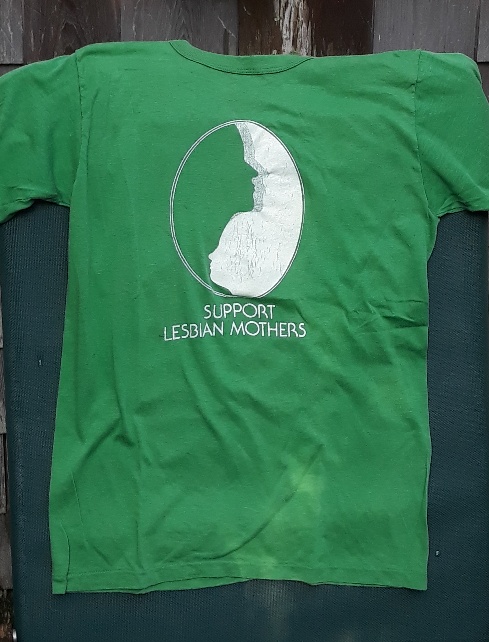
Support Lesbian Mothers

I could have acquired this T at Lammas, or at an event. Don’t know. In the 1970s and well into the ’80s — and in plenty of places even now — “lesbian mother” was either an oxymoron or anathema. In my social and political circles there weren’t many lesbian mothers, and virtually all were survivors of heterosexual relationships. Several prominent lesbians who were (almost) old enough to be our mothers had children: Adrienne Rich (b. 1929) had three sons, and Audre Lorde (b. 1934) had a son and a daughter. Singer-songwriter Alix Dobkin (b. 1940) wrote at least one song about the joys and challenges of being mother to Adrian, and in her later years was a happy grandma to Adrian’s three kids.

In the 1980s this was starting to change: lesbians, some in relationships, others single, were “starting families,” as the saying goes, by adoption or by getting pregnant. I don’t remember when the phrase “lesbian baby boom” became popular, but it most certainly did. A landmark documentary about lesbian mothers, Choosing Children, was released in 1985.

In those days, even demonstrably unfit fathers could count on winning custody battles with their lesbian ex-wives. I knew women who’d lost custody after grueling court fights, and I heard of men who, after winning in court, relinquished custody to their exes: they were more interested in winning than in taking responsibility for their kids.

Along with possibly hostile exes, a definitely hostile legal system, and all the challenges that go with raising children, period, lesbian mothers often didn’t get much practical support from their lesbian communities either. There were multiple, interacting reasons for this. We were a mono-generational lot, for one thing: I’d guess that at least 80 percent of us were between the ages of 25 and 40. Most of the white women among us were from somewhere else: we’d left hometowns and families behind, often on less-than-happy terms. As a result, we had to build support networks from scratch, and we didn’t have much energy, time, space, or money available for non-adults — or for elders either. (We did, I think, do an OK job supporting those among us who were faced with serious illness or injury.)

In addition, some of us just weren’t all that interested in children. I distinctly remember an incident when I was about 12: I was in the car with my mother, headed for the next town over, and when we were stopped at a red light I asked her why I, alone of my siblings, didn’t have a middle name. She replied that when I got married, I’d just drop it. In that instant I knew (1) that I was never getting married, and (2) that I needed a middle name.

Kids weren’t part of my thought process, not consciously at least: what I knew for sure was that I didn’t want my mother’s life. Much, much later, like when I was around 30 and had been out as a lesbian for several years, I was mildly curious about what pregnancy and childbirth might feel like, but I had zero interest in raising a child — or in having heterosex, although by then I knew that there were other ways to get pregnant. Turkey basters were most definitely a thing.

Sometimes it was stronger than lack of interest. The phrase “never-het lesbian,” meaning a lesbian with no heterosexual history, was in play, and having kids was taken as a fairly obvious sign of a heterosexual past. And if while growing up a woman had been subjected to heavy family pressure to get married and have children, and perhaps been disowned for not doing so — well, once one escaped that pressure, one might be at least a bit ambivalent about those who seemed to have acquiesced in and benefited from it.

I just pulled off my shelf the epic volume Our Right to Love: A Lesbian Resource Book, edited by Ginny Vida in cooperation with the women of the National Gay Task Force and published in 1978. It’s a rich and revealing collection, of essays and photos and an exhaustive national resource directory, of where we were in the late 1970s. The essays include “Sharing Your Lesbian Identity with Your Children” and “Lesbian Mothers in Transition,” and lesbian mothers and their kids show up in other essays too.

A quick Google search turned up a scientific paper from 1981: “Lesbian Mothers and Their Children: A Comparative Survey,” in the American Journal of Orthopsychiatry. In case anyone needed more evidence that lesbian mothers have been around for a while . . .


Writing about lesbian mothers reminded me of a book that came out in the late 1980s: Why Can’t Sharon Kowalski Come Home? by Karen Thompson and Julie Andrzejewski, published by Aunt Lute Books in 1989. I no longer have my copy, so I was thrilled to learn just now that, though it’s not in print, it’s still being read and remembered and copies can be found.

After Sharon Kowalski suffered serious brain damage in an auto accident, her parents refused to let her lover, Karen Thompson, even visit her in the hospital. A long court battle ensued, which Karen eventually won: she became Sharon’s legal guardian. The case was a cause célèbre in lesbian, feminist, and disability circles because it underscored just how vulnerable lesbian and gay relationships were when marriage equality was barely even a dream.

A 2003 book about the case is still in print from the University Press of Kansas: The Sharon Kowalski Case, by Casey Charles. Notes the publisher’s catalogue: “Charles weaves together various versions of the story to show how one isolated dispute in Minnesota became part of a larger national struggle for gay and lesbian rights in an era when the movement was coming of age both legally and politically. His account recalls the rough road lesbians and gay men have had to travel to gain legal recognition, examines how the law is politicized by the social stigma attached to homosexuality, and demonstrates how conflicted the decision to ‘come out’ can be for lesbians and gays who view ‘the closet’ as both prison and refuge.” Charles, a lawyer, English professor, and gay man with HIV, has written several books since.

This August 2018 article in Minnesota Lawyer brings the story almost up to the present day: “The Minnesota Legal Fight That Changed the Course of the Gay Rights Movement.” Karen has been Sharon’s guardian all these years, assisted by her current partner.

1979: Three Mile Island, etc.

From the May 6, 1979, march on Washington

If my T-shirts have anything to say about it, 1979 was the year of the nukes and, not surprisingly, the anti-nukes. The environmental movement wasn’t a priority with me; in fact, in the 1970s and into the following decade, I was more than a little suspicious of it. From Earth Day 1970 forward, it looked like a movement of mostly white middle-class people who got queasy if you talked too much about sex, race, or class. I’m glad to say that it’s become a lot more intersectional since then.

There was a strong environmental current within feminism, however, evidenced by works like Susan Griffin’s landmark Woman and Nature: The Roaring Inside Her and Andrée Collard’s The Rape of the Wild: Man’s Violence Against Animals and the Earth. The identification, even equation, of women with nature, nature with women, was and continues to be problematic: patriarchal thinking has long associated women with nature, and not in ways that acknowledged their power. Men were rational; women and nature were not. Women, like nature, so the thinking went, were there for men’s benefit.

To embrace the connection was to risk being deemed an “essentialist” — believing that women had some essential, innate nature that distinguished us from men. However, one needn’t be an essentialist to wonder if men with fame, glory, and/or profits on their minds are capable of imagining the possible consequences of their actions. Their shortcomings in this regard are nowhere more evident than in their treatment of the environment.

I recently learned from Rachel Maddow’s book Blowout that in 1969 — almost a full decade before Three Mile Island — the Austral Oil Company partnered with the U.S. Atomic Energy Commission to use a 43-kiloton nuclear bomb to gain access to vast natural gas deposits under Rulison, Colorado. This bomb was “nearly three times the power of the bomb that incinerated the interior of Hiroshima and killed nearly half of its 300,000 residents.”[1] The bomb did the trick, but fortunately the technology did not prove cost-effective for commercial fracking. It also made the natural gas “mildly radioactive,” according to officials.

It’s also worth noting that in 1945, when the U.S. dropped atomic bombs on Hiroshima and Nagasaki, no one realized how devastating, long-lasting, and lethal radiation poisoning would be. In 1969 this was very well known.

So almost 10 years after Austral and the AEC tried to frack with nukes in Colorado, at 4 a.m. on March 28, 1979, a cooling malfunction caused part of the core of reactor #2 at the Three Mile Island nuclear power plant, near Harrisburg, Pennsylvania, to melt down. It destroyed the reactor and released some radioactive gases into the atmosphere. At the time no one knew how much damage had been done either to the environment or to the people who worked in or lived close to the plant.[2] Worst-case scenarios were on everyone’s mind.

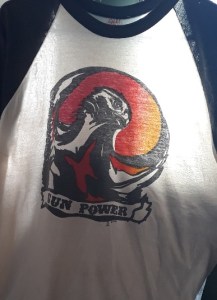
Can’t recall where I got this one, but I still like the graphic and the colors. It’s one of my very few baseball-style shirts.

The political, social, and psychological damage was huge. An immediate consequence was a massive march on Washington on May 6. That’s where I got the NO MORE HARRISBURGS! T-shirt. I don’t know how I came by the staff shirt, because I wasn’t a peacekeeper or otherwise officially involved with that particular action, which drew, according to this May 7, 1979, Washington Post story, “a vast crowd of at least 65,000 protesters reminiscent of antiwar throngs of a decade ago.”[3] I think the ordinary march shirt was blue, with a similar design. The same WaPo story suggests that solar and wind power were on many people’s minds. It reports that in her speech physician and anti-nuke activist Dr. Helen Caldicott said: “I call on President Carter to pass a law requiring every new house to be built with solar energy.”

My younger sister, Ellen, who was living in D.C. at the time, was seriously involved in the anti-nuke movement. She and other members of her affinity group, the Spiderworts, were arrested for demonstrating at the North Anna, Virginia, nuclear power plant on June 3, 1979. As Ellen wrote in a letter from jail dated July 22 and published in the August/September issue of off our backs:

“At our July 17 trial, 109 of us were found guilty and given 30 days and $100 fine, of which the jail time and $50 were suspended on a one year probation. Ten of us immediately placed ourselves in jail, because of our moral opposition to paying fines.”

Why “Spiderworts”? According to a April 25, 1979, story in the New York Times, “a common, roadside wildflower” known to be sensitive to pesticides, auto exhaust, and sulfur dioxide, “could also be an ultra‐sensitive monitor of ionizing radiation.” A Japanese scientist had found that “in certain artificially raised or cloned species of the plant, cells of hairs on the pollen‐bearing stamens mutate from blue to pink when exposed to as little as 150 millirems of radiation. Radioactive isotopes sometimes emitted by nuclear activities give off radiation at about that level.” When it comes to radiation, then, spiderworts can be likened to canaries in coal mines.

My group house sent at least one care package to our cohorts in jail. Beverly, one of my housemates and a chronic instigator, was almost certainly the one who organized the effort.

So that’s how I came by this Spiderworts tank top. I have very few tanks in my wardrobe, and apart from this one they’re all recent. Being big-boobed and physically active, I was never tempted to go braless in public, and with tank tops bra straps were forever slipping into view. Many, many years later bras started coming in colors, with straps that didn’t look so much like underwear. My happy medium back in the day was “muscle shirts,” which left your arms bare but concealed your bra straps. These were big in the 1980s and I have a bunch, but I don’t see them around much these days.

Coincidentally, my sister and I were both arrested at the age of 19 for political protests — eight years apart. On May 5, 1971, toward the end of the Mayday demonstrations against the Vietnam War, I got busted for sitting on the Capitol steps along with 1,200 others, even though we were sitting on the steps at the invitation of four members of Congress: Ron Dellums, Bella Abzug, Parren Mitchell, and Charles Rangel. I spent barely 48 hours in detention — and most of those hours were spent not in a jail but in the D.C. Coliseum along with hundreds of my fellow arrestees. I was one of the plaintiffs in Dellums v Powell, so almost 10 years later, thanks to the four representatives and the persistence of the ACLU, I received a $2,000 settlement for violation of my civil liberties.

Singer-songwriter-activist Holly Near was “On Tour for a Nuclear-Free Future” in the fall of that year, 1979, but this T-shirt is from the Boston performance. I definitely wasn’t there, but I was back and forth between DC and Boston two or three times a year and might have picked up the shirt at New Words Bookstore in Cambridge. D.C.-based Roadwork produced the tour, so I’m guessing the tour stopped in Washington. If it did, I would have been there.

It would not have been the first time I heard Holly live: that, I’m pretty sure, was at D.C.’s Gay Pride Day when it was still a block party on 20th Street NW between R and S, near where Lambda Rising bookstore was then located — maybe in 1978 or ’79?* She toured with Weavers alumna Ronnie Gilbert in 1984; I saw them at George Washington U., and the Lifeline album that resulted has never been far from my active playlist, first on LP and eventually on CD.

During the run-up to the 2012 presidential election, I got to hear Holly live on Martha’s Vineyard, at the Old Whaling Church. It was one of the rare times where my past and present crossed paths, and it’s no surprise that Holly was at the intersection. She has long been as well known in liberal and progressive circles as she is among feminists. I’m still quoting, or paraphrasing, something she said at that concert: that she didn’t expect perfection in any candidate for elective office, so she voted for the one she thought she could “struggle with.”

Totally unrelated to nukes and anti-nukes, the first national march for lesbian and gay rights took place on October 14, 1979. You bet my friends and I were among the estimated 100,000 marchers, but if there was a march T-shirt, I missed it. I do have one from the second march, in 1987; we’ll get there eventually. My strongest memory from that day is passing by the high wrought-iron fence at the south end of the White House grounds chanting “Two, four, six, eight, how do you know that Amy’s straight?” Amy Carter, the first daughter, was 12 years old at the time.

* * * * * * * * * * * * *

I believe this shirt was from the mid-1970s, and I think I got it from Mal Jones, who was my family’s Vineyard neighbor long before I moved to the Vineyard. The Save the Whales campaign targeting Japanese whaling practices was in the news ca. 1974. I wasn’t involved, but I never turn down a free T-shirt, and it does seem related to all of the above. This is probably, in other words, one of my very earliest shirts.

notes

[1] Maddow, Blowout: Corrupted Democracy, Rogue State Russia, and the Richest, Most Destructive Industry on Earth (Crown, 2019), chapter 2, “The Genie”

[2] With four decades’ worth of hindsight, it seems that the quantifiable damage done outside the plant was minimal.

[3] Note that the ERA march that took place less than a year before drew more than 100,000. One can’t help wondering if the Post reporter noticed, but maybe it’s just that the majority-female throng in July 1978 looked less like the antiwar marches of yesteryear.

* Update from 11/30/2021: It was 1978. My memory was just refreshed by a story I wrote about the D.C. Area Feminist Chorus that was published in Hot Wire: The Journal of Women’s Music and Culture in November 1985. More about the chorus, and Hot Wire, to come. Hot Wire‘s 30 issues are a precious trove of women’s/lesbian music through the mid-1990s, and they’re all available online as downloadable PDFs. You can find them here.

If you want to leave a comment and don’t see a Leave a Reply box, click the title of the post and then scroll to the bottom.