Black Hog, Dead Dog

If you’ve ever spent time on Martha’s Vineyard, or know someone who has, you’ve almost certainly seen a Black Dog T-shirt. The Black Dog T is, in a word I’m coming to hate, iconic. I do not own one of those Black Dog T-shirts. I do own these parodies, the Black Hog and the Dead Dog, created by Vineyard artisan Peter Hall around 1990. And thereon hang several tales.

Around 1990, before the Black Dog Tavern turned into an empire but when its signature T-shirt was well on the way to becoming a terrible cliché, Peter Hall created a T with the black dog logo upside down. Threatened with legal action, Hall took the upside-down dog shirts off the market. One of the great regrets of my life is that I didn’t move fast enough to get one.
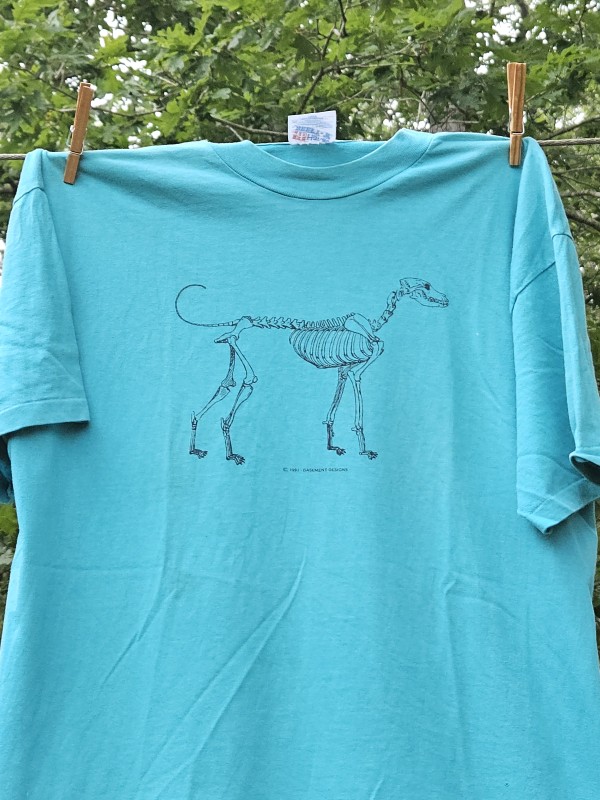
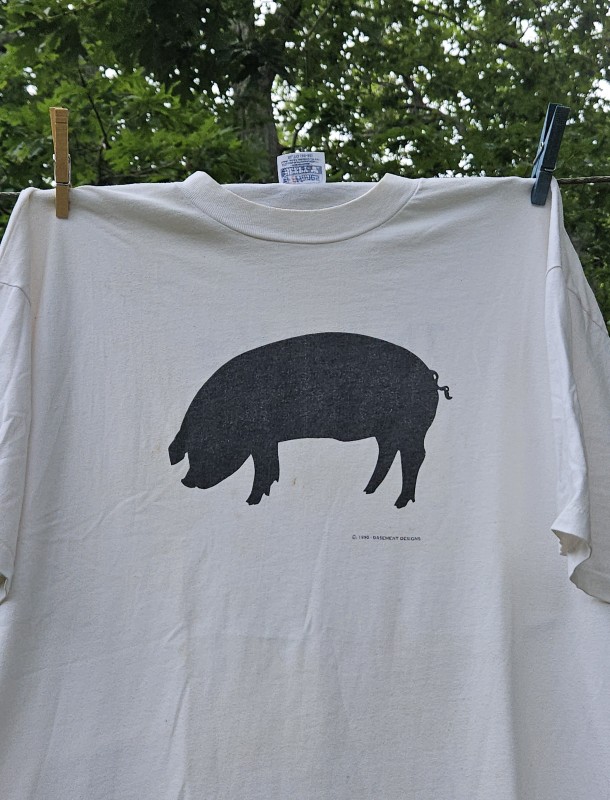
Above: the Dead Dog (2nd edition). Right: the Black Hog.

Shortly thereafter, Hall’s Basement Designs released two more shirts: the Black Hog and the Dead Dog. This time I moved fast enough to get one of each. The Black Dog sued for, among other offenses, trademark infringement, unfair competition, and unfair and deceptive trade practices. In a June 1993 decision, the U.S. District Court for Massachusetts pretty much supported Hall:

“For all of the foregoing reasons, this court finds that defendant’s use of his Black Hog and Dead Dog marks is a parody of plaintiff’s Black Dog marks having the intention and effect of amusing, rather than confusing, the public. Plaintiff’s claims of infringement, unfair competition, dilution and deceptive trade practices, therefore, are dismissed.”

You can read the whole decision here.

One of the delicious side effects of the brouhaha was that it came to light that in the mid or late 1970s the Black Dog owner had paid only $25 to the woman who designed the logo that was now helping the company make millions. I believe the artist got more money.

The backsides of the Dead Dog and the Black Hog. You’ll notice the similarity of the font to that used on the Black Dog shirts. The 1993 court ruling suggests that this is consistent with parody as long as there’s no intent to fool customers into thinking this is the real thing.

The owner, Robert S. Douglas, was not a struggling entrepreneur. When he died earlier this year, age 93, both Vineyard newspapers, the Vineyard Gazette and the Martha’s Vineyard Times, published extensive obituaries, but neither one mentioned his grandfather, James Henderson Douglas Sr., who was a founder of Quaker Oats.1 Robert Douglas’s influence on the Vineyard, especially Vineyard Haven and the maritime community, is a significant legacy, but it didn’t come out of nowhere either.
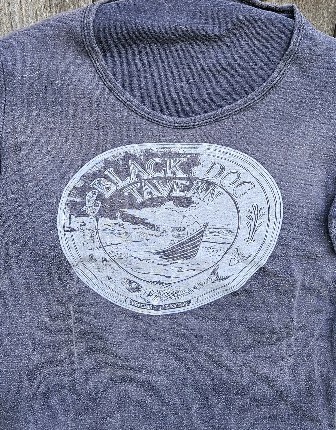
This is my one and only Black Dog shirt. I don’t know how I came by it, and there’s no indication of when it was made. It predates the iconic solo dog design. Early or mid 1980s? Late ’70s?

NOTE

  1. The Douglas Archive, a genealogical site based in the UK, has entries for Robert S. Douglas and his father, James Henderson Douglas Jr. The latter refers to James Sr. as a Quaker Oats co-founder, but he doesn’t seem to have his own entry. ↩︎

Incomings & Outgoings

Like all feminist bookstores, Lammas was a hub for the feminist and lesbian communities of the D.C. area, but because D.C. itself is a hub for the nation and the world, women from all over sought out Lammas when they were in town for conferences, school trips, vacation, you name it.

The librarians were my favorite. They’d come in from all around the Mid-Atlantic region and beyond, especially from small cities, towns, and rural areas with no feminist bookstore in reach. They’d nearly always have shopping lists, gleaned from feminist publications and word of mouth, and often dropped two or three hundred bucks in a visit.

Where did my T from the 14th Women and the Law conference come from? I didn’t attend, though it was indeed in D.C. An attendee might have given it to me, or it might have been left behind at the shop. I like the design: it illustrates how effective black & white can be.

Was the conference still being held? A Google search turned up several conferences with similar names, but none of them dated back this far. off our backs devoted about half of its May 1983 issue (vol. 13, no. 5) to the 14th conference; you can view it online at JSTOR, but you’ll need a JSTOR subscription to download it.

Searching on the full conference name, in quotes — “National Conference on Women and the Law” — yielded paydirt: a 1994 article by Elizabeth M. Schneider: “Feminist Lawmaking and Historical Consciousness: Bringing the Past into the Future.” (Published in the Virginia Journal of Social Policy & the Law, vol. 2, no. 1, it’s now available as a free PDF download, but the godawful URL is four lines long. Go to BrooklynWorks, “open-access scholarship from Brooklyn Law School,” and you can search for it there.) It’s worth the trip. Schneider writes that the conference, which was held from 1970 through 1992, “played a crucial role in shaping feminist legal history over the last twenty-five years.”


Lammas occasionally went on the road as well, and that’s how I came by “Sisterhood Is Blooming / Spring Will Never Be the Same”: selling books at a women’s conference at West Virginia University in (I’m guessing here) 1983 or 1984. The keynote speaker was Maya Angelou, and my main visual memory of the conference was of being near the back of a vast, packed gymnasium with Angelou onstage at the other end.

I’ve never been comfortable in crowds of mostly strangers, but I did fine when I had a role to play, and it didn’t get much better than selling feminist books and records to women who didn’t have ready access to either except by mail-order. Lammas owner-manager Mary Farmer was far more gregarious than I ever was. As a Ladyslipper distributor, she was often on the road in her big red Olds, visiting record stores or selling records at women’s music concerts. I was just as happy holding the fort at home.