Being new on the island and knowing almost no one, I obsessively read posters on telephone poles, devoured the Martha’s Vineyard Times front to back,[i] and studied everything on every bulletin board I came across. Surely there had to be some feminist activity somewhere, and if there was, surely a lesbian or two would be involved?
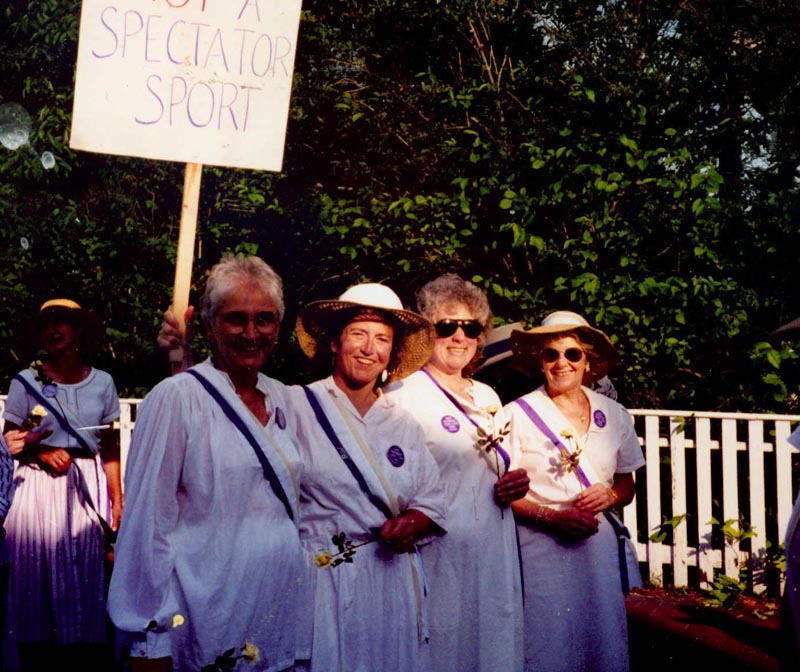
Well, no. As noted in Adult Child of Theater, my first connection with Vineyard lesbians (and gay men) was through theater. I did, however, find feminism on a bulletin board: several women were organizing a panel discussion on women’s issues for the local League of Women Voters. Contacting them, I learned that not only were they League members, they made up an informal women’s group that had been meeting for several years. I helped organize the panel, and after the project came off successfully I was invited (along with the other drop-in organizer) to join the group. This was my “girl gang” for about 10 years. Would I have stayed on the Vineyard without it? Quite possibly not, but unfortunately I have no T-shirt to show for it.
My early searching also led to the Flip Side, an itinerant performance venue that, as I recall, happened in a tent outside what was then the Ocean Club, an upscale seasonal restaurant, and later became home to the year-round Wintertide. I don’t remember which musicians I first heard there, but it was definitely my introduction to the literary trio known variously as the Poetry Construction Company (because if you weren’t in construction on Martha’s Vineyard, you weren’t taken seriously) or the Savage Poets of Martha’s Vineyard: George Mills, Lee McCormack, and Michelle Gerhard (now Jasny; a veterinarian whose clients have included my three dogs, she’s been writing the Visiting Veterinarian column for the Times for about three decades).
That led me to Wintertide Coffeehouse in the winter of 1986. Back then it was then a weekend thing from January through March, usually one weekend night a week, sometimes two. When I joined the all-volunteer crew, it was held at the Youth Hostel. Donna Bouchard, an experienced concert promoter, was then the coordinator. Not being a techie, I gravitated to the food operation: along with coffee and tea, we offered snack plates with crackers, cheese, salsa, and veggies.

By this point, Wintertide’s origins were already murky: ask three old hands how it started and you’d get three different origin stories. A few years later, for a 1991 Martha’s Vineyard Times story, I traced a credible line of descent back to 1979. This roughly coincides with a 2021 M.V. Times story (not by me) which located Wintertide’s origin in 1978 as part of Project, a program of M.V. Community Services aimed at giving young people off-season recreational options other than bars. Wintertide’s antecedents were more diverse than the Times article suggests: read the comments for a fuller story. Vineyarders have a long history of entertaining each other after the tourists and summer folk go home, and Wintertide was part of that tradition.
From the Youth Hostel, Wintertide moved to the basement of the Stone Church in Vineyard Haven, where it remained for the rest of the 1980s.
Wintertide performers included local musicians, the occasional touring singer-songwriter, and even musicians with national reputations and recording contracts. I heard jazz musician Stan Strickland at Wintertide when it was at the Youth Hostel, playing with Barbara Dacey, who along with being a musician was also a mainstay for decades at WMVY radio. Among the performers I heard for the first time at the Stone Church were Cheryl Wheeler and Bill Morrissey.
There was no shortage of island-grown talent either: Maynard Silva, Nancy Jephcote, Tristan Israel, Jimmy Burgoff, and many more. It was an ideal place to develop and perfect performance skills.
In a 2010 letter to the Times, I wrote: “The Wintertide I remember was a place where Vineyarders of all ages, old-timers and recent arrivals, came together to entertain ourselves. In the process we learned how to manage the kitchen, run the soundboard, or even perform onstage, whatever needed to be done.”
Inspired by the Savage Poets, I read poems at Wintertide’s regular open mics, and each winter I organized a “Word Wizardry” night featuring Vineyard poets and prose writers. Reading poetry before audiences primed for music taught me the importance of performance. In general I wasn’t a fan of poetry readings, but the likes of Judy Grahn, Pat Parker, Marge Piercy, and Audre Lorde had shown me that readings can be riveting.
Mary Payne of Island Theatre Workshop coached me in reading my own work: “The first rule,” she told me, “is to forget that you wrote it.” Just because you wrote it doesn’t mean you can communicate it effectively to a live audience. In fact, it can make it harder. You know what thoughts and feelings inspired the poem. When performing, you have to get your listeners to feel them too.
Tony Lombardi, the sound tech when Wintertide was at the Stone Church, had a vision of Wintertide as a year-round chem-free multigenerational hangout and performance space. He, with much help from others, made it happen: Wintertide opened year-round at Five Corners in January 1991. This momentous move looked like the dawn of a new age for Wintertide, but it turned out to be not just the end of the beginning — the years of being a peripatetic off-season venue — but also the beginning of the end. It was glorious while it lasted.

In my capacity as Martha’s Vineyard Times proofreader and frequent features stringer, I wrote the story about Wintertide’s big move. Later that year I succeeded Eileen Maley as the Times features editor. As I wrote in a 2018 blog post: “Not only was I a Wintertide board member, regular volunteer, and occasional performer, I was the Times features editor. To put it mildly, the roles got blurred. Wintertide had very little money for advertising; I could put whatever I wanted in the paper’s Calendar (arts & entertainment) section.” Once the Times moved to Five Corners that fall, it was right around the corner from Wintertide. That blurred the roles even further.

I’ve come to think of year-round Wintertide as, like Camelot, a “brief, shining moment.” The shining was real. I think especially of the Singer-Songwriter Retreats of 1992 and 1993, masterminded by Christine Lavin and brought to life by a cast of dozens, if not hundreds. The resulting recordings — Big Times in a Small Town from ’92 and Follow That Road from ’93 — are still available and still wonderful.
I think also of WIMP, the Wintertide Improv group, a troupe of Vineyard actors whose performances usually included a new installment of Troubled Shores, a serial soap opera about island life. WIMP continued after Wintertide’s demise in various locations. Troupe member Donna Swift started a long-running improv program for young people called, you guessed it, Troubled Shores. (See this 2008 Vineyard Gazette story for some of the details.)
But the brevity was also real, and probably inevitable given the place and the personnel. That prime, central, highly visible location was high rent for the time, which meant attention had to be paid to the bottom line, i.e., income. A local restaurateur was willing and able to take charge of the kitchen, which could have put Wintertide on a firmer financial footing without changing its mission or its vibe. This not only clashed with Tony’s vision of an all-volunteer operation, but it would have put a second person, the restaurateur, at the heart of it. Tony couldn’t have that. He wouldn’t compromise with Christine Lavin either, so after those two glorious years the Singer-Songwriter Retreat dwindled into a strictly local affair.
It was not a good sign that, long before that, I and a few other longtime volunteers had taken to calling the coffeehouse “Tonytide,”[ii] which pretty much sums up the problem.
Then Tony decided (for reasons I don’t know, because I and quite a few others had either left or backed off by then) to move on, and Wintertide began its fast slide into history. Tony’s subsequent projects, usually aimed at young people, happened under the aegis of the then new Vineyard YMCA, which meant access to both space and revenue that didn’t have to be raised through operations. He could have his cake and eat it too: run an all-volunteer operation without having to worry about the bottom line.
* * * * *
Meanwhile, on Daggett Ave. . . .
Daggett Ave. Cafe, another grassroots creative effort, started around 1990 — on, you guessed it, Daggett Ave. in Vineyard Haven, where a friend of musician/artist/eventual web designer Heather Goff was living at the time. As a single mom with a very young child, Heather usually couldn’t go out at night, so she invited creative friends over to entertain each other. By the time I learned of it, it had outgrown the friend’s living room. Most of the ones I attended took place downstairs at the Vineyard Playhouse, emceed by Helen Stratford, but before it moved to the Playhouse at least one Daggett Ave., maybe more, happened in the amazing great hall at Fourway on Franklin Street. It included not only poetry and music but dance and video — I distinctly remember Michael Johnson wheeling in a TV on a cart to show video.
Not all is lost (but things have changed)
Despite the devastation wrought by astronomical real estate prices, the consequent exodus of so many younger people from the Vineyard, and the fact that those who remain are often working two or three jobs and have little time to volunteer, there are signs that the grassroots music and arts scene is reviving, thanks in significant measure to nonprofit support and private funding. Circuit Arts, based at the Grange Hall in West Tisbury, is the relatively new umbrella organization drawing together several arts groups, including the Martha’s Vineyard Film Festival, the M.V. Children’s Theater Camp (a direct descendant of the Children’s Theatre started by Mary Payne), and Circuit Films.
Another new nonprofit, Stillpoint, got the go-ahead earlier this year to convert a West Tisbury barn into a multi-purpose community gathering place.
Wintertide never seriously sought foundation or corporate funding. It might have survived if it had, but for Tony that was out of the question: it would have meant giving up too much control. It’s just about impossible to imagine a seat-of-the-pants operation like Wintertide getting off the ground today, funded entirely by “sweat equity” and with none of the financial kind. But sweat equity magnified by generous donors and professional know-how? It seems to be having an effect.
Notes
[i] The fledgling Martha’s Vineyard Times, about which more later, was free, which the island’s other weekly, the Vineyard Gazette, was not. Everyone agreed that the Gazette had better photographs, but it was also Edgartown-centric and oriented to “the summer people,” neither of which applied to me, and besides, I was looking for island news, not pictures.
[ii] An infuriatingly inaccurate Martha’s Vineyard Patch story from 2012 suggests that we weren’t the only ones who conflated Tony and Wintertide: Tony did too.


 The T-Shirt Chronicles