1991–1994, etc.: ILGA, the Island Lesbian & Gay Association

The early ’90s get slippery for dates especially where the lesbian and gay awakening on Martha’s Vineyard is concerned. Complicating the chronology is that no one seems to have kept copies of Stone Walls, the handsome newsletter put out by Dan Waters and Hal Garneau for the fledgling Island Lesbian & Gay Association. I need to pay a visit to the Vineyard Gazette’s archives and also to find out what the Martha’s Vineyard Museum has in its files, but these things aren’t likely to happen till the worst of summer is over.

In late 2014, I was reminded of the importance of getting this history down where other people can find it. That summer, The Yard, a seasonal dance colony in Chilmark, claimed to have held the first public gay pride event on Martha’s Vineyard. I heard nothing about it through the usual channels, which is to say Facebook, word-of-mouth, or the bulletin board at up-island Cronig’s. No one else I know did either.

This was not surprising. A strange barrier stands between the summer island and the year-round island. It’s porous enough to see through, but only in one direction: we can see it, but it can’t see us. In June 2015 I blogged “Gay on MV” to get some of the history out there. Exactly seven years later, I had an opportunity to do it again, at the ceremonial raising of the “Progress Pride” flag in Ocean Park. “Pride Flag Flying,” another blog post, includes the remarks I prepared for that event.

So please consider this a work in progress.

When I moved back to D.C. in the spring of 1977, I knew where to find the lesbians and the feminists: through Lammas, the feminist bookstore, and through the Washington Area Women’s Center, then housed in the basement of the abandoned-and-falling-into-disrepair Sumner School at 17th and M Streets N.W.

Moving to Martha’s Vineyard in 1985 — for a year, mind you, just for a year — it was a different story. Where were the lesbians? I read every poster on every bulletin board and telephone pole and skimmed every story in both newspapers, looking for signs of lesbian, gay, and/or feminist activity. Nothing. Most startling was that no one seemed to be talking about AIDS, which by 1985 was a huge issue in D.C.

As recounted in “1985–86 (etc.): Adult Child of Theater,” it was much easier to find a 12-step program for adult children of alcoholics. And through that I found lesbians, gay men, and the island’s vibrant theater scene. As I wrote in “Gay on MV,” the Vineyard’s theater community was “like theater in most other places: a veritable hotbed of misfits and nonconformists, gay, lesbian, straight, both/and, and neither/nor. My people.”

But no one said “gay” or “lesbian” out loud in public. Oh no! If you did, it was assumed you were one, and that was risky. So we said “the L-word” (almost two decades later this commonly used closet phrase was appropriated for a TV series) or used the ASL sign for “L” or (gods help us) substituted “Lebanese” for “lesbian.” The island was just discovering AIDS, but to hear health-care professionals talk, you’d have assumed that HIV could only be contracted from dirty needles and blood transfusions.

The island’s lesbians and gay men knew better. Nancy Luedeman (1920–2010), theater mainstay and recovering alcoholic, created a panel for the AIDS Quilt that was included in the Quilt’s first national display in October 1987. Two of the four Vineyard men it memorialized were identified only by first name and last initial, the other two by initials only.

Around 1990 that began to change. See “Visiting the AIDS Quilt with My Mother” for what I currently recall (and have to further research) about this period. Many island gay men and lesbians realized that the time had come to go public, in part to help clear up the widespread misconceptions about gay people but also so we could find and support each other.
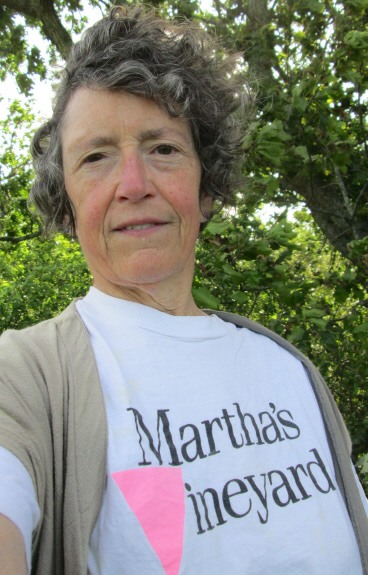
Me and the more discreet of ILGA’s two T-shirts in July 2014. In the early ’90s you could wear this one anywhere and hardly anyone knew what it meant.

The first meeting of what became ILGA, the Island Lesbian and Gay Association, took place in the big room at the Wooden Tent on State Road, Vineyard Haven, which was then owned by Edie Yoder and Kathy Rose. I was there, along with some 25 other Vineyarders, about half of them women and half of them men, nearly all of whom I knew at least by sight. Sitting in a big circle, we went round and introduced ourselves. When the third Kathy introduced herself, people were starting to chuckle, then when Lansing Bailey — a burly gent who was older than most of us — introduced himself as Kathy, we all lost it completely. No one there will ever forget it.

What neither I nor anyone I’ve spoken with so far can remember is exactly when this meeting took place. My best guess is 1991, either spring or fall (because no one has time for organizational meetings in the summer, and what’s more, that was the summer of Hurricane Bob).[2] Fairly early in 1992 I moved into the guest house at the Wooden Tent, and I’m 99% sure that at the time of that meeting I was still living up-island.

You could only wear this one out in public if you were willing to stop people in their tracks. Photo from July 2014.

ILGA’s primary purpose was social — our potlucks were amazing! — but it had a powerful impact on gay and lesbian visibility on Martha’s Vineyard. In the early ’90s you could wear the pink triangle shirt down Main Street, Vineyard Haven, without getting any double-takes or snotty remarks: the only people who recognized the pink triangle were friendly and everyone else thought it was just another Vineyard T-shirt. It took considerably more chutzpah to sport the “No Man Is an Island Lesbian” shirt in mixed company.

For the first time a newcomer or someone just coming out could find the words “Lesbian” and “Gay” in the organizations listing of the Vineyard phone book. Two of us, Robert Cropper and me, were out enough to have our names and phone numbers listed. (I don’t recall ever getting a crank call from that listing.)

Around this time — 1992 and ’93 — a homophobic politician, Ron Beaty Jr.[3] by name, on the Cape took to writing nasty letters to the editor equating gay people with immorality and AIDS, and pushing Gay Rights, Special Rights (1993), a video promoted by the Traditional Values Coalition.[4] A lesbian couple wrote a letter to the Martha’s Vineyard Times rebutting such fallacious fear-mongering. The editor said he’d publish it but only if their names were included. Since this couple had several kids in the school system, this was outrageous and several of us (I was the Times features editor at this point) said so, but it was the editor’s wife who got through to him: “Of course you should withhold their names,” she said, and that was that. The letter was published with the writers’ names withheld.

In the fall of 1993 two Oak Bluffs town fathers tried to get two of the earliest kids’ books about gay/lesbian families pulled from the Oak Bluffs School library: Heather Has Two Mommies (1989) and How Would You Feel If Your Dad Was Gay? (1991). This spawned several contentious meetings and letters to the editor. I remember one meeting in particular where the town fathers were joined by a fundamentalist minister and a former marine known for striding around town in his red satin Marine Corps jacket. At one point the minister claimed that AIDS was God’s scourge of the homosexuals (IIRC he used that exact phrase), to which ILGA regular Michele Lazerow pointed out that lesbians had the lowest incidence of HIV/AIDS of any group. This was greeted with much laughter and applause, so I don’t know whether the minister responded.

The heroes of the meeting were the school librarian, Jan Buhrman, and the eighth-grade member of the school committee, Jay Borselle.[5] Their eloquence helped turn the tide, and it reassured me and others that we had allies willing to step up. At the same time, the Martha’s Vineyard Library Association was the only organization that spoke out against the attempted book banning. As a former bookseller, I expected no less — librarians are the best! — but the silence in other quarters was disappointing.

In response I took the lead in organizing a Banned Books reading at Wintertide Coffeehouse in January 1994. I read from Heather Has Two Mommies, Robert read from How Would You Feel If Your Dad Was Gay?, and 18 or so volunteers picked a book from the American Library Association’s Banned Books list and read a short excerpt from it. The Rev. Ken Miner (d. 1997), pastor of Trinity United Methodist in Oak Bluffs, read the David and Jonathan story from the Bible. The place was packed, and we all went home invigorated.

That spring, the short-play festival at the Vineyard Playhouse included Susan Miller’s “It’s Our Town Too,” a poignant riff on Thornton Wilder’s classic Our Town in which the parents of the young people who grow up to marry are a gay couple and a lesbian couple.

Several ILGA members marched in Boston’s Gay and Lesbian Pride parade that June, behind a banner created by signmaker (and musician) Tom Hodgson. I don’t remember why I didn’t join them, maybe because I’d ODed on Gay Pride in my D.C. days, but I did get to a “Celebrate Gay Cod” event on the Cape that month. That’s where the button at the beginning of this piece comes from.

NOTES


[1] The AIDS Alliance sponsored the first Crossover Ball on New Year’s Eve 1994. Boys dressed as girls, girls dressed as boys, and everyone had a blast. These continued more or less biennially till 2005. Can you imagine such a thing happening on Martha’s Vineyard in the ’80s? I can’t either.

[2] Late October of that year brought the equally memorable No-Name Nor’easter, known elsewhere as the Perfect Storm. It delayed the move of the Martha’s Vineyard Times, whose features editor I then was, from Woodland Market to Five Corners. This makes me think that the first ILGA meeting happened earlier in the year, but we shall see!

[3] Gadfly Beaty is nothing if not persistent. For a summary of his antics, see this 2018 call for his removal from his seat on the Barnstable County Council. He wasn’t removed then — the BCC doesn’t have a removal mechanism — but he was eventually defeated for re-election. Now in 2024 he seems to be running again. He has referred to himself as the “Donald Trump of Cape Cod” and once referred to activist David Hogg as a “self-promoting opportunistic rat.”

[4] I procured a copy of this so several of us could see it firsthand. This got me on some pretty disgusting right-wing mailing lists, but eventually the appeals and alerts stopped coming.

[5] By the end of the decade, Jan Buhrman had begun an ever expanding and deepening career as a cook and advocate for locally sourced ingredients: https://www.janbuhrman.com/. Jay Borselle became a journalist and is now the news director for WBZ NewsRadio in Boston.

1990: Visiting the AIDS Quilt with My Mother

I’d already seen the whole AIDS Quilt twice, but my mother hadn’t seen any of it ever. I think going to see this display of a small part of it was her idea, but I was up for it. I also think she bought me the T-shirt, but I was up for that too.1

For the record, although the T-shirt says “Boston,” the display we went to was at MIT in Cambridge.

1990 stands out in my memory as the year Martha’s Vineyard discovered AIDS. Since HIV/AIDS was already looming large in the gay community, and increasingly in the lesbian community, when I left D.C. in 1985, this caused some cognitive dissonance, to put it mildly.

In D.C., since I was immersed in “the community” and worked at the feminist bookstore, I was generally and accurately assumed to be a lesbian. I never had to come out. When I got to the Vineyard, I realized I didn’t know how. Life was further complicated by the fact that at the time, most women dressed like the dykes I knew in D.C. — jeans, flannel or button-down shirts, shoes you could walk in. I learned to surreptitiously check for the presence or absence of a ring on the ring finger of any new acquaintance, though this could be misleading.

Me in my Common Threads shirt, 34 years later.

Life was even further complicated by the fact that if you said the word “lesbian” out loud everyone would (a) turn to look at you, and (b) assume you were one. This was OK with me but it wasn’t OK with others.2 So people really did use the American Sign Language sign for “L” or say (I’m not kidding about this) “Lebanese” when they meant “lesbian.”

As related in “1985–1986 (etc.): Adult Child of Theater,” I lucked out early. I’d arrived on the Vineyard in search of a 12-step program, and in finding ACA (Adult Children of Alcoholics) meetings, I also found lesbians — one lesbian in particular, the late Mary Payne, founder and artistic director of Island Theatre Workshop. She lured me into theater, and through theater I found my tribe(s).3

Is it fair to say that the island in general was less welcoming, less friendly? Since little if anything made it into the public eye, e.g., the newspapers or the island’s bulletin boards, it’s hard to know what people “in general” were thinking. I do remember attending a public meeting about HIV/AIDS in the very late 1980s where one of the main speakers, a locally prominent mental-health professional, implied that HIV/AIDS could only be contracted through blood transfusions and dirty needles.

This was beginning to change, however. Around that time, or maybe a little later, a proposal to install condom dispensers at the high school sparked controversy. Naturally some people disapproved because it was seen to condone students being sexually active, but the tide seemed to be moving in a more practical direction: if/when students were sexually active, they should be safely sexually active. Condoms helped avoid pregnancy, yes, but they also helped prevent the spread of STDs (sexually transmitted diseases), and the scariest STD at that time was HIV/AIDS.

Here’s where chronology gets a little fuzzy. My memory is clear, but so far I’ve found nothing to confirm or correct what I remember. What I remember is that a youngish Vineyard man named Joel Counsell died in a house fire in Vineyard Haven. The backstory, which I knew through word of mouth, mainly through 12-step connections, was that Joel, an addict and/or alcoholic who was also HIV-positive, had been trying to get help, but the island’s health-care options were too fragmented. The only support he found was in AA meetings that included gay or lesbian members.

After Joel’s death, and at least partly in response to it, the AIDS Alliance of Martha’s Vineyard was formed, both to coordinate and publicize the services available to people with HIV/AIDS, from testing to counseling to treatment, and to educate the public about the disease.4 (Rumors and misinformation about HIV/AIDS spread much more readily than the disease itself.)

Around this time, and related at least indirectly, the Island Lesbian & Gay Association (ILGA) was formed. I was one of the 26 Vineyarders at the first meeting, which was held in the big room at the Wooden Tent, then owned by a lesbian couple.5 More about ILGA in the next installment of The T-Shirt Chronicles.

NOTES

  1. In my defense, I’m pretty sure this was at least a decade before I swore “No more T-shirts!” ↩︎
  2. It took me a while to fully understand how small towns were different from big cities. Once words came out of your mouth, they couldn’t be taken back — and they traveled. Fast. Depending on the subject, you wouldn’t believe how fast. Many of my D.C. friends had moved there from, you guessed it, the small or smallish towns they’d grown up in and, often, where their families lived. So had I. Going in the opposite direction taught me a few things. ↩︎
  3. This included Wintertide Coffeehouse, which until January 1991 happened only on winter weekends. Music, theater, and the grassroots arts more generally tend to be where we outsiders and misfits find each other. ↩︎
  4. AZT was available at this point, but its effectiveness was limited and it was very expensive. Treatment options began to increase and improve in the early 1990s. Here’s a brief summary of how they advanced. ↩︎
  5. A couple of years later, in 1992, I became their tenant, moving into the separate guest house on the property. I lived there till the fall of 2001, which at that point was by far the longest I’d lived anywhere on the Vineyard. ↩︎

1985–1986 (etc.): Adult Child of Theater

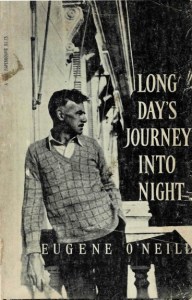
Where to begin? The family I grew up in had upper-crusty antecedents on both sides — New England on my father’s side, Virginia/Maryland/New England on my mother’s — but we looked middle/upper-middle class. My father was an architect. My mother didn’t work outside the home while my brothers, sister, and I were growing up. She talked with such evident longing about having done summer stock theater after WWII (during which she was in the SPARs, the women’s unit of the Coast Guard Reserve) that when I first read Eugene O’Neill’s Long Day’s Journey into Night my senior year of high school, I connected her instantly with Mary Tyrone, who clings to a belief that she could have been a concert pianist if only she hadn’t got married.

I’ve carried this copy with me since my senior year of high school.

That was not the only connection between my mother and Mary Tyrone: the latter was addicted to morphine, while my mother’s drug of choice was alcohol. She didn’t stop drinking till after a family intervention when I was in my mid-40s. As a teenager I was deep down convinced that if I drank, I would become an alcoholic too. So I didn’t drink.

In my mid-teens, however, I started eating compulsively. Between the beginning and end of junior year I gained 40 pounds and was totally oblivious till spring weigh-in in gym class. It took several years before I intuited the connection. Nancy Friday’s book My Mother, My Self came out in 1977, the same year I did, in case I needed any encouragement.

Alcoholism was no secret in lesbian and gay communities. For many years, lesbian and gay life had revolved around bars, but even in the late ’70s, when we were conscientiously creating “chem-free” spaces and events, it was impossible to avoid. By the early ’80s we were arguing about ways to deal with it. In the feminist and lesbian circles I moved in by then, the 12-Step program of Alcoholics Anonymous (AA) and Al-Anon was suspect from the get-go for its heavily patriarchal Christian God orientation. I didn’t know how to go about finding meetings that welcomed gay men, lesbians, and/or feminists. Coming up with effective alternatives, however, was a challenge.[1]

Among the first things I did when I landed on Martha’s Vineyard was go looking for a 12-Step program. They weren’t hard to find: both weekly papers included lists of meetings for several programs, mainly AA, Al-Anon, Narcotics Anonymous (NA), and Overeaters Anonymous (OA). That first fall I attended a couple of Al-Anon meetings. Most of the attendees were women with alcoholic husbands or ex-husbands. I was a lesbian who had grown up with an alcoholic mother but had left home a long time ago. They were dealing with day-in-day-out reality; I was dealing with patterns rooted in the past.

Since food was obviously my drug of choice, I tried a couple of OA meetings. At the time the few OA options on the Vineyard followed the “Grey Sheet” plan, which looked like, and indeed was, a diet. Not what I was looking for. I wanted to deal with the compulsion part, not control the calories I was taking in.

Then I found an Adult Children of Alcoholics (ACA) 12-Step meeting in the doctors’ wing of Martha’s Vineyard Hospital. There I found my tribe. I kept coming back. I was asked to lead the fourth meeting I ever attended. I didn’t realize at the time that this was highly unusual. Leading the meeting was Mary Payne, who was sure not only that the newcomer was, like her, a lesbian but that she would come out if she had to introduce herself. She had my number: I was and I did. On the Vineyard in the mid to late ’80s, gay men and lesbians lived mostly under the public radar. We knew each other, but no one was, as they say, “flaunting it.” This was my invitation. A door opened up. I walked through it, not knowing what the reaction would be. The reaction in that ACA meeting was pretty much “No big deal” and “Keep coming back.”

Along with being the chair of that particular meeting, Mary (1932–1996), the founding director of Island Theatre Workshop (ITW), was frequently described as “a dynamo.” This is 100% accurate. She was under five feet tall but had the presence and impact of a six-footer. AA’s 11th Tradition says that “our public relations policy is based on attraction rather than promotion.” Mary’s PR policy was the exact opposite: she was a tireless promoter, and in her worldview the overlap between theater and recovery was significant. Come by the theater — Katharine Cornell Theatre, “KC” as I soon learned to call it — during a rehearsal, said Mary. ITW was rehearsing Molière’s The Miser. I could help with PR. (This was probably my introduction to the Tisbury Printer, which printed all of ITW’s posters and programs.)

This T isn’t a T at all — it’s got a collar — and it predates my involvement with ITW, but it’s the only ITW shirt I’ve got.

I hadn’t done theater since high school, but over the years I’d often been at least on the peripheries of the performing arts, especially music. Hallowmas, my D.C. writers’ group, had given public readings. I was tempted, but I was also terrified. I envisioned the theater as a cavernous space with tiny figures at the far end, none of whom I recognized and none of whom noticed me.

When I finally mustered the nerve to walk up the outside stairs and open the door for real, what I saw was a cozy, even intimate space, flooded with light from tall multi-paned windows on both sides. Between the windows were four giant murals, two on each wall, depicting scenes from island history and island life.[2] In the mid-1980s the seats were covered in a green vinyl that could emit a sound like flatulence if you changed position. They’ve long since been replaced by a textured blue fabric that remains blessedly silent.

The front of the house, just in front of the proscenium stage, was bustling with activity. Rehearsals usually had two or three dogs in attendance: Mary’s Schipperke, Jenny; Nancy Luedeman’s Lhasa Apso, Featherbell; and Lee Fierro’s Meggie, who was larger than the other two but not by much. Dogs were of course verboten in KC, and equally of course Mary and company ignored the prohibition.

You’ve seen this shirt before, but some shirts keep coming back.

I was quickly hooked. Mary was impossible to say no to, but the reasons for “yes” were compelling. I was still getting my bearings on the Vineyard, still half thinking that I was just here for a year, and here, abracadabra, was a ready-made multigenerational circle of interesting friends and acquaintances, quite a few of whom were lesbian or gay. I got included in potlucks, holiday gatherings, and birthday parties. I got part-time jobs and house-sitting gigs through theater connections. On solstices, equinoxes, and cross-quarter days — the sacred days between the solstices and equinoxes: Samhain (Hallowmas), Brigid (Candlemas), Beltane (May Eve), and Lammas — Mary often hosted witchy celebrations in her living room.

Not surprisingly, all this theatrical ferment affected my writing. I set aside the novel I thought I’d come to the Vineyard to write. What came out of my pen and my brand-new computer was poetry, along with reviews and occasional essays for the lesbian and feminist publications I hadn’t quite left behind. My two first stage-managing gigs, first of Shakespeare’s Scottish Play and then of Medea, inspired work that I’m still proud of, including “The Assistant Stage Manager Addresses Her Broom After a Performance of Macbeth” (see below). I was giving readings and sometimes hosting an open-mic poetry night at Wintertide Coffeehouse (you’ll hear more about Wintertide in a future post). “MacPoem,” as I came to call it, was my favorite performance piece.

Step 2 of the 12-Step Program: “Came to believe that a Power greater than ourselves could restore us to sanity.” Theater was part of that power for me. While growing up, I had associated theater with addiction, so it was wildly appropriate that it become part of my recovery. Mary’s approach was, to say the least, unorthodox, but it worked.

Notes

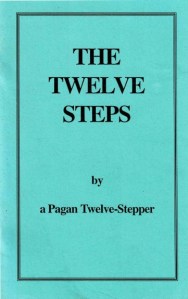
[1] This was what prompted me in the early 1990s to write a series of columns for the feminist wiccan journal Of a Like Mind, on working the steps from a pagan/feminist perspective. In keeping with the 11th and 12th Traditions, these were bylined “A Pagan Twelve-Stepper.” They were popular enough to be collected into a pamphlet, which I’ve still got a copy of.

[2] Before long I learned they’d been painted by Stan Murphy (1922–2003), the eminent Vineyard artist.

* * * * *

the assistant stage manager addresses her broom after a performance of “macbeth”

Who am I? Let me tell you what I do.
Within these walls I manage time and space,
make sure the pitcher’s on its hook before
its bearer wants it, warn the messenger
he’s on soon, check to see his torch is lit
and that the backstage lights are out. Right now
I’m cleaning up debris from this night’s show.
Is this a dagger I see before me?
It is, but split in pieces. I’m the one
who tapes it back together after hours.
Tomorrow night this plastic dagger turns
to steel, honed sharp enough to pierce a haunch
of gristly meat — or Duncan’s royal breast.
Before each show I sweep the stage. I see
green needles strewn where Birnam Wood has come
to rest the night before. I shiver, chilled,
as if I’d slept and woken centuries hence
with all my friends and family dead. And then
I sweep them all away. “Out, out, damn trees!”
I cry, “You haven’t come here yet! Begone!”

Here, separate ages stream like shimmering strands
in one great waterfall, and time dissolves.
Mere mortals we, what havoc do we wreak?
Elizabethan Shakespeare conjured up
Macbeth, medieval Scottish thane, and we
invoke them both, in nineteen eighty-six.
I watch the people enter, choose their seats,
and rustle through their programs. Normal folk,
it seems, and yet this gentle summer night
they’ve purchased tickets to a barren heath,
a draughty castle primed for treachery.
Right now the lights are up, the theatre walls
are strong, the windows fixed within their frames.
At eight o’clock the howling winds begin,
the wolves close in, the sturdy walls are gone.
These common folk, I wonder, have they bought
enough insurance? Have they changed their bills
for gold and silver coin? If challenged by
a kilted swordsman, how would they explain
their strangely tailored clothes?

                   No loyal lord
or rebel threatens me. Between the worlds,
or through this velvet curtain, I can move
at will. I warn the sound technician, “Ten
more minutes,” then I pass backstage to say,
“The house is filling up.” The Scottish king
is drinking ginger ale; a prince-to-be
in chino slacks is looking for his plaid.
The Thane of Glamis is pacing back and forth,
preoccupied with schemes to win the crown,
or trouble with his car. I prowl backstage,
alert for things and people out of place.
Last night I found a missing messenger
outside the theatre, smoking cigarettes.
I called him back in time: Macbeth’s bold wife
demanded news — What is your tidings?; he
was there to gasp, The king comes here tonight!

No phone lines run to Inverness, no news
at six o’clock. (Walter MacCronkite’s face
appears and says that base Macdonwald’s head
was nailed upon the wall, that Cawdor’s fled
and Glamis has been promoted; polls predict
he might go higher still.) The kingdom’s nerves
are messengers who run from king to thane
to lady. Take the Thane of Ross, who comes
to tell his cousin that her husband’s flown
to England, leaving her unguarded; then
he takes himself abroad, to where Macduff
and other rebel lords are planning war.
Macduff’s unguarded lady fares less well.
A breathless runner pleads, “Be not found here;
hence, with your little ones!” but on his heels
come murderers, death-arrows from the king.
Two sons, a daughter, and their mother die
with piercing shrieks that vibrate in my spine.

With piercing shrieks vibrating in my spine,
I contemplate a different line of work;
this sending harmless people to their deaths
is bad for my digestion, and what’s more,
it’s happening much too often. First I let
King Duncan in, and he gets killed in bed.
Could I have known so soon that Cawdor’s heart
was rotten? No. But shortly after, I
send scoundrels to the banquet hall; Macbeth
himself has called them. Not the kind of guest
that Duncan entertained! And then I tell
Macbeth’s friend Banquo and his son it’s time
to join the party. What about the thieves
I know are lurking on the gate road, dressed
to kill? But Banquo is a fighting man,
well-armed, and Fleance does escape. Not so
Macduff’s fair lady, and her kids. Could I
prevent their deaths? What if I plied the brutes
with Scotch? They might get drunk enough to lose
their maps, or drop their knives, or fall asleep.
What if I whispered in the lady’s ear,
“Don’t go outside today — and bar the doors.”

I doubt she’d pay attention. Each one goes
to meet the dagger destined for his breast.
Perhaps I’d get my point across if I
could speak in rhyme and paradox, the way
the witches do, with fair is foul, and foul
is fair. The witches manage time and space
like me; you could call me the unseen witch.
I wonder, are they working from a script?
You’ll see: the second sister sweeps the stage
as I do, clearing them the space they need
to cast their circles. We both summon kings
and apparitions out of time, although
our methods differ some. “You enter soon,”
I warn, “stage right.” Mundane, compared to how
my sisters work, with Double, double, toil
and trouble, cauldron, fire, and lengthy list
of weird ingredients — the eye of newt
and toe of frog, the blood of sow that ate
her piglets — but we get the same results.
Our audience is moved to awe, and then
proceeds along its merry way to rendez-vous
with fate, or Birnam Wood, or man not born
of woman. They get blamed for it. I don’t.

The witches disappear, and one last time
prince Malcolm calls his kin to see him crowned
at Scone. The set is struck, costumes returned
to cardboard boxes, wooden banquet bowls
and Scottish flag to rightful owners; kings
go home to mow the lawn or fix the car.
Where did the blasted heath go off to? I
am leaning on my broom again. What stays
when all the parts spin off? Just memories
of daggers, prophecies, and anguished screams?
The air still tingles here. The gates remain
but smaller, well concealed. I might reach in
and conjure back that knife, that messenger.
“There’s knocking at the gate,” the lady says,
“Give me your hand! What’s done cannot be undone.”  
To bed,
she says. To bed, to bed, to bed.

1984–87: Feminist Women’s Writing Workshops

I’d been writing for publication for several years before I decided that I needed something more. I was well enough educated, but as a writer I was largely self-taught. I belonged to Hallowmas Women Writers, a group of D.C. poets and writers that I’d helped form. It was a lifeline to my writer self, its members were doing interesting work, but all of us were engaged in other activities and I was discontented with the feedback I was giving as well as getting. As a fledgling editor, I’d benefited tremendously from working alongside someone who knew a lot more than I did and was willing to share. Were there comparable opportunities out there for women writers?

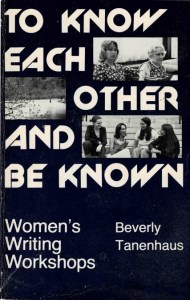
book cover

off our backs carried ads for the Feminist Women’s Writing Workshops (FW3), a 10-day live-in workshop held every summer in upstate New York. Founder-director Beverly Tanenhaus’s book about the workshops, To Know Each Other and Be Known (Motheroot Publications), came out in 1982. Lammas must have carried it, I must have noticed it, but I don’t think I’d actually read it. My copy has “July 1986” written under my name on the title page, which suggests I acquired it at the workshop that year.

I sent for the workshop brochure on February 5, 1984. Tuition, room, and board was $475, $425 if you applied by March 15. Could I afford it? Could I get 10 days off from Lammas in the middle of July? Where the hell was Ithaca, and how would I get there? I didn’t own a car, and my grasp of upstate New York geography was hazy.

Scariest of all, was I really ready? I didn’t know anyone who’d attended the workshop and could assure me that I wouldn’t be in over my head. The biggest risks I’d taken, like moving back to D.C., applying for that editorial job at the Red Cross, and becoming the book buyer at Lammas, had all turned out well. What if this one didn’t?

I sent in my deposit in time to get the early bird discount. My welcome letter from the director was dated March 16. The stars aligned, the logistics worked out, and I arrived by bus in Ithaca on July 15.

To say that the workshop was life-changing is both a cliché and an understatement. Our introductory session that first night opened with a recording from the first FW3 in 1975, of Adrienne Rich’s prose poem “Women and Honor: Some Notes on Lying.” This was already, and has been ever since, the closest thing I have to a bible. It’s about the importance of telling the truth to each other (and, by extension, to ourselves). What better way to challenge us as writers?

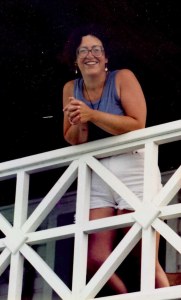
Me on the boathouse balcony just outside our meeting room. Probably 1987.

Our morning class sessions were held in the second floor of the Wells College boathouse, with Cayuga Lake glittering out the window and lapping gently at the shoreline. Each morning, an hour was devoted to the work of each of two participants. Copies had been distributed the previous day, and all of us came prepared. The guidelines: Comments were to be directed to the director, or to each other — not to the writer. The writer’s job was to listen until everyone had spoken, then respond at the end of the discussion. The power of 18 women focusing entirely on my work, taking it seriously for a solid, animated hour, was a revelation. So was the challenge of being one of the 18 women giving feedback to another writer, overriding the voices in my head whispering things like What if I’m wrong? What if I’m missing something? What if this isn’t all that important?

The rest of the day was open. Most of us gathered for meals in the cafeteria — the luxury of not having to prepare our own meals wasn’t lost on any of us — but the rest of the time we went our own occasionally intersecting ways in ones, twos, and threes, walking in the woods, swimming in the lake, writing in our rooms, sitting under a tree or by the lake to write or read.

During the week groups of us took field trips to the National Women’s Rights Historical Park at Seneca Falls, which had opened only two years before, and the National Women’s Hall of Fame, or into Ithaca, to hang out at Smedley’s, the feminist bookstore (proprietor Irene Zahava had been a workshop participant in the past and has edited many, many anthologies of women’s writing over the years), and of course to eat at least once at Moosewood Restaurant.

Poet-novelist Marge Piercy was the guest writer that year, in residence for a couple of days. We also heard from Elaine Gill, co-principal of Crossing Press, then located in nearby Trumansburg, and Nancy Bereano, who had edited Crossing’s Feminist Series and was just then establishing her own Firebrand Books, which quickly became a major player in the feminist print world.

As the re-entry meeting began on the last night of the workshop, I was feeling sad and euphoric, hopeful and apprehensive all at once. We had created magic; would I ever see these women again? As a writer I felt validated and capable; could I maintain my momentum when I got back to D.C.? We went round the circle, each woman sharing what she was going back to and what she was taking home with her. All of us had taken to heart the words of Adrienne Rich at our very first meeting: “When a woman tells the truth she is creating the possibility for more truth around her.”

Almost all of us, as it turned out. About two-thirds of the way around the circle, the workshop blew up. There were four lesbians at the workshop that year, of whom I was one. At the re-entry meeting, the other three charged the rest of us with making them feel unwelcome. They didn’t target me specifically — they didn’t target anyone, and were rather short on specific examples — but I was undeniably on the wrong side of a lesbian-straight split.

After the instigators left the room, most of the rest of us came together to talk about what had happened. We shared our immediate reactions. Most of us tried to identify what we had done to make the three women feel unwelcome. As the only lesbian in the circle at that point, I said I hadn’t felt unwelcome at all. I was a little surprised by this, because I was no stranger to the tensions that sometimes arose between lesbians and straight women in feminist spaces.

The D.C. lesbian feminist community and the national Women in Print network had become my home in a way that my growing-up home wasn’t. They were where and how and why I became a writer: developing my skills, giving me no end of things to observe and think and write about, seeing my words in print, and providing an audience (which I was also part of). So though I did spend time with the other lesbians at the workshop, hanging out with them wasn’t a priority. Connecting with sister writers was. Being taken seriously as a writer was.

Our shared effort that night to come to grips with what had just happened, speaking first-person and from the heart, was rare in my experience — so rare that in the months that followed I wrote a 6,000-word essay (never published) about the workshop experience. I still have the copy I shared with another workshop participant, with her extensive and thoughtful comments on it: she agreed with some of my points, challenged others (sometimes strenuously), and expanded my perceptions of what had happened.

I was willing then, and I’m willing now, to believe that the other three lesbians had experienced lesbophobia at the workshop, even though I had not. My problem then and now was with how they chose to bring it up, starting with the timing. The second-to-last night of the workshop had been devoted to a “creative bitching” session. We talked about what worked at the workshop and what could be improved in the future. Rather than bring their issues up then, the three chose to bring up their complaints at the re-entry session, our last time together as a group. Everyone would be leaving the next day. The three timed their confrontation so they wouldn’t have to deal with its consequences, or even see any of us face-to-face again. Then they walked away from the possibility of expanding truth to include all of us.

In an article about FW3 1986 for Hot Wire, the women’s music and culture journal, I wrote: “Perhaps the hardest lesson to learn is that inclusion in community here depends largely on a willingness to risk telling and hearing the truth — a willingness that is, not coincidentally, essential for feminist writing” (Hot Wire, March 1987).

I learned later that the main instigator of the confrontation had lobbied for a position as an assistant workshop director for the following year and been turned down. Was revenge at least part of her motive? I suspect so. As it turned out, the director asked me to be one of her assistants the next year, which enabled me to attend the workshop free of charge. Of course I accepted, and continued as an assistant through 1987. By the summer of 1988 I’d been hired as proofreader at the Martha’s Vineyard Times so taking 10 days off in the middle of July was out of the question.

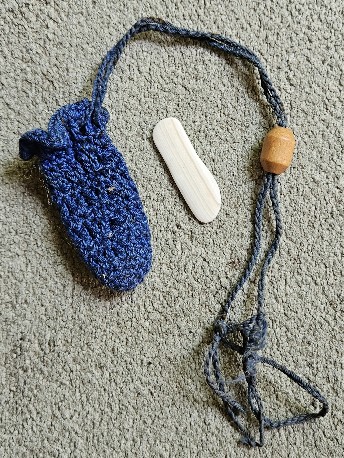
I still have that amulet bag, but my amulet has long since lost its purple. Tina M., if you read this, I remember you!

Before I left for my annual end-of-summer visit to the Vineyard in 1984, my first workshop year, a crafty (in more ways than one) member of Hallowmas Women Writers gave me an amulet bag she’d crocheted for me. For a while I wore that amulet bag around my neck with nothing in it. Then while I was walking on South Beach one afternoon an oblong bit of white-and-purple clam shell caught my eye. Into the amulet bag it went. When I returned to D.C., I wore it everywhere.

For a long time I liked to attribute my decision to move to Martha’s Vineyard to that amulet. There was, need I say, more to it. For years the lesbian feminist community and my writing had fed each other, confirmed each other, formed a dynamic whole. In the early ’80s fissures were growing just below the surface. In the early to mid 1980s AIDS, a barely identified syndrome with a dismal prognosis, was devastating the gay male community. Meanwhile, the lesbian community was polarizing around the so-called sex wars. The front lines included pornography and s/m, which one side saw as irredeemably misogynist and the other as liberating. Women I knew and admired were on both sides; the accusations were ugly and loud. As a writer I felt caught in a middle that was critical of both factions and wasn’t being heard. Did that middle even exist?

My experience at the 1984 Feminist Women’s Writing Workshop helped clarify and focus my uneasiness. If the community of lesbians and the community of writers diverged, my path would lie with the writers.

Looking back later, I realized that my urge to “get out of Dodge” had plenty to do with the Reagan administration, which altered the feel of D.C. whether you had any connection to the federal government or not. In July 1985, I left D.C. with all my belongings in a rental truck, deposited them in the basement of my parents’ home in the Boston suburbs, returned to the Feminist Women’s Writing Workshops for my first year as an assistant director, and by the end of the month was more or less living on Martha’s Vineyard.

When I Am an Old Woman

I acquired this shirt when I was around 30. Both the shirt and the poem whose first line graces it were popular with women my age, give or take a decade. This may sound odd but it isn’t: the poet, Jenny Joseph (1932–2018), was 29 when she wrote it, in 1961.

The possibly odd thing is that Jenny Joseph hated purple. It didn’t suit her, she said. I can’t help wondering if that was always the case. She was an accomplished poet, the author of several children’s books, and an all-round interesting person, but the poem became far more famous than she. Once the internet came along, it circulated widely with no name attached, and it has been often “adapted” over the decades — Google “when I am an old cowgirl” if you don’t believe me.

That’s enough to turn anyone against purple even if they loved it to start with. We poem quoters and T-shirt wearers loved purple. Lavender was for lesbians, and what was purple but a deeper shade of lavender? (If a T-shirt came in multiple colors, you could count on the lavender ones selling out first.)

So fast-forward about four decades. My friend Dan Waters — poet, master printer, artist, photographer, and my town’s moderator, among other things — has been photographing Vineyard characters for the Martha’s Vineyard Museum, and he asked if he could photograph me. Hell yes, said I.

Photo by Daniel A. Waters

As the appointed date for the shoot approached, however, I was having second thoughts. It wasn’t that I was nervous about being photographed, it was that I couldn’t decide what T-shirt to wear. As you well know by now, I have a lot of options. Should I pick a Vineyard shirt? one from my horsegirl years? an overtly feminist or blatantly dykey shirt?

I spread the likeliest candidates, at least a dozen of them, out on my bed. When my eye fell on “When I Am an Old Woman,” I knew: That’s the one.

The shirt is purple, of course, though you can’t tell that from the photo. I don’t generally think of myself as an old woman, though, since I was going on 70 when Dan took the picture and am closing in on 71 now, I surely am.

This particular T-shirt seemed right because I was wearing purple then and I’m wearing purple now.

The last three lines of Jenny Joseph’s poem go like this:

But maybe I ought to practise a little now?
So people who know me are not too shocked and surprised
When suddenly I am old, and start to wear purple.

No one, but no one, who knows me at all could be shocked or surprised that I wear purple. It’s probably one of my lesser idiosyncrasies.

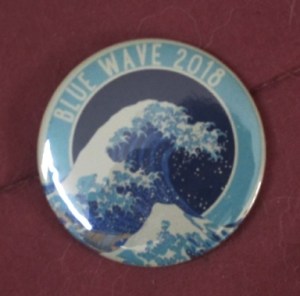
Wave image by Hokusai, button design by Alison Scott

From a visual point of view, I rather wished I hadn’t decided to wear those two buttons, but they do represent important parts of my life. The one on the left is “Blue Wave 2018,” about the midterm elections during what blessedly turned out to be the Trump administration’s only term.

The one on the right — well, that goes back a while. It’s from the October 15, 1969, march to end the war in Vietnam. The D.C. march was my first big demonstration. I was a first-semester freshman at Georgetown University, majoring in Arabic and already minoring in antiwar organizing. The same logo was used on the two-day moratorium that preceded the huge November 15, 1969, national march on Washington. The two-day Moratorium, November 13 and 14, included a long, solemn, single-file march from Arlington National Cemetery to the White House. Each marcher carried a sign bearing the name of a service member or civilian who had died in Southeast Asia. At the White House they deposited their name signs into coffins that had been set up for the purpose.

Dan’s photo of me, blown up to four by five feet, will eventually appear in rotation in the lobby of the Martha’s Vineyard Museum. He’s been at work on this project for a few years now: in 2019, before Covid-19 shut everything down, a selection of the huge photos was displayed at the museum. Who knows, maybe mine will eventually appear in a group show too!

If you don’t see a Leave a Reply block, click on the title of this post and then scroll to the bottom.

Wayward Books & Women’s Glib

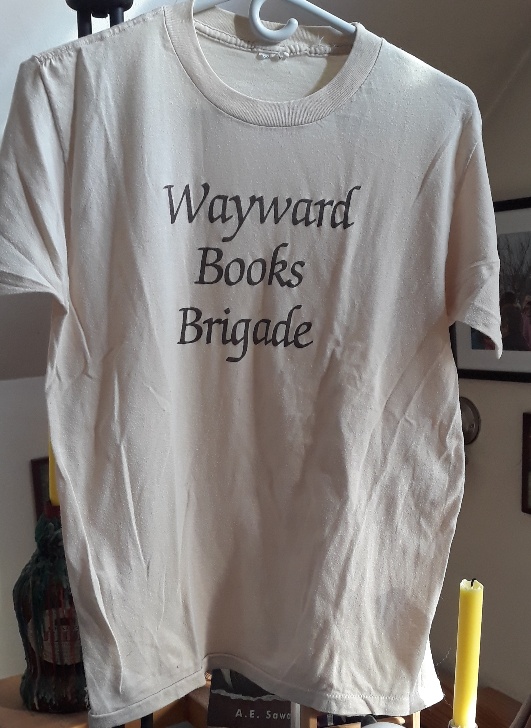
When bookstores move, staffers usually pack the books in boxes, load the boxes in a truck, and drive the truck to the new location. When Wayward Books moved, owners Sybil Pike and Doris Grumbach packed the books in grocery bags and volunteers passed them hand to hand along Pennsylvania Avenue SE to the new shop at 325 7th Street., which was practically next door to Lammas. I was one of the volunteers, and that’s how I got this T-shirt.

True, the distance was only three or four city blocks, and as I recall the brigade didn’t quite stretch the whole distance, so cars were called upon to ferry the books across the gap. But the operation was ingenious and fun, and it worked.

Wayward Books dealt in a carefully curated mix of secondhand and rare works, which meant those books had already been around. They probably took their latest move in stride.

Lammas was well represented in the Wayward Books Brigade, and not only because Wayward Books was moving into the immediate neighborhood. Pike and Grumbach had been a couple since the early 1970s, and Grumbach’s novels were regular sellers at Lammas, notably Chamber Music and The Ladies, which was based on the “Ladies of Llangollen,” two 18th-century Irish women who eloped to Wales, set up housekeeping as a married couple, and whose home became a go-to destination for literary luminaries of the time. Grumbach’s books focused on women’s lives, and often women in relationship with each other, which was not all that common at the time, especially for “mainstream” novelists.

Sybil, a retired research librarian at the Library of Congress, was the on-site manager at Wayward Books — I remember her as a strikingly handsome woman who would have been in her mid-fifties at the time — but Doris was also around when she wasn’t teaching or writing. The two shops complemented each other nicely: their inventories didn’t overlap, but their customers did.

A Washington Post story from April 1990, reporting on Wayward Books’ relocation to Sargentville, Maine, that month, notes that the Wayward Books Brigade comprised 70 volunteers and moved some 3,000 volumes from old location to new. The move to Maine involved three times that many books and was presumably not accomplished hand to hand.

The Post story also says the hand-to-hand move to 7th Street happened in 1985. I would have said a year earlier, because I left D.C. at the end of July 1985 and it seemed Wayward Books and Lammas had been neighbors for more than a few months at that point. But memory is tricky, so maybe not.

I just learned that Sybil passed in March of last year, at the age of 91, but that Doris seems to be alive in her 104th year. It sounds as though, around 2009, they moved together to a retirement community in Pennsylvania, where Sybil died and Doris still lives. Anyone with more information, please respond in the comments. If you don’t want your comment published, say so and it won’t be.


This T-shirt has nothing to do with Wayward Books — except that they both have to do with books, and that Women’s Glib was somewhat wayward in that it had to do with feminist humor, which many continue to swear is an oxymoron. Not for the first or last time, those “many” are so wrong.

Women’s Glib and Women’s Glibber, anthologies edited by Roz Warren, both came out in my bookselling days — I think. Amazon.com gives the early ’90s as pub dates for both books but notes in one case that it’s a second edition. I’m pretty sure I didn’t have anything in either book, although I was the class clown (female) in sixth grade and have been credited with having a pretty good, albeit barbed, sense of humor in all the decades since.

Interestingly enough (to me, at least), this is one of the very few — maybe even only? — Ts I have that features a book. I’ll hedge my bets on that one till I’ve excavated my whole collection. Either few books were featured on Ts or I wasn’t buying (or being given) the ones that were.

My humor tends to be in the moment — I think the word is “situational,” meaning that it arises from circumstances. I’ve never been fond of the other kind, such as stand-up, mainly because stand-up comedy back in the day was so misogynist, even when performed by one of the few women in the trade. Phyllis Diller embarrassed and infuriated me. I could admire Lucille Ball and I Love Lucy while being mortified by her tactics.

As a teenager and young adult I was a huge fan of the Smothers Brothers and Rowan and Martin’s Laugh-In. By the time Saturday Night Live got going, in the mid to late 1970s, I was doing fine without a TV and besides, SNL didn’t seem all that in sync with the lesbian-feminist life I was living.

Humor that was in sync with my life — I loved it. Alison Bechdel’s Dykes to Watch Out For strip and the books compiled from it were huge hits with Lammas customers. So were Nicole Hollander’s Sylvia books. They kept us laughing, and they kept us sane.

The first stand-up comedian who made me sit up, take notice, and even buy at least one of her albums was Kate Clinton. I heard her perform live in the early ’80s. What a revelation! The problem with stand-up comedy wasn’t me, it was the sexist, heterosexist comedy itself!

I’m thrilled to report that Roz Warren and Kate Clinton are still “making light,” as an early Clinton album had it, and you’ve almost certainly heard of Alison Bechdel, if not of Dykes to Watch Out For. I’m not sure if Nicole Hollander is still creating, but it’s not hard to find Sylvia online.

Sylvia — that Sylvia — was one of the namesakes of the TRS-80 that was Lammas’s and my first computer. The other two, as I think I mentioned before, were Sylvia Sherman, my high school history teacher, and Sylvia Abrams, my editorial mentor, without whom I would have had a hard time making a living these last four decades.

Hot Wire & Ladyslipper

December got away from me, as it often does, but I’m back! My last few posts have focused on music, and this one does too.

I was down to the last two music-related T-shirts from my D.C. days and couldn’t figure out how to tie them together. Should each one maybe get its own short post?

Me in my Ladyslipper T in 2021. This design was “vintage” by the time I acquired it, probably after I started working at Lammas.. It’s unusual in my collection both for its long sleeves and its French cut. The long sleeves mean it gets worn regularly in spring and fall.

Then I got it: These two Ts, one from Ladyslipper Music and one from Hot Wire: The Journal of Women’s Music & Culture, both represent the national and international aspect of women’s music, but I had an up-close-and-personal relationship with both of them. I contributed a couple of articles to Hot Wire, including the one about the D.C. Area Feminist Chorus. At Lammas, I shared the upstairs office with Flo Hollis, a full-time Ladyslipper staffer, Lammas owner-manager Mary Farmer was a Ladyslipper distributor, and the code for the Lammas alarm system was Ladyslipper’s PO box number: 3124.

Turns out there was another close connection. Hot Wire has made all 30 of the issues it published between November 1984 and September 1995 available for free as downloadable PDFs, but rather than search each one for articles about Ladyslipper — I was 100% certain they had to have published at least one — I Googled. Imagine my surprise when the story I turned up had been written by me.

OMG. Turned out the date in that citation, May 1985, was wrong — Hot Wire didn’t publish an issue that month — but another reference to the same article had the correct date, March 1985. I downloaded the whole issue and read my own words from almost 37 years ago.

From Hot Wire, vol. 1, no. 2 (March 1985)

No question, it sounds like me. Many of the details came roaring back from my memory; others I’d never forgotten. Some of it I had no recollection of at all. What impresses me the most going on four decades later is the account of how the Ladyslippers dealt with a complete communications breakdown among the three full-time staff members in the winter of 1982–83. “What often happens in such situations,” I wrote, “is that one person leaves, and the level of tension drops for a while.” But at Ladyslipper, as staffer Sue Brown noted, “everyone was too stubborn to leave.”

So they went into counseling as a group. As I wrote, “They were not prepared for the speed and intensity with which issues came to the surface.” In retrospect, Liz Snow described the experience as “shocking.” They continued in counseling for “about ten months.” No one abandoned ship. Ladyslipper did not fall apart; it continued to develop as a major force in the women’s music and culture scene for as long as there was one.

By then I’d had plenty of experience with groups that foundered on their inability and/or unwillingness to work things through. I’d left the Women’s Center collective because the group dynamics were driving me crazy and I had no idea what to do about it. So Ladyslipper’s example was an inspiration: with hard work and, most likely, some help from the outside, we could get through the rough places.*

Fans of Dykes To Watch Out For will immediately recognize the image as the work of Alison Bechdel, who went on to international fame as the author of the graphic memoir Fun Home and other works. We really did know her when.

Which brings me back to those 30 issues of Hot Wire, all available for free download. What a treasure! They’re indispensable, sure, for anyone interested in the stars and rising stars of the women’s music scene of the 1980s and ’90s, but note how many articles are devoted to how-tos and behind-the-scenes movement building. We were starting from scratch in those days, pretty much building the plane as we were flying it, because there were so few experts to learn from.

At the same time, we knew we hadn’t come out of nowhere. Enough others had tended enough fires to leave sparks. It’s a relief to know that the fires are still being tended, and the sparks are still out there, like fireflies on a summer night.

If you want to leave a comment and don’t see a Leave a Reply box, click the title of the blog post (above) and then scroll to the bottom.

notes

* I don’t need to say (do I?) that these problems are not unique to feminist groups. After I moved to Martha’s Vineyard, I found no shortage of examples of groups that either fell apart or drove some of their most valuable members out. Not infrequently those who left would start a new group whose purpose duplicated or overlapped with the old. When the Vineyard finally discovered AIDS, around 1990, it became apparent that various complementary organizations either weren’t aware of or weren’t on speaking terms with each other. More about that later.

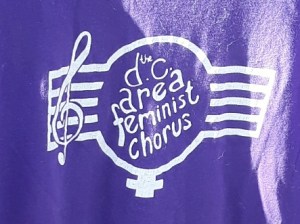
1984–85: D.C. Area Feminist Chorus

The story behind this one starts way, way back, long before I moved to D.C. the first time.

My family wasn’t especially musical. My maternal grandmother played the piano by ear, which I thought was cool, but unless Granmummie was visiting,[1] what music there was in our household came via records and the radio.

Not to discount the importance of records, however: When I left for college, I absconded with my father’s Joan Baez album, her first. I didn’t need to take his Tom Lehrer LPs — Lehrer’s first, the one whose cover featured a caricature of the pianist as the devil surrounded by the red flames of hell (see below), and That Was the Year That Was — because most of the songs were embedded in my memory.

I’ve still got that Joan album, and the 10 or so of its successors that I acquired legitimately in the following years, and I still know a ridiculous number of Tom Lehrer songs by heart.[2]

See what I mean? Originally released in 1953, when I was 2.

Like many middle-class-and-up suburban kids my siblings and I took piano lessons with varying degrees of enthusiasm. The teacher wasn’t especially inspired or inspiring. I did learn to read music, but I didn’t learn to pick songs out of the air the way my grandmother did. That was disappointing, but what I didn’t really understand was what all that tedious practice could lead to. If I had, maybe I would have persisted.

Or maybe not.

I did, however, like to sing. Singing was the best part of church, where we went almost every Sunday morning as a family: St. Peter’s Episcopal in Weston, Mass. From fifth grade through eighth I sang alto in the junior choir. After eighth grade, when we aged out of both the junior choir and Sunday school, we could join the adult choir, but the adult choir sang at the 11 a.m. service and my family went to the 9:15. That’s when I left the church.

In my eighth-grade year, Becky B., also an eighth-grader, a soprano who’d been in the choir as long as I had, told me that I always sang off-key. To avoid ruining the anthem, she said, I should just pretend to sing.

No one else — not the choir director/organist, not any other member of the choir, not any of my music teachers in school — had ever told me any such thing. Becky B. didn’t like me and I didn’t like her; she was a goody-two-shoes who was always playing up to the adults. But I feared she was right, that I had been found out.

Somehow I made it through the year. Then I stopped singing. Period. When I entered high school in the fall, the music teacher encouraged me more than once to try out for Glee Club. Since she directed the Glee Club, this should have given me confidence, but it didn’t. I was sure I’d fail and confirm beyond any doubt that Becky B. was right: I couldn’t sing.

It was years before I recognized the pattern: I’d pursue a skill, an instrument, a foreign language — then abandon it when I was on the verge of being able to actually use it. At that point you’re bound to make mistakes. In my family making mistakes got you creamed. My very intelligent and well-read father regularly ridiculed my mother for getting the wrong answer or saying anything he considered stupid. I learned to get my facts straight before I opened my mouth. From an early age I’d been good at words, anything to do with words. I stuck to words, spoken and written, but never sung.

I never stopped listening to music, though, or hanging around people who made music or were somehow in the music biz. Gradually, and usually in fits and starts, I got braver, venturing into territories where I didn’t have all the answers and was bound to make mistakes: taking that first editorial job at the American Red Cross, for instance, or becoming the book buyer at Lammas Bookstore. I did well at both, but note that they both had to do with words: in some ways I was pushing the boundaries of what I was already good at.

The D.C. Area Feminist Chorus was founded in 1978, prompted by a singing workshop led by Holly Near during that year’s Gay Pride celebration. In its early months it was leaderless, with members leading warm-ups and teaching each other songs.

At some point, they decided to engage a director/conductor, and after interviewing several candidates, they hired Deb Weiner. Deb either was already or was soon to become one of my housemates, but this did not prompt me to join the chorus. If anything, it was a deterrent: What if it was your housemate who had to tell you that you couldn’t sing on key and were dragging the group down?

I have an indelible memory of Deb conducting the combined D.C. Area Feminist Chorus and Gay Men’s Chorus of Washington at a holiday concert, in either 1981 or 1982. To be the conductor channeling all that massive sound! I was awed.

How did I come to finally join the D.C. Area Feminist Chorus? Well, I have it on good authority — my own words from 36 years ago — that I set out to write a story about the chorus for Hot Wire: The Journal of Women’s Music and Culture “and almost immediately found [my]self singing in the second soprano section.” By then Deb had moved on after several very successful years, Caroline Foty was the chorus director, and I was living on the far northeast fringe of Capitol Hill, subletting a large room from and sharing a kitchen with photographer Joan E. Biren (JEB).

By then, probably in 1984, I had joined the brand-new Gay and Lesbian Chorus of Washington (GLCW). How did I hear about it? I don’t remember. This was a small group, conducted by Tess Garcia, and my most vivid memory was of a performance we gave where Congressman Barney Frank, dressed in a leisure suit, reclined across several chairs in the front row. Most of the homemade cassette tape I have from a June 1985 performance is unplayable, but on the one audible cut, “Johnny, We Hardly Knew Ye,” we sound pretty good. According to the label, the program also included some P.D.Q. Bach, the spiritual “Soon Ah Will Be Done,” and selections from Annie.

I noted the most striking contrast between my two choruses in that Hot Wire story: “Because the GLCW did not choose to specialize in works by gay or lesbian composers, a chorus member could walk into any music store and be overwhelmed by the available selection.” Not so any Feminist Chorus member: all our music consisted of handwritten scores photocopied or similarly duplicated, because none of it had been published. Director Foty did some of the arranging, and fortunately feminist choruses were thriving at the time, and lots of sharing went on among them through the Sistersingers network. We were breaking ground, pioneers, in the forefront, and very aware of it.

We sang at least two songs from the Balkan women’s singing tradition. I can still fake the second soprano part of “Shto Mi e Milo,” which has been widely recorded.

One of my favorites from the chorus repertoire was a four-part setting of Edna St. Vincent Millay’s “Conscientious Objector.” I didn’t realize till about an hour ago not only that Mary Travers had performed it spectacularly, but that she wrote the solo setting and recorded it on her 1972 album Morning Glory.[3] I have a copy of the poem on my fridge: “I shall die / but that is all I shall do for Death . . .” It reminds me of the song.

The chorus made decisions collectively, including decisions about repertoire. “Conscientious Objector” almost didn’t make the cut; that was before I joined, so I don’t know what the objections were. As I recall, a couple of chorus members thought Malvina Reynolds’s “We Don’t Need the Men” was too anti-male. For others among us, this was a plus, not least because it was so tongue-in-cheekily Malvina. It was fun to remind people that Malvina wrote it in 1959.

The most controversial song I remember from my time in the chorus was “Sisters, Spring of Vietnam”; it clearly favored the Vietnamese liberation struggle against the French and the Americans, and that did not sit well with some members. Singing along with Lucha’s version I remember the tune, the harmony, and many of the words, so I’m pretty sure we sang it anyway, but some choristers chose to sit it out.

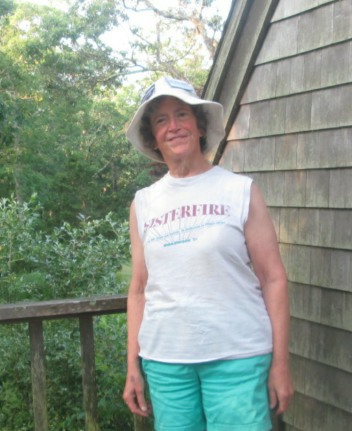
The back of the 1985 Sisterfire T. The D.C. Area Feminist Chorus is about halfway down.

My last gig with the D.C. Area Feminist Chorus was at Sisterfire, June 22 & 23, 1985. By the end of that summer I was semi-settled on Martha’s Vineyard. Music was much easier to find than feminism, and find it I did, volunteering at Wintertide Coffeehouse starting in 1986.

It took a while to find a way to start singing again. My way in turned out to be the annual Christmas performance of Messiah, sung by a large (and ever growing) pickup chorus of Vineyarders, many of whom sang regularly in various church choirs.

I’d never sung Messiah before, and most of the chorus seemed to know it by heart. More, although I could read music, I couldn’t “sight-sing,” sing from a score on first acquaintance. I still regret not having the nerve to audition for Glee Club in high school, where everybody learned to do stuff like that. I worked hard, I learned, and when, in my third year, I made it through the glorious “Amen” without losing my place, I thought I’d arrived.

The annual Messiah sings eventually grew into the Island Community Chorus, which did several concerts a year and with which I stayed until around 2005. I’ve managed to keep singing since then. In the age of Covid-19, I’ve participated almost weekly in Zoom sings (Zings?) with Susan Robbins of Libana, a women’s ensemble whose music I’ve loved since at least 1980, and a bunch of whose recordings I’ve got.

But it was the D.C. Area Feminist Chorus that got me singing again, and though I didn’t sing with it for much more than a year, this shirt is about how I found my (singing) voice again.

If you want to leave a comment and don’t see a Leave a Reply box, click the title of the blog post (above) and then scroll to the bottom.

notes

[1] Which was fairly often, because she lived only eight miles away.

[2] This is so common among the political circles I’ve moved in over the decades that if I sing or even hum a line, often someone in the vicinity will sing the next one back to me. A favorite memory from my freshman year at Georgetown U.: As a marshal for the huge Mobe (Mobilization Against the War) march on Washington on November 15, 1969, I was stationed on Pennsylvania Ave. between 6th and 7th. We were close enough together that we could reach out and touch our neighbors on either side. It was sunny but bloody cold, and my winter gear was still back in Massachusetts: I had this idea that since D.C. was a southern city I wouldn’t need it till after Thanksgiving. Wrong. Anyway, while waiting for the sun to get fully up and the march to start, we did a lot of jogging in place and making coffee runs to the nearest drugstore. Eventually one of us — maybe me, maybe not — started in on a Tom Lehrer song. No idea which one, so many of them would have been appropriate — maybe “The Wild West Is Where I Want to Be,” with its lines “I’ll watch the guided missiles / while the old FBI watches me”? We were sure the FBI and who knew what other intelligence agencies were around.

[3] My source for this is a detailed bio of Edna St. Vincent Millay on, of all things, the website for the ABC Oriental Rug & Cleaning Company in Ithaca, N.Y. There has to be an interesting story here, but I’ll have to save that rabbit hole for another time. The page seems to be updated regularly: it includes a reference to the ongoing pandemic and other events.

1980s: Sisterfire, Equinox & Sophie’s Parlor

Me looking stern in my 1983 Sisterfire T. The blue hat doesn’t quite work with the shirt and shorts, IMO. 2018 selfie.

Sisterfire is the only women’s music festival I ever attended. Both my T-shirts call it “an open-air celebration of women artists,” so it wasn’t just about music, but music was the main event. I was never seriously tempted by other music festivals, which were proliferating in all parts of the country in the 1980s. Partly it was that, working in a feminist bookstore and living in a lesbian community as I did, I didn’t need to travel to hang out with other dykes. Mostly I wasn’t and never have been comfortable in crowds of people I don’t know.

Even crowds of all women.

Back of the 1985 Sisterfire shirt. Pretty impressive lineup, no? The D.C. Area Feminist Chorus is in the middle, right above Diane Lindsay & Sue Fink.

I have, however, been known to enjoy myself in very large groups if I have a role to play. At Sisterfire I was part of the Lammas/Ladyslipper team, selling mostly records but some books as well. In 1985, the D.C. Area Feminist Chorus, in which I was then singing, was one of the street performers, so you’ll find its name on the back of the Sisterfire shirt for that year. Chorus members performed wearing the chorus’s own shirt, and you bet I’ve still got mine. It’s got its own story to tell and will get to tell it soon.

Me looking less stern and more color-coordinated in my 1985 Sisterfire T. 2018 selfie.

Sisterfire’s other compelling attraction was location: it took place in the close-in D.C. suburb of Takoma Park, Maryland. It was founded in 1982 by Amy Horowitz and the D.C.-based production company Roadwork, and the T-shirts testify that I was there in 1983 and 1985.

I left town in a U-Haul truck not long after that year’s Sisterfire, which my T-shirt says was on June 22 & 23, but Sisterfire continued into the late ’80s, not without controversy, not least because men could attend. I don’t remember the male presence being distracting or disruptive. On one hot afternoon, I do remember the announcer asking men to keep their shirts on because thanks to local ordinances and conventions women couldn’t take ours off.*

By the early 1980s, Roadwork was, in community terms, a powerhouse, booking national tours for the likes of Sweet Honey in the Rock and Holly Near and producing such standout concerts as the Varied Voices of Black Women (1978) and Cris Williamson’s appearance at Constitution Hall (1980). Naturally we sometimes snarkily referred to it as Roadhog, and a local graphic artist sported a brilliant parody of the 1983 Sisterfire shirt: it looked just like the official one till you realized the letters spelled out SISTERBLITZ.

Equinox Productions was a grassroots women’s production company — “group” is probably a better word, because they were all volunteers — formed to produce gigs too modest to get Roadwork’s attention.

One major benefit of Equinox and similar groups was the opportunity they gave women to develop skills in areas we’d been generally shut out of, like concert production and sound tech. D.C.-based Woman Sound, owned and managed by audio engineer Boden Sandstrom,[1] was a pioneer in the field and highly professional by the time this article appeared in the June 22, 1981, Washington Post.

By the time I moved back to D.C. in 1977, women’s music’s center of gravity — Olivia Records and the recording artists associated with it — had moved to the West Coast, but D.C. still had a thriving local music scene. Food for Thought, a popular vegetarian restaurant on Connecticut Ave., frequently featured live music; performers got paid by passing the hat. At least once singer-songwriter Casse Culver came down from the upstairs dressing room after her set, bandana masking her face like a Wild West bandit, and conducted pass-the-hat as a stickup. You probably couldn’t get away with that now, but at the time it was hilarious.

My favorite local musicians at the time included singer-songwriter Judy Reagan and the blues duo of Abbe Lyons and Cheryl Jacobs. Church basements and college classrooms[2] were popular year-round venues, and music could regularly be heard at rallies, demonstrations, and Gay & Lesbian Pride Day every June.

Sophie’s Parlor, the women’s radio collective’s show on WPFW-FM, was part of the mix, featuring interviews, books, and more as well as music. I’m pretty sure that this shirt was given to me by my Lammas colleague Deb Morris, who continued in the book biz long after I left and with whom (thanks to Facebook) I’m back in touch.

Sophie’s Parlor still has a weekly show on WPFW-FM. Wow. Its Facebook page says it’s “the oldest continuously running women’s music radio collective in the United States,” which is more than remarkable. The FB page also notes that it was founded at Georgetown University in 1972. I dropped out of GU halfway through my junior year, in December 1971; I remained in D.C. for the next few months, but I wasn’t aware of Sophie’s at that time. Next step is to see if I can livestream their weekly show: Wednesdays @ 3 p.m. EST.

I’ve long had a mild hankering to do a radio show — mild enough that I never sought out an opportunity to actually do it, and no opportunity ever presented itself. The closest I ever came was getting to pick what got played on the Lammas record player whenever I was working the floor. (Often I worked upstairs, keeping inventory on 5×8 file cards, one for each title, and placing orders. This was in the pre-digital age.) This was often how customers first heard the latest Cris Williamson or Holly Near, since they weren’t getting airplay in radioland, and of course we took requests. On Valentine’s Day every year I’d play all the shit-kicking anti-love songs I knew of. Favorites included Therese Edell’s “Winter of ’76,” Judy Reagan’s “Dispose of Properly,” and a whole bunch of Willie Tyson songs. Sample:

You go out to the kitchen
to get somethin' to eat
I watch you pick your bay leaves from a poison ivy tree
I got a feelin' you're gonna starve to death when I'm gone
Here's a brand new dime
Now you call me if I'm wrong
     © 1977 Willola Calloway Tyson
This is the back cover photo of Judy Reagan’s album Old Friends. I can name at least three-quarters of the women in it. That’s Judy at the top (you probably guessed this already). Photo by Morgan Gwenwald, used with permission.

If you want to leave a comment and don’t see a Leave a Reply box, click the title of the blog post (above) and then scroll to the bottom.

Notes

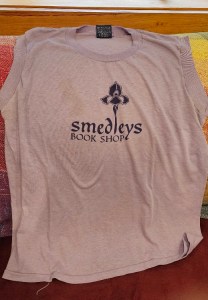
Curious fact: These four music shirts, all from the first half of the 1980s, are all muscle shirts, i.e., sleeveless. What makes this noteworthy is that I have maybe ten muscle shirts total in my extensive collection, and the others vary in subject: one’s goddess-related (you can see it at the bottom of the pagans post), one’s a dragon, and one’s from Smedley’s bookshop in Ithaca, N.Y. (that one will be along shortly), etc. So why (1) are so many of my muscle shirts music-related? and (2) did they go out of fashion?

* For more about Sisterfire’s early years, and why it didn’t happen in 1986, see Nancy Seeger, “Sisterfire: Why Did Roadwork Skip 1986,” Hot Wire: The Journal of Women’s Music and Culture, vol. 2, no. 4 (November 1986), p. 28. All of Hot Wire‘s 30 issues are available online as downloadable PDFs. You can find this one here. The story notes that in 1985 a petition opposing Sisterfire circulated in Takoma Park. Reasons included traffic and parking, noise, “the smell of marijuana smoke,” and “some women attending the festival wore no shirts.”

[1] Boden, then going by Barbara, is credited as engineering assistant, to veteran engineer Marilyn Ries, on Casse Culver’s 1976 LP Three Gypsies (Urana Records, founded by Marilyn Ries and K Gardner). The June 1981 WaPo story says that Woman Sound was then coming up on its sixth anniversary, which would have put its founding around the time Three Gypsies was being recorded.

While poking around online (I’ve been doing a lot of that while working on The T-Shirt Chronicles), I came across this tribute by Boden for her friend and mentor Tommy Linthicum, who passed away in 2007. In it she explains how she got into biz: Casse was looking for someone to train to run her sound. They eventually became partners.

[2] Particularly at George Washington University, where Lisa C., the office manager for the Women’s Studies department, was a frequent collaborator for both musical and literary events.

Pagans, Witches & Healers, Oh My!

Georgetown University is a Jesuit-run Catholic institution, and when I was there, 1969–1971, Catholic undergraduates were required to take four semesters of theology. Non-Catholics could take theology, but I opted for the alternative requirement, a two-year, four-semester course called Comparative Civilizations, aka “Comp Civ.” This was taught by Father Sebes, a diminutive older Jesuit whose academic background was in Far Eastern studies. The course covered Hinduism, Buddhism, Islam, and Taoism, and might (can’t remember for sure) have included some mention of the various flavors of Christianity. We referred to it as Pagan I and Pagan II.[1]

What was my image of “pagan” at that point? Surely I associated “pagan” with the gods and goddesses of ancient Greece and Rome, with the likes of Socrates, Plato, and Julius Caesar. The myths were interesting, but they were “back then,” history, and ancient history at that. Besides, the Christians had vanquished the pagans, right?

That changed big-time when I moved back to D.C. in 1977 and came out into lesbian and feminist communities that had been discussing religion, spirituality, ancient history, and related issues for years, and not with academic detachment either. Paganism, loosely defined or not defined at all, was alive, lively, and everywhere. Interest in Wicca, especially of the women-only Dianic sort, had been growing and deepening for at least a decade. (Diana and her Greek counterpart, Artemis, being the very rare goddesses who had as little to do with men as possible.)

Take Lammas Bookstore, where I quickly became a regular customer and eventually, in 1981, the book buyer. Founded in 1973, Lammas was named for the cross-quarter day between the summer solstice and the fall equinox. Before I moved back to D.C., I doubt I knew what a cross-quarter day was.

Someone must have given this to me, but I can’t remember who. This was a popular slogan. It was guaranteed to piss humorless Christians off.

The triumph of Christianity over paganism, considered a civilizational advance by the winners (surprise surprise), had also marked the “triumph” of a solitary male god over a pantheon that included goddesses as well as gods. As it turned out, over the centuries and millennia the goddesses in those pantheons had been losing power and status to the gods. In the myths I learned growing up, Hera had power but Zeus had more. It had not always been so.

I came to see Mary in a new light, as a vestige of the once powerful goddesses. The relentless male supremacists of the early Christian Church hadn’t been able to stamp her out. They co-opted her instead. Paradoxically enough, the intensely sexist and often misogynist Catholicism I’d encountered at Georgetown had a female side that the Episcopalianism I’d grown up with lacked.

The Christians were adept at co-opting what they couldn’t entirely suppress. Many major Christian holidays piggy-backed (that’s a polite term for it) on the old pagan solstices, equinoxes, and cross-quarter days: Christmas is Yule (winter solstice), Easter (spring equinox), and so on. The pagan year began with Samhain, Halloween, which I like most of my cohort learned about as a kid in single digits.[2] Clearly there was much more to it than trick-or-treating.

Getting ready to pop the cork at a Lammas anniversary celebration. From left: Liz Snow of Ladyslipper, Lammas owner Mary Farmer, me, Tina Lunson (printer), and Deb Morris. Probably 1983.

Lammas celebrated its anniversary every year with champagne and a big sale; the ceiling of the Seventh Street store was cork-pocked from those celebrations. Lesbian households might observe the various pagan/wiccan holidays, and often enough there were well-attended public rituals that featured singing, poetry, and lots of candles. We identified ourselves to each other by the jewelry we wore (pentacles, labryses,[3] goddess figures), the greetings we exchanged, and of course our T-shirts.

Pulling off my shelves the books that I devoured then and haven’t let go of, I can’t help noticing how many were published in 1979, just as my curiosity was flowering:

  • Starhawk’s The Spiral Dance, which introduced me and countless others to the Wheel of the Year and wiccan rituals
  • Margot Adler’s Drawing Down the Moon, a journalist’s in-depth survey of, as the subtitle put it, “Witches, Druids, Goddess-Worshippers, and Other Pagans in America Today” (an expanded edition was released in 1984)[4]
  • Merlin Stone’s two-volume Ancient Mirrors of Womanhood: Our Goddess and Heroine Heritage, a compilation of goddess stories from every continent inhabited by humans
  • Part 1 of Z. Budapest’s The Holy Book of Women’s Mysteries (part 2 came out in 1980)
  • Elaine Pagels’s The Gnostic Gospels, which explored the early texts that didn’t make it into the Christian canon, in which God was seen as both Mother and Father
  • JEB’s Eye to Eye: Portraits of Lesbians, which includes several witchy photos and witchy quotes
Lunar imagery was everywhere, and lunar calendars were popular. The connection to women’s cycles is not coincidental.

The previous year’s crop is just as impressive. Among the feminist essentials with major pagan connections published in 1978 were Mary Daly’s Gyn/Ecology, Sally Gearhart’s The Wanderground: Stories of the Hill Women, Susan Griffin’s Woman and Nature: The Roaring Inside Her, and the paperback of Merlin Stone’s When God Was a Woman.

Considering the time it takes to produce a book-length work, from research and writing through to physically producing it and getting it into the hands of interested readers, it was obvious the cauldron had been bubbling for quite some time.

For women awakening to feminism in the late 1960s and early 1970s, the past looked like a wasteland. But once women got to work researching and revisiting, rethinking and rearranging, the desert bloomed. For us coming of age in the 1960s, ’70s, and into the ’80s, as women’s studies professor Bonnie Morris writes, “It became second nature to have to look hard for lost history.” She compares it to “the upbeat excitement of a fierce girl detective searching for clues.”[5]

Among many other things, we learned that men called women “witches” in order to persecute, prosecute, and not infrequently kill them, and that this often had little or nothing to do with religion. Women who used herbs, touch, and common sense to heal were said to be practicing magic — exercising powers that men didn’t have and didn’t understand. As the male-dominated medical profession rose in influence, female healers were marginalized, their wisdom dismissed as superstition and “old wives’ tales.”[6]

The history that could be documented or otherwise proven beyond reasonable doubt was crucial, but so were the improvisations, the mythmaking and rituals, inspired by it. Some of the most-quoted lines of grassroots feminism came from Monique Wittig’s Les Guérillères, published in 1969 and translated into English in 1971. They describe pretty well what we were up to: “There was a time when you were not a slave, remember that. You walked alone, full of laughter, you bathed bare-bellied. You say you have lost all recollection of it, remember . . . You say there are no words to describe this time, you say it does not exist. But remember. Make an effort to remember. Or, failing that, invent.”

Remember. Make an effort to remember. Or, failing that, invent.

Monique Wittig, Les Guérillères

NOTES

[1] A Google search just turned up this short Washington Post piece about the course from 1993. It confirms my memory that Father Sebes’s background was indeed in Far Eastern studies; while living in China from 1940 to 1947, he spent part of the time interned by the Japanese. It disputes my description of him as “older”: born in 1915, he was only a few years older than my parents, who were both born in 1922. The author writes that “Comp Civ” was popularly known as “Buddhism for Baptists,” but I never heard it called that — and why Baptists? I couldn’t have told you which of my non-Catholic classmates came from Baptist households. Protestant denominations were all lumped together as “Other.”

[2] Halloween was also my mother’s birthday. I could tell a few stories about that, but instead I’ll tell one that my mother repeated fairly often. Her father (an embittered, said-to-be-brilliant upper-crusty WASP man) would tell her “You were born on Halloween so you’re a witch. If you’d been born a day later, you would have been a saint.” Nov. 1 being All Saints Day in many Christian calendars. Witches to me were Halloween, the Salem witch trials, and The Wizard of Oz. Glinda to the contrary, my associations weren’t positive.

[3] The labrys, a double-headed axe, originated in ancient Crete and has been adopted especially by lesbian feminists as a symbol of female strength. It was all over the place in the 1970s and beyond, on T-shirts and pottery, in jewelry and artwork. There are two classic examples in my Mary Daly blog post, one on a T-shirt and one in Mary’s hands. Mary was a hardcore labrys fan.

[4] One of life’s little synchronicities: Margot Adler and her longtime partner, John Gliedman, had their handfasting at the Lambert’s Cove Inn in West Tisbury when I was a chambermaid there: June 18, 1988, I’m told by this very good biographical article about her. The inn hosted many weddings during the years I worked there (1988 to 1990 or maybe 1991), but this was by far the best. I was just reminded that Adler’s middle name was Susanna, spelled the way I spell it.

[5] In The Disappearing L: Erasure of Lesbian Spaces and Culture (Albany: State University of New York Press, 2016). I hope The T-Shirt Chronicles will do its bit to push back against this erasure.

[6] In one of the many, many instances of reclaiming that have characterized feminism, “Old Wives Tales” was the name of San Francisco’s feminist bookstore. An excellent source on the how patriarchal medicine stigmatized women healers is Adrienne Rich’s Of Woman Born: Motherhood as Experience and Institution. First published in 1976, it’s still in print.

If you want to leave a comment and don’t see a Leave a Reply box, click the title of the blog post (above) and then scroll to the bottom.

Three more from my wardrobe. Left: The words say “Buto, Egyptian cobra goddess of protection.” Center: The flip side says “and the moon sees me.” This goes back at least to an English nursery rhyme of the late 18th century, but it and its variations show up in quite a few songs and kids’ books. Right: The image is inspired by prehistoric cave paintings. The theory is that these uncredited artworks were often created by women.