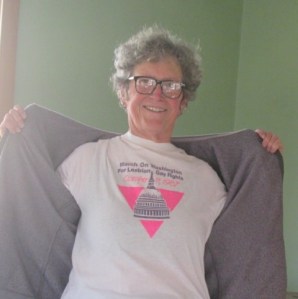
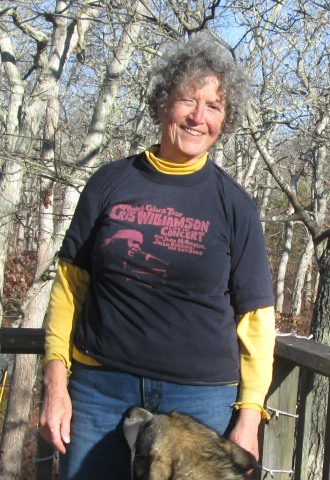
I’d already seen the whole AIDS Quilt twice, but my mother hadn’t seen any of it ever. I think going to see this display of a small part of it was her idea, but I was up for it. I also think she bought me the T-shirt, but I was up for that too.1
For the record, although the T-shirt says “Boston,” the display we went to was at MIT in Cambridge.
1990 stands out in my memory as the year Martha’s Vineyard discovered AIDS. Since HIV/AIDS was already looming large in the gay community, and increasingly in the lesbian community, when I left D.C. in 1985, this caused some cognitive dissonance, to put it mildly.
In D.C., since I was immersed in “the community” and worked at the feminist bookstore, I was generally and accurately assumed to be a lesbian. I never had to come out. When I got to the Vineyard, I realized I didn’t know how. Life was further complicated by the fact that at the time, most women dressed like the dykes I knew in D.C. — jeans, flannel or button-down shirts, shoes you could walk in. I learned to surreptitiously check for the presence or absence of a ring on the ring finger of any new acquaintance, though this could be misleading.
Me in my Common Threads shirt, 34 years later.
Life was even further complicated by the fact that if you said the word “lesbian” out loud everyone would (a) turn to look at you, and (b) assume you were one. This was OK with me but it wasn’t OK with others.2 So people really did use the American Sign Language sign for “L” or say (I’m not kidding about this) “Lebanese” when they meant “lesbian.”
As related in “1985–1986 (etc.): Adult Child of Theater,” I lucked out early. I’d arrived on the Vineyard in search of a 12-step program, and in finding ACA (Adult Children of Alcoholics) meetings, I also found lesbians — one lesbian in particular, the late Mary Payne, founder and artistic director of Island Theatre Workshop. She lured me into theater, and through theater I found my tribe(s).3
Is it fair to say that the island in general was less welcoming, less friendly? Since little if anything made it into the public eye, e.g., the newspapers or the island’s bulletin boards, it’s hard to know what people “in general” were thinking. I do remember attending a public meeting about HIV/AIDS in the very late 1980s where one of the main speakers, a locally prominent mental-health professional, implied that HIV/AIDS could only be contracted through blood transfusions and dirty needles.
This was beginning to change, however. Around that time, or maybe a little later, a proposal to install condom dispensers at the high school sparked controversy. Naturally some people disapproved because it was seen to condone students being sexually active, but the tide seemed to be moving in a more practical direction: if/when students were sexually active, they should be safely sexually active. Condoms helped avoid pregnancy, yes, but they also helped prevent the spread of STDs (sexually transmitted diseases), and the scariest STD at that time was HIV/AIDS.
Here’s where chronology gets a little fuzzy. My memory is clear, but so far I’ve found nothing to confirm or correct what I remember. What I remember is that a youngish Vineyard man named Joel Counsell died in a house fire in Vineyard Haven. The backstory, which I knew through word of mouth, mainly through 12-step connections, was that Joel, an addict and/or alcoholic who was also HIV-positive, had been trying to get help, but the island’s health-care options were too fragmented. The only support he found was in AA meetings that included gay or lesbian members.
After Joel’s death, and at least partly in response to it, the AIDS Alliance of Martha’s Vineyard was formed, both to coordinate and publicize the services available to people with HIV/AIDS, from testing to counseling to treatment, and to educate the public about the disease.4 (Rumors and misinformation about HIV/AIDS spread much more readily than the disease itself.)
Around this time, and related at least indirectly, the Island Lesbian & Gay Association (ILGA) was formed. I was one of the 26 Vineyarders at the first meeting, which was held in the big room at the Wooden Tent, then owned by a lesbian couple.5 More about ILGA in the next installment of The T-Shirt Chronicles.
NOTES
In my defense, I’m pretty sure this was at least a decade before I swore “No more T-shirts!” ↩︎
It took me a while to fully understand how small towns were different from big cities. Once words came out of your mouth, they couldn’t be taken back — and they traveled. Fast. Depending on the subject, you wouldn’t believe how fast. Many of my D.C. friends had moved there from, you guessed it, the small or smallish towns they’d grown up in and, often, where their families lived. So had I. Going in the opposite direction taught me a few things. ↩︎
This included Wintertide Coffeehouse, which until January 1991 happened only on winter weekends. Music, theater, and the grassroots arts more generally tend to be where we outsiders and misfits find each other. ↩︎
AZT was available at this point, but its effectiveness was limited and it was very expensive. Treatment options began to increase and improve in the early 1990s. Here’s a brief summary of how they advanced. ↩︎
A couple of years later, in 1992, I became their tenant, moving into the separate guest house on the property. I lived there till the fall of 2001, which at that point was by far the longest I’d lived anywhere on the Vineyard. ↩︎
The 1987 March on Washington for Lesbian & Gay Rights wasn’t my first national march, not by a long shot. Barely a month into my freshman year of college, I participated in the first Vietnam Moratorium march on October 15, 1969, then exactly one month later, on November 15, I was a marshal at the huge New Mobilization1 (aka “New Mobe”) march. From my station between 6th and 7th Streets NW, I got to watch hundreds of thousands of people pouring down Pennsylvania Ave. ten or twelve abreast. I’d never seen anything like it.
I still have visceral memories of that one. It was sunny, but it was chilly and I was underdressed: In my innocence I thought my winter duds could wait till I went home for Thanksgiving. Wrong. I wasn’t the only one either. Those who’d worn jackets hadn’t brought gloves, so we took turns making coffee runs to the nearest drugstore then warmed our hands by wrapping them around the cup. Several of us entertained the others, and the police officers stationed on the same block, singing Tom Lehrer songs. I could go on . . .
So the 1987 March for Lesbian & Gay Rights wasn’t my first national march, but it was the first I’d had to travel to. I’d moved back to Massachusetts in the summer of ’85, and by now into my third year, it looked like I was going to stay there.
I’d marched in the the first national March for Lesbian & Gay Rights in 1979, of course, but I don’t remember who I marched with. Maybe the off our backs contingent, or the Washington Area Women’s Center? I do remember passing along the back side of the White House grounds chanting with a whole bunch of other dykes “Two, four, six, eight, how do you know that Amy’s straight?” Amy Carter, daughter of then-president Jimmy Carter, was all of 12 at the time. We were, of course, giving her the benefit of the doubt, but — I just looked her up — she’s been heterosexually married twice and has two kids, so straight she seems to be.
The AIDS Quilt, officially the NAMES Project AIDS Memorial Quilt, was displayed for the first time during that march. Established almost exactly two years earlier, in November 1985, the Quilt at that point included 1,920 panels. Each panel was three by six feet; they were stitched into square blocks of eight panels each.
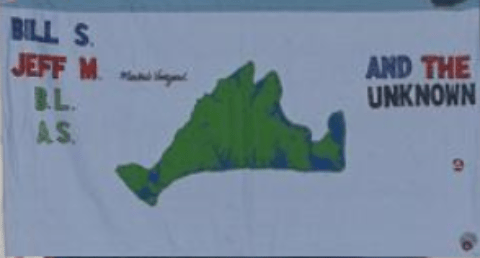
I knew about the Quilt. My friend Nancy Luedeman (1920–2010), a mainstay of Island Theatre Workshop and longtime partner of Mary Payne, had created a panel for four Vineyard men who had died of AIDS. I promised I would find her panel.
I was not prepared for how overwhelmed I felt as I walked down the rows between the blocks of panels. I’ve been deeply moved walking through cemeteries, noting the dates and the connections between people, but this was different: each panel was alive, evoking in color and imagery the life and personality of each person memorialized, each person lost. Finally I knew what it felt like to be in the presence of the sacred.
I did find Nancy’s panel. Two of the four men were identified by first name and last initial, the other two only by initials. This reflected the shame attached to AIDS, and homosexuality, on Martha’s Vineyard and in so many other places at the time. Nancy didn’t volunteer their full names, and I didn’t ask. I think Nancy said they’d all died off-island. Eventually I learned that Bill S. was Bill Spalding, who has another panel in the Quilt, with his full name on it. I don’t know about the others. If you do, please let me know.
Quilt panel created by Nancy Luedeman in memory of four Vineyard men who died of AIDS
The Quilt returned to D.C. a year later, and so did I. It had been on tour that spring and summer of 1988, growing all the while. By October 1988, spread out on the Ellipse, it comprised 8,288 panels. Too many to see all of them in only two or three hours, so I wandered, letting myself be drawn and directed by a name, an image, a thought.
A Red Cross caught my eye. I had worked at Red Cross national headquarters for four years in my D.C. days. That’s where I learned what an editor was, and where I started to become one. When I reached the panel and read the name on it, my knees collapsed under me. It was for my co-worker and friend Thom Higgins, whom I’d seen when I was in D.C. the previous October. He’d seemed fine. He didn’t say anything about being sick. He’d died earlier that year, I think in May.
The image in the middle is for Toastmasters, of which Thom was a dedicated member. IIRC the panel was created by Thom’s friend and my friend and former colleague Brad McMinn. Brad died, also of AIDS, in 1993.
My recollection is that Casselberry and Dupree were singing “Positive Vibration” at the other end of the Mall, but maybe I made that up. Now I can’t hear that song without thinking of Thom. I can’t think of Thom without hearing that song.
Formally the New Mobilization Committee to End the War in Vietnam. The successor to the National Mobilization Committee to End the War in Vietnam, which organized major antiwar events in 1967 and ’68, this was the coalition that organized the gigantic November 15, 1969, march. Frequently confused and/or conflated with it was the Vietnam Moratorium Committee, which organized the October 15 events across the country. It also organized the incredibly moving prelude to the November 15 march: On November 13 and 14, thousands of people walked from Arlington National Cemetery to the White House, each one bearing on a placard the name of someone killed in Vietnam. In front of the White House these placards were deposited into coffins set up for the purpose. I was involved in the housing and feeding operation ongoing at Georgetown and so was unable to participate. ↩︎
Yes, it’s been a long hiatus, but I’m finally getting back to work on The T-Shirt Chronicles. Last Saturday I did a talk at the West Tisbury library about what I’m now thinking of as Part 1 of the project (see poster below), with plenty of illustrations. I taught myself PowerPoint on the fly, and Matilda (my laptop) and the library’s AV equipment did the rest.
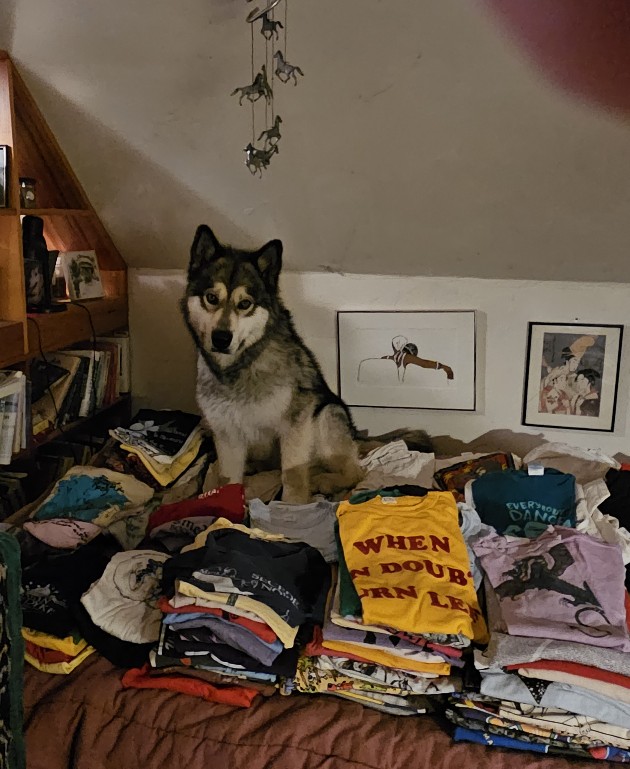
Getting the shirts out of the closet, where they overflow two good-sized boxes, was key. Once they were in my hands, the memories attached to them slithered back into my consciousness. As usual, the best (only!) antidote to procrastination is Get started. After that one thing tends to lead to another. Watch this space!
Above: Tam Lin, my four-year-old malamute, finally got his bed back. Below: Flyer for my talk at the West Tisbury library.
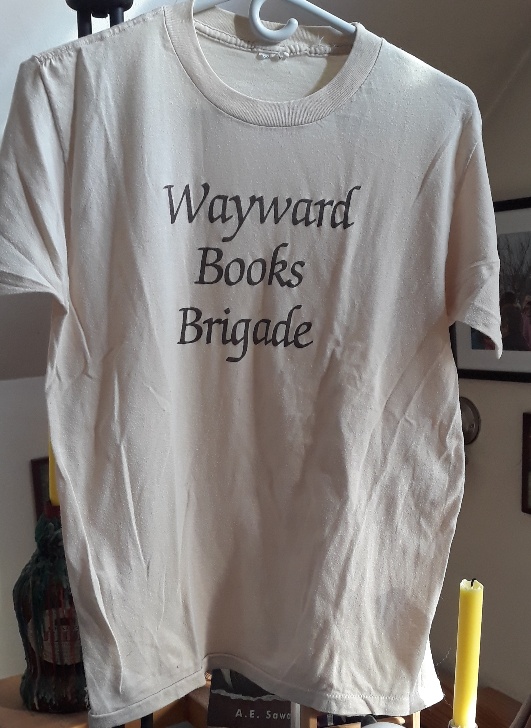
When bookstores move, staffers usually pack the books in boxes, load the boxes in a truck, and drive the truck to the new location. When Wayward Books moved, owners Sybil Pike and Doris Grumbach packed the books in grocery bags and volunteers passed them hand to hand along Pennsylvania Avenue SE to the new shop at 325 7th Street., which was practically next door to Lammas. I was one of the volunteers, and that’s how I got this T-shirt.
True, the distance was only three or four city blocks, and as I recall the brigade didn’t quite stretch the whole distance, so cars were called upon to ferry the books across the gap. But the operation was ingenious and fun, and it worked.
Wayward Books dealt in a carefully curated mix of secondhand and rare works, which meant those books had already been around. They probably took their latest move in stride.
Lammas was well represented in the Wayward Books Brigade, and not only because Wayward Books was moving into the immediate neighborhood. Pike and Grumbach had been a couple since the early 1970s, and Grumbach’s novels were regular sellers at Lammas, notably Chamber Music and The Ladies, which was based on the “Ladies of Llangollen,” two 18th-century Irish women who eloped to Wales, set up housekeeping as a married couple, and whose home became a go-to destination for literary luminaries of the time. Grumbach’s books focused on women’s lives, and often women in relationship with each other, which was not all that common at the time, especially for “mainstream” novelists.
Sybil, a retired research librarian at the Library of Congress, was the on-site manager at Wayward Books — I remember her as a strikingly handsome woman who would have been in her mid-fifties at the time — but Doris was also around when she wasn’t teaching or writing. The two shops complemented each other nicely: their inventories didn’t overlap, but their customers did.
A Washington Post story from April 1990, reporting on Wayward Books’ relocation to Sargentville, Maine, that month, notes that the Wayward Books Brigade comprised 70 volunteers and moved some 3,000 volumes from old location to new. The move to Maine involved three times that many books and was presumably not accomplished hand to hand.
The Post story also says the hand-to-hand move to 7th Street happened in 1985. I would have said a year earlier, because I left D.C. at the end of July 1985 and it seemed Wayward Books and Lammas had been neighbors for more than a few months at that point. But memory is tricky, so maybe not.
I just learned that Sybil passed in March of last year, at the age of 91, but that Doris seems to be alive in her 104th year. It sounds as though, around 2009, they moved together to a retirement community in Pennsylvania, where Sybil died and Doris still lives. Anyone with more information, please respond in the comments. If you don’t want your comment published, say so and it won’t be.
This T-shirt has nothing to do with Wayward Books — except that they both have to do with books, and that Women’s Glib was somewhat wayward in that it had to do with feminist humor, which many continue to swear is an oxymoron. Not for the first or last time, those “many” are so wrong.
Women’s Glib and Women’s Glibber, anthologies edited by Roz Warren, both came out in my bookselling days — I think. Amazon.com gives the early ’90s as pub dates for both books but notes in one case that it’s a second edition. I’m pretty sure I didn’t have anything in either book, although I was the class clown (female) in sixth grade and have been credited with having a pretty good, albeit barbed, sense of humor in all the decades since.
Interestingly enough (to me, at least), this is one of the very few — maybe even only? — Ts I have that features a book. I’ll hedge my bets on that one till I’ve excavated my whole collection. Either few books were featured on Ts or I wasn’t buying (or being given) the ones that were.
My humor tends to be in the moment — I think the word is “situational,” meaning that it arises from circumstances. I’ve never been fond of the other kind, such as stand-up, mainly because stand-up comedy back in the day was so misogynist, even when performed by one of the few women in the trade. Phyllis Diller embarrassed and infuriated me. I could admire Lucille Ball and I Love Lucy while being mortified by her tactics.
As a teenager and young adult I was a huge fan of the Smothers Brothers and Rowan and Martin’s Laugh-In. By the time Saturday Night Live got going, in the mid to late 1970s, I was doing fine without a TV and besides, SNL didn’t seem all that in sync with the lesbian-feminist life I was living.
Humor that was in sync with my life — I loved it. Alison Bechdel’s Dykes to Watch Out For strip and the books compiled from it were huge hits with Lammas customers. So were Nicole Hollander’s Sylvia books. They kept us laughing, and they kept us sane.
The first stand-up comedian who made me sit up, take notice, and even buy at least one of her albums was Kate Clinton. I heard her perform live in the early ’80s. What a revelation! The problem with stand-up comedy wasn’t me, it was the sexist, heterosexist comedy itself!
I’m thrilled to report that Roz Warren and Kate Clinton are still “making light,” as an early Clinton album had it, and you’ve almost certainly heard of Alison Bechdel, if not of Dykes to Watch Out For. I’m not sure if Nicole Hollander is still creating, but it’s not hard to find Sylvia online.
Sylvia — that Sylvia — was one of the namesakes of the TRS-80 that was Lammas’s and my first computer. The other two, as I think I mentioned before, were Sylvia Sherman, my high school history teacher, and Sylvia Abrams, my editorial mentor, without whom I would have had a hard time making a living these last four decades.
The story behind this one starts way, way back, long before I moved to D.C. the first time.
My family wasn’t especially musical. My maternal grandmother played the piano by ear, which I thought was cool, but unless Granmummie was visiting,[1] what music there was in our household came via records and the radio.
Not to discount the importance of records, however: When I left for college, I absconded with my father’s Joan Baez album, her first. I didn’t need to take his Tom Lehrer LPs — Lehrer’s first, the one whose cover featured a caricature of the pianist as the devil surrounded by the red flames of hell (see below), and That Was the Year That Was — because most of the songs were embedded in my memory.
I’ve still got that Joan album, and the 10 or so of its successors that I acquired legitimately in the following years, and I still know a ridiculous number of Tom Lehrer songs by heart.[2]
See what I mean? Originally released in 1953, when I was 2.
Like many middle-class-and-up suburban kids my siblings and I took piano lessons with varying degrees of enthusiasm. The teacher wasn’t especially inspired or inspiring. I did learn to read music, but I didn’t learn to pick songs out of the air the way my grandmother did. That was disappointing, but what I didn’t really understand was what all that tedious practice could lead to. If I had, maybe I would have persisted.
Or maybe not.
I did, however, like to sing. Singing was the best part of church, where we went almost every Sunday morning as a family: St. Peter’s Episcopal in Weston, Mass. From fifth grade through eighth I sang alto in the junior choir. After eighth grade, when we aged out of both the junior choir and Sunday school, we could join the adult choir, but the adult choir sang at the 11 a.m. service and my family went to the 9:15. That’s when I left the church.
In my eighth-grade year, Becky B., also an eighth-grader, a soprano who’d been in the choir as long as I had, told me that I always sang off-key. To avoid ruining the anthem, she said, I should just pretend to sing.
No one else — not the choir director/organist, not any other member of the choir, not any of my music teachers in school — had ever told me any such thing. Becky B. didn’t like me and I didn’t like her; she was a goody-two-shoes who was always playing up to the adults. But I feared she was right, that I had been found out.
Somehow I made it through the year. Then I stopped singing. Period. When I entered high school in the fall, the music teacher encouraged me more than once to try out for Glee Club. Since she directed the Glee Club, this should have given me confidence, but it didn’t. I was sure I’d fail and confirm beyond any doubt that Becky B. was right: I couldn’t sing.
It was years before I recognized the pattern: I’d pursue a skill, an instrument, a foreign language — then abandon it when I was on the verge of being able to actually use it. At that point you’re bound to make mistakes. In my family making mistakes got you creamed. My very intelligent and well-read father regularly ridiculed my mother for getting the wrong answer or saying anything he considered stupid. I learned to get my facts straight before I opened my mouth. From an early age I’d been good at words, anything to do with words. I stuck to words, spoken and written, but never sung.
I never stopped listening to music, though, or hanging around people who made music or were somehow in the music biz. Gradually, and usually in fits and starts, I got braver, venturing into territories where I didn’t have all the answers and was bound to make mistakes: taking that first editorial job at the American Red Cross, for instance, or becoming the book buyer at Lammas Bookstore. I did well at both, but note that they both had to do with words: in some ways I was pushing the boundaries of what I was already good at.
The D.C. Area Feminist Chorus was founded in 1978, prompted by a singing workshop led by Holly Near during that year’s Gay Pride celebration. In its early months it was leaderless, with members leading warm-ups and teaching each other songs.
At some point, they decided to engage a director/conductor, and after interviewing several candidates, they hired Deb Weiner. Deb either was already or was soon to become one of my housemates, but this did not prompt me to join the chorus. If anything, it was a deterrent: What if it was your housemate who had to tell you that you couldn’t sing on key and were dragging the group down?
I have an indelible memory of Deb conducting the combined D.C. Area Feminist Chorus and Gay Men’s Chorus of Washington at a holiday concert, in either 1981 or 1982. To be the conductor channeling all that massive sound! I was awed.
How did I come to finally join the D.C. Area Feminist Chorus? Well, I have it on good authority — my own words from 36 years ago — that I set out to write a story about the chorus for Hot Wire: The Journal of Women’s Music and Culture “and almost immediately found [my]self singing in the second soprano section.” By then Deb had moved on after several very successful years, Caroline Foty was the chorus director, and I was living on the far northeast fringe of Capitol Hill, subletting a large room from and sharing a kitchen with photographer Joan E. Biren (JEB).
By then, probably in 1984, I had joined the brand-new Gay and Lesbian Chorus of Washington (GLCW). How did I hear about it? I don’t remember. This was a small group, conducted by Tess Garcia, and my most vivid memory was of a performance we gave where Congressman Barney Frank, dressed in a leisure suit, reclined across several chairs in the front row. Most of the homemade cassette tape I have from a June 1985 performance is unplayable, but on the one audible cut, “Johnny, We Hardly Knew Ye,” we sound pretty good. According to the label, the program also included some P.D.Q. Bach, the spiritual “Soon Ah Will Be Done,” and selections from Annie.
I noted the most striking contrast between my two choruses in that Hot Wire story: “Because the GLCW did not choose to specialize in works by gay or lesbian composers, a chorus member could walk into any music store and be overwhelmed by the available selection.” Not so any Feminist Chorus member: all our music consisted of handwritten scores photocopied or similarly duplicated, because none of it had been published. Director Foty did some of the arranging, and fortunately feminist choruses were thriving at the time, and lots of sharing went on among them through the Sistersingers network. We were breaking ground, pioneers, in the forefront, and very aware of it.
We sang at least two songs from the Balkan women’s singing tradition. I can still fake the second soprano part of “Shto Mi e Milo,” which has been widely recorded.
One of my favorites from the chorus repertoire was a four-part setting of Edna St. Vincent Millay’s “Conscientious Objector.” I didn’t realize till about an hour ago not only that Mary Travers had performed it spectacularly, but that she wrote the solo setting and recorded it on her 1972 album Morning Glory.[3] I have a copy of the poem on my fridge: “I shall die / but that is all I shall do for Death . . .” It reminds me of the song.
The chorus made decisions collectively, including decisions about repertoire. “Conscientious Objector” almost didn’t make the cut; that was before I joined, so I don’t know what the objections were. As I recall, a couple of chorus members thought Malvina Reynolds’s “We Don’t Need the Men” was too anti-male. For others among us, this was a plus, not least because it was so tongue-in-cheekily Malvina. It was fun to remind people that Malvina wrote it in 1959.
The most controversial song I remember from my time in the chorus was “Sisters, Spring of Vietnam”; it clearly favored the Vietnamese liberation struggle against the French and the Americans, and that did not sit well with some members. Singing along with Lucha’s version I remember the tune, the harmony, and many of the words, so I’m pretty sure we sang it anyway, but some choristers chose to sit it out.
The back of the 1985 Sisterfire T. The D.C. Area Feminist Chorus is about halfway down.
My last gig with the D.C. Area Feminist Chorus was at Sisterfire, June 22 & 23, 1985. By the end of that summer I was semi-settled on Martha’s Vineyard. Music was much easier to find than feminism, and find it I did, volunteering at Wintertide Coffeehouse starting in 1986.
It took a while to find a way to start singing again. My way in turned out to be the annual Christmas performance of Messiah, sung by a large (and ever growing) pickup chorus of Vineyarders, many of whom sang regularly in various church choirs.
I’d never sung Messiah before, and most of the chorus seemed to know it by heart. More, although I could read music, I couldn’t “sight-sing,” sing from a score on first acquaintance. I still regret not having the nerve to audition for Glee Club in high school, where everybody learned to do stuff like that. I worked hard, I learned, and when, in my third year, I made it through the glorious “Amen” without losing my place, I thought I’d arrived.
The annual Messiah sings eventually grew into the Island Community Chorus, which did several concerts a year and with which I stayed until around 2005. I’ve managed to keep singing since then. In the age of Covid-19, I’ve participated almost weekly in Zoom sings (Zings?) with Susan Robbins of Libana, a women’s ensemble whose music I’ve loved since at least 1980, and a bunch of whose recordings I’ve got.
But it was the D.C. Area Feminist Chorus that got me singing again, and though I didn’t sing with it for much more than a year, this shirt is about how I found my (singing) voice again.
If you want to leave a comment and don’t see a Leave a Reply box, click the title of the blog post (above) and then scroll to the bottom.
notes
[1] Which was fairly often, because she lived only eight miles away.
[2] This is so common among the political circles I’ve moved in over the decades that if I sing or even hum a line, often someone in the vicinity will sing the next one back to me. A favorite memory from my freshman year at Georgetown U.: As a marshal for the huge Mobe (Mobilization Against the War) march on Washington on November 15, 1969, I was stationed on Pennsylvania Ave. between 6th and 7th. We were close enough together that we could reach out and touch our neighbors on either side. It was sunny but bloody cold, and my winter gear was still back in Massachusetts: I had this idea that since D.C. was a southern city I wouldn’t need it till after Thanksgiving. Wrong. Anyway, while waiting for the sun to get fully up and the march to start, we did a lot of jogging in place and making coffee runs to the nearest drugstore. Eventually one of us — maybe me, maybe not — started in on a Tom Lehrer song. No idea which one, so many of them would have been appropriate — maybe “The Wild West Is Where I Want to Be,” with its lines “I’ll watch the guided missiles / while the old FBI watches me”? We were sure the FBI and who knew what other intelligence agencies were around.
[3] My source for this is a detailed bio of Edna St. Vincent Millay on, of all things, the website for the ABC Oriental Rug & Cleaning Company in Ithaca, N.Y. There has to be an interesting story here, but I’ll have to save that rabbit hole for another time. The page seems to be updated regularly: it includes a reference to the ongoing pandemic and other events.
Apart from the cool slogan and great design, this shirt is distinctive for a couple of other reasons. I don’t have any other shirts in this color (what is it? “rust”?), and it’s one of the few I have in what used to be called “French cut” and now seems to be “women’s,” as opposed to “unisex.”
No, I wasn’t on the 1978 American Women’s Himalayan Expedition to Annapurna. I’ve never had any desire to climb anything that required more than the ability to walk upright. I first learned about the expedition when expedition leader Arlene Blum’s gorgeous book about it came out in 1980. Though the story went places I’d never been, it started in instantly recognizable territory: with the sexism and outright misogyny of the male mountain-climbing elite. I also recognized the powerful determination of women adepts in any male-dominated field to show the men that they are wrong.
I bought the T-shirt when Dr. Blum spoke in D.C. What year was it? I don’t remember, but I’m guessing 1981. Where did she speak? I don’t recall that either. Was I already working at Lammas then? I’ll only know that if I can find an exact date for the event, but my memory thinks I attended with Lammas owner Mary Farmer, which would explain how I knew about the event. For sure it didn’t take place at the shop, whose 400 square feet of selling space were far too small for talks and readings. Where did it take place? Once again I’m drawing a blank.[1]
My indelible memory is of Arlene Blum herself, or, more accurately, of my impression of her. In my mind’s eye she has long wavy dark hair, as she does in the Annapurna photos. She is tall, but she seems dressed to look smaller and younger than she is, in a purple and black dress that stops several inches above her knees. She’s trying to look like a schoolgirl, I thought at the time.
Which probably wasn’t her intent, and her dress may not have been purple and black either, but that’s what struck me: this physically and emotionally strong and highly intelligent (she had a doctorate in biochemistry) woman seemed to be downplaying all the traits that made her achievement possible. I’m guessing that she wasn’t nearly as comfortable with the whole book tour routine as she was organizing expeditions, climbing mountains, and doing research — building and leading teams rather than speaking to strangers whom she’d never see again.
By this time, I’d read and devoured Adrienne Rich’s collection The Dream of a Common Language: Poems 1974–1977. I know this for sure: I wrote my name and “Sept. 78” on the flyleaf of the book, a trade paperback that split along the spine maybe three decades ago from repeated readings. It includes Rich’s 1974 “Phantasia for Elvira Shatayev,” written for the leader of an all-women team that perished in a storm on Lenin Peak in August 1974. Narrated in Shatayev’s voice after death, it includes lines from the diary she wrote while she was living, like these:
Now we are readyand each of us knows it I have never loved
like this I have never seen
my own forces so taken up and shared
and given back
After the long training the early sieges
we are moving almost effortlessly in our love[2]
Visiting Arlene Blum’s website just now, I noticed a link for “Peak Lenin” in the Mountaineer section. The year was 1974. The coincidence of place and year gave me goosebumps, but the accompanying slide show was even more startling: Arlene Blum and her climbing buddies and Elvira Schatayeva and her team, along with other mountain-climbers, were all at base camp at Peak Lenin at the same time. Arlene was almost caught by the same storms that killed the Russian women. The slide show includes images of Elvira, known to her friends as Eva.
A cable of blue fire ropes our bodiesburning together in the snow We will not liveto settle for less We have dreamed of this
all of our lives
If you want to leave a comment and don’t see a Leave a Reply box, click the title of the blog post (above) and then scroll to the bottom.
notes
[1] To further confuse my already flummoxed memory, I just Googled Arlene Blum Annapurna Washington Post. This turned up a Washington Post story from December 9, 1980, that had Blum in town for an American Alpine Club meeting. This would have been shortly after the book came out. Did she give a public talk then, and did I attend it? If so, I definitely wasn’t working at Lammas, and it might explain why my sketchy memory of the venue doesn’t ring any bells. Another story, from April 1983, refers to a lecture Blum has just given, but it and the article itself focus on her 2,000-mile trek from one end of the Himalayas to the other. The talk I attended was definitely about Annapurna, so I’m pretty sure it wasn’t that one.
[2] Both this and the quote at the end are from Adrienne Rich’s “Phantasia for Elvira Shatayev,” in The Dream of a Common Language: Poems 1974–1977 (New York: W. W. Norton, 1978).
Here’s how I remembered it: The D.C. stop on Cris Williamson’s Flying Colors tour, at the DAR’s Constitution Hall, was my first women’s music concert. The year was 1978. I’d attended with a friend from my Georgetown University days, and our seats were way, way back in the orchestra. The stage seemed miles away. Though I loved Cris’s first album, The Changer and the Changed, I was underwhelmed by her live performance.
Flying Colors tour, 40 years later
Nope. Strange Paradise, the album the Flying Colors tour was celebrating, may indeed have come out in 1978,[1] but the tour itself didn’t happen till 1980: this Washington Post article from May 2, 1980, proves it.[2] The location was indeed Constitution Hall, and images of both the hall itself and a seating chart confirm my memory that the orchestra section is flat and very long: if you’re back in the double-letter rows, the stage would indeed seem very distant. The date must have been Saturday, May 3, 1980.
Get a grip, Memory: No way could this have been my first women’s music concert. When the Varied Voices of Black Women tour stopped at D.C.’s Ontario Theater in 1978, I was most definitely in the audience — and the Pacifica Radio Archives backs me up on the date with a catalogue entry for a recording from the last stop on that tour (at Medusa’s Revenge in New York City) on November 7, 1978. I remember being especially riveted by blueswoman Gwen Avery, with her big voice and white suit.[3] Ironically, she’s the only one of the headliners I don’t have on vinyl (except on the Lesbian Concentrate album, singing “Sugar Mama”) or, in the case of poet-activist Pat Parker, in print. (The other featured musicians were singer-composer Vicki Randle, pianist-composer Mary Watkins, and singer-percussionist-ensemble leader Linda “Tui” Tillery.)
I’m not a musician, but from the mid-1960s onward my life has had an amazing soundtrack. The music helped bind my various communities together. You know you’re part of the same community when you know the lyrics to the same songs and see each other at the same concerts. At the end of Women’s Center dances, we’d form a circle (often with the cashbox in the middle for safekeeping) and sing Cris’s “Song of the Soul.” We all knew all the words.
Since I was moving in at least two worlds at once, quite a few people protested: “Aren’t you limiting yourself, listening only to women?”
I pushed back: “Well, OK, but not so long ago my musical diet was mostly folk, mostly by men, with some classical, mostly Western European. Listening mostly to women expanded my musical world to include blues, jazz, and Balkan women’s singing, among other things. I learned about women who were conducting orchestras and other ensembles, not just playing in them; leading bands, not just fronting them. If women were doing it, I wanted to hear it.”
In truth, focusing on any particular genre, or tradition, or artist, or instrument, or time period, limits a person even while that person becomes adept in his or her particular specialty. If you go so deep into your specialty that everything else vanishes off the radar, you also limit the number of people who understand what you’re talking about.
Focusing on women in music — or women in anything — meant shifting the angle, changing the lens through which I viewed familiar terrain. Once I put women in the foreground, the male-dominated landscape didn’t disappear, but it did recede into the background.
For those accustomed to being in the foreground, I learned, this could be infuriating. Organize for women’s rights and you’re accused of hating men. If you call out white supremacy, you must be anti-white — even if you are white, in which case you’re a traitor to your race. And of course anyone who claims rights for the marginalized is guilty of “reverse discrimination.”
I’ve known for decades that, contrary to the claims of the over-optimistic, we don’t all benefit from the struggle for justice and equal rights, at least not immediately. In the long run we’ll probably all be better off, but in the shorter run the privileged often think they’re under attack and losing out. They fight back. I’ve lived almost my whole life in an era of backlash against the struggle for justice and equal rights for people of color and for women. Women’s music helped create and expand a space where we didn’t have to be on the defensive all the time. It also introduced me to musical styles I either hadn’t known much about or had dismissed as being just for and about guys.
There will be plenty more about women’s music before this blog has run its course. Right this minute, though, something strange is happening. In recent years, thanks especially to Facebook, I’ve been reconnecting with women from my D.C. days, women who remember many of the same songs, musicians, places, and events that I do. This is especially important because for the last 35+ years I’ve been living among people the vast majority of whom have no recollection of any of it, and of course as the years go by more and more of it gets lost. Sometimes I feel like the sole survivor of Atlantis, unable to convince anyone that my homeland ever existed.
Published by Aunt Lute Books, 2020
Then, in October 2020, Aunt Lute Books published Ginny Z Berson’s Olivia on the Record, the story of Olivia Records, women’s music pioneer and the label for Cris Williamson’s Changer and the Changed and several subsequent albums. I learned about it early enough to attend the book-launch party — my first Zoom book party! — at which Ginny and others spoke and Mary Watkins played.
Olivia had been founded in D.C. while I was a student in Philadelphia. By the time I moved back to town, in 1977, it had relocated to the West Coast. Before she co-founded Olivia, Ginny Berson was a member of the legendary lesbian-feminist Furies collective, which flourished in D.C. when I was a Georgetown University student majoring in Arabic and minoring in antiwar activism (or vice versa). It was at that book-launch party that I learned about Once a Fury, a brand-new documentary about the Furies (which I’ve since had a chance to see).
In the early 1970s I was mostly oblivious to the lesbian-feminist ferment happening elsewhere in the city, but once I moved back, the Furies, like Olivia Records, was part of my new community’s recent history. Before long, I had crossed paths with several former Furies (not, however, the collective’s most famous alumna, Rita Mae Brown) and held in my own hands copies of their newspaper at the Washington Area Women’s Center.
Clearly I’m not the sole survivor of Atlantis. Atlantis hasn’t sunk beneath the waves. My T-shirts are leading me back to what’s gone on in my absence, and what’s happening now. I just bought Cris Williamson’s latest CD, Motherland.The Furies newspaper has been digitized and is available online through the Sallie Bingham Center for Women’s History & Culture at Duke University.
Published by Bella Books, 2019
I’m currently reading Jamie Anderson’s An Army of Lovers: Women’s Music of the ’70s and ’80s, published by Bella Books in 2019. It’s more than a glorious reference work of who was making music then and where are they now, encompassing not just the musicians onstage but the sound techs, concert and festival producers, distributors, booksellers, the women behind our record labels and publications, and others who were behind the scenes making it happen. It also discusses the myriad challenges that all of us tried to address, with decidedly mixed results: racism, classism, anti-Semitism, and the often wildly unrealistic expectations we had of others and often of ourselves.
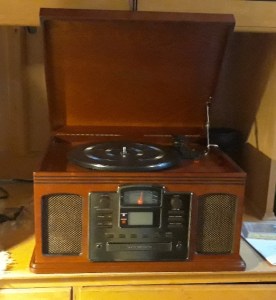
After living more than two decades with a considerable collection of LPs and nothing to play them on, this winter I bought a handsome machine that not only plays LPs, cassettes, and CDs, it can also record LPs and cassettes onto CDs. Much of the music released by major labels made it onto CD and/or MP3; plenty of it can even be found on YouTube. The same goes for some of the best-known musicians who recorded for feminist and other indie labels, such as Cris Williamson and Holly Near.
But others have disappeared leaving few if any traces. The first albums I recorded onto CD were three by Willie Tyson: Full Count, Debutante, and the self-titled Willie Tyson.
I didn’t expect my personal past to be sending such vivid shoots into my present world, but I can’t wait to see what happens next.
notes
[1] At least that’s what Cris Williamson’s website says. The chronology in the back of Olivia on the Record says 1980, as do Wikipedia and the MP3 I downloaded from iTunes. No wonder my memory is so screwed up.
[2] Note the parenthetical in the Washington Post story: “(What’s notable about this roadshow is that it’s coordinated by a nonprofit group organized expressly to put women on tour.)” That “nonprofit group” was almost certainly Roadwork, co-founded by Amy Horowitz and Bernice Johnson Reagon. Stick with this blog and you’ll hear more about them too.
[3] Please don’t tell me she was wearing some other color.











 The T-Shirt Chronicles