1990: Visiting the AIDS Quilt with My Mother

I’d already seen the whole AIDS Quilt twice, but my mother hadn’t seen any of it ever. I think going to see this display of a small part of it was her idea, but I was up for it. I also think she bought me the T-shirt, but I was up for that too.1

For the record, although the T-shirt says “Boston,” the display we went to was at MIT in Cambridge.

1990 stands out in my memory as the year Martha’s Vineyard discovered AIDS. Since HIV/AIDS was already looming large in the gay community, and increasingly in the lesbian community, when I left D.C. in 1985, this caused some cognitive dissonance, to put it mildly.

In D.C., since I was immersed in “the community” and worked at the feminist bookstore, I was generally and accurately assumed to be a lesbian. I never had to come out. When I got to the Vineyard, I realized I didn’t know how. Life was further complicated by the fact that at the time, most women dressed like the dykes I knew in D.C. — jeans, flannel or button-down shirts, shoes you could walk in. I learned to surreptitiously check for the presence or absence of a ring on the ring finger of any new acquaintance, though this could be misleading.

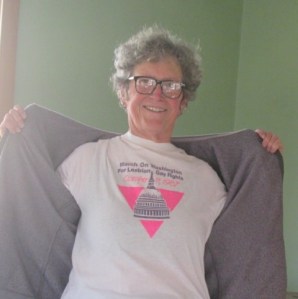
Me in my Common Threads shirt, 34 years later.

Life was even further complicated by the fact that if you said the word “lesbian” out loud everyone would (a) turn to look at you, and (b) assume you were one. This was OK with me but it wasn’t OK with others.2 So people really did use the American Sign Language sign for “L” or say (I’m not kidding about this) “Lebanese” when they meant “lesbian.”

As related in “1985–1986 (etc.): Adult Child of Theater,” I lucked out early. I’d arrived on the Vineyard in search of a 12-step program, and in finding ACA (Adult Children of Alcoholics) meetings, I also found lesbians — one lesbian in particular, the late Mary Payne, founder and artistic director of Island Theatre Workshop. She lured me into theater, and through theater I found my tribe(s).3

Is it fair to say that the island in general was less welcoming, less friendly? Since little if anything made it into the public eye, e.g., the newspapers or the island’s bulletin boards, it’s hard to know what people “in general” were thinking. I do remember attending a public meeting about HIV/AIDS in the very late 1980s where one of the main speakers, a locally prominent mental-health professional, implied that HIV/AIDS could only be contracted through blood transfusions and dirty needles.

This was beginning to change, however. Around that time, or maybe a little later, a proposal to install condom dispensers at the high school sparked controversy. Naturally some people disapproved because it was seen to condone students being sexually active, but the tide seemed to be moving in a more practical direction: if/when students were sexually active, they should be safely sexually active. Condoms helped avoid pregnancy, yes, but they also helped prevent the spread of STDs (sexually transmitted diseases), and the scariest STD at that time was HIV/AIDS.

Here’s where chronology gets a little fuzzy. My memory is clear, but so far I’ve found nothing to confirm or correct what I remember. What I remember is that a youngish Vineyard man named Joel Counsell died in a house fire in Vineyard Haven. The backstory, which I knew through word of mouth, mainly through 12-step connections, was that Joel, an addict and/or alcoholic who was also HIV-positive, had been trying to get help, but the island’s health-care options were too fragmented. The only support he found was in AA meetings that included gay or lesbian members.

After Joel’s death, and at least partly in response to it, the AIDS Alliance of Martha’s Vineyard was formed, both to coordinate and publicize the services available to people with HIV/AIDS, from testing to counseling to treatment, and to educate the public about the disease.4 (Rumors and misinformation about HIV/AIDS spread much more readily than the disease itself.)

Around this time, and related at least indirectly, the Island Lesbian & Gay Association (ILGA) was formed. I was one of the 26 Vineyarders at the first meeting, which was held in the big room at the Wooden Tent, then owned by a lesbian couple.5 More about ILGA in the next installment of The T-Shirt Chronicles.

NOTES

  1. In my defense, I’m pretty sure this was at least a decade before I swore “No more T-shirts!” ↩︎
  2. It took me a while to fully understand how small towns were different from big cities. Once words came out of your mouth, they couldn’t be taken back — and they traveled. Fast. Depending on the subject, you wouldn’t believe how fast. Many of my D.C. friends had moved there from, you guessed it, the small or smallish towns they’d grown up in and, often, where their families lived. So had I. Going in the opposite direction taught me a few things. ↩︎
  3. This included Wintertide Coffeehouse, which until January 1991 happened only on winter weekends. Music, theater, and the grassroots arts more generally tend to be where we outsiders and misfits find each other. ↩︎
  4. AZT was available at this point, but its effectiveness was limited and it was very expensive. Treatment options began to increase and improve in the early 1990s. Here’s a brief summary of how they advanced. ↩︎
  5. A couple of years later, in 1992, I became their tenant, moving into the separate guest house on the property. I lived there till the fall of 2001, which at that point was by far the longest I’d lived anywhere on the Vineyard. ↩︎

1987: March on D.C. for Lesbian & Gay Rights

The 1987 March on Washington for Lesbian & Gay Rights wasn’t my first national march, not by a long shot. Barely a month into my freshman year of college, I participated in the first Vietnam Moratorium march on October 15, 1969, then exactly one month later, on November 15, I was a marshal at the huge New Mobilization1 (aka “New Mobe”) march. From my station between 6th and 7th Streets NW, I got to watch hundreds of thousands of people pouring down Pennsylvania Ave. ten or twelve abreast. I’d never seen anything like it.

I still have visceral memories of that one. It was sunny, but it was chilly and I was underdressed: In my innocence I thought my winter duds could wait till I went home for Thanksgiving. Wrong. I wasn’t the only one either. Those who’d worn jackets hadn’t brought gloves, so we took turns making coffee runs to the nearest drugstore then warmed our hands by wrapping them around the cup. Several of us entertained the others, and the police officers stationed on the same block, singing Tom Lehrer songs. I could go on . . .

So the 1987 March for Lesbian & Gay Rights wasn’t my first national march, but it was the first I’d had to travel to. I’d moved back to Massachusetts in the summer of ’85, and by now into my third year, it looked like I was going to stay there.

I’d marched in the the first national March for Lesbian & Gay Rights in 1979, of course, but I don’t remember who I marched with. Maybe the off our backs contingent, or the Washington Area Women’s Center? I do remember passing along the back side of the White House grounds chanting with a whole bunch of other dykes “Two, four, six, eight, how do you know that Amy’s straight?” Amy Carter, daughter of then-president Jimmy Carter, was all of 12 at the time. We were, of course, giving her the benefit of the doubt, but — I just looked her up — she’s been heterosexually married twice and has two kids, so straight she seems to be.

The AIDS Quilt, officially the NAMES Project AIDS Memorial Quilt, was displayed for the first time during that march. Established almost exactly two years earlier, in November 1985, the Quilt at that point included 1,920 panels. Each panel was three by six feet; they were stitched into square blocks of eight panels each.

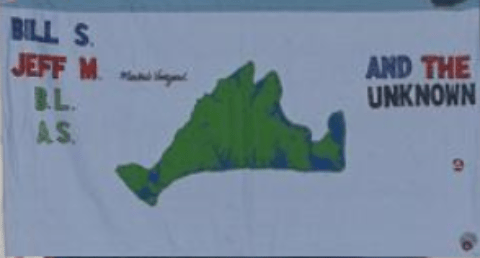
I knew about the Quilt. My friend Nancy Luedeman (1920–2010), a mainstay of Island Theatre Workshop and longtime partner of Mary Payne, had created a panel for four Vineyard men who had died of AIDS. I promised I would find her panel.

I was not prepared for how overwhelmed I felt as I walked down the rows between the blocks of panels. I’ve been deeply moved walking through cemeteries, noting the dates and the connections between people, but this was different: each panel was alive, evoking in color and imagery the life and personality of each person memorialized, each person lost. Finally I knew what it felt like to be in the presence of the sacred.

I did find Nancy’s panel. Two of the four men were identified by first name and last initial, the other two only by initials. This reflected the shame attached to AIDS, and homosexuality, on Martha’s Vineyard and in so many other places at the time. Nancy didn’t volunteer their full names, and I didn’t ask. I think Nancy said they’d all died off-island. Eventually I learned that Bill S. was Bill Spalding, who has another panel in the Quilt, with his full name on it. I don’t know about the others. If you do, please let me know.

Quilt panel created by Nancy Luedeman in memory of four Vineyard men who died of AIDS

The Quilt returned to D.C. a year later, and so did I. It had been on tour that spring and summer of 1988, growing all the while. By October 1988, spread out on the Ellipse, it comprised 8,288 panels. Too many to see all of them in only two or three hours, so I wandered, letting myself be drawn and directed by a name, an image, a thought.

A Red Cross caught my eye. I had worked at Red Cross national headquarters for four years in my D.C. days. That’s where I learned what an editor was, and where I started to become one. When I reached the panel and read the name on it, my knees collapsed under me. It was for my co-worker and friend Thom Higgins, whom I’d seen when I was in D.C. the previous October. He’d seemed fine. He didn’t say anything about being sick. He’d died earlier that year, I think in May.

The image in the middle is for Toastmasters, of which Thom was a dedicated member. IIRC the panel was created by Thom’s friend and my friend and former colleague Brad McMinn. Brad died, also of AIDS, in 1993.

My recollection is that Casselberry and Dupree were singing “Positive Vibration” at the other end of the Mall, but maybe I made that up. Now I can’t hear that song without thinking of Thom. I can’t think of Thom without hearing that song.

More about Thom in “1978: ERA March and the Red Cross Training Office.” He gave me my EDITOR shirt and my WHEN IN DOUBT TURN LEFT shirt. I still have both of them. I remember you, Thom.


NOTE

  1. Formally the New Mobilization Committee to End the War in Vietnam. The successor to the National Mobilization Committee to End the War in Vietnam, which organized major antiwar events in 1967 and ’68, this was the coalition that organized the gigantic November 15, 1969, march. Frequently confused and/or conflated with it was the Vietnam Moratorium Committee, which organized the October 15 events across the country. It also organized the incredibly moving prelude to the November 15 march: On November 13 and 14, thousands of people walked from Arlington National Cemetery to the White House, each one bearing on a placard the name of someone killed in Vietnam. In front of the White House these placards were deposited into coffins set up for the purpose. I was involved in the housing and feeding operation ongoing at Georgetown and so was unable to participate. ↩︎