1990: Antigone

The second of my two show-specific shirts, unlike the first, commemorates a production mounted entirely on the Vineyard, but not by either of the two established theater companies, Island Theatre Workshop and the Vineyard Playhouse.[1]
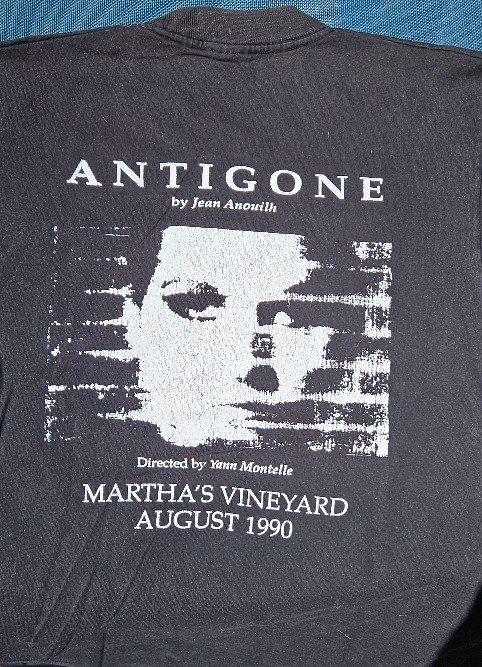
Concerts and road races are far more likely to have their own T-shirts. Not only is this a rarity in Vineyard annals, but it even includes the essential who, what, when, and where. The image may be that of Kristina Kreyling, who had the title role.

Seen from several decades later, the late 1980s and early ’90s were a golden age in Vineyard theater, and in the grassroots performing arts in general. “The Play’s the Thing,” a July 1990 story in the Martha’s Vineyard Times summer supplement, counted no fewer than seven companies in action that summer.[2]

Essential to this flowering was available space.[3] The Vineyard Playhouse could host full productions upstairs, and smaller ones downstairs, like the late-night comedy troupe Afterwords. Island Theatre Workshop (ITW) didn’t have its own home, but it had regular access to Katharine Cornell Theatre, upstairs from Tisbury Town Hall, and, for auditions and early rehearsals, to the parish hall at Grace Episcopal Church not far away.

Once Wintertide moved into its year-round home at Five Corners in January 1991, all sorts of creativity took root and flowered there, including WIMP, the Wintertide Improv group. Among WIMP’s offerings was “Troubled Shores,” a long-running soap-opera-style satire of island life.[4] I still vividly remember Theodore Sturgeon, chief surgeon at Wing and a Prayer Hospital (Toby Wilson), Sengekontacket Vanderhoop (Lisa Elliott), and John Farmboy (Chris Brophy).

Some performers and techies were identified primarily with one or the other theater groups, ITW or the Vineyard Playhouse, but most moved between them and Wintertide depending on available opportunities. Having both space and a pool of capable actors and tech crew available made it so much easier to mount a show than it would have been if you had to start from scratch.

Not only to mount a show, but to birth a new theater company: Chiaroscuro, the company behind the 1990 production of Jean Anouilh’s Antigone, was born on Martha’s Vineyard. Ironically, when Yann Montelle arrived on the Vineyard to visit a friend on Chappy, he was taking a break from theater in his native France. Then fate intervened: he met, then married, Anne Cook, an artist with a long family connection to the Vineyard. Together they founded Chiaroscuro.
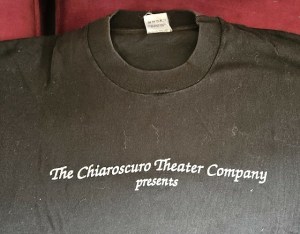
Chiaroscuro’s name was featured on the front of the shirt.

Yann and Chiaroscuro were active on the Vineyard for well under two years before Yann and Anne left for Portland, Maine, but the energy and quality of their activities were astonishing and invigorating to the island’s theater scene. In addition to directing, Yann ran workshops, at least two of which grew into full productions: Macchiavelli’s The Mandrake and Molière’s The Misanthrope. Of the former, he later told an interviewer[5] that “I wanted to do it to see if I could speak English. I had trouble because – you guys don’t realize it but you speak very fast!” To say he quickly became fluent is an understatement.

Yann also collaborated with fellow Frenchman Dominique Pochat (1956–2003) in the latter’s Red Nose Reviews, featuring Martin, Dominique’s clown persona. Dozens of Vineyarders, actors and non-actors, took their workshops; Red Noses started appearing in unexpected places. Red noses, by the way, have long been associated with clowns, but where did they come from? Origin stories vary: poke around online and you’ll find some of them. They’ve been described as “the smallest mask in the world.” I love this. With a red nose on, your face becomes both yours and not-yours. You’re free to become a you that isn’t seen in polite company.

And Yann directed several outstanding shows in 1990 and 1991. In addition to Antigone, I remember especially The Merchant of Venice (summer 1991) — which like Antigone was staged at the outdoor Tisbury Amphitheater[6] — and Sartre’s No Exit. I have copies of the reviews I wrote of several of these shows, so it’s not hard to remember the details. About Antigone I wrote that it was “one to see more than once, to discuss passionately far into the night over cappuccino or wine. Directed with care, graced with several outstanding performances, this ‘Antigone’ jerks you back and forth by the hair and leaves you breathless, dizzy, even awed.”

Randy Rapstine, who appeared in both Antigone and Merchant as well as other Vineyard productions (and with the Afterwords troupe), was one of several theater people who were then moving regularly between New York and the Vineyard. Asked to compare the two scenes, he noted that “in New York, you’re a small fish in a big pond,” while the Vineyard provided opportunities that were rare in New York. As a result, actors can take on a range of roles so audiences “see different parts of you.” He praised Vineyard theatergoers for being willing and able to do that.[7]

NOTES

[1] They rarely if ever created a T-shirt for a particular show. This makes sense. From auditions through rehearsals to opening and then closing night, a production’s life cycle might be eight weeks at most. Designing a shirt from scratch, then getting it printed and out on the street, would probably take at least four, by which point the run would be half over.

[2] For the record, they were the Vineyard Playhouse Company, Chiaroscuro Theatre Company, Full Circle, Island Entertainment Productions, Island Theatre Workshop, Red Nose and More, and Theater Arts Productions. The story was by yours truly.

[3] Also important was reasonably affordable housing. Year-round housing could usually be found at a realistic (for the Vineyard) price, and seasonal actors and techies could be put up in the spare rooms of year-rounders. As time went on, spare rooms became scarce, in part because young people who’d grown up on the Vineyard couldn’t afford to move out on their own.

[4] Led by WIMP veteran Donna Swift, Troubled Shores became the name of a Vineyard nonprofit focusing on theater (including improv) for young people on the Vineyard.

[5] That would be me. This was sort of Yann’s exit interview from the Vineyard: “Yann Montelle Seeks Out New Risks,” Martha’s Vineyard Times (August 29, 1991).

[6] If in warm weather, especially toward the end of the afternoon, you see vehicles parked bumper to bumper on both sides of State Road near the Tashmoo Overlook, that’s a sure sign there’s a show on at the Tisbury Amphitheater. This is a glorious clearing in the woods with a natural embankment that’s been augmented with very basic seating, e.g., railroad ties. Playgoers often bring their own beach chairs or blankets, and often a picnic. If you’ve never been there, pull off on the overlook when there isn’t a play going on, start walking down the access road, then take one of the paths on your right that leads into the amphitheater itself.

[7] Writing in the T-Shirt Chronicles about people I knew decades ago, I’m often afraid to look them up online. Randy was so talented and so motivated but the New York theater scene is so crowded and demanding. I didn’t want to learn that Randy had given it up and become a stockbroker. Good news: His subsequent career has included directing, producing, and teaching as well as acting in films as well as theater, and he’s still at it. Check out his website for details.

1989: “For Colored Girls Who Have Considered Suicide . . .”

Considering how many years I was involved in Vineyard theater and how many shows I was involved in, it’s surprising that I have only two T-shirts devoted to specific shows: this is one and the other will be up next.

I was the main theater reviewer for the Martha’s Vineyard Times when For Colored Girls Who Have Considered Suicide opened at the Old Whaling Church in Edgartown in August 1989. It’s obvious from the opening paragraph of my review (M.V. Times, Aug. 24, 1989) that I was blown away:

At its most profound, theater melds language and movement into a whole that overwhelms the individual senses, an experience so powerful that it becomes sacred. Marla Blakey’s production of Ntozake Shange’s “For Colored Girls Who Have Considered Suicide / When the Rainbow Is Enuf” . . . is that kind of theater.

Reviewers get to see the show for free, but I went back at full price (which I think was $20) at least once and I’m pretty sure twice before the run ended. Some while later a smaller production was mounted at Piatelli Studios, a multi-purpose space in the building next door to the West Tisbury post office.1 I saw that at least once too.

Note the “Martha’s Vineyard, 1989” at the bottom. This shirt was designed for this particular production. Sorry about the stains. My first couple of decades on the Vineyard, my clothes were often at the mercy of laundromats so I avoided white for this very reason.

NOTE

  1. When pianist Cheryl Piatelli owned it, the building was vivid pink. After Cheryl left, the pink disappeared and the building was given over to various healthy activities, e.g., exercise and alternative health care, so I never saw what it looked like inside. In October 2019, Vineyard-based nonprofit radio station MVY bought the building. After extensive renovations were completed, the station took up residence at the end of 2020. If the creative energy of the Piatelli years is still around, I think it’s happy with the new occupants. ↩︎

Reviewing Gyn/Ecology for off our backs

Mary Daly’s Gyn/Ecology: The Metaethics of Radical Feminism (Boston: Beacon Press, 1978) was bigger than a bombshell in the feminist world. It was more like an asteroid crashing into the ocean, creating a tsunami. I was a newcomer in the D.C. community, and not yet well grounded in feminist theory, never mind feminist theology, so it’s a bit of a wonder that I got to review Gyn/Ecology for off our backs.

off our backs, known to its friends as oob, was the hometown newspaper of D.C.’s feminist and lesbian communities, but it was also a national and even international publication. It was run by a collective, but every month the two-room walk-up office off Connecticut Ave. NW, opened up for layout weekend. By that point most of the writing and editing had been done and it was all hands on deck, supporters as well as collective members, to do the typing and paste-up necessary to produce the next issue. The rush to deadline made comrades and colleagues of us all. Everyone who helped out was listed among the Friends on the staff block for that issue.

My visual memory of the oob office is of a crowded, no-frills workspace whose walls were papered with posters from recent feminist history and covers from previous issues. I remember picking up the phone once — when the phone rang during layout, whoever was closest grabbed it — and it turned out to be someone I knew from Martha’s Vineyard who was involved in the women’s health movement. My worlds sometimes collided in interesting ways.

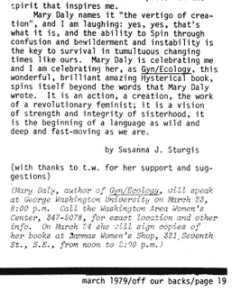
I did the typing and probably the layout for my Gyn/Ecology review, and for most of the articles I contributed to oob over the years, mostly interviews and book reviews. My typing ability came in handy, as did my facility with presstype. Here is what the layout looked like:

Apart from ads that came in camera-ready, all copy was produced on IBM Selectric typewriters. Veteran typists of the era will recognize the typeface as Letter Gothic, a popular Selectric sans serif option. Note that book titles are underscored, not italicized, even though we clearly had access to an italic typeball. Swapping typeballs in and out slowed you way down and often got ink on your fingers, so italics were only used for larger chunks of text — in this case quotes from the book being reviewed.

In those days, oob always put bylines at the end of stories, a characteristically feminist strategy to keep readers’ focus on the text instead of the author. I wasn’t the only one who would sometimes read the first few lines of a long story then skip to the end before deciding to continue.

Headings were done with presstype. This one is pretty good, but it’s hard not to notice that the baseline wobbles a little and that the space between “of” and “radical” is twice what it ought to be.

Typing was done on ordinary bond paper with margins set to the paper’s column width. If you caught a typo while you were typing, you fixed it with correction tape, which was preferable to correction fluid (like Liquid Paper or Wite-Out) because it didn’t have to dry. The newer Correcting Selectrics had a correction ribbon built in, parallel to the ink ribbon. I can’t remember if off our backs had any of them when I was involved.

Once completed, the typescript was sprayed with silicone to keep the ink from smearing, then cut with X-acto knives, waxed with a hand waxer, and pasted up on layout boards. The boards from the previous issue would have been stripped for reuse; they were reused until they wore out. Once in a while a page would go to print with the folio (running head) from the previous issue, meaning the date at the top of the page was wrong, but considering the intense, barely controlled chaos of layout weekend and the fact that most of us were amateurs, the gaffes were remarkably few.


Reading the first paragraph of my Gyn/Ecology review for the first time in at least 35 years confirms my memory: while writing it, I was terrified that I couldn’t do the book justice:

“I have been living with Gyn/Ecology: The Metaethics of Radical Feminism for about four months now–reading, rereading, reflecting, rejoicing, growing impatient with my fear of taking on such a magnificent, vast and tightly-woven book. Gyn/Ecology is written to us, for us, from our experience, about us, the untamed, the Hags, the “women reluctant to yield to wooing”. It is a process that aims to transcend the limits of writing, to break down the walls between the writer and reader and the  usual distinction between the creating and the product. Gyn/Ecology is breath-taking in its reach, astonishing in its power–yet it is also intensely personal and has exacted from me an intensely personal response. I write, therefore, to review not the book alone but the part it has played on my own journey into woman-defined space.”

Gyn/Ecology is grim in its exploration of misogyny across cultures and across the centuries, but when it comes to language it’s also immensely playful. As its title suggests, it breaks words apart and prompts one to look at them in unexpected ways. Does “recover,” for instance, mean to regain or to cover up again? Or maybe both at the same time?

From my copy of Gyn/Ecology

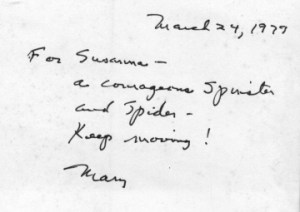
In the last paragraph, I write that “Gyn/Ecology, this wonderful, brilliant amazing Hysterical book, spins itself beyond the words that Mary Daly wrote.” It spun me well beyond writing the review. Though then as now I was happier playing first lieutenant than instigator, I led an ad hoc group — we called ourselves, of course, the D.C. Hags — to bring Mary to town. The SRO event was held in a lecture hall at George Washington University on March 23, 1979, with a book signing at Lammas the next day (I know that because the dates appear at the end of the review).

Then, in early April, a friend and I took the Night Owl train from D.C. to Boston to attend “We Have Done with Your Education,” a rally supporting Mary in one of her frequent battles with Boston College. Since BC, like Georgetown U., is Jesuit-run, I found it borderline miraculous that she got tenure and thrived there as long as she did. Not till 1999 was she forced to take early retirement because she insisted on keeping her advanced women’s studies courses women-only. (She would tutor privately any men who wanted to take the course.) The rally, held at Boston University, was held on April 8, 1979 — I know that because it’s on the T-shirt. Its title was based on a quote from Virginia Woolf’s Three Guineas (Daly embraced Woolf as a foremother):

“And let the daughters of educated men dance round the fire and heap armful upon armful of dead leaves upon the flames. And let their mothers lean from the upper windows and cry, ‘Let it blaze! Let it blaze! For we have done with this “education”!’”

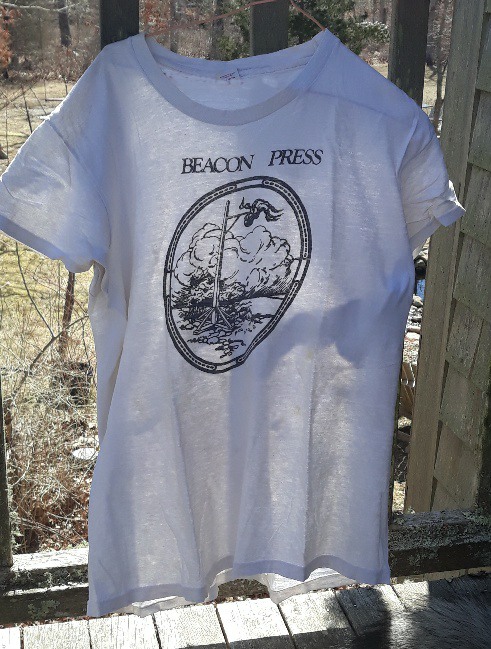
As a daughter of educated men, I might well have been dancing round the fire. The less predictable part is that my mother, Chiquita Mitchell Sturgis, might actually have been leaning from the upper windows. At the time, she was a clerical at Beacon Press, Unitarian Universalist–affiliated publisher of Mary Daly and many other essential feminist, liberal, and progressive writers, so requesting a Beacon book or contacting a Beacon author often meant working with my mother. What she made of Mary’s books I’ll never know, but she liked Mary and we both liked having something in common that had nothing to do with family or hometown.

Mary died on January 3, 2010. My obituary for her was published in the May/June 2010 Women’s Review of Books. Unfortunately it’s not available online, but fortunately (wonder of wonders) I still have the print version. Rather than focus on (obsess about?) Mary’s forced retirement from Boston College, which the mainstream media were covering ad nauseam, I started off by summarizing the “far more intriguing . . . story of how a nice Catholic girl from Schenectady, New York . . . transformed herself into a ‘revolting hag’ whose advice to posterity is ‘sin big.’”[1]

“Daly’s searchings were wild, exhilarating, infuriating, inspiring,” I wrote. “But I didn’t become a Daly groupie. As a reader, a writer, and a thinker, I’ve always been a pick-and-choose synthesizer. A few of Daly’s protégées, including Janice Raymond,[2] took her insights and tools and created powerful work with them. In less able hands, though, those insights and tools became little more than parlor tricks.”

My mother worked at Beacon Press, publisher of Mary Daly and other essential feminist writers, from the mid-1970s to the late ’80s.

When I wrote that obit for Mary Daly, I’d been an editor for more than 30 years, so it’s not all that surprising that I contributed to the Women’s Review of Books blog a post titled “Beyond God the Style Guide: Me? Edit Mary Daly?” Could I have done it? The mere thought was daunting, “even though,” I noted, “I’m the kind of copyeditor who argues with the dictionary, cheerfully makes exceptions to Chicago, and lets my authors do pretty much what they want as long as it makes sense and will (probably) pass muster with the publisher.”

Being a writer and a feminist as well as an editor, I went on: “From Church and the Second Sex onward, Mary Daly was continually improvising words and imagery to convey what hadn’t been conveyed before, and to examine ideas taken for granted for so long that they actively resisted exploration. Breaking trail is demanding and exhausting work. Being among the first to follow in a freshly broken trail isn’t exactly like traveling a paved road either.”

And that’s what editing Mary Daly would have been like: “following in a freshly broken trail.” Would I have been up to it? At the time Gyn/Ecology came out, almost certainly not. A few years later, fully fledged as an editor and more flexible than I’d been as an apprentice, I think I could have done it, though not without the terror that gripped me while I was writing that review.

notes

[1] Sources were Mary’s Outercourse: The Be-Dazzling Voyage (New York: HarperSanFrancisco, 1992) and “Sin Big,” in The New Yorker, February 26, 1996. To explore, or revisit, Mary’s work, check out The Mary Daly Reader, edited by Jennifer Rycenga and Linda Barufaldi (New York University Press, 2017).

[2] My interview with Jan Raymond appeared in off our backs for October 1979.

If you don’t see a Leave a Reply box, click the title of the blog post (above) and then scroll to the bottom.

This is the photo that appeared with my obituary for Mary. No credit was given, but if you know who the photographer was, please let me know and I’ll add it in. I can’t tell you how much I love this picture.