1985–1986: Morgana Comes on Board

The several seeds planted my first off-season on Martha’s Vineyard sent out tendrils that kept growing for years, often tangling with each other. Where to start, where to start?

It probably doesn’t really matter where I start because I’ll get to where I’m going no matter what, but let’s start with computers.

I acquired this T several years later, almost certainly in my science-fiction-con-going years (roughly the ’90s), but it’s the only computer-related shirt I’ve got so here it is.

My first serious computer relationship was with the TRS-80 that Lammas Bookstore acquired while I was working there, around 1983. The TRS-80 (the T in TRS is for Tandy, the main inventor, and the RS stands for Radio Shack, which produced and marketed it) was a wildly popular workhorse that introduced hundreds of thousands (millions?) of people to what IIRC were then called microcomputers, to distinguish them from the hulking machines that occupied whole rooms at universities and big businesses.

For the first few weeks I was terrified that I’d hit the wrong key and blow something up. It was a little like learning to drive. In both cases, the terror passed. I didn’t have my first real computer disaster till several years later, when I accidentally erased a client’s current accounts receivable file. Fortunately it was only March so it wasn’t hard to reconstruct it from bank statements and paper invoices. And by then my relationship with computers was so solid that one screw-up didn’t do it any damage.
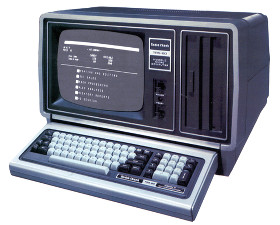
This TRS-80 Model II looks like my memory of Sylvia, except Sylvia’s case was white.

Once that TRS-80 and I got through our shakedown cruise, we became good buddies. I named her Sylvia after my editorial mentor, Sylvia Abrams; my brilliant high school history teacher, Sylvia Sherman; and Nicole Hollander’s Sylvia character. Sylvia had two 8-inch floppy drives in the same unit as the monitor, a separate keyboard, and a word processor called Scripsit. She was connected to a dot-matrix printer.

When I left Lammas and D.C., I was accompanied by the venerable red IBM Selectric I’d bought from a friend some years earlier, but I was ready for a computer of my own. Most participants at the Feminist Women’s Writing Workshops that summer of 1985 were still using typewriters, but at mealtimes we talked as much about computers as we did about food.

That fall, I found my way to EduComp, which was then located in a little house set back from the sidewalk on Main Street. Proprietor Pat Gregory introduced me to hard drives. I was an instant convert: with a 10MB (!!) hard drive and one floppy drive, instead of two floppy drives like Sylvia, you didn’t have to keep swapping program disks in and out. This option would add $500 to the cost of a basic system, but even to this chronically frugal New Englander it was hands-down worth it.

I bought my first computer on an off-island foray to Framingham: a Leading Edge Model D (an IBM clone). A Wikipedia article supports my memory of the cost: in addition to the $500 for the optional hard drive, I paid $1,500 for the computer itself (it also had a 5 1/4” floppy drive), $500 for WordPerfect 4.1, and $500 for an Epson LX-80 dot matrix printer. $3,000 was the most money I’d ever spent on anything.

Setting it up I was on my own, but in those days software came with manuals, hardware instructions weren’t hard to follow, and you could actually reach a real person by calling tech support. Once the tech guys (all the ones I spoke with were guys) ascertained that you had plugged the computer in, connected the cables, and turned the thing on, they treated you like someone who was capable of understanding and following directions.

Morgana was named for the Celtic goddess the Morrigan, for Fata Morgana (Morgan le Fay); and for the hero of C. J. Cherryh’s Morgaine novels. Her equine namesake was the Morgan horse. The Morgan horse stamp was released that September. I stuck one on Morgana’s case. As the first Morgana was succeeded by Morganas II, III, IV, and V, the stamp migrated to each one as a sign of continuity.

Since in September 1985 first-class postage was 22¢, it was also a reminder that while the price of computers kept coming down, the cost of mailing a letter kept going up. Believe it or not, I’ve still got that stamp, much the worse for wear (see right). After Morgana V, around 2010, I switched from desktops to laptops and started a new naming convention, so since then the stamp has been stuck to a cupboard door above what used to be my computer desk.

Me in my vintage Tisbury Printer T-shirt

As my savings dwindled, I entered the Vineyard workforce as a freelance typist, running an occasional “situation wanted” ad in the Martha’s Vineyard Times classifieds. The Tisbury Printer — with whom I’d established a connection doing PR and other print-related tasks for Island Theatre Workshop (more about that to come), and which I’m pleased to note still exists — referred me to people who wanted cut-rate typesetting for lengthy documents, booklets and even books. I’d type the manuscript on Morgana, then take the floppy disk down to EduComp (which unfortunately no longer exists, and which I miss a lot), which by then was located in the big building at the head of Main Street.

At first EduComp rented out time on its laser printers to the public, but it turned out that most customers needed so much hands-on support and supervision that it was taking up too much staff time. They made an exception for me and a couple of others who were capable of sitting down with a disk unsupervised and getting the job done. My girlfriend in the late ’80s was a graphic artist: she did the layout using my typescript. We produced a couple of books and at least two Nathan Mayhew Seminars course catalogues that way.

Come to think of it, seat-of-the-pants on-the-cheap publishing has been a theme through my adult life, from my antiwar movement days to my evening job proofreading that law weekly, to off our backs and Lammas Bookstore, on to the Vineyard, and right up to the present day. 1980s publishing technology was strictly horse-and-buggy compared to what we’ve got now, but hey, it got us where we wanted to go.
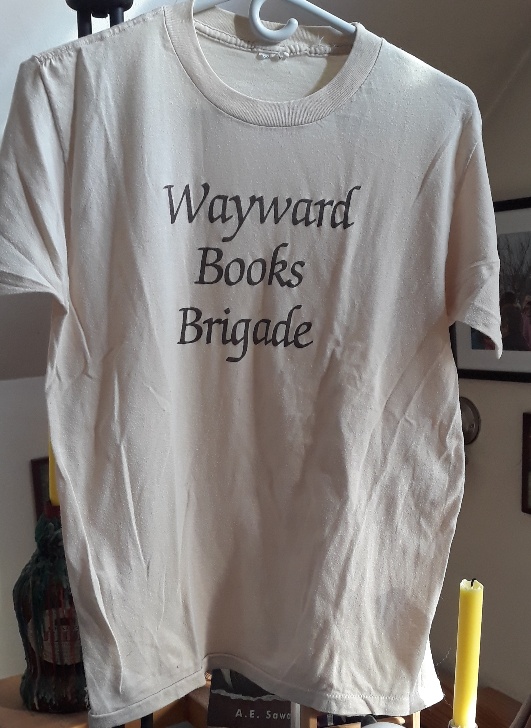
Wayward Books & Women’s Glib

When bookstores move, staffers usually pack the books in boxes, load the boxes in a truck, and drive the truck to the new location. When Wayward Books moved, owners Sybil Pike and Doris Grumbach packed the books in grocery bags and volunteers passed them hand to hand along Pennsylvania Avenue SE to the new shop at 325 7th Street., which was practically next door to Lammas. I was one of the volunteers, and that’s how I got this T-shirt.

True, the distance was only three or four city blocks, and as I recall the brigade didn’t quite stretch the whole distance, so cars were called upon to ferry the books across the gap. But the operation was ingenious and fun, and it worked.

Wayward Books dealt in a carefully curated mix of secondhand and rare works, which meant those books had already been around. They probably took their latest move in stride.

Lammas was well represented in the Wayward Books Brigade, and not only because Wayward Books was moving into the immediate neighborhood. Pike and Grumbach had been a couple since the early 1970s, and Grumbach’s novels were regular sellers at Lammas, notably Chamber Music and The Ladies, which was based on the “Ladies of Llangollen,” two 18th-century Irish women who eloped to Wales, set up housekeeping as a married couple, and whose home became a go-to destination for literary luminaries of the time. Grumbach’s books focused on women’s lives, and often women in relationship with each other, which was not all that common at the time, especially for “mainstream” novelists.

Sybil, a retired research librarian at the Library of Congress, was the on-site manager at Wayward Books — I remember her as a strikingly handsome woman who would have been in her mid-fifties at the time — but Doris was also around when she wasn’t teaching or writing. The two shops complemented each other nicely: their inventories didn’t overlap, but their customers did.

A Washington Post story from April 1990, reporting on Wayward Books’ relocation to Sargentville, Maine, that month, notes that the Wayward Books Brigade comprised 70 volunteers and moved some 3,000 volumes from old location to new. The move to Maine involved three times that many books and was presumably not accomplished hand to hand.

The Post story also says the hand-to-hand move to 7th Street happened in 1985. I would have said a year earlier, because I left D.C. at the end of July 1985 and it seemed Wayward Books and Lammas had been neighbors for more than a few months at that point. But memory is tricky, so maybe not.

I just learned that Sybil passed in March of last year, at the age of 91, but that Doris seems to be alive in her 104th year. It sounds as though, around 2009, they moved together to a retirement community in Pennsylvania, where Sybil died and Doris still lives. Anyone with more information, please respond in the comments. If you don’t want your comment published, say so and it won’t be.


This T-shirt has nothing to do with Wayward Books — except that they both have to do with books, and that Women’s Glib was somewhat wayward in that it had to do with feminist humor, which many continue to swear is an oxymoron. Not for the first or last time, those “many” are so wrong.

Women’s Glib and Women’s Glibber, anthologies edited by Roz Warren, both came out in my bookselling days — I think. Amazon.com gives the early ’90s as pub dates for both books but notes in one case that it’s a second edition. I’m pretty sure I didn’t have anything in either book, although I was the class clown (female) in sixth grade and have been credited with having a pretty good, albeit barbed, sense of humor in all the decades since.

Interestingly enough (to me, at least), this is one of the very few — maybe even only? — Ts I have that features a book. I’ll hedge my bets on that one till I’ve excavated my whole collection. Either few books were featured on Ts or I wasn’t buying (or being given) the ones that were.

My humor tends to be in the moment — I think the word is “situational,” meaning that it arises from circumstances. I’ve never been fond of the other kind, such as stand-up, mainly because stand-up comedy back in the day was so misogynist, even when performed by one of the few women in the trade. Phyllis Diller embarrassed and infuriated me. I could admire Lucille Ball and I Love Lucy while being mortified by her tactics.

As a teenager and young adult I was a huge fan of the Smothers Brothers and Rowan and Martin’s Laugh-In. By the time Saturday Night Live got going, in the mid to late 1970s, I was doing fine without a TV and besides, SNL didn’t seem all that in sync with the lesbian-feminist life I was living.

Humor that was in sync with my life — I loved it. Alison Bechdel’s Dykes to Watch Out For strip and the books compiled from it were huge hits with Lammas customers. So were Nicole Hollander’s Sylvia books. They kept us laughing, and they kept us sane.

The first stand-up comedian who made me sit up, take notice, and even buy at least one of her albums was Kate Clinton. I heard her perform live in the early ’80s. What a revelation! The problem with stand-up comedy wasn’t me, it was the sexist, heterosexist comedy itself!

I’m thrilled to report that Roz Warren and Kate Clinton are still “making light,” as an early Clinton album had it, and you’ve almost certainly heard of Alison Bechdel, if not of Dykes to Watch Out For. I’m not sure if Nicole Hollander is still creating, but it’s not hard to find Sylvia online.

Sylvia — that Sylvia — was one of the namesakes of the TRS-80 that was Lammas’s and my first computer. The other two, as I think I mentioned before, were Sylvia Sherman, my high school history teacher, and Sylvia Abrams, my editorial mentor, without whom I would have had a hard time making a living these last four decades.