1987: March on D.C. for Lesbian & Gay Rights

The 1987 March on Washington for Lesbian & Gay Rights wasn’t my first national march, not by a long shot. Barely a month into my freshman year of college, I participated in the first Vietnam Moratorium march on October 15, 1969, then exactly one month later, on November 15, I was a marshal at the huge New Mobilization1 (aka “New Mobe”) march. From my station between 6th and 7th Streets NW, I got to watch hundreds of thousands of people pouring down Pennsylvania Ave. ten or twelve abreast. I’d never seen anything like it.

I still have visceral memories of that one. It was sunny, but it was chilly and I was underdressed: In my innocence I thought my winter duds could wait till I went home for Thanksgiving. Wrong. I wasn’t the only one either. Those who’d worn jackets hadn’t brought gloves, so we took turns making coffee runs to the nearest drugstore then warmed our hands by wrapping them around the cup. Several of us entertained the others, and the police officers stationed on the same block, singing Tom Lehrer songs. I could go on . . .
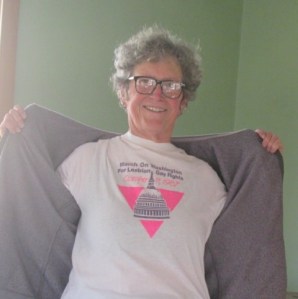
So the 1987 March for Lesbian & Gay Rights wasn’t my first national march, but it was the first I’d had to travel to. I’d moved back to Massachusetts in the summer of ’85, and by now into my third year, it looked like I was going to stay there.

I’d marched in the the first national March for Lesbian & Gay Rights in 1979, of course, but I don’t remember who I marched with. Maybe the off our backs contingent, or the Washington Area Women’s Center? I do remember passing along the back side of the White House grounds chanting with a whole bunch of other dykes “Two, four, six, eight, how do you know that Amy’s straight?” Amy Carter, daughter of then-president Jimmy Carter, was all of 12 at the time. We were, of course, giving her the benefit of the doubt, but — I just looked her up — she’s been heterosexually married twice and has two kids, so straight she seems to be.

The AIDS Quilt, officially the NAMES Project AIDS Memorial Quilt, was displayed for the first time during that march. Established almost exactly two years earlier, in November 1985, the Quilt at that point included 1,920 panels. Each panel was three by six feet; they were stitched into square blocks of eight panels each.

I knew about the Quilt. My friend Nancy Luedeman (1920–2010), a mainstay of Island Theatre Workshop and longtime partner of Mary Payne, had created a panel for four Vineyard men who had died of AIDS. I promised I would find her panel.

I was not prepared for how overwhelmed I felt as I walked down the rows between the blocks of panels. I’ve been deeply moved walking through cemeteries, noting the dates and the connections between people, but this was different: each panel was alive, evoking in color and imagery the life and personality of each person memorialized, each person lost. Finally I knew what it felt like to be in the presence of the sacred.

I did find Nancy’s panel. Two of the four men were identified by first name and last initial, the other two only by initials. This reflected the shame attached to AIDS, and homosexuality, on Martha’s Vineyard and in so many other places at the time. Nancy didn’t volunteer their full names, and I didn’t ask. I think Nancy said they’d all died off-island. Eventually I learned that Bill S. was Bill Spalding, who has another panel in the Quilt, with his full name on it. I don’t know about the others. If you do, please let me know.
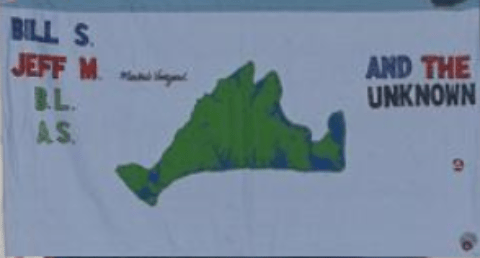
Quilt panel created by Nancy Luedeman in memory of four Vineyard men who died of AIDS

The Quilt returned to D.C. a year later, and so did I. It had been on tour that spring and summer of 1988, growing all the while. By October 1988, spread out on the Ellipse, it comprised 8,288 panels. Too many to see all of them in only two or three hours, so I wandered, letting myself be drawn and directed by a name, an image, a thought.

A Red Cross caught my eye. I had worked at Red Cross national headquarters for four years in my D.C. days. That’s where I learned what an editor was, and where I started to become one. When I reached the panel and read the name on it, my knees collapsed under me. It was for my co-worker and friend Thom Higgins, whom I’d seen when I was in D.C. the previous October. He’d seemed fine. He didn’t say anything about being sick. He’d died earlier that year, I think in May.

The image in the middle is for Toastmasters, of which Thom was a dedicated member. IIRC the panel was created by Thom’s friend and my friend and former colleague Brad McMinn. Brad died, also of AIDS, in 1993.

My recollection is that Casselberry and Dupree were singing “Positive Vibration” at the other end of the Mall, but maybe I made that up. Now I can’t hear that song without thinking of Thom. I can’t think of Thom without hearing that song.

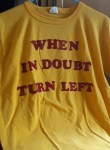
More about Thom in “1978: ERA March and the Red Cross Training Office.” He gave me my EDITOR shirt and my WHEN IN DOUBT TURN LEFT shirt. I still have both of them. I remember you, Thom.


NOTE

  1. Formally the New Mobilization Committee to End the War in Vietnam. The successor to the National Mobilization Committee to End the War in Vietnam, which organized major antiwar events in 1967 and ’68, this was the coalition that organized the gigantic November 15, 1969, march. Frequently confused and/or conflated with it was the Vietnam Moratorium Committee, which organized the October 15 events across the country. It also organized the incredibly moving prelude to the November 15 march: On November 13 and 14, thousands of people walked from Arlington National Cemetery to the White House, each one bearing on a placard the name of someone killed in Vietnam. In front of the White House these placards were deposited into coffins set up for the purpose. I was involved in the housing and feeding operation ongoing at Georgetown and so was unable to participate. ↩︎

1979: I Become an Editor

My first full-time paid job with job title “editor” gave me a career path when I didn’t know what a career path was. I didn’t even know what an editor was. I did understand what editing was, but wasn’t it just something that writers did?

I landed in this job through a series of coincidences any one of which could have turned me in a different direction. The first was getting hired as a clerical at Red Cross national headquarters. The next was transferring into the Office of Personnel Training and Development.

I liked my colleagues in the training office, especially Betty O. and Thom, the work was interesting, but I had a strong hunch that I wouldn’t be there long. When an opening for Publications Editor appeared on the internal help-wanted list, Betty O. and, especially, Thom pushed me to apply. I did.

I aced the editing test and must have done OK in the interview, because I was offered the job. After I started, I was told by one of my new colleagues, somewhat breathlessly, that on the test I had “scored higher than a Harvard Ph.D.” Even then I knew better than to be impressed by this.

I also learned that my soon-to-be supervisors had had to go to bat for me, because the Personnel Office tried to block my promotion. I was jumping from grade 23, in the clerical ranks, to grade 28, which was considered professional: this apparently was not done. The staffing specialist in charge of professional positions demanded that I produce evidence that I had graduated from college, a requirement for grades 28 and up. I took the wind out of her sails by showing up with my diploma, which certified me a 1974 graduate in history of the University of Pennsylvania, magna cum laude.

Thom made me that orange EDITOR shirt to celebrate. He also gave me WHEN IN DOUBT TURN LEFT, which was something I said fairly often, having figured it out while hiking and hitchhiking around Great Britain and Ireland in 1975. Neither one of them has gone out of date.

The publications office, known as Publication Services, was located on the fringe of Alexandria’s Old Town, in the Red Cross’s Eastern Field Office building (which I was told had once been a brewery). In its big, high-ceilinged room, the editors had cubicles down one side and production was on the other. The director and deputy director had offices in opposite corners at one end; the art department was down the hall. I soon presstyped myself a sign for my cubicle: “Cubicle 4, OOPS: Making the Semiliterate Printable.” OOPS stood for Office of Publications Services, which wasn’t quite the official name but close enough.

The best thing about Cubicle 4 was that next door was Sylvia Abrams, editor extraordinaire. She had been an editor in New York before her second marriage brought her to D.C. I am not kidding when I say that working under her wing for two years made it possible for me to earn a living as a reasonably competent editor for 40 years and counting. She introduced me to the University of Chicago Press’s A Manual of Style, 12th edition, which shortly changed its name to what everyone called it anyway: the Chicago Manual of Style. It’s currently up to edition 17, and I’m still using it regularly and still complaining about the lousy index, though I do admit that it’s improved over the years.

Me in Cubicle 4, ca. 1980

Sylvia answered my questions. She looked my work over and made comments whenever I asked her to. She showed me interesting challenges from her own work. She passed on editorial nuggets from her extensive experience. I’m probably part of the last generation to learn editing the old way, by apprenticeship to a master, and till the day I die I’ll be grateful I had the opportunity to work alongside her.

The job was ideal for a fledgling editor in other ways as well. The stuff we edited ranged from bureaucratic forms that required minimal changes to brochures, training manuals, and textbooks for Red Cross courses. In general the authors were not professional writers. In some cases the task of producing a document fell to whoever hadn’t said “Not me!” fast enough. Each edited ms. had to be cleared face-to-face with the writer. This required tact as well as expertise; often it was the less experienced and least willing writers who were the most touchy.

In my more than two decades of freelancing mostly for publishers, I usually don’t have any direct contact with the authors whose manuscripts I work on. Nevertheless, I mentally explain my more substantive edits to those invisible authors and write my queries as if I were speaking them aloud. It’s a great habit for an editor to get into, and for me it started in the Red Cross publications office.

I must confess, though, that like many novice editors, I did suffer from “piss on fire hydrant syndrome”: making changes that didn’t need to be made mainly to prove that I was well versed in editorial esoterica. For several years after I learned the which/that distinction (that for restrictive clauses, which for nonrestrictive), I was a menace with a red pencil.

I was the office wiseass. On one wall of my cubicle I taped the before and after versions of especially challenging sentences. Some repeat writers scanned the wall to see if any of their prose had earned a place on it. Editors and artists all submitted biweekly reports of all the jobs we were in charge of. All that was required was each job’s title and status, and that was all that most of my colleagues delivered. Not me, however. I’ve still got copies of several of mine, and it’s a wonder I got away with that much wiseassery.

But I did. When I left the Publications Office after two years, my performance review was stellar. Wrote my immediate supervisor:

“Projects edited by Susanna Sturgis were frequently highly praised by both the sponsoring offices and Publications Services. She was successfully responsible for projects that involved extensive rewriting to minimize jargon and vagueness. Her sensitivity to logic was valuable.

“Miss Sturgis worked efficiently under time pressure and demonstrated ability to organize and carry out a variety of projects simultaneously.”

Was I really that good? I hope so.

Though I loved the work and my colleagues, I liked less and less what I saw of the way big bureaucracies — or at least this big bureaucracy — operated. The epitome of this was Frank, the deputy director of Publications. Frank was built like the Little King in the old comic strip, only taller. To call him incompetent is too polite. He’d been at National Headquarters for over 15 years, and it seems his spots hadn’t changed in the least. Rather than fire him or get him to shape up, one office would pass him on to the next via lateral transfer or promotion, always with a glowing performance review. At some point the glowing reviews made it impossible to fire him; he was gay, D.C. had a Human Rights Act, and he would have had a strong case for a discrimination suit if anyone had told the truth: he could have pointed to those reviews as evidence that the firing was not for cause.

None of us were sure what he did all day. He would occasionally call one of the editors from his corner office and ask us to look up a word: we had Webster’s Second International (Sylvia’s prized copy) on a lectern at one end of our little corridor and Webster’s Third at the other. Frank, like all the rest of us, had a standard-size dictionary in his office. He quickly learned not to call me, because I’d say I was busy and suggest he look it up himself.

Monday mornings he’d often come round to each cubicle and tell each of us in turn what he eaten at his several-course Sunday dinner. Of course the less reverent among us made fun of him behind his back, but after a while I got fed up. I went round to all my colleagues, asked what they’d had for supper the day before, typed it up, put it in a frame, and left it on Frank’s desk. Thus ended the Sunday-dinner recitations.

After trying unsuccessfully to get higher-ups to take the Frank problem seriously, I gave notice in the spring of 1981. I left the Red Cross a month or so before my 30th birthday, thinking I was going to take a little time off to write before finding another job. That’s not the way it worked out.

Still an editor after all these years, ca. 2014

If you want to leave a comment and don’t see a Leave a Reply box, click the title of the post and then scroll to the bottom.

1978: ERA March and the Red Cross Training Office

From the back of the T-shirt

The July 9, 1978, march to extend the deadline for ratification of the Equal Rights Amendment (ERA) was the “largest march for women’s rights in the nation’s history” up to that time. Organizers, led by NOW (the National Organization for Women), were overwhelmed by the unexpectedly large turnout, and the march stepped off an hour and a half late. On short notice, owing to the huge crowd, the police had to close off all of Constitution Avenue, instead of just the anticipated half.

Of course I went. Everyone I knew went. For those of us in the D.C. area, rallies and demonstrations were easy to get to, and get to them we did. We’d often have out-of-towners crashing on our couches and floors. It wasn’t till the Second National March for Lesbian and Gay Rights on October 11, 1987, two years after I’d moved to Martha’s Vineyard, that I actually had to travel to a demo. (Yes, I have the T-shirt, and don’t worry, we’ll get to it eventually.) Massive demonstrations were old hat to me. I had to be reminded how life-changing they could be for first-timers — as indeed the November 1969 March on Washington to End the War had been for me.

The front of the shirt. Is that top stripe violet or purple?

The colors of the women’s suffrage movement, gold, white, and violet (the initial letters of which, I’ve been told, signified “Give Women the Vote”), were much in evidence, on signs and banners as well as the T-shirt. Alice Paul, founder of the National Woman’s Party and a key organizer in the early 20th century suffrage movement, had died exactly one year before, on July 9, 1977. By bringing the militant tactics of the British suffrage movement to the U.S. she had helped revitalize and expand a flagging movement.

The British movement’s colo(u)rs were, by the way, purple, white, and green. For more about the suffragist colors, see this article. It doesn’t mention the “Give Women the Vote” connection, which may have well have been invented post facto by someone who preferred violet to purple.

After the 19th Amendment was ratified in 1920, Alice Paul’s focus turned to securing legal equality for women through the ERA, which she drafted with Crystal Eastman (who was, among other things, a co-founder both of the Congressional Union, forerunner of the National Woman’s Party, and of the ACLU) and first introduced in Congress in 1923. It was widely known then as the Lucretia Mott Amendment, after the pioneering abolitionist and suffragist leader. The original ERA was rewritten in 1943 and has since been widely known as the Alice Paul Amendment. The text: “Equality of rights under the law shall not be denied or abridged by the United States or by any state on account of sex.”

It’s so unassuming, so self-evident and logical, that it’s hard to credit how revolutionary it remains. Forty-two years after that march, the ERA still hasn’t passed. For a brief history of the ERA, and where it stands now, here’s some background and some FAQs.


I didn’t get this T-shirt at the march, however. It was given to me by my boss at the time, Betty O., director of the Office of Personnel Training and Development (OPTD, aka “the training office”) at Red Cross national headquarters. That’s part of the story too.

As a job-hunting fledgling clerical, I’d been terrified by my glimpse of the typing pool at a big Boston insurance company. Oddly enough, my first permanent assignment at the Red Cross was in the Insurance Office. Here nine employees were crammed into a drab office, most of whose floor space was devoted to file cabinets. At one end the clerks spent most of the day following up on and filing insurance claims of all sorts: worker’s comp, unemployment, motor vehicle, medical, and so on. The other end was occupied by the three professional staff and the two secretaries, the junior of whom was me. I worked for the assistant director, a nice guy who wasn’t all that bright, and the insurance specialist, a woman who was very bright and not nice at all, quite possibly because her two superiors were nowhere near as competent as she was.

The big challenge of this job was boredom. I generally finished my typing and filing in barely half the time allotted, which gave me plenty of time to do Women’s Center work. Like most bright kids, in school I’d developed a facility for what wasn’t yet called multi-tasking: I could do math homework in English class and still have the right answer when the English teacher called on me unexpectedly. Gradually this skill carried over into my non-work life, and not in a good way, like I’d be drafting a book review in my head while in a Women’s Center collective meeting and devoting full attention to neither one.

Gossip among Red Cross clericals had it that the Office of Personnel Training and Development was a good place to work, so when an opening for staff assistant (a clerical position one step up from secretary) appeared on the internal help wanted list, I applied and was hired. I had only a vague idea of what they did there, but this was a good move. Elizabeth Olson, known to all as Betty O., the training director, was one of the most remarkable people I’ve ever met. Born in 1914, she’d joined the Red Cross in 1943 and risen through the ranks, a woman who remained committed to her work and her career even as the postwar tide was herding women of her class and color into the home.

The training office developed and implemented internal training courses for a nationwide organization with four regional offices and myriad chapters, some large and others very small. These ranged from time management to effective supervision to training staffers to teach the various courses. It turned out to be interesting stuff. I had a long-running argument with one of the two assistant directors about the term “human resources,” which was replacing “personnel” in the business world at that time.[1] He embraced it; I hated it, maintaining that it reduced people to the status of widgets.

The training office staff, 1978–79. From left: Betty O., me, Thom, Carolyn Moran (who retired while I worked there), Nancy Addcox, and Priscilla whose last name I forget because she got married and changed it.

We were a small staff: director, two assistant directors, two staff assistants, and one secretary. At this time, many educated women were concealing their ability to type in the belief, often well founded, that if they let superiors and colleagues know they could type, they would wind up doing nothing else. Betty O. could type, but she didn’t conceal that fact because she realized that if she did some of her own clerical work, the clerical staff would be free to take on more non-clerical tasks and contribute to the mission of the office. And we did.

Thom Higgins quickly became my best Red Cross buddy. He was the senior staff assistant, a Vietnam vet a few years older than I. We quickly established that he was gay and I was a lesbian. Personal experience was already teaching me that gay men and lesbians were not natural allies: many of the gay men I ran into were unwilling to consider the possibility that they were sexist as hell, which they were. Thom wasn’t, something he attributed to the fact that he had six sisters and no brothers.

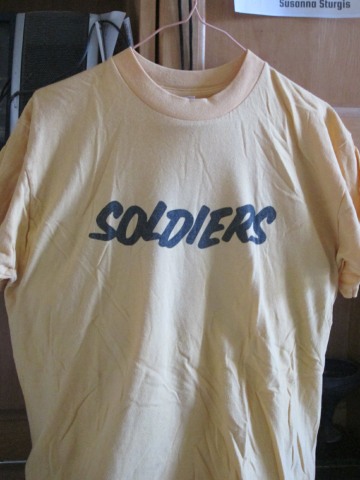
We became the core of a free-floating group that met at the rooftop lounge of the Hotel Washington[2] most Fridays after work to “process the week.” The group included Bruce Bant, an ex of Thom’s with whom he was still close friends, and Charles H., Thom’s current, who was an aide of some sort to some Republican congressman and who could have stepped out of an ad in GQ. Bruce, like Thom, was a Vietnam vet — they’d met in Vietnam, if I remember correctly — but unlike Thom he was career military. He’d recently retired as a sergeant major, having edited Soldiers, the enlisted service members’ magazine, and was now involved in the beginnings of what became USA Today.

I was the radical lesbian anti-militarist feminist in the group. We razzed each other endlessly about politics and the military but were always friendly about it. Although we were in Washington, the belly of the political beast, politics seemed a long way off. One Friday afternoon Bruce produced a Soldiers T-shirt and said he’d give it to me only if I promised to wear it. I promised, and I did, more than once.

Ever since starting the T-Shirt Chronicles, my favorite procrastination research technique has been looking up people, places, and events that my story touches on in some way. Thom died of AIDS in 1988 — I’ve got a story about that, and he comes up again before I learn of his passing — but I had no idea whether Bruce was still on the planet or not. A quick Google search found a LinkedIn entry that had to be him. He was living in Florida. Should I contact him? He probably had no recollection of me, but he might be able to place me if I mentioned the Soldiers T-shirt, the rooftop lounge at the Hotel Washington, and Thom.

Just now I went looking again. His LinkedIn page is still up, as is a Facebook timeline with an entry from February 2020, but near the top of the Google hits was the news that Bruce died in Fort Lauderdale on September 27, 2020. Also among the top hits was a guest column from the March 21, 2010, South Florida Gay News, entitled “Don’t Ask, Don’t Tell Has Been a Complete Failure.” The byline is Bruce Bant, Retired Army Sergeant Major. It’s him for absolute sure. I’m sorry I missed you, Bruce.


Notes

[1] The term itself dated back at least to the early 20th century, but it does seem that it was a hot topic in the 1970s. My tenure in the training office was 1978–79, so it seems plausible that it was a contested term at ARC NHQ at that time.

[2] Now, as far as I can tell, the W Washington, on 15th Street N.W. near Pennsylvania Ave.


If you don’t see a Leave a Reply box, click on the title of this post and scroll down.