Two of the best jobs I’ve ever had fell into my lap. The first was book buyer for Lammas, D.C.’s feminist bookstore. The other was working for the Martha’s Vineyard Times. I wouldn’t have had the nerve to apply for either of them.

As my savings dwindled toward the end of my first year on the Vineyard, I started running a classified ad hiring out as a freelance typist. That got me a few short not-very-interesting gigs. More productive was my connection, through theater, with the Tisbury Printer. This led to several book-length editing jobs and editing and typesetting at least two catalogues for the Nathan Mayhew Seminars, a local nonprofit offering a variety of adult ed courses.
With my PC — Morgana, the first of five desktops that would bear that name — I could do pretty good cut-rate typesetting. I’d do the typing and formatting at home then take the disk (a 5 1/4 inch floppy) down to EduComp,[1] which was renting out time on its laser printers, and print out the copy. My girlfriend at the time, a talented graphic artist, did the paste-up. Before long, EduComp stopped offering this service because too many customers either messed things up or required too much hand-holding, but they made exceptions for me and a couple of others because we knew what we were doing. I was undeniably proud of being an exception.
Word got around that I was a competent typist with editorial capabilities. At a West Tisbury town meeting, the woman in front of me turned around and asked if I did freelance typing. I said I did. She turned out to be Eileen Maley, the Calendar/Community, i.e., features, editor of the Martha’s Vineyard Times. Their editorial typesetter was scheduled to have surgery soon and would be out for a few weeks. Would I be interested in filling in?
When I said yes, I probably sounded self-assured and confident. I wasn’t. Other than Eileen, whom I’d just met, I didn’t know anyone who worked at the Times or anything about their typesetting software. True to form, my imagination conjured a scenario where I’d be out of my depth and make a fool of myself. However, I’d made a similar leap of faith when I ventured into Katharine Cornell Theatre that first time, and that had turned out well. Maybe this would too?
The Times at that point was the upstart paper, having been founded in 1984 by five Vineyard businessmen as an alternative to the venerable (established in 1846) Vineyard Gazette. Reading only the Gazette, one might conclude that the year-round working island barely existed and that bad things never happened on Martha’s Vineyard; its subscriber base was mostly off-island from Labor Day to Memorial Day. Its coverage was so focused on its home base in Edgartown that Times people took to calling it “an Edgartown weekly.” Gazette staffers got back by referring to the Times as “the other paper.”
This not-always-good-natured rivalry went on for years. The Times was delivered free to every island post office or mailbox, a huge attraction for advertisers targeting a year-round audience. Naturally the Gazette retaliated with a full-page house ad featuring a trash can overflowing with discarded copies of the Times.
The Times office was nowhere near as elegant as the wood-shingled building that still houses the Gazette. When I first showed up to work, it was located behind Woodland Market on State Road in Vineyard Haven, in a long, low building that no longer exists. It once housed the Spaghetti Pot restaurant. The Spaghetti Pot was before my time, but rumor had it that the astonishingly red-orange carpeting in the newsroom was part of its legacy: had it perhaps been dyed with, or to resemble, spaghetti sauce?
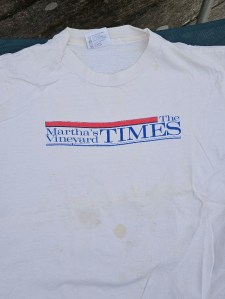
The building’s midsection was the newsroom, with reporters’ and editors’ desks lined up along the windows, which commanded a view of the dusty parking lot. Eileen’s desk was at the front of the row, and mine, as the pinch-hit typesetter and eventually the on-staff proofreader, was at the end. The three desks between us were occupied by all but one of the reporters. The exception was Gerry Kelly, who held court in an executive-type chair at an oversize desk next to the wall at one end of the newsroom.
Dubbed by a journalist admirer “the greatest one-man band in the history of journalism,” Gerry was the Times’ lead reporter and also a mainstay of the Calendar section: every week he wrote the food column, often featuring island restaurants, plus a book review, plus, from Memorial Day till well into the fall, a couple of art gallery reviews. He turned out copy like yard goods — a wonder to me because I’m on the slow side: I can’t turn the internal editor off when I’m writing. My only way around this is to write in longhand. This works because my handwriting is so hard to read that the internal editor gives up and goes along for the ride.

Sure, Gerry’s copy invariably needed at least some editing and/or fact-checking, but that was a small price to pay. When an ad was cancelled at the last minute, he could fill the hole. When an ad came in late, he could cut two or three or four inches out of a story that was already pasted up. He’d head into Production, non-repro-blue pen in hand, swearing “Not one word!” and do what had to be done.
A few years later, when I left the Times (for the first time) in the fall of 1993, Gerry paid me the supreme compliment: on my staff farewell card, he wrote “You saved me a year’s wear and tear on my dictionary.”
I customarily worked with my own copy of the American Heritage Dictionary open in my lap. The office Merriam-Webster’s was readily accessible on top of the long bookshelf in the middle of the newsroom but it was rarely consulted. Instead staffers would call out “Susanna, how do you spell . . . ?” or “What’s another word for . . . ?” and I would answer, usually without looking it up. Over the years more than one person remarked that I always had the dictionary open although I was the only person on staff who didn’t need one. My response: “That’s why I don’t need one.”
Behind me at the old office, in a rectangular room barely large enough for a desk and file cabinets, dwelt editor in chief Doug Cabral. A perk of this mini-office was that it had a door to the outside. Its door into the newsroom, which was almost always open, was barely an arm’s length away from where I sat. Since Doug could and did slip in and out with no one but me the wiser, one of my unofficial tasks was to relay news of his arrivals and departures to the rest of the staff.
Doug had his own wastebasket, of course, but he often dropped his candy wrappers in mine so his wife, who was monitoring his diet, wouldn’t see them.
After the Times moved to its current quarters at Five Corners in the fall of 1991, Doug’s office was on the second floor. He could leave the building through a rear door without passing through the large front room that housed the editorial, production, and advertising staff. So we rarely knew whether he was in the building or not, what he was doing when he was upstairs or where he went when he left.
At both the old building and the new, Wednesday was all-hands-on-deck deadline day. For many years, Joni Merry, a production staffer and also the West Tisbury town news columnist, would make lunch — all takers chipped in to pay for the groceries (usually $2 each) — then we’d all gather to eat around tables set up in the middle of the newsroom.[2]
At one of these sit-down lunches in the late ’80s, Don Lyons, former minister, current ad sales rep, sports editor, and by then Joni’s husband, leaned back in his chair and asked “Does anyone know the five rarest license plates on Martha’s Vineyard?” I can’t remember what five we came up with, or what Don’s five actually were. Now I could hazard you a good guess about Don’s five — they almost certainly included Hawaii, Nebraska, and North Dakota — because his question turned me into a license plate spotter. I’ve been playing ever since and have the annotated U.S. maps to prove it.

For many years, Don and I traded sightings. One summer we tag-teamed to track down a tour bus bearing a North Dakota plate that Joni had seen headed this way on the ferry: North Dakota was the rarest of the rare.[3] We figured it would be leaving by the end of the afternoon, but we couldn’t find out if it would be from Vineyard Haven or Oak Bluffs. So we stalked both docks whenever a boat would start loading for departure. Don finally spotted the bus in Vineyard Haven. By the time I arrived, Don had spoken with the bus driver — and learned that though the bus was registered in North Dakota, the tour group was from New Jersey. It counted nonetheless.[4]
Unlike the Gazette, the Times was printed off-island. Until digital transmission became possible toward the end of the ’90s, this meant that “the boards” — the pasted-up pages — had to be on the 5 o’clock ferry from Vineyard Haven. Since the Steamship dock was literally around the corner from the Times office, Doug was often out the door with barely minutes to spare, the big black portfolio case under his arm.[5]

1991 was a big year for the Vineyard, the Times, and me. In the spring, Eileen Maley retired as the paper’s first Calendar/Community editor. Having been her unofficial apprentice and understudy for almost three years, I put in for the job. I’d been doing it for more than a week before Doug confirmed that I was now indeed the Calendar/Community editor and put my name on the masthead. He never put me on salary, however: I continued to submit a time sheet every week and get paid by the hour. Since I wasn’t full-time, I got no benefits. The upside was that when I was ready to move on, I didn’t have to worry about losing health insurance because I was already paying for my own major medical policy.
To be fair, the Times in those days was operating on something not much wider than a shoestring. Each Thursday morning the staff would meet to postmortem the issue just published and start planning the next week’s. At the end of the meeting, Doug would pass out paychecks, whereupon we’d extricate ourselves as gracefully as possible from whatever we were doing and race to our respective banks to deposit our checks. Not infrequently the late arrivals would learn that there were insufficient funds in the Times account to cover the checks. They were always covered eventually, but if you were on the brink of overdrawn yourself, the suspense was real.
Hurricane Bob arrived on August 19 of that year, and despite the many impressive storms that have followed, more than 32 years later it remains the last full-fledged hurricane to hit New England. Unlike most big tropical storms, Bob arrived at the height of “the season,” on Monday, August 19. The annual Agricultural Fair had just finished its three-day run at the old Ag Hall.[6] The summer hordes were still here.
Bob was a huge deal. Hurricane winds took out trees that hadn’t been seriously challenged since the nameless hurricane of 1938. The sound of chainsaws was heard throughout the land. Living up-island on a dirt road back in the woods, I was lucky: a nurse at Martha’s Vineyard Hospital lived nearby, so volunteer EMTs and firefighters came to clear the road so she could get to work.
The flip side was that our little area didn’t get its power back for almost 10 days. The Times office, however, was on a major trunk line and got its power back within hours. Those of us without power at home brought our perishables to work and we feasted for a couple of days. I washed my hair in the office sink more than once. Bees whose hives had been destroyed were everywhere. Outdoor cafés hung improvised bee catchers from hooks on the wall: plastic soft drink containers with sweet stuff inside. Buzzing bees sounded a lot like distant chainsaws.
Labor Day came and went, life returned to more-or-less normal, but 1991 wasn’t done with us yet: the No-Name Nor’easter[7] arrived at the end of October. The Times was just about to move into its new office at Five Corners, but Five Corners flooded even worse than usual and the just-laid floor of the newsroom was underwater and had to be replaced. Fortunately, the electric sockets and wiring had all been installed a foot above the floor so they weren’t affected. My main memory of the move: I was helping move a desk into place when Trip Barnes, whose trucking company was handling the Times relocation, apparently decided that women couldn’t hold up half a desk and tried to wrest my end away from me. The result was that it fell on my foot. No lasting harm was done to my foot, but my opinion of Trip took a hit.
The Times move to Five Corners put it right around the corner from Wintertide Coffeehouse, which had moved into its year-round home the previous January. The traffic back and forth was non-stop: Wintertide manager Tony Lombardi was in the Times office almost as often as I was at Wintertide. Wintertide had no advertising budget to speak of; I could put pretty much anything I wanted in the Calendar section, and assign freelancers to write profiles, previews, and reviews that I couldn’t do myself. I saw advocating for the island’s grassroots music, theater, and general creative scene as part of my job.
The high point of my Times career was almost certainly the Martha’s Vineyard Singer-Songwriter Retreats of 1992 and 1993, masterminded by Christine Lavin and brought to life by a cast of dozens, if not hundreds. The resulting recordings — Big Times in a Small Town from ’92 and Follow That Road from ’93 — are still available and still wonderful.
I resigned as Calendar editor in the fall of 1993, mainly due to burnout: after I left, what I’d been doing was divvied up two and a half ways. I’d never entirely stopped being the lead proofreader or a pinch-hit typesetter either. But it was still one of the best jobs I ever had.
. . . . .
Postscript: I returned to the Times toward the end of 1996 as a one-woman copy desk. I pitched the job — something I’d never done before and haven’t done since — because (1) they needed the help, and (2) the freelance book packager who had been responsible for about 3/4 of my income decided to pack it in and move to New Hampshire. I was slowly building up my freelance client base, but I couldn’t live on that income yet. I left again in mid-1999, having established enough publisher connections to have a reasonably steady income. I had also, however, bought myself a horse, which wouldn’t have been in anyone’s How to Make Ends Meet on Martha’s Vineyard guide. Much more about that later.
NOTES
[1] EduComp, the indispensable art and office supply and computer store at the head of Main Street, Vineyard Haven, closed for good in the fall of 2020. Sales had been declining thanks to online competition, and the onset of COVID-19 finished it off. Founder and proprietor Pat Gregory was murdered while hiking in California in 2014, but his family carried on in the years following.
[2] After the move to Five Corners, we actually had a lunch/break room, but it wasn’t big enough to hold everybody. The lunch custom continued, but more of us ate at our desks.
[3] In my first 30+ years of the game, I spotted North Dakota maybe twice, including that tour bus. It’s now showed up three years running, 2022, 2023, and 2024, always in the same place — behind the Martha’s Vineyard Hospital — and for several months in a row. Evidently a North Dakota resident is a travel nurse or doctor at MVH.
[4] Don passed in August 2021, age 94. His obituary doesn’t mention the license plate game, but it’s still a fascinating picture of a remarkable man.
[5] Infrequently the boards would travel by air instead of sea. Doug usually made the drive to the airport, but I remember pinch-hitting once or twice. The airport was six miles from the office, so we couldn’t be quite so last-minute about finishing the last page or two.
[6] In 1991, the fair was still three days long, Thursday through Saturday, and took place at the “old Ag Hall,” now known at the Grange. It moved to the brand-new Ag Hall in 1995. In 1997 the first day of the Fair was drowned out by torrential rain, so Sunday was added to compensate. Sunday at the Fair proved so popular that the Fair has been a four-day affair ever since.
[7] The No-Name Nor’easter is better known as the Perfect Storm, after Sebastian Junger’s book of that title. The Perfect Storm (W. W. Norton, 1997) focused on the loss of the Andrea Gail, a commercial fishing boat out of Gloucester, with all six hands during the storm.


 The T-Shirt Chronicles