
The early ’90s get slippery for dates especially where the lesbian and gay awakening on Martha’s Vineyard is concerned. Complicating the chronology is that no one seems to have kept copies of Stone Walls, the handsome newsletter put out by Dan Waters and Hal Garneau for the fledgling Island Lesbian & Gay Association. I need to pay a visit to the Vineyard Gazette’s archives and also to find out what the Martha’s Vineyard Museum has in its files, but these things aren’t likely to happen till the worst of summer is over.
In late 2014, I was reminded of the importance of getting this history down where other people can find it. That summer, The Yard, a seasonal dance colony in Chilmark, claimed to have held the first public gay pride event on Martha’s Vineyard. I heard nothing about it through the usual channels, which is to say Facebook, word-of-mouth, or the bulletin board at up-island Cronig’s. No one else I know did either.
This was not surprising. A strange barrier stands between the summer island and the year-round island. It’s porous enough to see through, but only in one direction: we can see it, but it can’t see us. In June 2015 I blogged “Gay on MV” to get some of the history out there. Exactly seven years later, I had an opportunity to do it again, at the ceremonial raising of the “Progress Pride” flag in Ocean Park. “Pride Flag Flying,” another blog post, includes the remarks I prepared for that event.
So please consider this a work in progress.
When I moved back to D.C. in the spring of 1977, I knew where to find the lesbians and the feminists: through Lammas, the feminist bookstore, and through the Washington Area Women’s Center, then housed in the basement of the abandoned-and-falling-into-disrepair Sumner School at 17th and M Streets N.W.
Moving to Martha’s Vineyard in 1985 — for a year, mind you, just for a year — it was a different story. Where were the lesbians? I read every poster on every bulletin board and telephone pole and skimmed every story in both newspapers, looking for signs of lesbian, gay, and/or feminist activity. Nothing. Most startling was that no one seemed to be talking about AIDS, which by 1985 was a huge issue in D.C.
As recounted in “1985–86 (etc.): Adult Child of Theater,” it was much easier to find a 12-step program for adult children of alcoholics. And through that I found lesbians, gay men, and the island’s vibrant theater scene. As I wrote in “Gay on MV,” the Vineyard’s theater community was “like theater in most other places: a veritable hotbed of misfits and nonconformists, gay, lesbian, straight, both/and, and neither/nor. My people.”
But no one said “gay” or “lesbian” out loud in public. Oh no! If you did, it was assumed you were one, and that was risky. So we said “the L-word” (almost two decades later this commonly used closet phrase was appropriated for a TV series) or used the ASL sign for “L” or (gods help us) substituted “Lebanese” for “lesbian.” The island was just discovering AIDS, but to hear health-care professionals talk, you’d have assumed that HIV could only be contracted from dirty needles and blood transfusions.
The island’s lesbians and gay men knew better. Nancy Luedeman (1920–2010), theater mainstay and recovering alcoholic, created a panel for the AIDS Quilt that was included in the Quilt’s first national display in October 1987. Two of the four Vineyard men it memorialized were identified only by first name and last initial, the other two by initials only.
Around 1990 that began to change. See “Visiting the AIDS Quilt with My Mother” for what I currently recall (and have to further research) about this period. Many island gay men and lesbians realized that the time had come to go public, in part to help clear up the widespread misconceptions about gay people but also so we could find and support each other.
The first meeting of what became ILGA, the Island Lesbian and Gay Association, took place in the big room at the Wooden Tent on State Road, Vineyard Haven, which was then owned by Edie Yoder and Kathy Rose. I was there, along with some 25 other Vineyarders, about half of them women and half of them men, nearly all of whom I knew at least by sight. Sitting in a big circle, we went round and introduced ourselves. When the third Kathy introduced herself, people were starting to chuckle, then when Lansing Bailey — a burly gent who was older than most of us — introduced himself as Kathy, we all lost it completely. No one there will ever forget it.
What neither I nor anyone I’ve spoken with so far can remember is exactly when this meeting took place. My best guess is 1991, either spring or fall (because no one has time for organizational meetings in the summer, and what’s more, that was the summer of Hurricane Bob).[2] Fairly early in 1992 I moved into the guest house at the Wooden Tent, and I’m 99% sure that at the time of that meeting I was still living up-island.

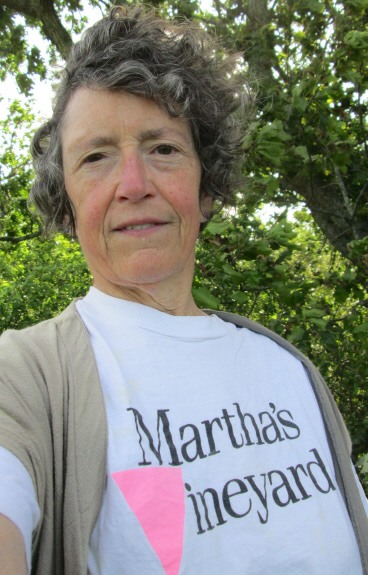
ILGA’s primary purpose was social — our potlucks were amazing! — but it had a powerful impact on gay and lesbian visibility on Martha’s Vineyard. In the early ’90s you could wear the pink triangle shirt down Main Street, Vineyard Haven, without getting any double-takes or snotty remarks: the only people who recognized the pink triangle were friendly and everyone else thought it was just another Vineyard T-shirt. It took considerably more chutzpah to sport the “No Man Is an Island Lesbian” shirt in mixed company.
For the first time a newcomer or someone just coming out could find the words “Lesbian” and “Gay” in the organizations listing of the Vineyard phone book. Two of us, Robert Cropper and me, were out enough to have our names and phone numbers listed. (I don’t recall ever getting a crank call from that listing.)
Around this time — 1992 and ’93 — a homophobic politician, Ron Beaty Jr.[3] by name, on the Cape took to writing nasty letters to the editor equating gay people with immorality and AIDS, and pushing Gay Rights, Special Rights (1993), a video promoted by the Traditional Values Coalition.[4] A lesbian couple wrote a letter to the Martha’s Vineyard Times rebutting such fallacious fear-mongering. The editor said he’d publish it but only if their names were included. Since this couple had several kids in the school system, this was outrageous and several of us (I was the Times features editor at this point) said so, but it was the editor’s wife who got through to him: “Of course you should withhold their names,” she said, and that was that. The letter was published with the writers’ names withheld.
In the fall of 1993 two Oak Bluffs town fathers tried to get two of the earliest kids’ books about gay/lesbian families pulled from the Oak Bluffs School library: Heather Has Two Mommies (1989) and How Would You Feel If Your Dad Was Gay? (1991). This spawned several contentious meetings and letters to the editor. I remember one meeting in particular where the town fathers were joined by a fundamentalist minister and a former marine known for striding around town in his red satin Marine Corps jacket. At one point the minister claimed that AIDS was God’s scourge of the homosexuals (IIRC he used that exact phrase), to which ILGA regular Michele Lazerow pointed out that lesbians had the lowest incidence of HIV/AIDS of any group. This was greeted with much laughter and applause, so I don’t know whether the minister responded.
The heroes of the meeting were the school librarian, Jan Buhrman, and the eighth-grade member of the school committee, Jay Borselle.[5] Their eloquence helped turn the tide, and it reassured me and others that we had allies willing to step up. At the same time, the Martha’s Vineyard Library Association was the only organization that spoke out against the attempted book banning. As a former bookseller, I expected no less — librarians are the best! — but the silence in other quarters was disappointing.
In response I took the lead in organizing a Banned Books reading at Wintertide Coffeehouse in January 1994. I read from Heather Has Two Mommies, Robert read from How Would You Feel If Your Dad Was Gay?, and 18 or so volunteers picked a book from the American Library Association’s Banned Books list and read a short excerpt from it. The Rev. Ken Miner (d. 1997), pastor of Trinity United Methodist in Oak Bluffs, read the David and Jonathan story from the Bible. The place was packed, and we all went home invigorated.
That spring, the short-play festival at the Vineyard Playhouse included Susan Miller’s “It’s Our Town Too,” a poignant riff on Thornton Wilder’s classic Our Town in which the parents of the young people who grow up to marry are a gay couple and a lesbian couple.
Several ILGA members marched in Boston’s Gay and Lesbian Pride parade that June, behind a banner created by signmaker (and musician) Tom Hodgson. I don’t remember why I didn’t join them, maybe because I’d ODed on Gay Pride in my D.C. days, but I did get to a “Celebrate Gay Cod” event on the Cape that month. That’s where the button at the beginning of this piece comes from.
NOTES
[1] The AIDS Alliance sponsored the first Crossover Ball on New Year’s Eve 1994. Boys dressed as girls, girls dressed as boys, and everyone had a blast. These continued more or less biennially till 2005. Can you imagine such a thing happening on Martha’s Vineyard in the ’80s? I can’t either.
[2] Late October of that year brought the equally memorable No-Name Nor’easter, known elsewhere as the Perfect Storm. It delayed the move of the Martha’s Vineyard Times, whose features editor I then was, from Woodland Market to Five Corners. This makes me think that the first ILGA meeting happened earlier in the year, but we shall see!
[3] Gadfly Beaty is nothing if not persistent. For a summary of his antics, see this 2018 call for his removal from his seat on the Barnstable County Council. He wasn’t removed then — the BCC doesn’t have a removal mechanism — but he was eventually defeated for re-election. Now in 2024 he seems to be running again. He has referred to himself as the “Donald Trump of Cape Cod” and once referred to activist David Hogg as a “self-promoting opportunistic rat.”
[4] I procured a copy of this so several of us could see it firsthand. This got me on some pretty disgusting right-wing mailing lists, but eventually the appeals and alerts stopped coming.
[5] By the end of the decade, Jan Buhrman had begun an ever expanding and deepening career as a cook and advocate for locally sourced ingredients: https://www.janbuhrman.com/. Jay Borselle became a journalist and is now the news director for WBZ NewsRadio in Boston.
 The T-Shirt Chronicles