1987?–1993: Martha’s Vineyard Times

Two of the best jobs I’ve ever had fell into my lap. The first was book buyer for Lammas, D.C.’s feminist bookstore. The other was working for the Martha’s Vineyard Times. I wouldn’t have had the nerve to apply for either of them.

As my savings dwindled toward the end of my first year on the Vineyard, I started running a classified ad hiring out as a freelance typist. That got me a few short not-very-interesting gigs. More productive was my connection, through theater, with the Tisbury Printer. This led to several book-length editing jobs and editing and typesetting at least two catalogues for the Nathan Mayhew Seminars, a local nonprofit offering a variety of adult ed courses.

With my PC — Morgana, the first of five desktops that would bear that name — I could do pretty good cut-rate typesetting. I’d do the typing and formatting at home then take the disk (a 5 1/4 inch floppy) down to EduComp,[1] which was renting out time on its laser printers, and print out the copy. My girlfriend at the time, a talented graphic artist, did the paste-up. Before long, EduComp stopped offering this service because too many customers either messed things up or required too much hand-holding, but they made exceptions for me and a couple of others because we knew what we were doing. I was undeniably proud of being an exception.

Word got around that I was a competent typist with editorial capabilities. At a West Tisbury town meeting, the woman in front of me turned around and asked if I did freelance typing. I said I did. She turned out to be Eileen Maley, the Calendar/Community, i.e., features, editor of the Martha’s Vineyard Times. Their editorial typesetter was scheduled to have surgery soon and would be out for a few weeks. Would I be interested in filling in?

When I said yes, I probably sounded self-assured and confident. I wasn’t. Other than Eileen, whom I’d just met, I didn’t know anyone who worked at the Times or anything about their typesetting software. True to form, my imagination conjured a scenario where I’d be out of my depth and make a fool of myself. However, I’d made a similar leap of faith when I ventured into Katharine Cornell Theatre that first time, and that had turned out well. Maybe this would too?

The Times at that point was the upstart paper, having been founded in 1984 by five Vineyard businessmen as an alternative to the venerable (established in 1846) Vineyard Gazette. Reading only the Gazette, one might conclude that the year-round working island barely existed and that bad things never happened on Martha’s Vineyard; its subscriber base was mostly off-island from Labor Day to Memorial Day. Its coverage was so focused on its home base in Edgartown that Times people took to calling it “an Edgartown weekly.” Gazette staffers got back by referring to the Times as “the other paper.”

This not-always-good-natured rivalry went on for years. The Times was delivered free to every island post office or mailbox, a huge attraction for advertisers targeting a year-round audience. Naturally the Gazette retaliated with a full-page house ad featuring a trash can overflowing with discarded copies of the Times.

The Times office was nowhere near as elegant as the wood-shingled building that still houses the Gazette. When I first showed up to work, it was located behind Woodland Market on State Road in Vineyard Haven, in a long, low building that no longer exists. It once housed the Spaghetti Pot restaurant. The Spaghetti Pot was before my time, but rumor had it that the astonishingly red-orange carpeting in the newsroom was part of its legacy: had it perhaps been dyed with, or to resemble, spaghetti sauce?
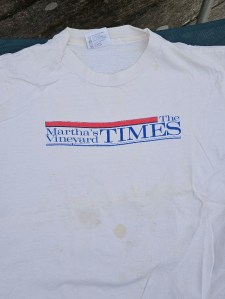
Sorry about the stains. If I ever learn to use bleach, I could probably make them go away, but that hasn’t happened yet.

The building’s midsection was the newsroom, with reporters’ and editors’ desks lined up along the windows, which commanded a view of the dusty parking lot. Eileen’s desk was at the front of the row, and mine, as the pinch-hit typesetter and eventually the on-staff proofreader, was at the end. The three desks between us were occupied by all but one of the reporters. The exception was Gerry Kelly, who held court in an executive-type chair at an oversize desk next to the wall at one end of the newsroom.

Dubbed by a journalist admirer “the greatest one-man band in the history of journalism,” Gerry was the Times’ lead reporter and also a mainstay of the Calendar section: every week he wrote the food column, often featuring island restaurants, plus a book review, plus, from Memorial Day till well into the fall, a couple of art gallery reviews. He turned out copy like yard goods — a wonder to me because I’m on the slow side: I can’t turn the internal editor off when I’m writing. My only way around this is to write in longhand. This works because my handwriting is so hard to read that the internal editor gives up and goes along for the ride.

Times baseball cap, front . . .

Sure, Gerry’s copy invariably needed at least some editing and/or fact-checking, but that was a small price to pay. When an ad was cancelled at the last minute, he could fill the hole. When an ad came in late, he could cut two or three or four inches out of a story that was already pasted up. He’d head into Production, non-repro-blue pen in hand, swearing “Not one word!” and do what had to be done.
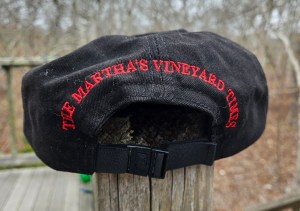
. . . and back. I’ve never been a baseball cap wearer, but I’ve still got mine.

A few years later, when I left the Times (for the first time) in the fall of 1993, Gerry paid me the supreme compliment: on my staff farewell card, he wrote “You saved me a year’s wear and tear on my dictionary.”

I customarily worked with my own copy of the American Heritage Dictionary open in my lap. The office Merriam-Webster’s was readily accessible on top of the long bookshelf in the middle of the newsroom but it was rarely consulted. Instead staffers would call out “Susanna, how do you spell . . . ?” or “What’s another word for . . . ?” and I would answer, usually without looking it up. Over the years more than one person remarked that I always had the dictionary open although I was the only person on staff who didn’t need one. My response: “That’s why I don’t need one.”

Behind me at the old office, in a rectangular room barely large enough for a desk and file cabinets, dwelt editor in chief Doug Cabral. A perk of this mini-office was that it had a door to the outside. Its door into the newsroom, which was almost always open, was barely an arm’s length away from where I sat. Since Doug could and did slip in and out with no one but me the wiser, one of my unofficial tasks was to relay news of his arrivals and departures to the rest of the staff.

Doug had his own wastebasket, of course, but he often dropped his candy wrappers in mine so his wife, who was monitoring his diet, wouldn’t see them.

After the Times moved to its current quarters at Five Corners in the fall of 1991, Doug’s office was on the second floor. He could leave the building through a rear door without passing through the large front room that housed the editorial, production, and advertising staff. So we rarely knew whether he was in the building or not, what he was doing when he was upstairs or where he went when he left.

At both the old building and the new, Wednesday was all-hands-on-deck deadline day. For many years, Joni Merry, a production staffer and also the West Tisbury town news columnist, would make lunch — all takers chipped in to pay for the groceries (usually $2 each) — then we’d all gather to eat around tables set up in the middle of the newsroom.[2]

At one of these sit-down lunches in the late ’80s, Don Lyons, former minister, current ad sales rep, sports editor, and by then Joni’s husband, leaned back in his chair and asked “Does anyone know the five rarest license plates on Martha’s Vineyard?” I can’t remember what five we came up with, or what Don’s five actually were. Now I could hazard you a good guess about Don’s five — they almost certainly included Hawaii, Nebraska, and North Dakota — because his question turned me into a license plate spotter. I’ve been playing ever since and have the annotated U.S. maps to prove it.

I’ve spotted North Dakota three years running at the Martha’s Vineyard Hospital Don would be amazed.

For many years, Don and I traded sightings. One summer we tag-teamed to track down a tour bus bearing a North Dakota plate that Joni had seen headed this way on the ferry: North Dakota was the rarest of the rare.[3] We figured it would be leaving by the end of the afternoon, but we couldn’t find out if it would be from Vineyard Haven or Oak Bluffs. So we stalked both docks whenever a boat would start loading for departure. Don finally spotted the bus in Vineyard Haven. By the time I arrived, Don had spoken with the bus driver — and learned that though the bus was registered in North Dakota, the tour group was from New Jersey. It counted nonetheless.[4]

Unlike the Gazette, the Times was printed off-island. Until digital transmission became possible toward the end of the ’90s, this meant that “the boards” — the pasted-up pages — had to be on the 5 o’clock ferry from Vineyard Haven. Since the Steamship dock was literally around the corner from the Times office, Doug was often out the door with barely minutes to spare, the big black portfolio case under his arm.[5]

This is from my last day of my first stint at the Times, in October 1993. It’ll give you an idea of what “the boards” looked like before the paper went completely digital by the end of the decade. (P.S. I did not usually wear dangly earrings to work.)

1991 was a big year for the Vineyard, the Times, and me. In the spring, Eileen Maley retired as the paper’s first Calendar/Community editor. Having been her unofficial apprentice and understudy for almost three years, I put in for the job. I’d been doing it for more than a week before Doug confirmed that I was now indeed the Calendar/Community editor and put my name on the masthead. He never put me on salary, however: I continued to submit a time sheet every week and get paid by the hour. Since I wasn’t full-time, I got no benefits. The upside was that when I was ready to move on, I didn’t have to worry about losing health insurance because I was already paying for my own major medical policy.

To be fair, the Times in those days was operating on something not much wider than a shoestring. Each Thursday morning the staff would meet to postmortem the issue just published and start planning the next week’s. At the end of the meeting, Doug would pass out paychecks, whereupon we’d extricate ourselves as gracefully as possible from whatever we were doing and race to our respective banks to deposit our checks. Not infrequently the late arrivals would learn that there were insufficient funds in the Times account to cover the checks. They were always covered eventually, but if you were on the brink of overdrawn yourself, the suspense was real.

Hurricane Bob arrived on August 19 of that year, and despite the many impressive storms that have followed, more than 32 years later it remains the last full-fledged hurricane to hit New England. Unlike most big tropical storms, Bob arrived at the height of “the season,” on Monday, August 19. The annual Agricultural Fair had just finished its three-day run at the old Ag Hall.[6] The summer hordes were still here.

Bob was a huge deal. Hurricane winds took out trees that hadn’t been seriously challenged since the nameless hurricane of 1938. The sound of chainsaws was heard throughout the land. Living up-island on a dirt road back in the woods, I was lucky: a nurse at Martha’s Vineyard Hospital lived nearby, so volunteer EMTs and firefighters came to clear the road so she could get to work.

The flip side was that our little area didn’t get its power back for almost 10 days. The Times office, however, was on a major trunk line and got its power back within hours. Those of us without power at home brought our perishables to work and we feasted for a couple of days. I washed my hair in the office sink more than once. Bees whose hives had been destroyed were everywhere. Outdoor cafés hung improvised bee catchers from hooks on the wall: plastic soft drink containers with sweet stuff inside. Buzzing bees sounded a lot like distant chainsaws.

Labor Day came and went, life returned to more-or-less normal, but 1991 wasn’t done with us yet: the No-Name Nor’easter[7] arrived at the end of October. The Times was just about to move into its new office at Five Corners, but Five Corners flooded even worse than usual and the just-laid floor of the newsroom was underwater and had to be replaced. Fortunately, the electric sockets and wiring had all been installed a foot above the floor so they weren’t affected. My main memory of the move: I was helping move a desk into place when Trip Barnes, whose trucking company was handling the Times relocation, apparently decided that women couldn’t hold up half a desk and tried to wrest my end away from me. The result was that it fell on my foot. No lasting harm was done to my foot, but my opinion of Trip took a hit.

The Times move to Five Corners put it right around the corner from Wintertide Coffeehouse, which had moved into its year-round home the previous January. The traffic back and forth was non-stop: Wintertide manager Tony Lombardi was in the Times office almost as often as I was at Wintertide. Wintertide had no advertising budget to speak of; I could put pretty much anything I wanted in the Calendar section, and assign freelancers to write profiles, previews, and reviews that I couldn’t do myself. I saw advocating for the island’s grassroots music, theater, and general creative scene as part of my job.

The high point of my Times career was almost certainly the Martha’s Vineyard Singer-Songwriter Retreats of 1992 and 1993, masterminded by Christine Lavin and brought to life by a cast of dozens, if not hundreds. The resulting recordings — Big Times in a Small Town from ’92 and Follow That Road from ’93 — are still available and still wonderful.

I resigned as Calendar editor in the fall of 1993, mainly due to burnout: after I left, what I’d been doing was divvied up two and a half ways. I’d never entirely stopped being the lead proofreader or a pinch-hit typesetter either. But it was still one of the best jobs I ever had.

. . . . .

Postscript: I returned to the Times toward the end of 1996 as a one-woman copy desk. I pitched the job — something I’d never done before and haven’t done since — because (1) they needed the help, and (2) the freelance book packager who had been responsible for about 3/4 of my income decided to pack it in and move to New Hampshire. I was slowly building up my freelance client base, but I couldn’t live on that income yet. I left again in mid-1999, having established enough publisher connections to have a reasonably steady income. I had also, however, bought myself a horse, which wouldn’t have been in anyone’s How to Make Ends Meet on Martha’s Vineyard guide. Much more about that later.

NOTES

[1] EduComp, the indispensable art and office supply and computer store at the head of Main Street, Vineyard Haven, closed for good in the fall of 2020. Sales had been declining thanks to online competition, and the onset of COVID-19 finished it off. Founder and proprietor Pat Gregory was murdered while hiking in California in 2014, but his family carried on in the years following.

[2] After the move to Five Corners, we actually had a lunch/break room, but it wasn’t big enough to hold everybody. The lunch custom continued, but more of us ate at our desks.

[3] In my first 30+ years of the game, I spotted North Dakota maybe twice, including that tour bus. It’s now showed up three years running, 2022, 2023, and 2024, always in the same place — behind the Martha’s Vineyard Hospital — and for several months in a row. Evidently a North Dakota resident is a travel nurse or doctor at MVH.

[4]  Don passed in August 2021, age 94. His obituary doesn’t mention the license plate game, but it’s still a fascinating picture of a remarkable man.

[5] Infrequently the boards would travel by air instead of sea. Doug usually made the drive to the airport, but I remember pinch-hitting once or twice. The airport was six miles from the office, so we couldn’t be quite so last-minute about finishing the last page or two.

[6] In 1991, the fair was still three days long, Thursday through Saturday, and took place at the “old Ag Hall,” now known at the Grange. It moved to the brand-new Ag Hall in 1995. In 1997 the first day of the Fair was drowned out by torrential rain, so Sunday was added to compensate. Sunday at the Fair proved so popular that the Fair has been a four-day affair ever since.

[7] The No-Name Nor’easter is better known as the Perfect Storm, after Sebastian Junger’s book of that title. The Perfect Storm (W. W. Norton, 1997) focused on the loss of the Andrea Gail, a commercial fishing boat out of Gloucester, with all six hands during the storm.

1985–1986: Morgana Comes on Board

The several seeds planted my first off-season on Martha’s Vineyard sent out tendrils that kept growing for years, often tangling with each other. Where to start, where to start?

It probably doesn’t really matter where I start because I’ll get to where I’m going no matter what, but let’s start with computers.

I acquired this T several years later, almost certainly in my science-fiction-con-going years (roughly the ’90s), but it’s the only computer-related shirt I’ve got so here it is.

My first serious computer relationship was with the TRS-80 that Lammas Bookstore acquired while I was working there, around 1983. The TRS-80 (the T in TRS is for Tandy, the main inventor, and the RS stands for Radio Shack, which produced and marketed it) was a wildly popular workhorse that introduced hundreds of thousands (millions?) of people to what IIRC were then called microcomputers, to distinguish them from the hulking machines that occupied whole rooms at universities and big businesses.

For the first few weeks I was terrified that I’d hit the wrong key and blow something up. It was a little like learning to drive. In both cases, the terror passed. I didn’t have my first real computer disaster till several years later, when I accidentally erased a client’s current accounts receivable file. Fortunately it was only March so it wasn’t hard to reconstruct it from bank statements and paper invoices. And by then my relationship with computers was so solid that one screw-up didn’t do it any damage.

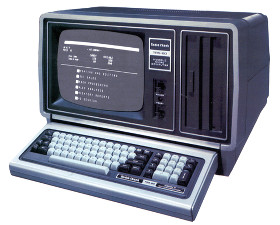
This TRS-80 Model II looks like my memory of Sylvia, except Sylvia’s case was white.

Once that TRS-80 and I got through our shakedown cruise, we became good buddies. I named her Sylvia after my editorial mentor, Sylvia Abrams; my brilliant high school history teacher, Sylvia Sherman; and Nicole Hollander’s Sylvia character. Sylvia had two 8-inch floppy drives in the same unit as the monitor, a separate keyboard, and a word processor called Scripsit. She was connected to a dot-matrix printer.

When I left Lammas and D.C., I was accompanied by the venerable red IBM Selectric I’d bought from a friend some years earlier, but I was ready for a computer of my own. Most participants at the Feminist Women’s Writing Workshops that summer of 1985 were still using typewriters, but at mealtimes we talked as much about computers as we did about food.

That fall, I found my way to EduComp, which was then located in a little house set back from the sidewalk on Main Street. Proprietor Pat Gregory introduced me to hard drives. I was an instant convert: with a 10MB (!!) hard drive and one floppy drive, instead of two floppy drives like Sylvia, you didn’t have to keep swapping program disks in and out. This option would add $500 to the cost of a basic system, but even to this chronically frugal New Englander it was hands-down worth it.

I bought my first computer on an off-island foray to Framingham: a Leading Edge Model D (an IBM clone). A Wikipedia article supports my memory of the cost: in addition to the $500 for the optional hard drive, I paid $1,500 for the computer itself (it also had a 5 1/4” floppy drive), $500 for WordPerfect 4.1, and $500 for an Epson LX-80 dot matrix printer. $3,000 was the most money I’d ever spent on anything.

Setting it up I was on my own, but in those days software came with manuals, hardware instructions weren’t hard to follow, and you could actually reach a real person by calling tech support. Once the tech guys (all the ones I spoke with were guys) ascertained that you had plugged the computer in, connected the cables, and turned the thing on, they treated you like someone who was capable of understanding and following directions.

Morgana was named for the Celtic goddess the Morrigan, for Fata Morgana (Morgan le Fay); and for the hero of C. J. Cherryh’s Morgaine novels. Her equine namesake was the Morgan horse. The Morgan horse stamp was released that September. I stuck one on Morgana’s case. As the first Morgana was succeeded by Morganas II, III, IV, and V, the stamp migrated to each one as a sign of continuity.

Since in September 1985 first-class postage was 22¢, it was also a reminder that while the price of computers kept coming down, the cost of mailing a letter kept going up. Believe it or not, I’ve still got that stamp, much the worse for wear (see right). After Morgana V, around 2010, I switched from desktops to laptops and started a new naming convention, so since then the stamp has been stuck to a cupboard door above what used to be my computer desk.

Me in my vintage Tisbury Printer T-shirt

As my savings dwindled, I entered the Vineyard workforce as a freelance typist, running an occasional “situation wanted” ad in the Martha’s Vineyard Times classifieds. The Tisbury Printer — with whom I’d established a connection doing PR and other print-related tasks for Island Theatre Workshop (more about that to come), and which I’m pleased to note still exists — referred me to people who wanted cut-rate typesetting for lengthy documents, booklets and even books. I’d type the manuscript on Morgana, then take the floppy disk down to EduComp (which unfortunately no longer exists, and which I miss a lot), which by then was located in the big building at the head of Main Street.

At first EduComp rented out time on its laser printers to the public, but it turned out that most customers needed so much hands-on support and supervision that it was taking up too much staff time. They made an exception for me and a couple of others who were capable of sitting down with a disk unsupervised and getting the job done. My girlfriend in the late ’80s was a graphic artist: she did the layout using my typescript. We produced a couple of books and at least two Nathan Mayhew Seminars course catalogues that way.

Come to think of it, seat-of-the-pants on-the-cheap publishing has been a theme through my adult life, from my antiwar movement days to my evening job proofreading that law weekly, to off our backs and Lammas Bookstore, on to the Vineyard, and right up to the present day. 1980s publishing technology was strictly horse-and-buggy compared to what we’ve got now, but hey, it got us where we wanted to go.

1981–1985: Lammas Bookstore

Two of the best jobs I’ve ever had fell into my lap.[1] I wouldn’t have had the nerve to apply for either of them. Conventional wisdom for decades has held that women apply for jobs we’re sure we can do, while men apply for jobs they think they can learn to do. I fit the female stereotype, but my caution wasn’t just due to my sex. The message I internalized over the years from watching my perfectionist father ridicule my mother for getting her facts wrong was that it wasn’t safe to not have the right answer. It’s pretty much impossible to venture into new territory without making mistakes and asking questions that reveal that you don’t know everything. In addition, plenty of people were likely to write me off on the basis of my physical appearance, so I had to be hyper-qualified before I even thought of applying for anything.

In the spring of 1981, I quit my first editorial job (see “1979: I Become an Editor” for how I got that job and why I left) intending to take some time to focus on my writing. That’s not the way it worked out. About a month later, Mary Farmer, owner-manager of Lammas Bookstore, asked me to become the store’s book buyer. We were at my group house in Mount Pleasant prepping for my 30th birthday party; Mary was seeing one of my housemates at the time. I’d assigned her to halve cranberries for cranberry bread. The cranberries were squishy because, though I was already modestly renowned for my cranberry bread,[2] I hadn’t yet figured out that cranberries are much easier to cut in half if you freeze them first.

I’d bet good money that my face at the time didn’t show how astonished I was when Mary asked if I’d come work for her: Mary and Lammas were at the center of the D.C. women’s community, and I was way off on the peripheries somewhere. I had no idea she even knew who I was.

As it turned out, Lammas’s current buyer was leaving, and both she and Mary had noticed from my frequent forays into the store that not only was I an avid reader, but my tastes ran from history to feminist theory to poetry to fiction. Mary herself claimed not to be a reader, which wasn’t quite true, but she had her hands full as the regional music distributor for Ladyslipper. In addition to managing the store’s finances (enough in itself to bring on ulcers — read on!), she bought the records, jewelry, crafts, and cards. Wisely enough, she hired a co-worker to handle books and periodicals.[3]

How to convey how much that job changed my life? Let me try to re/count the ways.

The Lammas softball team on the cover of Willie Tyson’s Full Count (1974). Mary Farmer is 2nd from right in the back row, Willie is in the middle of that row with Ginny Berson (co-founder of Olivia Records) to her left and sound engineer Boden Sandstrom of Woman Sound at far left. I did not play softball but I did go to a bunch of games. (Cover photo by JEB.)

Back then I was at best dimly aware of how goods reached the shelves of retail outlets — which were all “brick and mortar” at the time, though we didn’t call them that because what else was there? I learned. When a title ran out, it had to be reordered. If it was new and/or selling briskly, it had to be reordered before the last copy sold.

There were two options: order from the publisher or from a distributor. When you ordered direct from the publisher, the discount was better — meaning we paid a smaller percentage of the retail price, which meant we got to keep more of the cash when the book was sold — but you had to order a larger quantity, possibly more than you could sell in several months. With a distributor it was possible to order two of this title and five of that. Distributors came in two flavors: those focusing on independent presses, including the feminist ones, and those who dealt with “the majors,” like Random House and Norton.[4]

Books, like other retail goods, have to be paid for before they sell, but you can’t sell a book that isn’t on the shelf. Most (all? virtually all?) feminist businesses were seriously undercapitalized. This meant that bills had to be paid out of revenue, and cash flow was always an issue. We couldn’t stock everything we wanted, but we had to stock what we needed, i.e., anything that was in demand and selling well.

Publishers’ invoices were supposed to be paid in 30 days. They virtually never got paid in 30 days, but when 60 days started stretching toward 90, you risked getting put on hold. If you were on hold with a publisher and needed one of its titles, you ordered from a distributor — and put that publisher on the priority to-be-paid list.

Lammas, at the beginning of August, is the cross-quarter day between the summer solstice and the fall equinox — and also Lammas Bookstore’s birthday. We celebrated every year with champagne and a sale. From left: Liz Snow of Ladyslipper Music, owner Mary Farmer (a Ladyslipper distributor), me, The Printer Tina Lunson, and staffer Deb Morris, who went on to Politics & Prose Bookstore in D.C. She’s wearing the 10th anniversary shirt, so this was probably 1983. I’ve got the old one on.

Feminist publishers were always on the priority to-be-paid list. They were in the same undercapitalized boat we were, except that their burden was even worse: the costs of publishing a book have to be paid up-front, and it can be six months after publication date before the income even starts to roll in. The independent distributors were next, particularly Inland Book Company. We couldn’t afford to be on hold with them. (See note 4 below for the why of this.)

What I learned in those days keeps coming up, most recently not long after the Covid-19 shutdown started, when huge gaps began to appear on grocery-store shelves that were usually crammed full. Supply chains, usually invisible to the consumer, were in the news. In April 2020, I blogged about them — and traced my awareness of their importance to my experience at Lammas.

Serendipitously the second Women in Print conference was held in suburban Maryland in October 1981, a few months after I’d started my new job.[5] As a writer, an activist, an amateur local historian, I already knew I was part of something far greater than myself. Seeing that “something greater” in the flesh, meeting women I’d only known from seeing their names in print and reading their words — well, it was something else. This neophyte bookseller couldn’t have asked for a better training program. At one plenary session I found myself sitting next to Adrienne Rich, who told me how much she’d liked a review of mine she’d just accepted for the lesbian journal Sinister Wisdom[6](of which she and her partner, Michelle Cliff, were then the editors).

At Women in Print I had a crash course in how it all fit together: publishers, bookstores, periodicals, print shops, designers, editors . . . The birth of Kitchen Table: Women of Color Press was announced at that conference. It was historic in so many ways.

In my early months at Lammas I learned the details of ordering, stocking, interacting with customers, explaining the challenges of acquiring a title to women who were as clueless about the mechanics as I had been a few weeks earlier. For instance, in the early 1980s much work in feminist theory and history was published by university presses. Few university-press books were carried by any distributors, in large part because those presses only offered a 20% discount — which meant that for distributors there was no profit to be made whatsoever. Ordinarily, when a customer special-ordered a book, it was something we were out of temporarily and could restock on our next regular order. Not so with university-press books: in those cases I really had to order a single copy, knowing that between the short discount and the postage the store might actually lose money on the transaction.

For a regular customer I would do it, no question: I knew for certain that they’d return to pick up and pay for the book. For someone I’d never seen before, I learned to request a deposit on the retail price.

Over time I also learned to make a distinction between customers — and feminists in general — who understood the economics of running a small, economically fragile feminist business (or were willing to learn) and those who seemed to think we all lived in a utopian world where economic considerations did not apply. Mary, Lammas’s owner-manager, regularly ran into women who were surprised to find her doing her own laundry at the local laundromat. This often willful cluelessness was all too common in the women’s community, and 40 years later I keep running into it on Martha’s Vineyard too.[7] My patience with this crap left town a long time ago.

The 10th anniversary T from 1983. Our celebration concert (at All Souls Church, IIRC) featured pioneer Jewish lesbian singer-songwriter Maxine Feldman and local favorite Judy Reagan.

Meanwhile — well, I got to work in the heart of D.C.’s women’s community, which meant I got to meet and talk with so many women I wouldn’t have met otherwise. I knew just about everything that was going on, in town, in the book biz, and in the women’s music biz, across the country and even around the world, usually before most other people did. I got to talk continuously about books and call it work, because it was. I got to build up a women’s fantasy/science fiction collection; partly as a result, in 1984 I became Feminist Bookstore News’s first columnist, reviewing (you guessed it) fantasy and science fiction. This continued till 1996, long after I left D.C., and got me lots of free books.

The most lasting impact on me as a writer was the ongoing one-on-one contact with women to whom the printed word mattered. Books and articles opened new vistas for their readers, and the remarkable thing was that you couldn’t predict what book or story or newspaper article was going to make a decisive difference in someone’s life. And yes, I got to call customers’ attention to the works that had made a big difference in mine.

You’ll be hearing more about Lammas, the book biz, and why I eventually left town if you keep following this blog. I’m still trying to make sense of it all myself.

If you want to leave a comment and don’t see a Leave a Reply box, click the title of this post and then scroll to the bottom.

notes

[1] The other was working for the Martha’s Vineyard Times, where I started as a part-time temp proofreader at the end of the decade. More about that later.

[2] My recipe came from Jean Stewart Wexler and Louise Tate King’s Martha’s Vineyard Cookbook, with minor modifications (less sugar, more orange juice). Forty years later I still make it regularly. That’s why a third of the space in the freezer of my small fridge is devoted to frozen cranberries. Cranberries are only available in the fall, so if you want cranberry bread year-round you stock up then and freeze them.

[3] The store was founded in 1973 by two lesbian jewelers as Lammas Women’s Shop. Feminist and lesbian books were scarce at that point, so they only occupied a shelf or two. That changed rapidly in the following years. IIRC Mary started off as their manager but within a year or two bought the store. The jewelers continued to make jewelry under the name Lielin, which was made up of syllables from their first names, LesLIE and LINda. I’m spacing their surnames but will probably rediscover or remember them in my (virtual) travels.

[4] In the early 1980s, the main trade distributors were Baker & Taylor and Ingram. The main indie-press distributors were Bookpeople and Inland Book Company. Since Bookpeople was on the West Coast and Inland was in Connecticut, freight charges were less from Inland, so I ordered more from them. Without getting down in the weeds about book pricing — all you have to know is that (1) books are heavy, (2) the bookstore pays the freight, and (3) since the retail price was generally printed on the book, a store couldn’t increase it to compensate for freight costs, not without being accused of ripping people off. By this time Women in Distribution (WinD), which specialized in feminist-press books, had folded, but Helaine Harris, one of WinD’s principals along with Cynthia Gair and Lee Schwing, was working for Daedalus, which dealt in books “remaindered” by the big trade publishers. Daedalus was based in nearby Maryland, so when a remaindered title was of interest to us (as often happened), Helaine would deliver it in person, saving us a bunch of money in freight charges. Helaine, incidentally, was a veteran of the Furies collective, as was Lee Schwing.

[5] The first Women in Print conference, of the movement pioneers, was held in Omaha, Nebraska, in 1976.

[6] Sinister Wisdom still exists. Not only is it still a journal of lesbian writing, it’s been publishing works that would otherwise get lost, such as The Complete Works of Pat Parker, edited by Julie R. Enszer, and Sister Love: The Letters of Audre Lorde and Pat Parker, 1974–1989. If this thrills you half as much as it does me, or even if you’re just curious, visit www.sinisterwisdom.org, email sinisterwisdom@gmail.com, or write Sinister Wisdom, 2333 Mcintosh Rd., Dover, FL 33527. P.S. I had work published in SW 14, 17, 28, and 35. I also know that “Sinister Wisdom” came from a line in Joanna Russ’s The Female Man. You see the challenge here? All it takes is a name to send me off on a dozen tangents, in part to remind me that my life really happened and that some of what I remember might be useful to others.

[7] More about that later. Much more. Remind me if I forget.

1979–1981: Biking to Alexandria

Like any self-respecting suburban/small-town kid I got my driver’s license as soon as I was old enough — 16 1/2 in Massachusetts if you’d taken driver’s ed — but I didn’t own a motor vehicle till I was 37, three years after I moved to Martha’s Vineyard. In D.C. I walked, took public transit, and rode my bicycle.

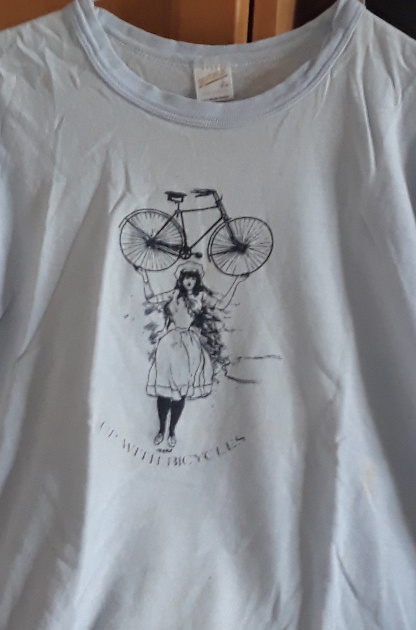
Neither of my bicycle Ts comes attached to a particular event. I got this one, “Up with Bicycles,” in my D.C. bike-commuting days, probably at Lammas Bookstore.

My bike, a blue Peugeot 10-speed, was my college graduation present to myself. I named her Blue Mist II, after the armored Rolls-Royce T. E. Lawrence rode in the desert during World War I.[1] In D.C. I thought of her as my “urban horse”: I was barely a decade out of horses at the time and had no idea that in my 40s I would get back in. I’ve got plenty of horse-related T-shirts and stories to go with them, but you’re going to have to wait awhile till we get there.

Biking to work at Red Cross National Headquarters, first from my Dupont Circle bedsit and then from group houses in the Mount Pleasant neighborhood (which is just north of Adams Morgan, which is just north of Dupont Circle), was easy. Google Maps tells me that my usual route, via 16th Street, was a little under three miles. In the morning it was mostly downhill. I still remember the visceral thrill of whizzing down 16th Street in rush-hour traffic, trying to avoid breathing too much bus exhaust, wearing a dress and (of course) no helmet.

On more than one Friday I biked home up 18th Street in dusk or dark after “processing the week” with colleagues in the rooftop lounge at the Hotel Washington. I was sometimes, I confess, a little tipsy when I set out, but the mostly uphill ride took care of that.

With my promotion to editor, my commute got longer: from Mount Pleasant to Old Town Alexandria by my route is a little over 11 miles. It was a great ride: bike path almost all the way, down into Rock Creek Park behind the National Zoo, a little maneuvering to get past the Lincoln Memorial and onto Memorial Bridge, then down the Mount Vernon Trail (whose official name I didn’t know when I was riding on it) all the way to Alexandria.

I made the round-trip by bike most days if the weather wasn’t awful. When it was, my public transit commute took about the same amount of time. Since Metrorail only went as far as National Airport at that point, the trip involved three transfers, one from the 42 bus to the Dupont Circle Metro station, one from the Red Line to the Blue Line at Metro Center, then a third from National Airport to the Old Town bus, whose number I don’t remember.

Washington was famously built on a swamp. Summers are hot and sultry. Thermal inversions are not uncommon: the exhaust from tens of thousands of cars hangs over downtown, visible to anyone who looks south from a higher elevation. Summer started in earnest not long after I was promoted to Publications, and I kept biking to work.

At the end of the day — quitting time was 4:45 p.m. — I’d be unlocking my bike and someone would ask, “You’re going to bike home? It’s a hundred and five degrees out.” I’d stop at the Lincoln Memorial, a little more than halfway, to drink at a water bubbler, splash my face, and soak my bandanna in cold water before tying it back around my head. (No helmet then either.) The last leg of my trip was by far the steepest uphill, out of Rock Creek Park up to my Mount Pleasant neighborhood. I could, and sometimes did, ride the whole way, going slower and slower till near the top bike and I were in danger of falling over, but more often I’d get off at some point and walk to where the terrain leveled off.

You’ll never guess where I bought this one! I probably got it when I was still an occasional visitor to the island, i.e., before 1985. Kennedy Studios, an art gallery and framing shop that still exists on Main Street, Vineyard Haven, offered at least one other version of this design, with sailboats instead of bicycles.

The morning commute wasn’t quite as hot, but biking more than 11 miles in the humid 80s would leave anyone in need of a shower. Trouble was, there was only one shower in the Eastern Field Office building, and it was located in the men’s room in the basement which was the level you entered from the parking lot where the bike rack was. The women’s room down the hall had no such amenities.

I and a couple of women who liked to run on their lunch hours successfully lobbied management to reserve the shower-equipped men’s room for women’s use for half an hour in the morning and half an hour at lunch. Nice idea, but in practice male employees would congregate outside the door at the restricted times, directing snotty remarks at us and complaining about having to wait to pee.

I gave up PDQ and went back to improvising a sponge bath in the women’s bathroom and changing out of my sweaty T-shirt and into more presentable office clothes. (My concession to being promoted into the professional ranks was to stop wearing T-shirts to work, which I had done on occasion in the training office.)

My other biking-related challenge was more momentous. In summer heat I was biking to Alexandria in rolled-up jeans. This was as clammy and uncomfortable as you can imagine. Why not wear gym shorts? you ask.

Why not indeed. Well, at the time I weighed over 200 pounds. I could wear men’s shirts, but men’s pants didn’t suit my shape so I had to buy pants in the plus-size women’s shops. In the affordable-price range these inclined to polyester and other unbreathable fabrics ill-suited to physical activity, so I stuck with jeans, which could be found in 100% cotton at any size.

I went looking in the plus-size stores for women’s gym shorts. They didn’t exist, not in Washington, D.C., at any rate, not at that time.[2] Plus-size women were presumed uninterested in or incapable of exercise. It didn’t take a Sherlock Holmes to deduce that plus-size women’s disinterest in exercise might have something to do with the lack of plus-size women’s exercise clothing. Plenty of men thought any fat woman riding a bike or jogging was fair game for their insults. They harassed thin women too, of course, but with wolf whistles and come-ons, not comments on how ugly they were.

In a sporting goods store I came upon a rack of men’s gym shorts that went up to XL. They looked like they might fit my hips. No way would I have tried them on in the store: that would have meant admitting that they were for me. I might even have mumbled to an inquiring clerk that I was buying them for a friend or a brother. I went out on a limb and bought three pair. I took them home and with trepidation tried them on, one after another. They all fit.

I loved those shorts. One was purple with yellow trim, one green with white trim, and I wish I could remember the third — blue with white trim sounds right, but I’m not sure. Being fat, I rarely wore shorts, period, so the rush of wind on my bare legs as I biked along the Potomac was a revelation. I felt immediate empathy with women of past and not-so-past generations as they shed corsets, voluminous skirts, and skirts so tight they practically locked your knees together.

The fat liberation movement was very visible in grassroots feminist and lesbian communities at the time. It freed me to take these issues seriously, and to look more closely at my own personal history with compulsive eating and getting fat, but the more closely I looked, the most pissed off I got. In an essay published in Lesbian Contradiction in its Winter 1983–84 issue, I wrote that “when I first discovered fat liberation literature, I felt so betrayed. I expected so much but found so many of my experiences dismissed as truisms, stereotypes, and self-delusions.” The essay takes off from that dismissal to warn against the temptation to formulate premature orthodoxies from women’s incredibly diverse experiences, which were being publicly articulated often for the first time.

About a year later my essay “‘Is This the New Thing We Have to Be P.C. About’” appeared in Sinister Wisdom 29. It too takes off from an incident involving fat and fat liberation, and goes a few steps further in exploring the notion of political correctness as understood by feminists and lefties at the time. (Before long, around the mid-1980s, the right wing got hold of it and turned it into an all-purpose slur against anyone who took sexism, racism, and social justice in general seriously.)

Looking back at these two essays from almost four decades later, I detect some clues as to why in mid-1985 I decided to leave the lesbian-feminist community and relocate to Martha’s Vineyard (for a year, mind you: just a year): as a fat woman and as a feminist who took fat liberation seriously but disagreed with its emerging ideology, I was feeling a little estranged from my community. But at the time, biking to Alexandria in gym shorts was wonderfully liberating.


Technological aside: Living in the District and working in Alexandria posed a problem. My bank, Riggs, was in the city, and “bankers’ hours” were still the rule: banks were only open weekdays from 9 a.m. to 3 p.m. Either ATMs (automatic teller machines) arrived in the nick of time (which is how I’ve remembered it all these years) or thanks to my new circumstances I realized how useful they could be (now that I’ve read up on the history of ATMs in the U.S., this seems more likely). I used them to deposit paychecks and obtain cash. What I don’t recall is what these ATMs required in the way of identification. Major credit cards were hard to get, and I didn’t have one.

However, in 1979, probably in the spring, my group household moved from the 1700 block of Kenyon NW to the 1700 block of Kilbourne. The move was complicated by the fact that only one of us had a credit card, it was maxed out, so we couldn’t rent a truck — and none of us had a car either. Thanks to the generosity of friends, we managed to move all our goods and furniture from one block to the next in a vehicle brigade that went on most of the day. That decided me: It was time to get myself a credit card.

In those days, major credit cards were not easy to get. Tempting offers did not arrive regularly in the mail. I followed the usual route: using my checking account and puny savings account as reference, I obtained the card offered by my bank. It’s plausible that ATM access was a more pressing motive to acquire a credit card than the knowledge that eventually I would move again and need to rent a truck. If plastic wasn’t required, how did one identify oneself to the cash-dispensing machine? I have no memory of what I actually did while standing at the ATM. If you were around at the time and remember how it actually worked, please drop a hint in the comments.

[1] In 2017 the original Blue Mist, a Rolls-Royce Silver Ghost, made headlines when a team of historians managed to trace the car’s history. That story is told in “Historians Discover the Identity of Lawrence of Arabia’s Rolls-Royce.” Note that the dateline on this July 5, 2017, story is Alexandria, Va. Here’s the tale as wittily told, with photographs, by a descendant of one of the pre-war owners: “Blue Mist – How Lawrence of Arabia Nicked Granny’s Roller.” An earlier pre-war owner went down with the Titanic. After the end of the war, the car was sold to an Egyptian businessman. So far it’s been lost to history. In the summer of 2017, however, it was reported that a couple of Rolls/Lawrence fans in Vermont were building a replica of Blue Mist, with completion expected in 2018. I haven’t found any updates on that either, but if/when I do, I’ll update this blog post. A replica was used in the 1962 film Lawrence of Arabia, but I don’t know how exact a copy it was. For sure it looked the part!

[2] The situation started to improve in the following decade and has improved plenty since then.


1978: ERA March and the Red Cross Training Office

From the back of the T-shirt

The July 9, 1978, march to extend the deadline for ratification of the Equal Rights Amendment (ERA) was the “largest march for women’s rights in the nation’s history” up to that time. Organizers, led by NOW (the National Organization for Women), were overwhelmed by the unexpectedly large turnout, and the march stepped off an hour and a half late. On short notice, owing to the huge crowd, the police had to close off all of Constitution Avenue, instead of just the anticipated half.

Of course I went. Everyone I knew went. For those of us in the D.C. area, rallies and demonstrations were easy to get to, and get to them we did. We’d often have out-of-towners crashing on our couches and floors. It wasn’t till the Second National March for Lesbian and Gay Rights on October 11, 1987, two years after I’d moved to Martha’s Vineyard, that I actually had to travel to a demo. (Yes, I have the T-shirt, and don’t worry, we’ll get to it eventually.) Massive demonstrations were old hat to me. I had to be reminded how life-changing they could be for first-timers — as indeed the November 1969 March on Washington to End the War had been for me.

The front of the shirt. Is that top stripe violet or purple?

The colors of the women’s suffrage movement, gold, white, and violet (the initial letters of which, I’ve been told, signified “Give Women the Vote”), were much in evidence, on signs and banners as well as the T-shirt. Alice Paul, founder of the National Woman’s Party and a key organizer in the early 20th century suffrage movement, had died exactly one year before, on July 9, 1977. By bringing the militant tactics of the British suffrage movement to the U.S. she had helped revitalize and expand a flagging movement.

The British movement’s colo(u)rs were, by the way, purple, white, and green. For more about the suffragist colors, see this article. It doesn’t mention the “Give Women the Vote” connection, which may have well have been invented post facto by someone who preferred violet to purple.

After the 19th Amendment was ratified in 1920, Alice Paul’s focus turned to securing legal equality for women through the ERA, which she drafted with Crystal Eastman (who was, among other things, a co-founder both of the Congressional Union, forerunner of the National Woman’s Party, and of the ACLU) and first introduced in Congress in 1923. It was widely known then as the Lucretia Mott Amendment, after the pioneering abolitionist and suffragist leader. The original ERA was rewritten in 1943 and has since been widely known as the Alice Paul Amendment. The text: “Equality of rights under the law shall not be denied or abridged by the United States or by any state on account of sex.”

It’s so unassuming, so self-evident and logical, that it’s hard to credit how revolutionary it remains. Forty-two years after that march, the ERA still hasn’t passed. For a brief history of the ERA, and where it stands now, here’s some background and some FAQs.


I didn’t get this T-shirt at the march, however. It was given to me by my boss at the time, Betty O., director of the Office of Personnel Training and Development (OPTD, aka “the training office”) at Red Cross national headquarters. That’s part of the story too.

As a job-hunting fledgling clerical, I’d been terrified by my glimpse of the typing pool at a big Boston insurance company. Oddly enough, my first permanent assignment at the Red Cross was in the Insurance Office. Here nine employees were crammed into a drab office, most of whose floor space was devoted to file cabinets. At one end the clerks spent most of the day following up on and filing insurance claims of all sorts: worker’s comp, unemployment, motor vehicle, medical, and so on. The other end was occupied by the three professional staff and the two secretaries, the junior of whom was me. I worked for the assistant director, a nice guy who wasn’t all that bright, and the insurance specialist, a woman who was very bright and not nice at all, quite possibly because her two superiors were nowhere near as competent as she was.

The big challenge of this job was boredom. I generally finished my typing and filing in barely half the time allotted, which gave me plenty of time to do Women’s Center work. Like most bright kids, in school I’d developed a facility for what wasn’t yet called multi-tasking: I could do math homework in English class and still have the right answer when the English teacher called on me unexpectedly. Gradually this skill carried over into my non-work life, and not in a good way, like I’d be drafting a book review in my head while in a Women’s Center collective meeting and devoting full attention to neither one.

Gossip among Red Cross clericals had it that the Office of Personnel Training and Development was a good place to work, so when an opening for staff assistant (a clerical position one step up from secretary) appeared on the internal help wanted list, I applied and was hired. I had only a vague idea of what they did there, but this was a good move. Elizabeth Olson, known to all as Betty O., the training director, was one of the most remarkable people I’ve ever met. Born in 1914, she’d joined the Red Cross in 1943 and risen through the ranks, a woman who remained committed to her work and her career even as the postwar tide was herding women of her class and color into the home.

The training office developed and implemented internal training courses for a nationwide organization with four regional offices and myriad chapters, some large and others very small. These ranged from time management to effective supervision to training staffers to teach the various courses. It turned out to be interesting stuff. I had a long-running argument with one of the two assistant directors about the term “human resources,” which was replacing “personnel” in the business world at that time.[1] He embraced it; I hated it, maintaining that it reduced people to the status of widgets.

The training office staff, 1978–79. From left: Betty O., me, Thom, Carolyn Moran (who retired while I worked there), Nancy Addcox, and Priscilla whose last name I forget because she got married and changed it.

We were a small staff: director, two assistant directors, two staff assistants, and one secretary. At this time, many educated women were concealing their ability to type in the belief, often well founded, that if they let superiors and colleagues know they could type, they would wind up doing nothing else. Betty O. could type, but she didn’t conceal that fact because she realized that if she did some of her own clerical work, the clerical staff would be free to take on more non-clerical tasks and contribute to the mission of the office. And we did.

Thom Higgins quickly became my best Red Cross buddy. He was the senior staff assistant, a Vietnam vet a few years older than I. We quickly established that he was gay and I was a lesbian. Personal experience was already teaching me that gay men and lesbians were not natural allies: many of the gay men I ran into were unwilling to consider the possibility that they were sexist as hell, which they were. Thom wasn’t, something he attributed to the fact that he had six sisters and no brothers.

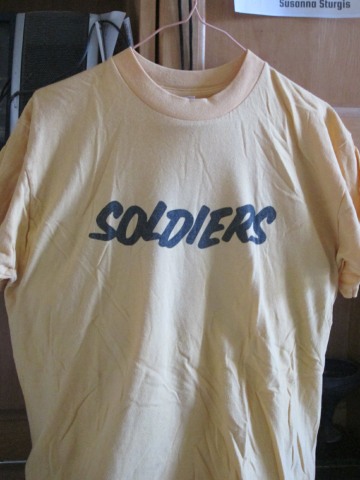
We became the core of a free-floating group that met at the rooftop lounge of the Hotel Washington[2] most Fridays after work to “process the week.” The group included Bruce Bant, an ex of Thom’s with whom he was still close friends, and Charles H., Thom’s current, who was an aide of some sort to some Republican congressman and who could have stepped out of an ad in GQ. Bruce, like Thom, was a Vietnam vet — they’d met in Vietnam, if I remember correctly — but unlike Thom he was career military. He’d recently retired as a sergeant major, having edited Soldiers, the enlisted service members’ magazine, and was now involved in the beginnings of what became USA Today.

I was the radical lesbian anti-militarist feminist in the group. We razzed each other endlessly about politics and the military but were always friendly about it. Although we were in Washington, the belly of the political beast, politics seemed a long way off. One Friday afternoon Bruce produced a Soldiers T-shirt and said he’d give it to me only if I promised to wear it. I promised, and I did, more than once.

Ever since starting the T-Shirt Chronicles, my favorite procrastination research technique has been looking up people, places, and events that my story touches on in some way. Thom died of AIDS in 1988 — I’ve got a story about that, and he comes up again before I learn of his passing — but I had no idea whether Bruce was still on the planet or not. A quick Google search found a LinkedIn entry that had to be him. He was living in Florida. Should I contact him? He probably had no recollection of me, but he might be able to place me if I mentioned the Soldiers T-shirt, the rooftop lounge at the Hotel Washington, and Thom.

Just now I went looking again. His LinkedIn page is still up, as is a Facebook timeline with an entry from February 2020, but near the top of the Google hits was the news that Bruce died in Fort Lauderdale on September 27, 2020. Also among the top hits was a guest column from the March 21, 2010, South Florida Gay News, entitled “Don’t Ask, Don’t Tell Has Been a Complete Failure.” The byline is Bruce Bant, Retired Army Sergeant Major. It’s him for absolute sure. I’m sorry I missed you, Bruce.


Notes

[1] The term itself dated back at least to the early 20th century, but it does seem that it was a hot topic in the 1970s. My tenure in the training office was 1978–79, so it seems plausible that it was a contested term at ARC NHQ at that time.

[2] Now, as far as I can tell, the W Washington, on 15th Street N.W. near Pennsylvania Ave.


If you don’t see a Leave a Reply box, click on the title of this post and scroll down.