The Road to WisCon 14 (1990)

WisCon, the world’s first and probably only fantasy/science fiction convention that focuses on feminist speculative fiction, was born in 1977 in Madison, Wisconsin. Thanks to Joan Nestle at the Lesbian Herstory Archives, an avid f/sf fan, I learned about it and f/sf fandom, including feminist f/sf fandom, before too many years had passed; see “I Discover Women Writing F/SF” for details.

But it wasn’t till February 1990 that I attended my first WisCon, WisCon 14. I got there by a circuitous route, which looks something like this:

I could have sworn this T said “WISCON 14” on it but obviously it doesn’t. Hal Davis gave it to me @ WisCon 14. I’d never met Hal before, and I know all that stuff about not accepting gifts from strangers, but I’m glad I accepted this one. Hal and I are still in touch 34 years later, though my last WisCon was in 2006. That’s some kind of record.

In the late 1970s, having got wind of the wealth of fantasy and science fiction being written by women, I started haunting Moonstone Bookcellar, the f/sf bookstore on Connecticut Ave., near Washington Circle. After a skim through the pages, I’d buy almost anything with a woman’s name on the cover.

While several of us were prepping for my 30th birthday party, in June 1981, Mary Farmer, owner and manager of Lammas, D.C.’s feminist bookstore, asked me to sign on as Lammas’s book buyer. Once I got my bearings, surprise, surprise, I started building up the store’s f/sf collection.

In 1984, Carol Seajay, founder, editor, and publisher of Feminist Bookstore News, invited me to become FBN’s first columnist. “Susanna Sturgis on Science Fiction” debuted shortly thereafter. Big perk was that I could now get free review copies from publishers.1

Also in 1984, I attended the Feminist Women’s Writing Workshops for the first time. FW3 in those years was held at Wells College in tiny Aurora, N.Y., but was based in Ithaca, 30 miles away. I got to meet Irene “Zee” Zahava, proprietor of Smedley’s, Ithaca’s feminist bookstore, and Nancy Bereano, then the editor of Crossing Press’s great feminist series and about to establish her own trail-blazing Firebrand Books.

Zee was just starting to edit anthologies, often of women’s writing; by now she has edited a gazillion and branched out into offering writers’ workshops. Back then, however, she opened the way for me to edit three anthologies of women’s f/sf for Crossing: Memories and Visions (1989), The Women Who Walk Through Fire (1990), and Tales of Magic Realism by Women (Dreams in a Minor Key) (1991).
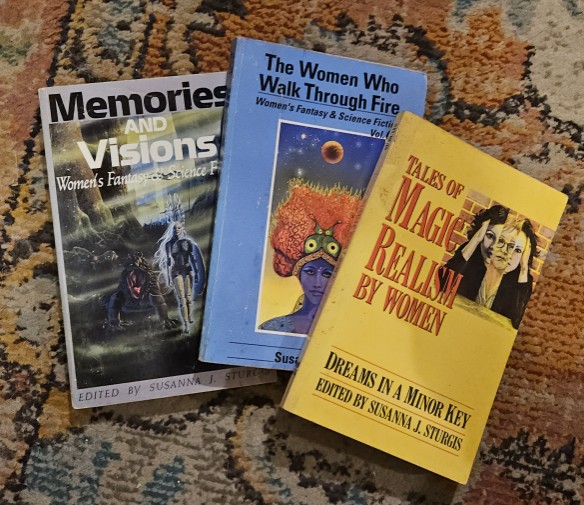
My three women’s f/sf anthologies

By the time Tales of Magic Realism came out, my relationship with Crossing had frayed so that was my last anthology. Personalities aside, the real underlying problem was the structural disconnect between feminist publishing and feminist f/sf readers. Feminist publishing and bookselling emphasized the trade paperback format; f/sf was overwhelmingly a mass-market world. Feminist f/sf fans could find their favorite women authors in f/sf bookstores. Only a handful of feminist booksellers knew f/sf well enough to build a feminist f/sf section, notably Karen Axness at Room of One’s Own in Madison and Paula Wallace at Full Circle in Albuquerque.

While at Lammas I had stocked a fine feminist f/sf section, which f/sf fans appreciated but was a hard sell to other fans of fiction by women. The widespread conviction that f/sf was only about spaceships and elves resisted all my attempts to unseat it.2 But my work at Lammas and especially my Feminist Bookstore News column did catch the attention of Crossing Press and others.

Among those who noticed my FBN column was the archivist/librarian for the Boston chapter of Daughters of Bilitis (DOB), who was also the East Coast half of fantasy writer J. F. Rivkin. In those days female protagonists had become more common in f/sf, but often they were the only woman in a team of men. If a novel had two significant female characters, they tended to be rivals, not allies. So J. F. Rivkin’s first novel, Silverglass (1986), was right up my alley: sword & sorcery featuring lesbian partners who had adventures together.

J. F. Rivkin/East was also well connected with the women writers in the New England f/sf scene, which is how I came to be included in a group signing at Glad Day, Boston’s gay bookstore, then located on Boylston Street near Copley Square. I’m pretty sure the year was 1990, after The Women Who Walk Through Fire came out that spring and after I had attended my first WisCon in February. There for the first time I met Ellen Kushner, Delia Sherman, Melissa Scott, Lisa A. Barnett, and “J.F./East” herself. Wow.

With WisCon and that momentous Glad Day signing, a whole world opened up, one I’d been only dimly aware of in my feminist bookselling days. Not only did it keep me busy for most of the 1990s, it greatly expanded my T-shirt collection, thanks in particular to the wonderful Ts created by Freddie Baer for the James Tiptree Jr. Award. The Tiptree, for speculative fiction that explores and expands our understanding of gender, was launched by authors Pat Murphy and Karen Joy Fowler at WisCon 15, my second WisCon, and I chaired the Tiptree jury in 1994. More about that later.

NOTES

  1. I continued writing the f/sf column till 1996, 11 years after I left D.C., so the freebies continued to arrive. Since I was only interested in the ones by women, I’d take the rest down to Book Den East, which sold used and rare books, and sell them. Bookseller Cindy Meisner [1944–2023] told me these were snatched up by young male sf fans who loved getting brand-new books for cheap. ↩︎
  2. Genre fiction per se was never the problem. Mysteries have been huge in the feminist press since they were introduced, and don’t get me started about lesbian romance. Lammas customers would tell me they found fantasy or science fiction too unbelievable then come to the check-out counter with a lesbian romance about a nice lesbian on vacation who falls in love with a slightly older woman who turns out to be independently wealthy and they live happily ever after. ↩︎

1991–1994, etc.: ILGA, the Island Lesbian & Gay Association

The early ’90s get slippery for dates especially where the lesbian and gay awakening on Martha’s Vineyard is concerned. Complicating the chronology is that no one seems to have kept copies of Stone Walls, the handsome newsletter put out by Dan Waters and Hal Garneau for the fledgling Island Lesbian & Gay Association. I need to pay a visit to the Vineyard Gazette’s archives and also to find out what the Martha’s Vineyard Museum has in its files, but these things aren’t likely to happen till the worst of summer is over.

In late 2014, I was reminded of the importance of getting this history down where other people can find it. That summer, The Yard, a seasonal dance colony in Chilmark, claimed to have held the first public gay pride event on Martha’s Vineyard. I heard nothing about it through the usual channels, which is to say Facebook, word-of-mouth, or the bulletin board at up-island Cronig’s. No one else I know did either.

This was not surprising. A strange barrier stands between the summer island and the year-round island. It’s porous enough to see through, but only in one direction: we can see it, but it can’t see us. In June 2015 I blogged “Gay on MV” to get some of the history out there. Exactly seven years later, I had an opportunity to do it again, at the ceremonial raising of the “Progress Pride” flag in Ocean Park. “Pride Flag Flying,” another blog post, includes the remarks I prepared for that event.

So please consider this a work in progress.

When I moved back to D.C. in the spring of 1977, I knew where to find the lesbians and the feminists: through Lammas, the feminist bookstore, and through the Washington Area Women’s Center, then housed in the basement of the abandoned-and-falling-into-disrepair Sumner School at 17th and M Streets N.W.

Moving to Martha’s Vineyard in 1985 — for a year, mind you, just for a year — it was a different story. Where were the lesbians? I read every poster on every bulletin board and telephone pole and skimmed every story in both newspapers, looking for signs of lesbian, gay, and/or feminist activity. Nothing. Most startling was that no one seemed to be talking about AIDS, which by 1985 was a huge issue in D.C.

As recounted in “1985–86 (etc.): Adult Child of Theater,” it was much easier to find a 12-step program for adult children of alcoholics. And through that I found lesbians, gay men, and the island’s vibrant theater scene. As I wrote in “Gay on MV,” the Vineyard’s theater community was “like theater in most other places: a veritable hotbed of misfits and nonconformists, gay, lesbian, straight, both/and, and neither/nor. My people.”

But no one said “gay” or “lesbian” out loud in public. Oh no! If you did, it was assumed you were one, and that was risky. So we said “the L-word” (almost two decades later this commonly used closet phrase was appropriated for a TV series) or used the ASL sign for “L” or (gods help us) substituted “Lebanese” for “lesbian.” The island was just discovering AIDS, but to hear health-care professionals talk, you’d have assumed that HIV could only be contracted from dirty needles and blood transfusions.

The island’s lesbians and gay men knew better. Nancy Luedeman (1920–2010), theater mainstay and recovering alcoholic, created a panel for the AIDS Quilt that was included in the Quilt’s first national display in October 1987. Two of the four Vineyard men it memorialized were identified only by first name and last initial, the other two by initials only.

Around 1990 that began to change. See “Visiting the AIDS Quilt with My Mother” for what I currently recall (and have to further research) about this period. Many island gay men and lesbians realized that the time had come to go public, in part to help clear up the widespread misconceptions about gay people but also so we could find and support each other.

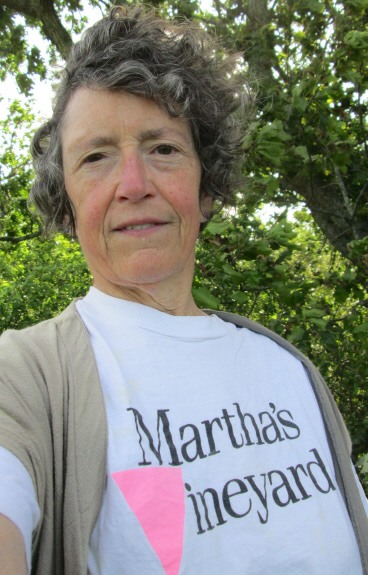
Me and the more discreet of ILGA’s two T-shirts in July 2014. In the early ’90s you could wear this one anywhere and hardly anyone knew what it meant.

The first meeting of what became ILGA, the Island Lesbian and Gay Association, took place in the big room at the Wooden Tent on State Road, Vineyard Haven, which was then owned by Edie Yoder and Kathy Rose. I was there, along with some 25 other Vineyarders, about half of them women and half of them men, nearly all of whom I knew at least by sight. Sitting in a big circle, we went round and introduced ourselves. When the third Kathy introduced herself, people were starting to chuckle, then when Lansing Bailey — a burly gent who was older than most of us — introduced himself as Kathy, we all lost it completely. No one there will ever forget it.

What neither I nor anyone I’ve spoken with so far can remember is exactly when this meeting took place. My best guess is 1991, either spring or fall (because no one has time for organizational meetings in the summer, and what’s more, that was the summer of Hurricane Bob).[2] Fairly early in 1992 I moved into the guest house at the Wooden Tent, and I’m 99% sure that at the time of that meeting I was still living up-island.

You could only wear this one out in public if you were willing to stop people in their tracks. Photo from July 2014.

ILGA’s primary purpose was social — our potlucks were amazing! — but it had a powerful impact on gay and lesbian visibility on Martha’s Vineyard. In the early ’90s you could wear the pink triangle shirt down Main Street, Vineyard Haven, without getting any double-takes or snotty remarks: the only people who recognized the pink triangle were friendly and everyone else thought it was just another Vineyard T-shirt. It took considerably more chutzpah to sport the “No Man Is an Island Lesbian” shirt in mixed company.

For the first time a newcomer or someone just coming out could find the words “Lesbian” and “Gay” in the organizations listing of the Vineyard phone book. Two of us, Robert Cropper and me, were out enough to have our names and phone numbers listed. (I don’t recall ever getting a crank call from that listing.)

Around this time — 1992 and ’93 — a homophobic politician, Ron Beaty Jr.[3] by name, on the Cape took to writing nasty letters to the editor equating gay people with immorality and AIDS, and pushing Gay Rights, Special Rights (1993), a video promoted by the Traditional Values Coalition.[4] A lesbian couple wrote a letter to the Martha’s Vineyard Times rebutting such fallacious fear-mongering. The editor said he’d publish it but only if their names were included. Since this couple had several kids in the school system, this was outrageous and several of us (I was the Times features editor at this point) said so, but it was the editor’s wife who got through to him: “Of course you should withhold their names,” she said, and that was that. The letter was published with the writers’ names withheld.

In the fall of 1993 two Oak Bluffs town fathers tried to get two of the earliest kids’ books about gay/lesbian families pulled from the Oak Bluffs School library: Heather Has Two Mommies (1989) and How Would You Feel If Your Dad Was Gay? (1991). This spawned several contentious meetings and letters to the editor. I remember one meeting in particular where the town fathers were joined by a fundamentalist minister and a former marine known for striding around town in his red satin Marine Corps jacket. At one point the minister claimed that AIDS was God’s scourge of the homosexuals (IIRC he used that exact phrase), to which ILGA regular Michele Lazerow pointed out that lesbians had the lowest incidence of HIV/AIDS of any group. This was greeted with much laughter and applause, so I don’t know whether the minister responded.

The heroes of the meeting were the school librarian, Jan Buhrman, and the eighth-grade member of the school committee, Jay Borselle.[5] Their eloquence helped turn the tide, and it reassured me and others that we had allies willing to step up. At the same time, the Martha’s Vineyard Library Association was the only organization that spoke out against the attempted book banning. As a former bookseller, I expected no less — librarians are the best! — but the silence in other quarters was disappointing.

In response I took the lead in organizing a Banned Books reading at Wintertide Coffeehouse in January 1994. I read from Heather Has Two Mommies, Robert read from How Would You Feel If Your Dad Was Gay?, and 18 or so volunteers picked a book from the American Library Association’s Banned Books list and read a short excerpt from it. The Rev. Ken Miner (d. 1997), pastor of Trinity United Methodist in Oak Bluffs, read the David and Jonathan story from the Bible. The place was packed, and we all went home invigorated.

That spring, the short-play festival at the Vineyard Playhouse included Susan Miller’s “It’s Our Town Too,” a poignant riff on Thornton Wilder’s classic Our Town in which the parents of the young people who grow up to marry are a gay couple and a lesbian couple.

Several ILGA members marched in Boston’s Gay and Lesbian Pride parade that June, behind a banner created by signmaker (and musician) Tom Hodgson. I don’t remember why I didn’t join them, maybe because I’d ODed on Gay Pride in my D.C. days, but I did get to a “Celebrate Gay Cod” event on the Cape that month. That’s where the button at the beginning of this piece comes from.

NOTES


[1] The AIDS Alliance sponsored the first Crossover Ball on New Year’s Eve 1994. Boys dressed as girls, girls dressed as boys, and everyone had a blast. These continued more or less biennially till 2005. Can you imagine such a thing happening on Martha’s Vineyard in the ’80s? I can’t either.

[2] Late October of that year brought the equally memorable No-Name Nor’easter, known elsewhere as the Perfect Storm. It delayed the move of the Martha’s Vineyard Times, whose features editor I then was, from Woodland Market to Five Corners. This makes me think that the first ILGA meeting happened earlier in the year, but we shall see!

[3] Gadfly Beaty is nothing if not persistent. For a summary of his antics, see this 2018 call for his removal from his seat on the Barnstable County Council. He wasn’t removed then — the BCC doesn’t have a removal mechanism — but he was eventually defeated for re-election. Now in 2024 he seems to be running again. He has referred to himself as the “Donald Trump of Cape Cod” and once referred to activist David Hogg as a “self-promoting opportunistic rat.”

[4] I procured a copy of this so several of us could see it firsthand. This got me on some pretty disgusting right-wing mailing lists, but eventually the appeals and alerts stopped coming.

[5] By the end of the decade, Jan Buhrman had begun an ever expanding and deepening career as a cook and advocate for locally sourced ingredients: https://www.janbuhrman.com/. Jay Borselle became a journalist and is now the news director for WBZ NewsRadio in Boston.

Wayward Books & Women’s Glib

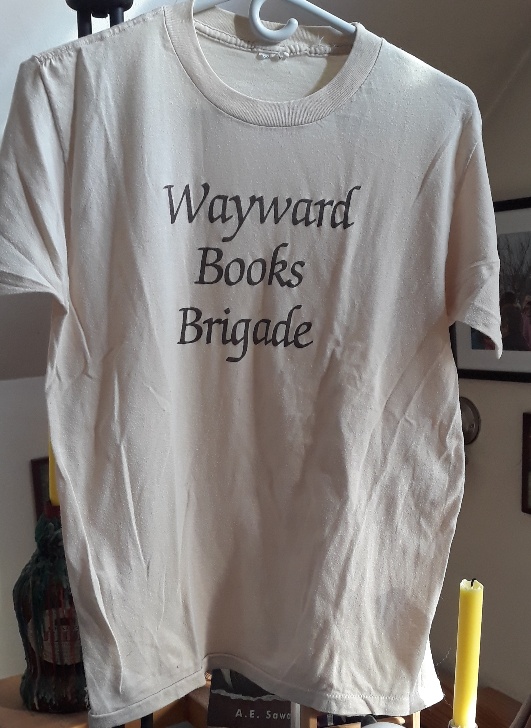
When bookstores move, staffers usually pack the books in boxes, load the boxes in a truck, and drive the truck to the new location. When Wayward Books moved, owners Sybil Pike and Doris Grumbach packed the books in grocery bags and volunteers passed them hand to hand along Pennsylvania Avenue SE to the new shop at 325 7th Street., which was practically next door to Lammas. I was one of the volunteers, and that’s how I got this T-shirt.

True, the distance was only three or four city blocks, and as I recall the brigade didn’t quite stretch the whole distance, so cars were called upon to ferry the books across the gap. But the operation was ingenious and fun, and it worked.

Wayward Books dealt in a carefully curated mix of secondhand and rare works, which meant those books had already been around. They probably took their latest move in stride.

Lammas was well represented in the Wayward Books Brigade, and not only because Wayward Books was moving into the immediate neighborhood. Pike and Grumbach had been a couple since the early 1970s, and Grumbach’s novels were regular sellers at Lammas, notably Chamber Music and The Ladies, which was based on the “Ladies of Llangollen,” two 18th-century Irish women who eloped to Wales, set up housekeeping as a married couple, and whose home became a go-to destination for literary luminaries of the time. Grumbach’s books focused on women’s lives, and often women in relationship with each other, which was not all that common at the time, especially for “mainstream” novelists.

Sybil, a retired research librarian at the Library of Congress, was the on-site manager at Wayward Books — I remember her as a strikingly handsome woman who would have been in her mid-fifties at the time — but Doris was also around when she wasn’t teaching or writing. The two shops complemented each other nicely: their inventories didn’t overlap, but their customers did.

A Washington Post story from April 1990, reporting on Wayward Books’ relocation to Sargentville, Maine, that month, notes that the Wayward Books Brigade comprised 70 volunteers and moved some 3,000 volumes from old location to new. The move to Maine involved three times that many books and was presumably not accomplished hand to hand.

The Post story also says the hand-to-hand move to 7th Street happened in 1985. I would have said a year earlier, because I left D.C. at the end of July 1985 and it seemed Wayward Books and Lammas had been neighbors for more than a few months at that point. But memory is tricky, so maybe not.

I just learned that Sybil passed in March of last year, at the age of 91, but that Doris seems to be alive in her 104th year. It sounds as though, around 2009, they moved together to a retirement community in Pennsylvania, where Sybil died and Doris still lives. Anyone with more information, please respond in the comments. If you don’t want your comment published, say so and it won’t be.


This T-shirt has nothing to do with Wayward Books — except that they both have to do with books, and that Women’s Glib was somewhat wayward in that it had to do with feminist humor, which many continue to swear is an oxymoron. Not for the first or last time, those “many” are so wrong.

Women’s Glib and Women’s Glibber, anthologies edited by Roz Warren, both came out in my bookselling days — I think. Amazon.com gives the early ’90s as pub dates for both books but notes in one case that it’s a second edition. I’m pretty sure I didn’t have anything in either book, although I was the class clown (female) in sixth grade and have been credited with having a pretty good, albeit barbed, sense of humor in all the decades since.

Interestingly enough (to me, at least), this is one of the very few — maybe even only? — Ts I have that features a book. I’ll hedge my bets on that one till I’ve excavated my whole collection. Either few books were featured on Ts or I wasn’t buying (or being given) the ones that were.

My humor tends to be in the moment — I think the word is “situational,” meaning that it arises from circumstances. I’ve never been fond of the other kind, such as stand-up, mainly because stand-up comedy back in the day was so misogynist, even when performed by one of the few women in the trade. Phyllis Diller embarrassed and infuriated me. I could admire Lucille Ball and I Love Lucy while being mortified by her tactics.

As a teenager and young adult I was a huge fan of the Smothers Brothers and Rowan and Martin’s Laugh-In. By the time Saturday Night Live got going, in the mid to late 1970s, I was doing fine without a TV and besides, SNL didn’t seem all that in sync with the lesbian-feminist life I was living.

Humor that was in sync with my life — I loved it. Alison Bechdel’s Dykes to Watch Out For strip and the books compiled from it were huge hits with Lammas customers. So were Nicole Hollander’s Sylvia books. They kept us laughing, and they kept us sane.

The first stand-up comedian who made me sit up, take notice, and even buy at least one of her albums was Kate Clinton. I heard her perform live in the early ’80s. What a revelation! The problem with stand-up comedy wasn’t me, it was the sexist, heterosexist comedy itself!

I’m thrilled to report that Roz Warren and Kate Clinton are still “making light,” as an early Clinton album had it, and you’ve almost certainly heard of Alison Bechdel, if not of Dykes to Watch Out For. I’m not sure if Nicole Hollander is still creating, but it’s not hard to find Sylvia online.

Sylvia — that Sylvia — was one of the namesakes of the TRS-80 that was Lammas’s and my first computer. The other two, as I think I mentioned before, were Sylvia Sherman, my high school history teacher, and Sylvia Abrams, my editorial mentor, without whom I would have had a hard time making a living these last four decades.

My Only Bread Shirt

During my sojourn in England in 1974–75, I discovered unsliced bread. When I returned to the States in late November 1975, I discovered that sliced bread — at least what was available in the western suburbs of Boston at the time — didn’t measure up. After my Grandma died in February 1976, I moved into her (large) house to take care of it and her Lab, Max. In her big country kitchen I taught myself to make bread. I taught myself out of a paperback book because there were no bakers in my family. As I recall, I caught on quickly. One attempt did turn into the proverbial brick, but that was it.

Apart from almost five years when I was living in an apartment with no oven,1 I have been baking my own bread ever since. Bread is pretty much my only culinary accomplishment. If I don’t bring some form of bread to potlucks, people wonder if I’m OK. For about 25 years in a row I won ribbons for my yeast breads at the annual Martha’s Vineyard Agricultural Society fair. (Full disclosure: The yeast bread categories were nowhere near as competitive as the quick breads, and forget about brownies and cookies.)

Considering how central bread has been to my daily life for so long, it’s surprising that this is my only bread-related T-shirt. Even more surprising, to me anyway, is that I don’t remember how I came by it. I’ve never been to Gladewater, Texas, so someone must have given it to me, but I don’t recall who. A Google search tells me that Glory Bee Baking Co. closed its doors in 2010. Even though I’d never been there, that made me sad.

Independent bakeries have something in common with independent bookstores, and to paraphrase John Donne, the death of any one of them diminishes me and the communities I’m part of. Just up the street from Lammas Bookstore was the Women’s Community Bakery, which (as I just learned from Googling) closed in 1992.

“Just up the street” I say, but Pennsylvania Avenue SE was like a moat and for all the time I spent in the neighborhood I rarely crossed it.2 I had plenty of opportunities to sample their wares, however, with an emphasis on the cookies, muffins, and other non-bread offerings. If the Women’s Community Bakery ever had its own T-shirt, it must have passed me by.

I do still have my copy of Uprisings: The Whole Grain Bakers’ Book, published in 1983, which includes recipes from more than 30 independent bakeries, including the Women’s Community Bakery. It’s a handsome, spiral-bound volume, with each bakery’s section hand-lettered in its own distinctive style, and the introductory pages cover just about everything you need to know about bread baking if you’ve never done it before.

I rarely baked anything from it because so many of the ingredients could not be found in the supermarkets or ethnic groceries near me. Malt syrup? Millet flour? Soy margarine? Turned-down page corners and check marks do indicate that I tried some of them, though. These days exotic ingredients are easier to find, at least on Martha’s Vineyard, and I’m more confident about improvising and substituting than I was four decades ago, so maybe I’ll try again.

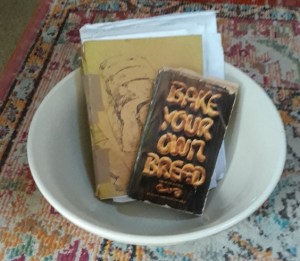
What I lack in bread-related T-shirts, I make up for in items related to bread-baking. Not surprisingly, many of these have been given to me by housemates and others with a vested interest in my continuing to make bread. These include my big bread bowl, my green-marble rolling pin, and my copy of Beard on Bread, which is held together with strapping tape. (See photo. My other most used book, Floss and Stan Dworkin’s Bake Your Own Bread, is in three pieces.)

The largest gift is the table I knead bread on. This was rescued from a Mount Pleasant (D.C.) alley by onetime housemate Beverly, she who also made my Feminism Is a Lesbian Plot shirt. Being handy with tools, she installed dowels to stabilize it, and voilà, the perfect kneading table. It’s accompanied me on all my many moves over more than four decades because most kitchen counters are the wrong height for kneading, at least if you’re very slightly over five-foot-four. In between bakings, it masquerades as an ordinary worktable, barely visible under the stacks of files, notebooks, and loose papers piled upon it.

Bread baker’s corner, with kneaded dough ready to be cut into loaves

If you want to leave a comment and don’t see a Leave a Reply box, click the title of the blog post (above) and then scroll to the bottom.

notes

1. This jumps ahead to Martha’s Vineyard, where affordable year-round housing was in crisis before I arrived in 1985 but denial was epidemic among the comfortably housed and it’s only been in the last few years that most people started to acknowledge that the situation was desperate. Landlords and tenants collude in evading local bylaws on what constitutes an apartment by omitting stoves from the dwelling. I cooked my meals with a hotplate and microwave, which worked fine — but I couldn’t bake bread. This was in the mid-2000s, from 2002 to 2007.

2. Phase 1, aka “the Phase,” one of the few lesbian-friendly bars in D.C. at the time, was also “just up the street,” across Pennsylvania Ave. on Eighth Street, but if I went there more than half a dozen times in my D.C. years I’d be surprised. I’ve never been a bar person. The Phase closed in 2016 (or maybe 2015, according to one website). The area around Lammas was its own self-contained neighborhood, anchored by Eastern Market, which is still there, seems to be thriving in an upscale sort of way, and even has its own website. I was in Eastern Market several times a week, usually looking for either a pulled-pork sandwich or Doris’s hamantaschen.

Support Lesbian Mothers

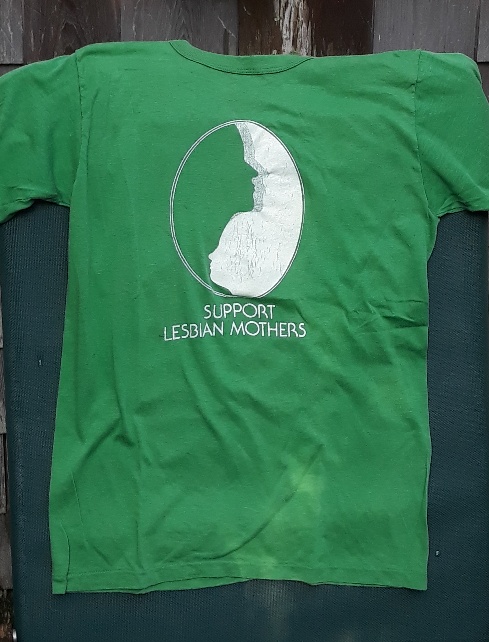
I could have acquired this T at Lammas, or at an event. Don’t know. In the 1970s and well into the ’80s — and in plenty of places even now — “lesbian mother” was either an oxymoron or anathema. In my social and political circles there weren’t many lesbian mothers, and virtually all were survivors of heterosexual relationships. Several prominent lesbians who were (almost) old enough to be our mothers had children: Adrienne Rich (b. 1929) had three sons, and Audre Lorde (b. 1934) had a son and a daughter. Singer-songwriter Alix Dobkin (b. 1940) wrote at least one song about the joys and challenges of being mother to Adrian, and in her later years was a happy grandma to Adrian’s three kids.

In the 1980s this was starting to change: lesbians, some in relationships, others single, were “starting families,” as the saying goes, by adoption or by getting pregnant. I don’t remember when the phrase “lesbian baby boom” became popular, but it most certainly did. A landmark documentary about lesbian mothers, Choosing Children, was released in 1985.

In those days, even demonstrably unfit fathers could count on winning custody battles with their lesbian ex-wives. I knew women who’d lost custody after grueling court fights, and I heard of men who, after winning in court, relinquished custody to their exes: they were more interested in winning than in taking responsibility for their kids.

Along with possibly hostile exes, a definitely hostile legal system, and all the challenges that go with raising children, period, lesbian mothers often didn’t get much practical support from their lesbian communities either. There were multiple, interacting reasons for this. We were a mono-generational lot, for one thing: I’d guess that at least 80 percent of us were between the ages of 25 and 40. Most of the white women among us were from somewhere else: we’d left hometowns and families behind, often on less-than-happy terms. As a result, we had to build support networks from scratch, and we didn’t have much energy, time, space, or money available for non-adults — or for elders either. (We did, I think, do an OK job supporting those among us who were faced with serious illness or injury.)

In addition, some of us just weren’t all that interested in children. I distinctly remember an incident when I was about 12: I was in the car with my mother, headed for the next town over, and when we were stopped at a red light I asked her why I, alone of my siblings, didn’t have a middle name. She replied that when I got married, I’d just drop it. In that instant I knew (1) that I was never getting married, and (2) that I needed a middle name.

Kids weren’t part of my thought process, not consciously at least: what I knew for sure was that I didn’t want my mother’s life. Much, much later, like when I was around 30 and had been out as a lesbian for several years, I was mildly curious about what pregnancy and childbirth might feel like, but I had zero interest in raising a child — or in having heterosex, although by then I knew that there were other ways to get pregnant. Turkey basters were most definitely a thing.

Sometimes it was stronger than lack of interest. The phrase “never-het lesbian,” meaning a lesbian with no heterosexual history, was in play, and having kids was taken as a fairly obvious sign of a heterosexual past. And if while growing up a woman had been subjected to heavy family pressure to get married and have children, and perhaps been disowned for not doing so — well, once one escaped that pressure, one might be at least a bit ambivalent about those who seemed to have acquiesced in and benefited from it.

I just pulled off my shelf the epic volume Our Right to Love: A Lesbian Resource Book, edited by Ginny Vida in cooperation with the women of the National Gay Task Force and published in 1978. It’s a rich and revealing collection, of essays and photos and an exhaustive national resource directory, of where we were in the late 1970s. The essays include “Sharing Your Lesbian Identity with Your Children” and “Lesbian Mothers in Transition,” and lesbian mothers and their kids show up in other essays too.

A quick Google search turned up a scientific paper from 1981: “Lesbian Mothers and Their Children: A Comparative Survey,” in the American Journal of Orthopsychiatry. In case anyone needed more evidence that lesbian mothers have been around for a while . . .


Writing about lesbian mothers reminded me of a book that came out in the late 1980s: Why Can’t Sharon Kowalski Come Home? by Karen Thompson and Julie Andrzejewski, published by Aunt Lute Books in 1989. I no longer have my copy, so I was thrilled to learn just now that, though it’s not in print, it’s still being read and remembered and copies can be found.

After Sharon Kowalski suffered serious brain damage in an auto accident, her parents refused to let her lover, Karen Thompson, even visit her in the hospital. A long court battle ensued, which Karen eventually won: she became Sharon’s legal guardian. The case was a cause célèbre in lesbian, feminist, and disability circles because it underscored just how vulnerable lesbian and gay relationships were when marriage equality was barely even a dream.

A 2003 book about the case is still in print from the University Press of Kansas: The Sharon Kowalski Case, by Casey Charles. Notes the publisher’s catalogue: “Charles weaves together various versions of the story to show how one isolated dispute in Minnesota became part of a larger national struggle for gay and lesbian rights in an era when the movement was coming of age both legally and politically. His account recalls the rough road lesbians and gay men have had to travel to gain legal recognition, examines how the law is politicized by the social stigma attached to homosexuality, and demonstrates how conflicted the decision to ‘come out’ can be for lesbians and gays who view ‘the closet’ as both prison and refuge.” Charles, a lawyer, English professor, and gay man with HIV, has written several books since.

This August 2018 article in Minnesota Lawyer brings the story almost up to the present day: “The Minnesota Legal Fight That Changed the Course of the Gay Rights Movement.” Karen has been Sharon’s guardian all these years, assisted by her current partner.

1980: Secede Now

I acquired my SECEDE NOW T-shirt on Martha’s Vineyard in the late 1970s, years before I moved to the Vineyard year-round, though I was spending time there now and then. It’s now so historic that mine was recently included in a T-shirt exhibit at the Martha’s Vineyard Museum. Here’s the story behind it: In 1977, the Massachusetts House of Representatives reduced its number from 240 to 160. Among the districts eliminated in the reduction were Martha’s Vineyard and Nantucket, which up to that time had each had its own seat in the House. This provoked indignant threats to secede from the Commonwealth of Massachusetts and generated, along with this T-shirt, a striking flag that is still occasionally seen in these parts.

Selfie ca. 2018

My SECEDE NOW story has nothing to do with the Massachusetts legislature, or Massachusetts either: it unfolded in D.C., around 1980. If I had to identify the five most important turning points in my adult life, this would be one of them. It’s about daring to be seen, and it starts with the 1979 publication of JEB’s Eye to Eye: Portraits of Lesbians.

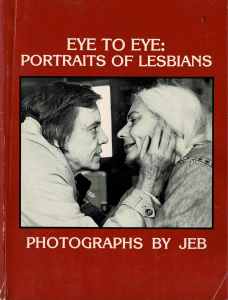
Eye to Eye was a revelation, an inspiration, a major milestone on the road to lesbian visibility. The local impact might have been even greater than the national one: JEB (Joan E. Biren) had long been a visible mainstay of the D.C. lesbian community — she was a veteran of the Furies collective — and many of the women depicted in its pages lived in and around D.C. I had at least a nodding acquaintance with several of them, and would get to know some much better in coming years. Of course I bought Eye to Eye as soon as it came out, and you bet I’ve still got my copy.[1]

Every woman who appeared in Eye to Eye was unfathomably brave. As a writer in the Unicorn Times, a D.C. alternative newspaper, put it when the book was released: “It is almost impossible to publish photos of lesbian mothers with their children because of the mother’s fears of losing their children in custody cases. Mothers are not the only lesbians who can’t be photographed. Women afraid of losing their jobs, lesbians from other countries afraid of deportment, and lesbians afraid of disownment from their families all had to refuse Biren’s permission to be published.”

The 1979 edition. Could there have been a better cover photo than Kady (left) and Pagan? And no, my copy isn’t going anywhere.

Those sentences were quoted in Paul Moakley’s excellent (I’m serious about this. Read it!) interview with JEB for Time magazine in February 2021, when Eye to Eye was reissued in hardcover, the original intact but expanded with new essays. In 2021 it may be as pathbreaking, as revelatory, as it was in 1979. Lesbians are on TV these days, we can get married, and so on, but we’re submerged in the LGBTQ coalition (in which G has been dominant from the beginning) and erased by supposedly inclusive words like queer and gender-nonconforming. We’re invisible in a whole new way.

In 1979 I did notice an absence in Eye to Eye, however: women who were fat like me. The absence wasn’t total: Dot the chef is what I’d call zaftig, but she was also middle-aged, which to my 28-year-old mind let her off the looks hook; and one of the quintet gathered around the National Lesbian Feminist Organization banner at the 1978 ERA march might have been around my size. But none of the women photographed bare-breasted or naked were anywhere close to zaftig, never mind fat.

I got it, or thought I did: a powerful stereotype at the time (which hasn’t entirely gone away) was that lesbians turned to women because they “couldn’t get a man,” and being fat got you sorted PDQ into that category. I took for granted that being fat made you a liability, that Eye to Eye would be taken more seriously if we weren’t in it. I felt petty for even noticing our absence. Of course I didn’t mention it when I reviewed the book. I doubt I ever even said it out loud.

Then Beth K., a D.C. photographer whom I knew from my Washington Area Women’s Center days, announced that she was planning a show of lesbian portraits. Each image would be accompanied by the woman’s own words. Rather than choose her subjects, she was soliciting volunteers from the community. Words coupled with images! I was a writer, after all — wasn’t this right up my alley? My written words went out in public all the time. Writing short was a challenge (still is), but I could do it.

But–but–but . . . Being a fledgling editor as well as a writer, I could control my words; often I even had some say about how they appeared in print. I would have zero control over how I appeared in a photograph, or of what people would see when they looked at it. If people could see what I looked like, would they still take my words seriously?

My ruthlessly rational feminist self went up against against my own muddled assumptions. Fat lesbians were a liability — did I believe I was a liability? (Yes.) Did I see the connection between believing my physical appearance made me a liability and railing against a misogynist culture that valued women according to their physical appearance? (Uh . . . yeah. Sort of.) What was this really about? (I’m terrified.) Of what? (Seeing what I really look like.) So if Beth asks if you’d like to be in the show, what are you going to tell her?

And that’s where I choked. My “reasons” flourished in the privacy of my head,[2] but if I said them out loud to someone else, even I would have to see what crap they were. By asking for volunteers, Beth had given me the opportunity to say yes. If I didn’t say yes, I better shut up about the absence of fat lesbians from books and photo shows. So I said yes.

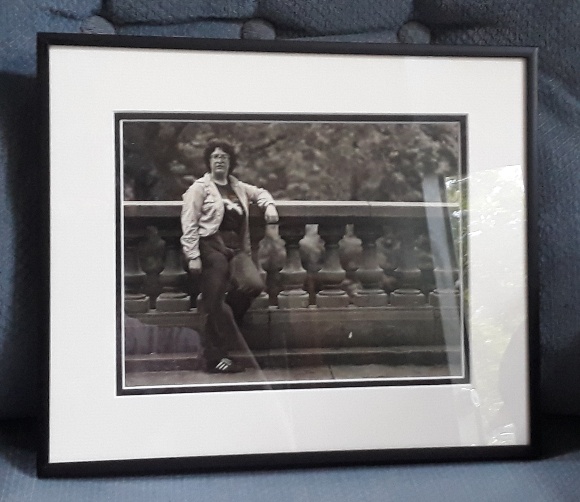
Here’s the photo, which I just had reframed. I chose the location: a stone bridge over Rock Creek behind the National Zoo, not far from where I lived, which I biked over several times a week going to and from work in Alexandria. I wore my SECEDE NOW T-shirt as a personal declaration of independence.

I don’t have a copy of what I wrote for the show; I might have lost it, or it might be buried in one of the file drawers I have from before “files” were saved on disks or hard drives or in the cloud. I remember comparing being a lesbian to being a writer: nature and nurture — potential — had something to do with both, but decisive in both cases were the choices I kept making over time. The choice to say YES to being photographed was a big one.

What I see when I look at that photo today is a young woman who, despite being uncomfortable in her own body and uneasy about being seen, is standing out in the open. She hasn’t partially concealed herself behind a tree, or at a typewriter. She’s meeting photographer and camera eye to eye.

Forty-plus years later I meet her likewise and salute her courage.

If you want to leave a comment and don’t see a Leave a Reply box, click the title of the post and then scroll to the bottom.

notes

[1] I’m not the only one. In the Time interview cited above, JEB says: “For years I would go into my local gay bookstore to their secondhand section. It was never there. Never! Today people are all telling me they still have the one they bought in 1979. . . . I gave a copy to my college library (Mt. Holyoke), and it was stolen—maybe like seven times. Eventually, they had to lock it up in the stacks, where they had this cage with all the rare books from the Middle Ages.”

[2] Pete Morton hadn’t written “Another Train” yet, but he nailed it (and a few other things) in that great song: “Imagination plays the worst tricks.” When I first heard “Another Train” — covered by the Poozies in the mid-1990s — I was sure Sally Barker was singing to me, her invisible arm around my shoulders in some bar somewhere. That led me to Pete Morton’s own version, and a whole slew of his CDs. I’m still hoping to hear him live some day . . .