Back to Horses (and into Dogs)

I was horse crazy from an early age. In this my paternal grandmother, aka Grandma, formally Rosamond Thomas Bennett Sturgis Little,1 played a major role. A longtime horsewoman, she had three sons, none of whom had the slightest interest in horses. Then along came I, first child of her oldest son (aka Dad, formally Robert Shaw Sturgis). Grandma pounced.

It didn’t take much pouncing. Being a girl, I was susceptible from the start. One of the first movies I ever saw – maybe the first – was Tonka, the mostly fictional backstory of a real horse that survived Custer’s defeat at the Little Big Horn. It came out in 1958, the year I turned seven. Did Grandma take me to see it? Very possible, since at that point my mother was occupied with my next younger brother (b. 1952, about 16 months younger than I) and the brother after that (b. 1956, who would have been barely two).2

I got a horse for my 12th birthday. I could go on (and on and on) about the teenage years that followed, but I have no T-shirts to show for it because at that point T-shirts were either work clothes or underwear and overwhelmingly worn by men. Message T’s didn’t go mainstream for another decade. Suffice it to say that my life revolved around horses (including my town’s 4-H), school (which I loved and was very good at), and becoming a teenage Arabist. After graduation, I moved to D.C. for college, became a city girl, and assumed I’d left horses behind.

However, as noted in “1979–1981: Biking to Alexandria,” I did call my trusty Peugeot 10-speed my “urban horse.” Like any self-respecting and transportationally desperate suburban kid, I got my driver’s license as soon as I could,3 but I didn’t own a motor vehicle till I was 37.

In 1992, seven years after I moved to Martha’s Vineyard, fate intervened in a big way. My real estate agent girlfriend knew I had a horsey background and so enlisted me to help a client of hers move her two horses from where they’d been boarding (Misty Meadows) to her new place about a mile away, across the road from what was then Rainbow Farm. (Since 2009 it’s been the Grey Barn and Farm.)

The very first Red Pony T-shirt, and the one I wore most often

The two horses were Nevada, an 8- or 9-year-old Andalusian mare, and Foxy, a yearling half-Arab filly – the “red pony” who gave the soon-to-be farm the name that’s on these three T-shirts. The client was Karin Magid, who was returning to the Vineyard after years living and working in England with her filmmaker husband; they were now divorced. I’ll leave the real estate agent’s name out of it because she died in 2018, by which time she’d long since moved off-island and we’d been out of touch for well over two decades.4

Karin rode Nevada, I led Foxy, and girlfriend followed in her Toyota Tercel wagon. I had just returned from a science fiction convention outside Toronto and was still in my travel clothes: blue culottes and a rose-colored top. Girlfriend had probably picked me up at the boat. As a teenager I wouldn’t have been caught dead dealing with horses in get-up like this.

Meeting Karin and reconnecting with horses changed my life but it didn’t happen overnight. My job as Martha’s Vineyard Times features editor kept me busy, especially during “the season.” President Clinton and his family visited the Vineyard for the first time in August 1993, and the Times office became Madhouse Central. The Clintons, understandably, spent most of their time doing R&R in seclusion, which left (what seemed like) half the national press corps either trying to spot them or roaming the island in search of scoops. Yes, I have a T-shirt to commemorate the occasion. It’ll be up next.

I was also very involved with Wintertide, where the stupendous Singer-Songwriter Retreats masterminded by the inimitable Christine Lavin took place in September 1992 and September 1993. Then that fall, two Oak Bluffs town fathers, encouraged by a couple of fundamentalist ministers, tried to get two of the first kids’ books about gay/lesbian families pulled from the Oak Bluffs School library. I had a hand in resisting that too, most notably in organizing the successful Banned Books reading that took place at Wintertide in January 1994.

After that, however, I had both the time and the opportunity to get back into horses in earnest. By then, Ali, a Morab gelding, had moved in as a semi-permanent boarder. He and I hit it off. I did some informal lessons with Karin but more often hit the trails with her or whatever house guest was eager to ride and competent to be allowed out unsupervised.

Naturally, since I was pretty much freeloading, I mucked out stalls, picked paddocks, and cleaned tack. It seems you can take the girl out of the barn for many years, but you can’t take the barn out of the girl. Much more about that later. I have lots of horse-related T-shirts.

Karin and the Red Pony were also instrumental in getting me back into dogs. When I was growing up, my family usually had two dogs and two cats. Everyone in town had at least one dog. During my D.C. years, dogs were out of the question, especially if you got around entirely by bus, bike, and on foot. Moving twice a year on Martha’s Vineyard wasn’t conducive to dogs either, but then through family connections4 I slid into a housing situation that included a Lab-Doberman cross named Jackson. Cris Jones, my housemate/homeowner, was working in southern California most of the year, coming home only in summer and sometimes for winter break, so I looked after Jackson.

Early in 1992 I moved into the guest house at the Wooden Tent, where I lived for the next decade. My connection with dogs continued. In 1993 Karin’s bitch Nanu, a Samoyed–border collie cross, had a planned litter by Bear, a local long-hair (“woolly”) malamute. I became a sort of foster dog-mother to two of them, especially Tigger, whom Karin kept and of whom I have lots of photos. Tigger and I went for walks and on other outings; he sometimes even stayed overnight.
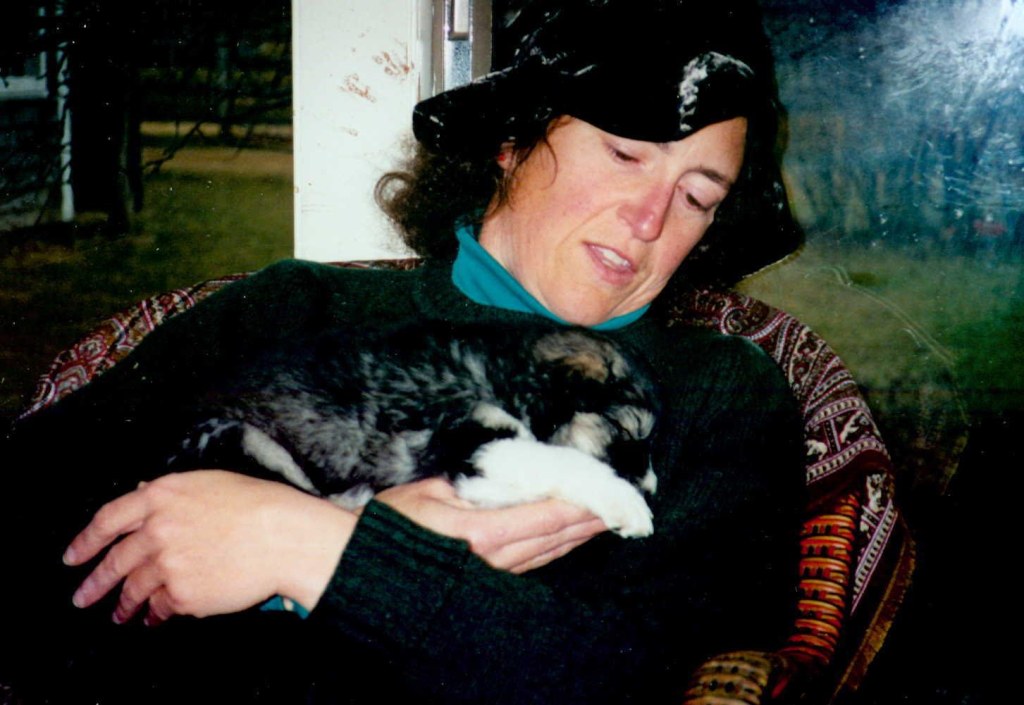
Me and puppy Rhodry, ca. January 1, 1995

I’d been convinced that I didn’t know enough to have a dog of my own. Gradually I realized that yes I did, and what I didn’t know I could find out. In the fall of 1994 Nanu got pregnant by Bear again. This pregnancy was unplanned, but no one was upset about it. They were born on December 17. I got in line for a puppy.

Puppy Rhodry with big brother Tigger

Being semi-freelance and semi-unemployed, I spent hours upon hours with the puppies as they grew. (I have pictures. OMG, do I have pictures.) This was the “Star Wars” litter: the five boys all got Star Wars names, but only one of the three girls did because there was only one girl in Star Wars: Leia. Before the pups were three weeks old little Han Solo picked me. He then became Rhodry, after the protagonist in Katharine “Kit” Kerr’s Deverry novels, which I was tearing through at the time.

At six weeks, he moved in with me. Before too long, Edie and Kathy, my neighbor/landladies, had acquired a Portuguese water dog, Rosie,5 and fenced in their backyard. Rosie and Rhodry became best buds and were frequently in and out of each other’s houses.

Before Rhodry, I knew very little about Alaskan malamutes, but since Rhodry very much took after his dad looks-wise, I started learning more. By the time he passed in February 2008, I’d decided that my next dog would be a malamute. We’ll get there eventually, I promise.

P.S. Here are two later Red Pony T-shirts. The one on the right says “The Red Pony / Martha’s Vineyard ” on the back.

NOTES

  1. Her maiden name was Bennett. She divorced George Sturgis, who died in 1944, seven years before I was born, then married David M. Little, who died in 1954. At least one photo exists of little me walking hand in hand with “Uncle Dave,” but I have no memories of him. Grandma’s preferred monogram was RTL, no Bennett and definitely no Sturgis. The “T” stood for Thomas, specifically Isaiah Thomas, Revolutionary War era printer and patriot, of whom she was a descendant (so, you’ve probably guessed, am I). ↩︎
  2. A little over four years later, Grandma took me to see Lawrence of Arabia on its first run, in one of Boston’s classic old movie theaters. The rest of the family went to see How the West Was Won. Clearly the U.S. West had lost ground to the Middle East in my esteem; spending time with Grandma was also a plus. Lawrence was released in mid-December 1962, so this was early in 1963, my sixth-grade year, before I turned 12 in June.
    By then I was already interested in the Middle East, having done a fourth-grade school geography project on the sultanates and sheikhdoms of the Arabian peninsula. I’m almost sure I read T. E. Lawrence’s Seven Pillars of Wisdom for the first time in fifth grade, after finding it on a high bookshelf in Grandma’s den. This does seem somewhat precocious for a ten-year-old, but I just checked some dates. I was an avid subscriber to Landmark Books, a history series for young readers. Alistair Maclean’s biography Lawrence of Arabia was issued as part of the series in January 1962, and I probably read it shortly thereafter. This was smack in the middle of my fifth-grade year. After that I would have recognized Seven Pillars in Grandma’s den, and the abridged version, Revolt in the Desert, right beside it. ↩︎
  3. This was delayed a few days because shortly before I was scheduled to take the test at the Registry of Motor Vehicles, I got run over by my then two-year-old colt. This wasn’t his fault. His stall opened into a small paddock. Being December, it was dark. It was also feeding time. He was out in the paddock; I was standing in the doorway and didn’t see him coming. I came to in the opposite corner of the stall. I probably wasn’t out more than a few seconds, but my head was ringing for a few days. My driving test was put off till it stopped, but I still got my license well before winter vacation. ↩︎
  4. My father, an architect, had even designed the house I found myself living in. The “family connections” were too complicated to explain here. Buy me a beer sometime and I’ll explain. ↩︎
  5. Their first PWD, Gina, had died very young, I think of a congenital condition. Rosie, thank heavens, was healthy and lived a good long life. ↩︎
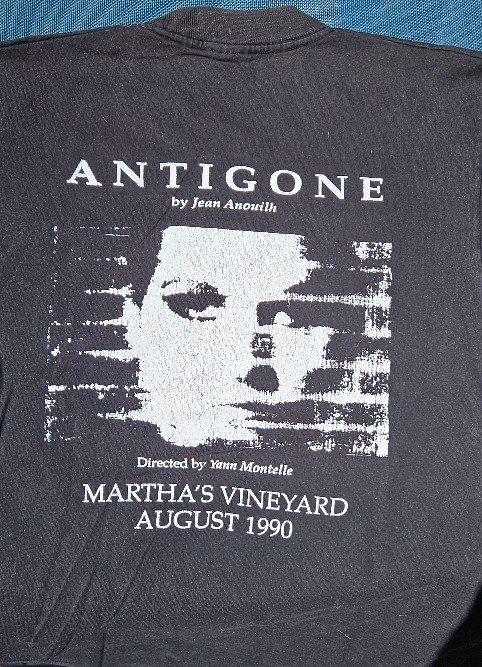
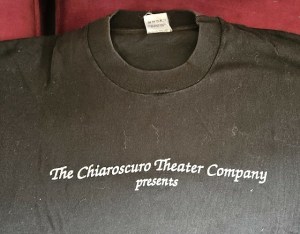
1990: Antigone

The second of my two show-specific shirts, unlike the first, commemorates a production mounted entirely on the Vineyard, but not by either of the two established theater companies, Island Theatre Workshop and the Vineyard Playhouse.[1]

Concerts and road races are far more likely to have their own T-shirts. Not only is this a rarity in Vineyard annals, but it even includes the essential who, what, when, and where. The image may be that of Kristina Kreyling, who had the title role.

Seen from several decades later, the late 1980s and early ’90s were a golden age in Vineyard theater, and in the grassroots performing arts in general. “The Play’s the Thing,” a July 1990 story in the Martha’s Vineyard Times summer supplement, counted no fewer than seven companies in action that summer.[2]

Essential to this flowering was available space.[3] The Vineyard Playhouse could host full productions upstairs, and smaller ones downstairs, like the late-night comedy troupe Afterwords. Island Theatre Workshop (ITW) didn’t have its own home, but it had regular access to Katharine Cornell Theatre, upstairs from Tisbury Town Hall, and, for auditions and early rehearsals, to the parish hall at Grace Episcopal Church not far away.

Once Wintertide moved into its year-round home at Five Corners in January 1991, all sorts of creativity took root and flowered there, including WIMP, the Wintertide Improv group. Among WIMP’s offerings was “Troubled Shores,” a long-running soap-opera-style satire of island life.[4] I still vividly remember Theodore Sturgeon, chief surgeon at Wing and a Prayer Hospital (Toby Wilson), Sengekontacket Vanderhoop (Lisa Elliott), and John Farmboy (Chris Brophy).

Some performers and techies were identified primarily with one or the other theater groups, ITW or the Vineyard Playhouse, but most moved between them and Wintertide depending on available opportunities. Having both space and a pool of capable actors and tech crew available made it so much easier to mount a show than it would have been if you had to start from scratch.

Not only to mount a show, but to birth a new theater company: Chiaroscuro, the company behind the 1990 production of Jean Anouilh’s Antigone, was born on Martha’s Vineyard. Ironically, when Yann Montelle arrived on the Vineyard to visit a friend on Chappy, he was taking a break from theater in his native France. Then fate intervened: he met, then married, Anne Cook, an artist with a long family connection to the Vineyard. Together they founded Chiaroscuro.

Chiaroscuro’s name was featured on the front of the shirt.

Yann and Chiaroscuro were active on the Vineyard for well under two years before Yann and Anne left for Portland, Maine, but the energy and quality of their activities were astonishing and invigorating to the island’s theater scene. In addition to directing, Yann ran workshops, at least two of which grew into full productions: Macchiavelli’s The Mandrake and Molière’s The Misanthrope. Of the former, he later told an interviewer[5] that “I wanted to do it to see if I could speak English. I had trouble because – you guys don’t realize it but you speak very fast!” To say he quickly became fluent is an understatement.

Yann also collaborated with fellow Frenchman Dominique Pochat (1956–2003) in the latter’s Red Nose Reviews, featuring Martin, Dominique’s clown persona. Dozens of Vineyarders, actors and non-actors, took their workshops; Red Noses started appearing in unexpected places. Red noses, by the way, have long been associated with clowns, but where did they come from? Origin stories vary: poke around online and you’ll find some of them. They’ve been described as “the smallest mask in the world.” I love this. With a red nose on, your face becomes both yours and not-yours. You’re free to become a you that isn’t seen in polite company.

And Yann directed several outstanding shows in 1990 and 1991. In addition to Antigone, I remember especially The Merchant of Venice (summer 1991) — which like Antigone was staged at the outdoor Tisbury Amphitheater[6] — and Sartre’s No Exit. I have copies of the reviews I wrote of several of these shows, so it’s not hard to remember the details. About Antigone I wrote that it was “one to see more than once, to discuss passionately far into the night over cappuccino or wine. Directed with care, graced with several outstanding performances, this ‘Antigone’ jerks you back and forth by the hair and leaves you breathless, dizzy, even awed.”

Randy Rapstine, who appeared in both Antigone and Merchant as well as other Vineyard productions (and with the Afterwords troupe), was one of several theater people who were then moving regularly between New York and the Vineyard. Asked to compare the two scenes, he noted that “in New York, you’re a small fish in a big pond,” while the Vineyard provided opportunities that were rare in New York. As a result, actors can take on a range of roles so audiences “see different parts of you.” He praised Vineyard theatergoers for being willing and able to do that.[7]

NOTES

[1] They rarely if ever created a T-shirt for a particular show. This makes sense. From auditions through rehearsals to opening and then closing night, a production’s life cycle might be eight weeks at most. Designing a shirt from scratch, then getting it printed and out on the street, would probably take at least four, by which point the run would be half over.

[2] For the record, they were the Vineyard Playhouse Company, Chiaroscuro Theatre Company, Full Circle, Island Entertainment Productions, Island Theatre Workshop, Red Nose and More, and Theater Arts Productions. The story was by yours truly.

[3] Also important was reasonably affordable housing. Year-round housing could usually be found at a realistic (for the Vineyard) price, and seasonal actors and techies could be put up in the spare rooms of year-rounders. As time went on, spare rooms became scarce, in part because young people who’d grown up on the Vineyard couldn’t afford to move out on their own.

[4] Led by WIMP veteran Donna Swift, Troubled Shores became the name of a Vineyard nonprofit focusing on theater (including improv) for young people on the Vineyard.

[5] That would be me. This was sort of Yann’s exit interview from the Vineyard: “Yann Montelle Seeks Out New Risks,” Martha’s Vineyard Times (August 29, 1991).

[6] If in warm weather, especially toward the end of the afternoon, you see vehicles parked bumper to bumper on both sides of State Road near the Tashmoo Overlook, that’s a sure sign there’s a show on at the Tisbury Amphitheater. This is a glorious clearing in the woods with a natural embankment that’s been augmented with very basic seating, e.g., railroad ties. Playgoers often bring their own beach chairs or blankets, and often a picnic. If you’ve never been there, pull off on the overlook when there isn’t a play going on, start walking down the access road, then take one of the paths on your right that leads into the amphitheater itself.

[7] Writing in the T-Shirt Chronicles about people I knew decades ago, I’m often afraid to look them up online. Randy was so talented and so motivated but the New York theater scene is so crowded and demanding. I didn’t want to learn that Randy had given it up and become a stockbroker. Good news: His subsequent career has included directing, producing, and teaching as well as acting in films as well as theater, and he’s still at it. Check out his website for details.

1989: “For Colored Girls Who Have Considered Suicide . . .”

Considering how many years I was involved in Vineyard theater and how many shows I was involved in, it’s surprising that I have only two T-shirts devoted to specific shows: this is one and the other will be up next.

I was the main theater reviewer for the Martha’s Vineyard Times when For Colored Girls Who Have Considered Suicide opened at the Old Whaling Church in Edgartown in August 1989. It’s obvious from the opening paragraph of my review (M.V. Times, Aug. 24, 1989) that I was blown away:

At its most profound, theater melds language and movement into a whole that overwhelms the individual senses, an experience so powerful that it becomes sacred. Marla Blakey’s production of Ntozake Shange’s “For Colored Girls Who Have Considered Suicide / When the Rainbow Is Enuf” . . . is that kind of theater.

Reviewers get to see the show for free, but I went back at full price (which I think was $20) at least once and I’m pretty sure twice before the run ended. Some while later a smaller production was mounted at Piatelli Studios, a multi-purpose space in the building next door to the West Tisbury post office.1 I saw that at least once too.

Note the “Martha’s Vineyard, 1989” at the bottom. This shirt was designed for this particular production. Sorry about the stains. My first couple of decades on the Vineyard, my clothes were often at the mercy of laundromats so I avoided white for this very reason.

NOTE

  1. When pianist Cheryl Piatelli owned it, the building was vivid pink. After Cheryl left, the pink disappeared and the building was given over to various healthy activities, e.g., exercise and alternative health care, so I never saw what it looked like inside. In October 2019, Vineyard-based nonprofit radio station MVY bought the building. After extensive renovations were completed, the station took up residence at the end of 2020. If the creative energy of the Piatelli years is still around, I think it’s happy with the new occupants. ↩︎

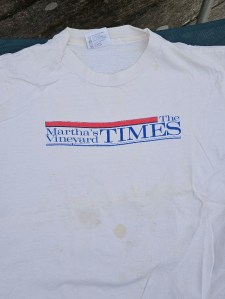
1987?–1993: Martha’s Vineyard Times

Two of the best jobs I’ve ever had fell into my lap. The first was book buyer for Lammas, D.C.’s feminist bookstore. The other was working for the Martha’s Vineyard Times. I wouldn’t have had the nerve to apply for either of them.

As my savings dwindled toward the end of my first year on the Vineyard, I started running a classified ad hiring out as a freelance typist. That got me a few short not-very-interesting gigs. More productive was my connection, through theater, with the Tisbury Printer. This led to several book-length editing jobs and editing and typesetting at least two catalogues for the Nathan Mayhew Seminars, a local nonprofit offering a variety of adult ed courses.

With my PC — Morgana, the first of five desktops that would bear that name — I could do pretty good cut-rate typesetting. I’d do the typing and formatting at home then take the disk (a 5 1/4 inch floppy) down to EduComp,[1] which was renting out time on its laser printers, and print out the copy. My girlfriend at the time, a talented graphic artist, did the paste-up. Before long, EduComp stopped offering this service because too many customers either messed things up or required too much hand-holding, but they made exceptions for me and a couple of others because we knew what we were doing. I was undeniably proud of being an exception.

Word got around that I was a competent typist with editorial capabilities. At a West Tisbury town meeting, the woman in front of me turned around and asked if I did freelance typing. I said I did. She turned out to be Eileen Maley, the Calendar/Community, i.e., features, editor of the Martha’s Vineyard Times. Their editorial typesetter was scheduled to have surgery soon and would be out for a few weeks. Would I be interested in filling in?

When I said yes, I probably sounded self-assured and confident. I wasn’t. Other than Eileen, whom I’d just met, I didn’t know anyone who worked at the Times or anything about their typesetting software. True to form, my imagination conjured a scenario where I’d be out of my depth and make a fool of myself. However, I’d made a similar leap of faith when I ventured into Katharine Cornell Theatre that first time, and that had turned out well. Maybe this would too?

The Times at that point was the upstart paper, having been founded in 1984 by five Vineyard businessmen as an alternative to the venerable (established in 1846) Vineyard Gazette. Reading only the Gazette, one might conclude that the year-round working island barely existed and that bad things never happened on Martha’s Vineyard; its subscriber base was mostly off-island from Labor Day to Memorial Day. Its coverage was so focused on its home base in Edgartown that Times people took to calling it “an Edgartown weekly.” Gazette staffers got back by referring to the Times as “the other paper.”

This not-always-good-natured rivalry went on for years. The Times was delivered free to every island post office or mailbox, a huge attraction for advertisers targeting a year-round audience. Naturally the Gazette retaliated with a full-page house ad featuring a trash can overflowing with discarded copies of the Times.

The Times office was nowhere near as elegant as the wood-shingled building that still houses the Gazette. When I first showed up to work, it was located behind Woodland Market on State Road in Vineyard Haven, in a long, low building that no longer exists. It once housed the Spaghetti Pot restaurant. The Spaghetti Pot was before my time, but rumor had it that the astonishingly red-orange carpeting in the newsroom was part of its legacy: had it perhaps been dyed with, or to resemble, spaghetti sauce?

Sorry about the stains. If I ever learn to use bleach, I could probably make them go away, but that hasn’t happened yet.

The building’s midsection was the newsroom, with reporters’ and editors’ desks lined up along the windows, which commanded a view of the dusty parking lot. Eileen’s desk was at the front of the row, and mine, as the pinch-hit typesetter and eventually the on-staff proofreader, was at the end. The three desks between us were occupied by all but one of the reporters. The exception was Gerry Kelly, who held court in an executive-type chair at an oversize desk next to the wall at one end of the newsroom.

Dubbed by a journalist admirer “the greatest one-man band in the history of journalism,” Gerry was the Times’ lead reporter and also a mainstay of the Calendar section: every week he wrote the food column, often featuring island restaurants, plus a book review, plus, from Memorial Day till well into the fall, a couple of art gallery reviews. He turned out copy like yard goods — a wonder to me because I’m on the slow side: I can’t turn the internal editor off when I’m writing. My only way around this is to write in longhand. This works because my handwriting is so hard to read that the internal editor gives up and goes along for the ride.

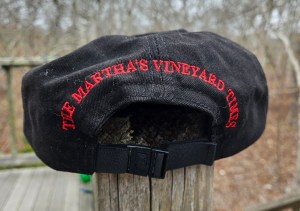
Times baseball cap, front . . .

Sure, Gerry’s copy invariably needed at least some editing and/or fact-checking, but that was a small price to pay. When an ad was cancelled at the last minute, he could fill the hole. When an ad came in late, he could cut two or three or four inches out of a story that was already pasted up. He’d head into Production, non-repro-blue pen in hand, swearing “Not one word!” and do what had to be done.

. . . and back. I’ve never been a baseball cap wearer, but I’ve still got mine.

A few years later, when I left the Times (for the first time) in the fall of 1993, Gerry paid me the supreme compliment: on my staff farewell card, he wrote “You saved me a year’s wear and tear on my dictionary.”

I customarily worked with my own copy of the American Heritage Dictionary open in my lap. The office Merriam-Webster’s was readily accessible on top of the long bookshelf in the middle of the newsroom but it was rarely consulted. Instead staffers would call out “Susanna, how do you spell . . . ?” or “What’s another word for . . . ?” and I would answer, usually without looking it up. Over the years more than one person remarked that I always had the dictionary open although I was the only person on staff who didn’t need one. My response: “That’s why I don’t need one.”

Behind me at the old office, in a rectangular room barely large enough for a desk and file cabinets, dwelt editor in chief Doug Cabral. A perk of this mini-office was that it had a door to the outside. Its door into the newsroom, which was almost always open, was barely an arm’s length away from where I sat. Since Doug could and did slip in and out with no one but me the wiser, one of my unofficial tasks was to relay news of his arrivals and departures to the rest of the staff.

Doug had his own wastebasket, of course, but he often dropped his candy wrappers in mine so his wife, who was monitoring his diet, wouldn’t see them.

After the Times moved to its current quarters at Five Corners in the fall of 1991, Doug’s office was on the second floor. He could leave the building through a rear door without passing through the large front room that housed the editorial, production, and advertising staff. So we rarely knew whether he was in the building or not, what he was doing when he was upstairs or where he went when he left.

At both the old building and the new, Wednesday was all-hands-on-deck deadline day. For many years, Joni Merry, a production staffer and also the West Tisbury town news columnist, would make lunch — all takers chipped in to pay for the groceries (usually $2 each) — then we’d all gather to eat around tables set up in the middle of the newsroom.[2]

At one of these sit-down lunches in the late ’80s, Don Lyons, former minister, current ad sales rep, sports editor, and by then Joni’s husband, leaned back in his chair and asked “Does anyone know the five rarest license plates on Martha’s Vineyard?” I can’t remember what five we came up with, or what Don’s five actually were. Now I could hazard you a good guess about Don’s five — they almost certainly included Hawaii, Nebraska, and North Dakota — because his question turned me into a license plate spotter. I’ve been playing ever since and have the annotated U.S. maps to prove it.

I’ve spotted North Dakota three years running at the Martha’s Vineyard Hospital Don would be amazed.

For many years, Don and I traded sightings. One summer we tag-teamed to track down a tour bus bearing a North Dakota plate that Joni had seen headed this way on the ferry: North Dakota was the rarest of the rare.[3] We figured it would be leaving by the end of the afternoon, but we couldn’t find out if it would be from Vineyard Haven or Oak Bluffs. So we stalked both docks whenever a boat would start loading for departure. Don finally spotted the bus in Vineyard Haven. By the time I arrived, Don had spoken with the bus driver — and learned that though the bus was registered in North Dakota, the tour group was from New Jersey. It counted nonetheless.[4]

Unlike the Gazette, the Times was printed off-island. Until digital transmission became possible toward the end of the ’90s, this meant that “the boards” — the pasted-up pages — had to be on the 5 o’clock ferry from Vineyard Haven. Since the Steamship dock was literally around the corner from the Times office, Doug was often out the door with barely minutes to spare, the big black portfolio case under his arm.[5]

This is from my last day of my first stint at the Times, in October 1993. It’ll give you an idea of what “the boards” looked like before the paper went completely digital by the end of the decade. (P.S. I did not usually wear dangly earrings to work.)

1991 was a big year for the Vineyard, the Times, and me. In the spring, Eileen Maley retired as the paper’s first Calendar/Community editor. Having been her unofficial apprentice and understudy for almost three years, I put in for the job. I’d been doing it for more than a week before Doug confirmed that I was now indeed the Calendar/Community editor and put my name on the masthead. He never put me on salary, however: I continued to submit a time sheet every week and get paid by the hour. Since I wasn’t full-time, I got no benefits. The upside was that when I was ready to move on, I didn’t have to worry about losing health insurance because I was already paying for my own major medical policy.

To be fair, the Times in those days was operating on something not much wider than a shoestring. Each Thursday morning the staff would meet to postmortem the issue just published and start planning the next week’s. At the end of the meeting, Doug would pass out paychecks, whereupon we’d extricate ourselves as gracefully as possible from whatever we were doing and race to our respective banks to deposit our checks. Not infrequently the late arrivals would learn that there were insufficient funds in the Times account to cover the checks. They were always covered eventually, but if you were on the brink of overdrawn yourself, the suspense was real.

Hurricane Bob arrived on August 19 of that year, and despite the many impressive storms that have followed, more than 32 years later it remains the last full-fledged hurricane to hit New England. Unlike most big tropical storms, Bob arrived at the height of “the season,” on Monday, August 19. The annual Agricultural Fair had just finished its three-day run at the old Ag Hall.[6] The summer hordes were still here.

Bob was a huge deal. Hurricane winds took out trees that hadn’t been seriously challenged since the nameless hurricane of 1938. The sound of chainsaws was heard throughout the land. Living up-island on a dirt road back in the woods, I was lucky: a nurse at Martha’s Vineyard Hospital lived nearby, so volunteer EMTs and firefighters came to clear the road so she could get to work.

The flip side was that our little area didn’t get its power back for almost 10 days. The Times office, however, was on a major trunk line and got its power back within hours. Those of us without power at home brought our perishables to work and we feasted for a couple of days. I washed my hair in the office sink more than once. Bees whose hives had been destroyed were everywhere. Outdoor cafés hung improvised bee catchers from hooks on the wall: plastic soft drink containers with sweet stuff inside. Buzzing bees sounded a lot like distant chainsaws.

Labor Day came and went, life returned to more-or-less normal, but 1991 wasn’t done with us yet: the No-Name Nor’easter[7] arrived at the end of October. The Times was just about to move into its new office at Five Corners, but Five Corners flooded even worse than usual and the just-laid floor of the newsroom was underwater and had to be replaced. Fortunately, the electric sockets and wiring had all been installed a foot above the floor so they weren’t affected. My main memory of the move: I was helping move a desk into place when Trip Barnes, whose trucking company was handling the Times relocation, apparently decided that women couldn’t hold up half a desk and tried to wrest my end away from me. The result was that it fell on my foot. No lasting harm was done to my foot, but my opinion of Trip took a hit.

The Times move to Five Corners put it right around the corner from Wintertide Coffeehouse, which had moved into its year-round home the previous January. The traffic back and forth was non-stop: Wintertide manager Tony Lombardi was in the Times office almost as often as I was at Wintertide. Wintertide had no advertising budget to speak of; I could put pretty much anything I wanted in the Calendar section, and assign freelancers to write profiles, previews, and reviews that I couldn’t do myself. I saw advocating for the island’s grassroots music, theater, and general creative scene as part of my job.

The high point of my Times career was almost certainly the Martha’s Vineyard Singer-Songwriter Retreats of 1992 and 1993, masterminded by Christine Lavin and brought to life by a cast of dozens, if not hundreds. The resulting recordings — Big Times in a Small Town from ’92 and Follow That Road from ’93 — are still available and still wonderful.

I resigned as Calendar editor in the fall of 1993, mainly due to burnout: after I left, what I’d been doing was divvied up two and a half ways. I’d never entirely stopped being the lead proofreader or a pinch-hit typesetter either. But it was still one of the best jobs I ever had.

. . . . .

Postscript: I returned to the Times toward the end of 1996 as a one-woman copy desk. I pitched the job — something I’d never done before and haven’t done since — because (1) they needed the help, and (2) the freelance book packager who had been responsible for about 3/4 of my income decided to pack it in and move to New Hampshire. I was slowly building up my freelance client base, but I couldn’t live on that income yet. I left again in mid-1999, having established enough publisher connections to have a reasonably steady income. I had also, however, bought myself a horse, which wouldn’t have been in anyone’s How to Make Ends Meet on Martha’s Vineyard guide. Much more about that later.

NOTES

[1] EduComp, the indispensable art and office supply and computer store at the head of Main Street, Vineyard Haven, closed for good in the fall of 2020. Sales had been declining thanks to online competition, and the onset of COVID-19 finished it off. Founder and proprietor Pat Gregory was murdered while hiking in California in 2014, but his family carried on in the years following.

[2] After the move to Five Corners, we actually had a lunch/break room, but it wasn’t big enough to hold everybody. The lunch custom continued, but more of us ate at our desks.

[3] In my first 30+ years of the game, I spotted North Dakota maybe twice, including that tour bus. It’s now showed up three years running, 2022, 2023, and 2024, always in the same place — behind the Martha’s Vineyard Hospital — and for several months in a row. Evidently a North Dakota resident is a travel nurse or doctor at MVH.

[4]  Don passed in August 2021, age 94. His obituary doesn’t mention the license plate game, but it’s still a fascinating picture of a remarkable man.

[5] Infrequently the boards would travel by air instead of sea. Doug usually made the drive to the airport, but I remember pinch-hitting once or twice. The airport was six miles from the office, so we couldn’t be quite so last-minute about finishing the last page or two.

[6] In 1991, the fair was still three days long, Thursday through Saturday, and took place at the “old Ag Hall,” now known at the Grange. It moved to the brand-new Ag Hall in 1995. In 1997 the first day of the Fair was drowned out by torrential rain, so Sunday was added to compensate. Sunday at the Fair proved so popular that the Fair has been a four-day affair ever since.

[7] The No-Name Nor’easter is better known as the Perfect Storm, after Sebastian Junger’s book of that title. The Perfect Storm (W. W. Norton, 1997) focused on the loss of the Andrea Gail, a commercial fishing boat out of Gloucester, with all six hands during the storm.