Apart from the cool slogan and great design, this shirt is distinctive for a couple of other reasons. I don’t have any other shirts in this color (what is it? “rust”?), and it’s one of the few I have in what used to be called “French cut” and now seems to be “women’s,” as opposed to “unisex.”
No, I wasn’t on the 1978 American Women’s Himalayan Expedition to Annapurna. I’ve never had any desire to climb anything that required more than the ability to walk upright. I first learned about the expedition when expedition leader Arlene Blum’s gorgeous book about it came out in 1980. Though the story went places I’d never been, it started in instantly recognizable territory: with the sexism and outright misogyny of the male mountain-climbing elite. I also recognized the powerful determination of women adepts in any male-dominated field to show the men that they are wrong.
I bought the T-shirt when Dr. Blum spoke in D.C. What year was it? I don’t remember, but I’m guessing 1981. Where did she speak? I don’t recall that either. Was I already working at Lammas then? I’ll only know that if I can find an exact date for the event, but my memory thinks I attended with Lammas owner Mary Farmer, which would explain how I knew about the event. For sure it didn’t take place at the shop, whose 400 square feet of selling space were far too small for talks and readings. Where did it take place? Once again I’m drawing a blank.[1]
My indelible memory is of Arlene Blum herself, or, more accurately, of my impression of her. In my mind’s eye she has long wavy dark hair, as she does in the Annapurna photos. She is tall, but she seems dressed to look smaller and younger than she is, in a purple and black dress that stops several inches above her knees. She’s trying to look like a schoolgirl, I thought at the time.
Which probably wasn’t her intent, and her dress may not have been purple and black either, but that’s what struck me: this physically and emotionally strong and highly intelligent (she had a doctorate in biochemistry) woman seemed to be downplaying all the traits that made her achievement possible. I’m guessing that she wasn’t nearly as comfortable with the whole book tour routine as she was organizing expeditions, climbing mountains, and doing research — building and leading teams rather than speaking to strangers whom she’d never see again.
By this time, I’d read and devoured Adrienne Rich’s collection The Dream of a Common Language: Poems 1974–1977. I know this for sure: I wrote my name and “Sept. 78” on the flyleaf of the book, a trade paperback that split along the spine maybe three decades ago from repeated readings. It includes Rich’s 1974 “Phantasia for Elvira Shatayev,” written for the leader of an all-women team that perished in a storm on Lenin Peak in August 1974. Narrated in Shatayev’s voice after death, it includes lines from the diary she wrote while she was living, like these:
Now we are readyand each of us knows it I have never loved
like this I have never seen
my own forces so taken up and shared
and given back
After the long training the early sieges
we are moving almost effortlessly in our love[2]
Visiting Arlene Blum’s website just now, I noticed a link for “Peak Lenin” in the Mountaineer section. The year was 1974. The coincidence of place and year gave me goosebumps, but the accompanying slide show was even more startling: Arlene Blum and her climbing buddies and Elvira Schatayeva and her team, along with other mountain-climbers, were all at base camp at Peak Lenin at the same time. Arlene was almost caught by the same storms that killed the Russian women. The slide show includes images of Elvira, known to her friends as Eva.
A cable of blue fire ropes our bodiesburning together in the snow We will not liveto settle for less We have dreamed of this
all of our lives
If you want to leave a comment and don’t see a Leave a Reply box, click the title of the blog post (above) and then scroll to the bottom.
notes
[1] To further confuse my already flummoxed memory, I just Googled Arlene Blum Annapurna Washington Post. This turned up a Washington Post story from December 9, 1980, that had Blum in town for an American Alpine Club meeting. This would have been shortly after the book came out. Did she give a public talk then, and did I attend it? If so, I definitely wasn’t working at Lammas, and it might explain why my sketchy memory of the venue doesn’t ring any bells. Another story, from April 1983, refers to a lecture Blum has just given, but it and the article itself focus on her 2,000-mile trek from one end of the Himalayas to the other. The talk I attended was definitely about Annapurna, so I’m pretty sure it wasn’t that one.
[2] Both this and the quote at the end are from Adrienne Rich’s “Phantasia for Elvira Shatayev,” in The Dream of a Common Language: Poems 1974–1977 (New York: W. W. Norton, 1978).
We’d been warned all our lives: Don’t go out at night, and most especially don’t go out alone at night. “Alone” implied “unaccompanied by a man.” When I was a student at Georgetown University, a series of rapes and assaults on campus prompted male students to organize an escort service to see female students safely home from the library at night.[1] The Take Back the Night movement that arose in the 1970s believed that women should be able to walk anywhere we wanted any time of day, alone or with others, in safety. Women shouldn’t have to depend on men to protect us from — it was understood, if often not spoken aloud — other men.
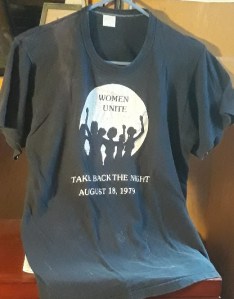
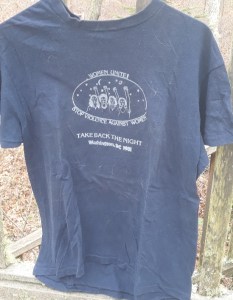
I’ve got three Take Back the Night T-shirts, two from particular events (the ones with dates on them), one more general. The 1981 march in D.C. I must have attended. I’m not sure in what city the 1979 event took place, or how I came by the T-shirt. In 1979, there was a Take Back the Night march in D.C. I definitely attended and it definitely had a T-shirt, but not long after the event I donated mine to the Lesbian Herstory Archives.
Nevertheless, I can see it in my mind’s eye: a big black women’s symbol set on the diagonal, with words clustered around it, all on an orange background. Halloween colors. I don’t remember what the words said. They probably included the date, but I don’t remember that either. The event left such a bad taste in my mouth that I was never going to wear the shirt, so I gave it away.
If you have any info on where this march took place, please let me know! Text: “Women Unite! Take Back the Night, August 18, 1979.”
The organizers had bitterly debated what role men should play in the march. I and most of my lesbian-feminist friends opposed male participation: didn’t it send a message that women needed male support to “take back the night”? The counterargument was that straight women wouldn’t participate if men were excluded. Those opposed to male participation were generally white, lesbian and/or radical feminist, and relatively new to D.C. Those advocating for it were generally black and straight and had deeper roots in the community. The upshot was that men were welcome to join in.
At the event itself, a contingent of black men either worked or pushed their way to the head of the march: after-the-fact reports varied, and I was too far back in the line to see what was happening. However it happened, men wound up leading a march that was supposed to be about women empowering ourselves.
In the next few years I came to realize that what happened that night had its roots in the planning process, and even deeper roots in the explosive mix of racism, sexism, and heterosexism that few of us paid enough attention to and none of us knew how to deal with. Would things have worked out differently if all the lesbians hadn’t been white and all the black women hadn’t been straight?
I wish now that I had kept that T-shirt. If I wore it today, people might say, “Cool shirt! Where did you get it?” None of them would likely know the backstory, and if anyone did — well, I’d want to know what they remembered and what their perspective on the whole thing was, then and in retrospect. What side they were on wouldn’t matter much. If I could teleport back to 1979 with my 2021 consciousness intact, I wouldn’t be standing in exactly the same place either.
That 1979 march taught me plenty, though it took a few years for the lessons to sink in. It’s possible to give something away without letting it go.[2]
I was learning that it wasn’t just the night that we needed to take back, or, more accurately, claim for the first time. Around that time I was volunteering with the Lesbian Resource and Counseling Center (LRCC), the only woman-specific program of the Whitman-Walker Clinic.[3] In these pre-AIDS days, the clinic was one step up from a shoestring operation. Its flagship program was the Gay Men’s VD Clinic, and the vibe was overwhelmingly male.
The LRCC did peer counseling, provided referrals, and hosted a rap group. The clinic administration had agreed that on LRCC nights the clinic space would be women-only, but it was not unusual for the rap group to be interrupted by men lugging in tables and other supplies from that night’s VD clinic, which rotated among the various men’s bars and baths. When confronted about this, one guy’s surly response was typical: “Don’t forget who brings in the money around here.”
Text: “Women Unite / Stop Violence Against Women / Take Back the Night / Washington, DC 1981”
At the LRCC I did pretty much what I’d done at the Washington Area Women’s Center: staff the phone and lead rap groups. I wasn’t involved all that long, however, although I enjoyed the work. More and more I was focusing on the written word, writing and editing; other interests were falling by the wayside. I was contributing fairly regularly to off our backs and the Washington Blade, the D.C.-Baltimore area’s gay newspaper. At the Blade it gradually became apparent who was in charge and whose inclusion was strictly conditional.
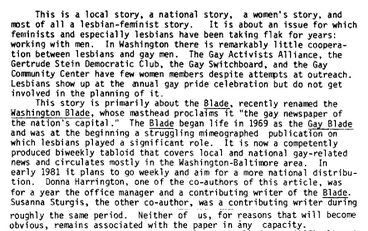
Donna J. Harrington and I recounted our experiences in “The Dulling of the Blade,” a lengthy story published in the December 1980 off our backs.[4] Donna had been the Blade’s office manager and a contributing writer for about a year. I had been a contributing writer during roughly the same period, recruited at a time when the gay-male-run paper seemed eager to include lesbians.[5] Over the months, this eagerness deteriorated into hostility that was often blatantly sexist. In researching the story, Donna and I learned that our experiences were not unusual among lesbians working in gay-male-dominated organizations. These outfits had a lot in common with those run by straight men.
The opening two paragraphs from “The Dulling of the Blade”
The editor in chief denied that sexism was an issue; he attributed all problems to “individual personality clashes.” Donna and I disagreed. We concluded “that the gay men who run the Blade have serious problems with lesbian-feminists, and we have come to suspect that they do not believe that lesbian-feminists have enough ‘clout’ to make working with them worth precious male time. Their common response is to get rid of the women who make them uncomfortable. Donna and her predecessor at the Blade and D–– S–– when she was at Philadelphia Gay News had a common experience: as they became more radical, more assertive about feminist issues, and more closely identified with the women’s community, their relationships with their gay male colleagues disintegrated. Their competence and commitment abruptly came under attack.”
Clearly it wasn’t just the night that women needed to take back, and it wasn’t just straight men who were the problem. I didn’t have the patience to deal with them, or much interest in developing the skills necessary to do so. (Many years later, a girlfriend said, with a hint of exasperation, that I had “a complete absence of gush.” I was, and still am, rather pleased with this, but sometimes it does get in the way.)
Before “The Dulling of the Blade” appeared, I was getting more and more frustrated with my job as an editor in the Red Cross publications office. I loved the work. I loved the commute. I loved most of my colleagues and how well we worked together — with one exception. Go back to “1979: I Become an Editor” and you’ll recognize him immediately: Frank. Except it wasn’t so much Frank the individual: in small doses and with the right light, he provided plenty of roll-your-eyes hilarity to compensate somewhat for his incompetence. What grated on me was that he was getting away with it because the American Red Cross was letting him get away with it. Friends who worked in comparably big bureaucracies had comparable stories about incompetent, invariably male co-workers. Big bureaucracies and I were not made for each other. In the spring of 1981 I gave notice; my last day was in late May.
I planned to take a few weeks off, focus on my writing, and then decide what next. “What next” appeared sooner than expected, at my 30th birthday in early June. Watch this space: it’s coming.
If you want to leave a comment and don’t see a Leave a Reply box, click the title of the post and then scroll to the bottom.
Notes
[1] The women’s dorms were on the campus periphery, much closer to Georgetown University Hospital than to the library, classroom buildings, and other centers of student life. Why? You guessed it: because until very recently the overwhelming majority of female Georgetown undergrads were in the nursing school. At night, the walkways were mostly deserted. Co-ed dorms were late coming to conservative, Jesuit-run Georgetown. One argument in their favor was that the two isolated women’s dorms made female students easy targets for predators.
[2] It would be another decade before Kimberlé Crenshaw introduced the word intersectionality, to underscore how our identities are multiple, and how the various components can both complement and contradict each other in myriad ways. However, the concept had been out there for years, and not surprisingly it was feminists of color who were in the forefront of developing it. See for instance the classic “Combahee River Collective Statement,” written by a Boston-based collective of Black feminists in 1977, first published the following year, and never more important than it is today.
[3] In the decades since, the clinic has gone big-time as Whitman-Walker Health. In the 1980s the HIV/AIDS crisis pushed other issues — and lesbians — to the periphery, but it seems that from about 1990 onward Whitman-Walker recommitted itself to “close that gap by providing comprehensive and inclusive care for the lesbian, bi, and queer women’s community” by instituting its Lesbian Services program. By the way, the Whitman in the organization’s name honors, you guessed it, Walt Whitman. The Walker is for Dr. Mary Walker, who wasn’t as far as I know a lesbian or even especially woman-identified but who was a woman pioneer in the medical field.
[4] “The Dulling of the Blade” is archived on JSTOR, along with all of oob’s back issues. “Independent researchers” can read up to 100 articles a month on JSTOR if you sign up for a free account. The access URL for the article is http://www.jstor.org/stable/25773405.
[5] I’ve heard this attributed to the vulnerability gay men were feeling in the late 1970s. Anita Bryant’s Save Our Children was in full cry, with white evangelicals at the forefront. A Dade County (FL) ordinance offering some protection on the basis of sexual orientation was overwhelmingly overturned by voters in a June 1977 referendum. In November 1978, Harvey Milk, the first openly gay elected official in California, was assassinated, along with San Francisco mayor George Moscone. By 1980, though, at least in D.C., mainstream (straight) politicians were showing up at gay (male) events, so white gay men felt more secure and hence, it seems, less in need of lesbian support. When AIDS (first known as GRID, Gay-Related Immune Deficiency) surfaced in 1981 and quickly became an epidemic, gay men pushed lesbian interests even further to the peripheries — while across the country and around the world many, many lesbians threw themselves into advocating for and taking care of their gay male friends and colleagues.
Like any self-respecting suburban/small-town kid I got my driver’s license as soon as I was old enough — 16 1/2 in Massachusetts if you’d taken driver’s ed — but I didn’t own a motor vehicle till I was 37, three years after I moved to Martha’s Vineyard. In D.C. I walked, took public transit, and rode my bicycle.
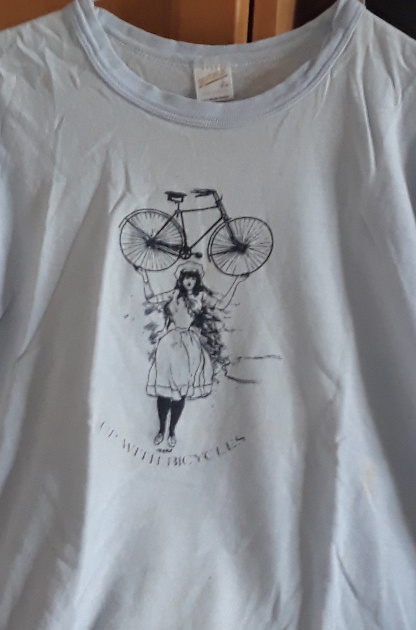
Neither of my bicycle Ts comes attached to a particular event. I got this one, “Up with Bicycles,” in my D.C. bike-commuting days, probably at Lammas Bookstore.
My bike, a blue Peugeot 10-speed, was my college graduation present to myself. I named her Blue Mist II, after the armored Rolls-Royce T. E. Lawrence rode in the desert during World War I.[1] In D.C. I thought of her as my “urban horse”: I was barely a decade out of horses at the time and had no idea that in my 40s I would get back in. I’ve got plenty of horse-related T-shirts and stories to go with them, but you’re going to have to wait awhile till we get there.
Biking to work at Red Cross National Headquarters, first from my Dupont Circle bedsit and then from group houses in the Mount Pleasant neighborhood (which is just north of Adams Morgan, which is just north of Dupont Circle), was easy. Google Maps tells me that my usual route, via 16th Street, was a little under three miles. In the morning it was mostly downhill. I still remember the visceral thrill of whizzing down 16th Street in rush-hour traffic, trying to avoid breathing too much bus exhaust, wearing a dress and (of course) no helmet.
On more than one Friday I biked home up 18th Street in dusk or dark after “processing the week” with colleagues in the rooftop lounge at the Hotel Washington. I was sometimes, I confess, a little tipsy when I set out, but the mostly uphill ride took care of that.
With my promotion to editor, my commute got longer: from Mount Pleasant to Old Town Alexandria by my route is a little over 11 miles. It was a great ride: bike path almost all the way, down into Rock Creek Park behind the National Zoo, a little maneuvering to get past the Lincoln Memorial and onto Memorial Bridge, then down the Mount Vernon Trail (whose official name I didn’t know when I was riding on it) all the way to Alexandria.
I made the round-trip by bike most days if the weather wasn’t awful. When it was, my public transit commute took about the same amount of time. Since Metrorail only went as far as National Airport at that point, the trip involved three transfers, one from the 42 bus to the Dupont Circle Metro station, one from the Red Line to the Blue Line at Metro Center, then a third from National Airport to the Old Town bus, whose number I don’t remember.
Washington was famously built on a swamp. Summers are hot and sultry. Thermal inversions are not uncommon: the exhaust from tens of thousands of cars hangs over downtown, visible to anyone who looks south from a higher elevation. Summer started in earnest not long after I was promoted to Publications, and I kept biking to work.
At the end of the day — quitting time was 4:45 p.m. — I’d be unlocking my bike and someone would ask, “You’re going to bike home? It’s a hundred and five degrees out.” I’d stop at the Lincoln Memorial, a little more than halfway, to drink at a water bubbler, splash my face, and soak my bandanna in cold water before tying it back around my head. (No helmet then either.) The last leg of my trip was by far the steepest uphill, out of Rock Creek Park up to my Mount Pleasant neighborhood. I could, and sometimes did, ride the whole way, going slower and slower till near the top bike and I were in danger of falling over, but more often I’d get off at some point and walk to where the terrain leveled off.
You’ll never guess where I bought this one! I probably got it when I was still an occasional visitor to the island, i.e., before 1985. Kennedy Studios, an art gallery and framing shop that still exists on Main Street, Vineyard Haven, offered at least one other version of this design, with sailboats instead of bicycles.
The morning commute wasn’t quite as hot, but biking more than 11 miles in the humid 80s would leave anyone in need of a shower. Trouble was, there was only one shower in the Eastern Field Office building, and it was located in the men’s room in the basement which was the level you entered from the parking lot where the bike rack was. The women’s room down the hall had no such amenities.
I and a couple of women who liked to run on their lunch hours successfully lobbied management to reserve the shower-equipped men’s room for women’s use for half an hour in the morning and half an hour at lunch. Nice idea, but in practice male employees would congregate outside the door at the restricted times, directing snotty remarks at us and complaining about having to wait to pee.
I gave up PDQ and went back to improvising a sponge bath in the women’s bathroom and changing out of my sweaty T-shirt and into more presentable office clothes. (My concession to being promoted into the professional ranks was to stop wearing T-shirts to work, which I had done on occasion in the training office.)
My other biking-related challenge was more momentous. In summer heat I was biking to Alexandria in rolled-up jeans. This was as clammy and uncomfortable as you can imagine. Why not wear gym shorts? you ask.
Why not indeed. Well, at the time I weighed over 200 pounds. I could wear men’s shirts, but men’s pants didn’t suit my shape so I had to buy pants in the plus-size women’s shops. In the affordable-price range these inclined to polyester and other unbreathable fabrics ill-suited to physical activity, so I stuck with jeans, which could be found in 100% cotton at any size.
I went looking in the plus-size stores for women’s gym shorts. They didn’t exist, not in Washington, D.C., at any rate, not at that time.[2] Plus-size women were presumed uninterested in or incapable of exercise. It didn’t take a Sherlock Holmes to deduce that plus-size women’s disinterest in exercise might have something to do with the lack of plus-size women’s exercise clothing. Plenty of men thought any fat woman riding a bike or jogging was fair game for their insults. They harassed thin women too, of course, but with wolf whistles and come-ons, not comments on how ugly they were.
In a sporting goods store I came upon a rack of men’s gym shorts that went up to XL. They looked like they might fit my hips. No way would I have tried them on in the store: that would have meant admitting that they were for me. I might even have mumbled to an inquiring clerk that I was buying them for a friend or a brother. I went out on a limb and bought three pair. I took them home and with trepidation tried them on, one after another. They all fit.
I loved those shorts. One was purple with yellow trim, one green with white trim, and I wish I could remember the third — blue with white trim sounds right, but I’m not sure. Being fat, I rarely wore shorts, period, so the rush of wind on my bare legs as I biked along the Potomac was a revelation. I felt immediate empathy with women of past and not-so-past generations as they shed corsets, voluminous skirts, and skirts so tight they practically locked your knees together.
The fat liberation movement was very visible in grassroots feminist and lesbian communities at the time. It freed me to take these issues seriously, and to look more closely at my own personal history with compulsive eating and getting fat, but the more closely I looked, the most pissed off I got. In an essay published in Lesbian Contradiction in its Winter 1983–84 issue, I wrote that “when I first discovered fat liberation literature, I felt so betrayed. I expected so much but found so many of my experiences dismissed as truisms, stereotypes, and self-delusions.” The essay takes off from that dismissal to warn against the temptation to formulate premature orthodoxies from women’s incredibly diverse experiences, which were being publicly articulated often for the first time.
About a year later my essay “‘Is This the New Thing We Have to Be P.C. About’” appeared in Sinister Wisdom 29. It too takes off from an incident involving fat and fat liberation, and goes a few steps further in exploring the notion of political correctness as understood by feminists and lefties at the time. (Before long, around the mid-1980s, the right wing got hold of it and turned it into an all-purpose slur against anyone who took sexism, racism, and social justice in general seriously.)
Looking back at these two essays from almost four decades later, I detect some clues as to why in mid-1985 I decided to leave the lesbian-feminist community and relocate to Martha’s Vineyard (for a year, mind you: just a year): as a fat woman and as a feminist who took fat liberation seriously but disagreed with its emerging ideology, I was feeling a little estranged from my community. But at the time, biking to Alexandria in gym shorts was wonderfully liberating.
Technological aside: Living in the District and working in Alexandria posed a problem. My bank, Riggs, was in the city, and “bankers’ hours” were still the rule: banks were only open weekdays from 9 a.m. to 3 p.m. Either ATMs (automatic teller machines) arrived in the nick of time (which is how I’ve remembered it all these years) or thanks to my new circumstances I realized how useful they could be (now that I’ve read up on the history of ATMs in the U.S., this seems more likely). I used them to deposit paychecks and obtain cash. What I don’t recall is what these ATMs required in the way of identification. Major credit cards were hard to get, and I didn’t have one.
However, in 1979, probably in the spring, my group household moved from the 1700 block of Kenyon NW to the 1700 block of Kilbourne. The move was complicated by the fact that only one of us had a credit card, it was maxed out, so we couldn’t rent a truck — and none of us had a car either. Thanks to the generosity of friends, we managed to move all our goods and furniture from one block to the next in a vehicle brigade that went on most of the day. That decided me: It was time to get myself a credit card.
In those days, major credit cards were not easy to get. Tempting offers did not arrive regularly in the mail. I followed the usual route: using my checking account and puny savings account as reference, I obtained the card offered by my bank. It’s plausible that ATM access was a more pressing motive to acquire a credit card than the knowledge that eventually I would move again and need to rent a truck. If plastic wasn’t required, how did one identify oneself to the cash-dispensing machine? I have no memory of what I actually did while standing at the ATM. If you were around at the time and remember how it actually worked, please drop a hint in the comments.
[1] In 2017 the original Blue Mist, a Rolls-Royce Silver Ghost, made headlines when a team of historians managed to trace the car’s history. That story is told in “Historians Discover the Identity of Lawrence of Arabia’s Rolls-Royce.” Note that the dateline on this July 5, 2017, story is Alexandria, Va. Here’s the tale as wittily told, with photographs, by a descendant of one of the pre-war owners: “Blue Mist – How Lawrence of Arabia Nicked Granny’s Roller.” An earlier pre-war owner went down with the Titanic. After the end of the war, the car was sold to an Egyptian businessman. So far it’s been lost to history. In the summer of 2017, however, it was reported that a couple of Rolls/Lawrence fans in Vermont were building a replica of Blue Mist, with completion expected in 2018. I haven’t found any updates on that either, but if/when I do, I’ll update this blog post. A replica was used in the 1962 film Lawrence of Arabia, but I don’t know how exact a copy it was. For sure it looked the part!
[2] The situation started to improve in the following decade and has improved plenty since then.
This version is unusual for its blue edging at sleeves and neckline. I have no other Ts of this style.
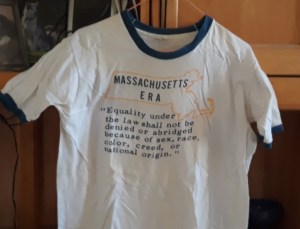
In late spring or early summer of 1976 I started volunteering for the campaign to ratify the Massachusetts Equal Rights Amendment. I’ve got three T-shirts from it. The one with the white background didn’t circulate widely; it was an early draft, and the limited stock probably got handed out free to volunteers. The other two are the final version, with the text of the amendment on the front and “Vote Yes on #1” on the back. The text, now part of the state constitution, part 1, article 1: “Equality under the law shall not be denied or abridged because of sex, race, color, creed or national origin.”
Bus and trolley drivers often leaned in to read the text.
The green and the black ones got worn a lot. The paint splatters on the black one came from helping paint a friend’s guest bedroom in West Tisbury more than 10 years later. The only downside was that the large number of words in relatively small type gave bus and trolley drivers an excuse to stare at your boobs and pretend to be reading the text.
Although I’d encountered blatant sexism as a Georgetown University undergrad, I was still shocked by how controversial the ERA was, and how blatant the fear-mongering against it. A New York Times story from November 1, 1976, noted “rumors and feelings, vociferously denied by the supporters of the measure but nevertheless in wide currency, that the amendment will result in things like unisex public toilets, homosexual marriages and female draftees.”
Massachusetts did lead the country in legalizing same-sex marriage, but that wasn’t till 2004, a full generation after the ERA was added to the state constitution.
Then, as now, the news media routinely fell back on phrases like “vociferously denied by supporters of the measure,” but rarely refuted the antis’ claims with expert legal or historical opinion.
Massachusetts ERA campaign headquarters was on the walk-up second floor of the Women’s Educational and Industrial Union on Boylston Street, not far from the Public Garden and Boston Common. It was at least 75% workspace and at most 25% office: a desk for the campaign president and one for the one-woman clerical staff.
In memory, the workspace was dominated by a huge table (it might have been a humongous piece of plywood resting on several sawhorses), on which were spread out the raw materials for statewide mailings. These days massive mailing lists are saved out of sight on computers. Sorting by zip code -‑ necessary to qualify for the bulk-mail rate if you’re using the U.S. Postal Service — can be done in seconds. Not so in 1976. In 1976 the mailing list had to be typed on letter-size paper and formatted so it could be photocopied onto mailing labels. Each sheet of paper contained addresses from the same zip code, and the most common zip codes each had their own folder.
Think about it. New names coming in — and they were coming in all the time, especially after an event was held or an ad appeared in the paper — couldn’t be seamlessly added to the existing list. The only way to recognize duplicates, or obvious errors, was by eyeball.
By election day I knew most of the zip codes in Massachusetts by heart. If a label said “Boston, MA 01108” I knew at once that something was wrong. (01108 is in Springfield. 02108 is in Boston — Beacon Hill, to be precise.) Most often it was the zip.
I did most of my volunteering in the office, but I also ran occasional errands, like driving to New Hampshire to pick up a print job. Because my family had a summer place on Martha’s Vineyard, I helped out at an ERA fundraiser at the Field Gallery in West Tisbury; somewhere lost in my boxes of stuff may still be a photo I took of singer-songwriter James Taylor sitting on the stone step at the back of the gallery. On Election Day 1976 I was passing out “Vote Yes on Question #1” literature at a polling place in the Back Bay, where I got to meet both Elaine Noble, who was running for re-election as the first out lesbian or gay member of any state legislature in the country, and Barney Frank, who then represented a neighboring district in the state House of Representatives -‑ and was not yet out.[1]
That fall I started working part-time as a proofreader for the Town Crier Company: my first paid gig in the editorial field. The company, which published my hometown newspaper, the Town Crier, also did contract work. I was hired to work on a weekly newspaper they were publishing for Massachusetts law professionals.[2] This was an evening job. When I arrived for my shift, the newsroom and the offices in general were dark and deserted. It was just me; the typesetter, Jessie from Maynard; and Dave the production manager, who was occupied elsewhere in the building unless the hardware needed attention.
It’s the hardware that fascinates me most these days. (If you’re similarly intrigued, check out this site when you’ve got an hour or two to kill.) The technical side of publishing has evolved a lot in my lifetime, and I’ve had plenty of hands-on experience, especially with the shoestring-budget side of it. I’m old enough to have wrestled with mimeograph machines, been splattered with ink by a run-amok Gestetner, and laid out flyers with Formaline and presstype. So here’s what I remember of how I did my job in 1976–77.
Jessie the typesetter sat in the far corner of the large, utilitarian production room. I think the copy she relayed to me for proofreading was printed on plain paper. I fed the sheets into a phototypesetting computer. It had some OCR (optical character recognition — a term I learned later) capability, but it wasn’t hyper-precise so part of my job was to clean up the mess. My workstation had a video display screen, a QWERTY keyboard, and the characteristic IBM Selectric “golf ball” but one that produced what looked like an extended barcode under the letters. After I’d made my corrections, I hit a key, which produced a long tape with many holes punched in it. Each pattern represented a specific letter, punctuation mark, or other typographical instruction. Like this:
I then took the tape and threaded it through the CompuGraphic photocompositor, which was massive and gray and dominated its corner of the room. It produced film in a sealed container. This I took over to the developer, which looked like a big white washboard or sloping easel. What eventually came over the top of the easel/washboard was, voilà! a galley proof.
At this stage I sometimes spotted errors that had escaped my not-yet-eagle eye. I was learning, on the fly and without a supervisor, how to read like a proofreader: letter for letter, not word for word. As you might guess, the procedure just described was way too complicated and time-consuming to be repeated just to correct transposed words or letters, which is what nearly all of these errors were. So I’d go to the light table and with straight edge, X-acto knife, and Scotch tape correct the goof manually. I was pretty good at this, and the ability stood me in good stead through the coming years of laying out flyers with Formaline and presstype.
Correcting typos got much easier when I got my first PC in 1985, but CTRL-X,C,V and all the rest of it did not make my manual dexterity entirely obsolete. It wasn’t till the mid to late 1990s that desktop publishing technology made Formaline, presstype, and proportional scales largely obsolete (but as you can see, I’ve still got mine).
Notes
[1] Both were re-elected that year. In 1978, the house was shrunk from 240 members to 160, and the resulting redistricting threw them into the same district. Noble decided not to run again. She had taken a lot of heat not only as an out lesbian but as a staunch supporter of school desegregation, a very hot issue in Boston during the 1970s. By the way, the resizing of the Massachusetts House of Representatives cost both Martha’s Vineyard and Nantucket their seats in the legislature. This prompted a “Secede Now” movement, and I have a T-shirt to prove it. I’m wearing it in my profile pic. More about it by and by.
[2] This might have been the Massachusetts Lawyers Weekly, which still exists but which was founded in 1972. My recollection is that this was a startup modeled on something similar being published in New York. The Weston Town Crier, along with its siblings in Wayland and Sudbury, still exists in some form, but it seems to be published in Framingham and owned by Gannett.
If you don’t see a Leave a Reply block, go here and scroll down.








 The T-Shirt Chronicles