1987?–1993: Martha’s Vineyard Times

Two of the best jobs I’ve ever had fell into my lap. The first was book buyer for Lammas, D.C.’s feminist bookstore. The other was working for the Martha’s Vineyard Times. I wouldn’t have had the nerve to apply for either of them.

As my savings dwindled toward the end of my first year on the Vineyard, I started running a classified ad hiring out as a freelance typist. That got me a few short not-very-interesting gigs. More productive was my connection, through theater, with the Tisbury Printer. This led to several book-length editing jobs and editing and typesetting at least two catalogues for the Nathan Mayhew Seminars, a local nonprofit offering a variety of adult ed courses.

With my PC — Morgana, the first of five desktops that would bear that name — I could do pretty good cut-rate typesetting. I’d do the typing and formatting at home then take the disk (a 5 1/4 inch floppy) down to EduComp,[1] which was renting out time on its laser printers, and print out the copy. My girlfriend at the time, a talented graphic artist, did the paste-up. Before long, EduComp stopped offering this service because too many customers either messed things up or required too much hand-holding, but they made exceptions for me and a couple of others because we knew what we were doing. I was undeniably proud of being an exception.

Word got around that I was a competent typist with editorial capabilities. At a West Tisbury town meeting, the woman in front of me turned around and asked if I did freelance typing. I said I did. She turned out to be Eileen Maley, the Calendar/Community, i.e., features, editor of the Martha’s Vineyard Times. Their editorial typesetter was scheduled to have surgery soon and would be out for a few weeks. Would I be interested in filling in?

When I said yes, I probably sounded self-assured and confident. I wasn’t. Other than Eileen, whom I’d just met, I didn’t know anyone who worked at the Times or anything about their typesetting software. True to form, my imagination conjured a scenario where I’d be out of my depth and make a fool of myself. However, I’d made a similar leap of faith when I ventured into Katharine Cornell Theatre that first time, and that had turned out well. Maybe this would too?

The Times at that point was the upstart paper, having been founded in 1984 by five Vineyard businessmen as an alternative to the venerable (established in 1846) Vineyard Gazette. Reading only the Gazette, one might conclude that the year-round working island barely existed and that bad things never happened on Martha’s Vineyard; its subscriber base was mostly off-island from Labor Day to Memorial Day. Its coverage was so focused on its home base in Edgartown that Times people took to calling it “an Edgartown weekly.” Gazette staffers got back by referring to the Times as “the other paper.”

This not-always-good-natured rivalry went on for years. The Times was delivered free to every island post office or mailbox, a huge attraction for advertisers targeting a year-round audience. Naturally the Gazette retaliated with a full-page house ad featuring a trash can overflowing with discarded copies of the Times.

The Times office was nowhere near as elegant as the wood-shingled building that still houses the Gazette. When I first showed up to work, it was located behind Woodland Market on State Road in Vineyard Haven, in a long, low building that no longer exists. It once housed the Spaghetti Pot restaurant. The Spaghetti Pot was before my time, but rumor had it that the astonishingly red-orange carpeting in the newsroom was part of its legacy: had it perhaps been dyed with, or to resemble, spaghetti sauce?
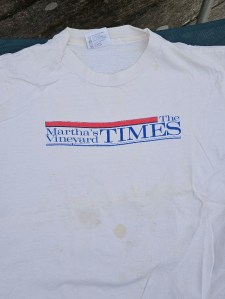
Sorry about the stains. If I ever learn to use bleach, I could probably make them go away, but that hasn’t happened yet.

The building’s midsection was the newsroom, with reporters’ and editors’ desks lined up along the windows, which commanded a view of the dusty parking lot. Eileen’s desk was at the front of the row, and mine, as the pinch-hit typesetter and eventually the on-staff proofreader, was at the end. The three desks between us were occupied by all but one of the reporters. The exception was Gerry Kelly, who held court in an executive-type chair at an oversize desk next to the wall at one end of the newsroom.

Dubbed by a journalist admirer “the greatest one-man band in the history of journalism,” Gerry was the Times’ lead reporter and also a mainstay of the Calendar section: every week he wrote the food column, often featuring island restaurants, plus a book review, plus, from Memorial Day till well into the fall, a couple of art gallery reviews. He turned out copy like yard goods — a wonder to me because I’m on the slow side: I can’t turn the internal editor off when I’m writing. My only way around this is to write in longhand. This works because my handwriting is so hard to read that the internal editor gives up and goes along for the ride.

Times baseball cap, front . . .

Sure, Gerry’s copy invariably needed at least some editing and/or fact-checking, but that was a small price to pay. When an ad was cancelled at the last minute, he could fill the hole. When an ad came in late, he could cut two or three or four inches out of a story that was already pasted up. He’d head into Production, non-repro-blue pen in hand, swearing “Not one word!” and do what had to be done.
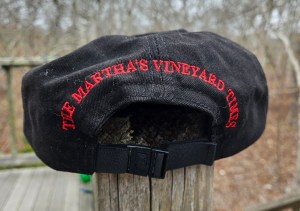
. . . and back. I’ve never been a baseball cap wearer, but I’ve still got mine.

A few years later, when I left the Times (for the first time) in the fall of 1993, Gerry paid me the supreme compliment: on my staff farewell card, he wrote “You saved me a year’s wear and tear on my dictionary.”

I customarily worked with my own copy of the American Heritage Dictionary open in my lap. The office Merriam-Webster’s was readily accessible on top of the long bookshelf in the middle of the newsroom but it was rarely consulted. Instead staffers would call out “Susanna, how do you spell . . . ?” or “What’s another word for . . . ?” and I would answer, usually without looking it up. Over the years more than one person remarked that I always had the dictionary open although I was the only person on staff who didn’t need one. My response: “That’s why I don’t need one.”

Behind me at the old office, in a rectangular room barely large enough for a desk and file cabinets, dwelt editor in chief Doug Cabral. A perk of this mini-office was that it had a door to the outside. Its door into the newsroom, which was almost always open, was barely an arm’s length away from where I sat. Since Doug could and did slip in and out with no one but me the wiser, one of my unofficial tasks was to relay news of his arrivals and departures to the rest of the staff.

Doug had his own wastebasket, of course, but he often dropped his candy wrappers in mine so his wife, who was monitoring his diet, wouldn’t see them.

After the Times moved to its current quarters at Five Corners in the fall of 1991, Doug’s office was on the second floor. He could leave the building through a rear door without passing through the large front room that housed the editorial, production, and advertising staff. So we rarely knew whether he was in the building or not, what he was doing when he was upstairs or where he went when he left.

At both the old building and the new, Wednesday was all-hands-on-deck deadline day. For many years, Joni Merry, a production staffer and also the West Tisbury town news columnist, would make lunch — all takers chipped in to pay for the groceries (usually $2 each) — then we’d all gather to eat around tables set up in the middle of the newsroom.[2]

At one of these sit-down lunches in the late ’80s, Don Lyons, former minister, current ad sales rep, sports editor, and by then Joni’s husband, leaned back in his chair and asked “Does anyone know the five rarest license plates on Martha’s Vineyard?” I can’t remember what five we came up with, or what Don’s five actually were. Now I could hazard you a good guess about Don’s five — they almost certainly included Hawaii, Nebraska, and North Dakota — because his question turned me into a license plate spotter. I’ve been playing ever since and have the annotated U.S. maps to prove it.

I’ve spotted North Dakota three years running at the Martha’s Vineyard Hospital Don would be amazed.

For many years, Don and I traded sightings. One summer we tag-teamed to track down a tour bus bearing a North Dakota plate that Joni had seen headed this way on the ferry: North Dakota was the rarest of the rare.[3] We figured it would be leaving by the end of the afternoon, but we couldn’t find out if it would be from Vineyard Haven or Oak Bluffs. So we stalked both docks whenever a boat would start loading for departure. Don finally spotted the bus in Vineyard Haven. By the time I arrived, Don had spoken with the bus driver — and learned that though the bus was registered in North Dakota, the tour group was from New Jersey. It counted nonetheless.[4]

Unlike the Gazette, the Times was printed off-island. Until digital transmission became possible toward the end of the ’90s, this meant that “the boards” — the pasted-up pages — had to be on the 5 o’clock ferry from Vineyard Haven. Since the Steamship dock was literally around the corner from the Times office, Doug was often out the door with barely minutes to spare, the big black portfolio case under his arm.[5]

This is from my last day of my first stint at the Times, in October 1993. It’ll give you an idea of what “the boards” looked like before the paper went completely digital by the end of the decade. (P.S. I did not usually wear dangly earrings to work.)

1991 was a big year for the Vineyard, the Times, and me. In the spring, Eileen Maley retired as the paper’s first Calendar/Community editor. Having been her unofficial apprentice and understudy for almost three years, I put in for the job. I’d been doing it for more than a week before Doug confirmed that I was now indeed the Calendar/Community editor and put my name on the masthead. He never put me on salary, however: I continued to submit a time sheet every week and get paid by the hour. Since I wasn’t full-time, I got no benefits. The upside was that when I was ready to move on, I didn’t have to worry about losing health insurance because I was already paying for my own major medical policy.

To be fair, the Times in those days was operating on something not much wider than a shoestring. Each Thursday morning the staff would meet to postmortem the issue just published and start planning the next week’s. At the end of the meeting, Doug would pass out paychecks, whereupon we’d extricate ourselves as gracefully as possible from whatever we were doing and race to our respective banks to deposit our checks. Not infrequently the late arrivals would learn that there were insufficient funds in the Times account to cover the checks. They were always covered eventually, but if you were on the brink of overdrawn yourself, the suspense was real.

Hurricane Bob arrived on August 19 of that year, and despite the many impressive storms that have followed, more than 32 years later it remains the last full-fledged hurricane to hit New England. Unlike most big tropical storms, Bob arrived at the height of “the season,” on Monday, August 19. The annual Agricultural Fair had just finished its three-day run at the old Ag Hall.[6] The summer hordes were still here.

Bob was a huge deal. Hurricane winds took out trees that hadn’t been seriously challenged since the nameless hurricane of 1938. The sound of chainsaws was heard throughout the land. Living up-island on a dirt road back in the woods, I was lucky: a nurse at Martha’s Vineyard Hospital lived nearby, so volunteer EMTs and firefighters came to clear the road so she could get to work.

The flip side was that our little area didn’t get its power back for almost 10 days. The Times office, however, was on a major trunk line and got its power back within hours. Those of us without power at home brought our perishables to work and we feasted for a couple of days. I washed my hair in the office sink more than once. Bees whose hives had been destroyed were everywhere. Outdoor cafés hung improvised bee catchers from hooks on the wall: plastic soft drink containers with sweet stuff inside. Buzzing bees sounded a lot like distant chainsaws.

Labor Day came and went, life returned to more-or-less normal, but 1991 wasn’t done with us yet: the No-Name Nor’easter[7] arrived at the end of October. The Times was just about to move into its new office at Five Corners, but Five Corners flooded even worse than usual and the just-laid floor of the newsroom was underwater and had to be replaced. Fortunately, the electric sockets and wiring had all been installed a foot above the floor so they weren’t affected. My main memory of the move: I was helping move a desk into place when Trip Barnes, whose trucking company was handling the Times relocation, apparently decided that women couldn’t hold up half a desk and tried to wrest my end away from me. The result was that it fell on my foot. No lasting harm was done to my foot, but my opinion of Trip took a hit.

The Times move to Five Corners put it right around the corner from Wintertide Coffeehouse, which had moved into its year-round home the previous January. The traffic back and forth was non-stop: Wintertide manager Tony Lombardi was in the Times office almost as often as I was at Wintertide. Wintertide had no advertising budget to speak of; I could put pretty much anything I wanted in the Calendar section, and assign freelancers to write profiles, previews, and reviews that I couldn’t do myself. I saw advocating for the island’s grassroots music, theater, and general creative scene as part of my job.

The high point of my Times career was almost certainly the Martha’s Vineyard Singer-Songwriter Retreats of 1992 and 1993, masterminded by Christine Lavin and brought to life by a cast of dozens, if not hundreds. The resulting recordings — Big Times in a Small Town from ’92 and Follow That Road from ’93 — are still available and still wonderful.

I resigned as Calendar editor in the fall of 1993, mainly due to burnout: after I left, what I’d been doing was divvied up two and a half ways. I’d never entirely stopped being the lead proofreader or a pinch-hit typesetter either. But it was still one of the best jobs I ever had.

. . . . .

Postscript: I returned to the Times toward the end of 1996 as a one-woman copy desk. I pitched the job — something I’d never done before and haven’t done since — because (1) they needed the help, and (2) the freelance book packager who had been responsible for about 3/4 of my income decided to pack it in and move to New Hampshire. I was slowly building up my freelance client base, but I couldn’t live on that income yet. I left again in mid-1999, having established enough publisher connections to have a reasonably steady income. I had also, however, bought myself a horse, which wouldn’t have been in anyone’s How to Make Ends Meet on Martha’s Vineyard guide. Much more about that later.

NOTES

[1] EduComp, the indispensable art and office supply and computer store at the head of Main Street, Vineyard Haven, closed for good in the fall of 2020. Sales had been declining thanks to online competition, and the onset of COVID-19 finished it off. Founder and proprietor Pat Gregory was murdered while hiking in California in 2014, but his family carried on in the years following.

[2] After the move to Five Corners, we actually had a lunch/break room, but it wasn’t big enough to hold everybody. The lunch custom continued, but more of us ate at our desks.

[3] In my first 30+ years of the game, I spotted North Dakota maybe twice, including that tour bus. It’s now showed up three years running, 2022, 2023, and 2024, always in the same place — behind the Martha’s Vineyard Hospital — and for several months in a row. Evidently a North Dakota resident is a travel nurse or doctor at MVH.

[4]  Don passed in August 2021, age 94. His obituary doesn’t mention the license plate game, but it’s still a fascinating picture of a remarkable man.

[5] Infrequently the boards would travel by air instead of sea. Doug usually made the drive to the airport, but I remember pinch-hitting once or twice. The airport was six miles from the office, so we couldn’t be quite so last-minute about finishing the last page or two.

[6] In 1991, the fair was still three days long, Thursday through Saturday, and took place at the “old Ag Hall,” now known at the Grange. It moved to the brand-new Ag Hall in 1995. In 1997 the first day of the Fair was drowned out by torrential rain, so Sunday was added to compensate. Sunday at the Fair proved so popular that the Fair has been a four-day affair ever since.

[7] The No-Name Nor’easter is better known as the Perfect Storm, after Sebastian Junger’s book of that title. The Perfect Storm (W. W. Norton, 1997) focused on the loss of the Andrea Gail, a commercial fishing boat out of Gloucester, with all six hands during the storm.

1984–87: Feminist Women’s Writing Workshops

I’d been writing for publication for several years before I decided that I needed something more. I was well enough educated, but as a writer I was largely self-taught. I belonged to Hallowmas Women Writers, a group of D.C. poets and writers that I’d helped form. It was a lifeline to my writer self, its members were doing interesting work, but all of us were engaged in other activities and I was discontented with the feedback I was giving as well as getting. As a fledgling editor, I’d benefited tremendously from working alongside someone who knew a lot more than I did and was willing to share. Were there comparable opportunities out there for women writers?

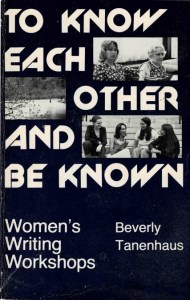
book cover

off our backs carried ads for the Feminist Women’s Writing Workshops (FW3), a 10-day live-in workshop held every summer in upstate New York. Founder-director Beverly Tanenhaus’s book about the workshops, To Know Each Other and Be Known (Motheroot Publications), came out in 1982. Lammas must have carried it, I must have noticed it, but I don’t think I’d actually read it. My copy has “July 1986” written under my name on the title page, which suggests I acquired it at the workshop that year.

I sent for the workshop brochure on February 5, 1984. Tuition, room, and board was $475, $425 if you applied by March 15. Could I afford it? Could I get 10 days off from Lammas in the middle of July? Where the hell was Ithaca, and how would I get there? I didn’t own a car, and my grasp of upstate New York geography was hazy.

Scariest of all, was I really ready? I didn’t know anyone who’d attended the workshop and could assure me that I wouldn’t be in over my head. The biggest risks I’d taken, like moving back to D.C., applying for that editorial job at the Red Cross, and becoming the book buyer at Lammas, had all turned out well. What if this one didn’t?

I sent in my deposit in time to get the early bird discount. My welcome letter from the director was dated March 16. The stars aligned, the logistics worked out, and I arrived by bus in Ithaca on July 15.

To say that the workshop was life-changing is both a cliché and an understatement. Our introductory session that first night opened with a recording from the first FW3 in 1975, of Adrienne Rich’s prose poem “Women and Honor: Some Notes on Lying.” This was already, and has been ever since, the closest thing I have to a bible. It’s about the importance of telling the truth to each other (and, by extension, to ourselves). What better way to challenge us as writers?

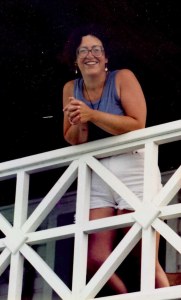
Me on the boathouse balcony just outside our meeting room. Probably 1987.

Our morning class sessions were held in the second floor of the Wells College boathouse, with Cayuga Lake glittering out the window and lapping gently at the shoreline. Each morning, an hour was devoted to the work of each of two participants. Copies had been distributed the previous day, and all of us came prepared. The guidelines: Comments were to be directed to the director, or to each other — not to the writer. The writer’s job was to listen until everyone had spoken, then respond at the end of the discussion. The power of 18 women focusing entirely on my work, taking it seriously for a solid, animated hour, was a revelation. So was the challenge of being one of the 18 women giving feedback to another writer, overriding the voices in my head whispering things like What if I’m wrong? What if I’m missing something? What if this isn’t all that important?

The rest of the day was open. Most of us gathered for meals in the cafeteria — the luxury of not having to prepare our own meals wasn’t lost on any of us — but the rest of the time we went our own occasionally intersecting ways in ones, twos, and threes, walking in the woods, swimming in the lake, writing in our rooms, sitting under a tree or by the lake to write or read.

During the week groups of us took field trips to the National Women’s Rights Historical Park at Seneca Falls, which had opened only two years before, and the National Women’s Hall of Fame, or into Ithaca, to hang out at Smedley’s, the feminist bookstore (proprietor Irene Zahava had been a workshop participant in the past and has edited many, many anthologies of women’s writing over the years), and of course to eat at least once at Moosewood Restaurant.

Poet-novelist Marge Piercy was the guest writer that year, in residence for a couple of days. We also heard from Elaine Gill, co-principal of Crossing Press, then located in nearby Trumansburg, and Nancy Bereano, who had edited Crossing’s Feminist Series and was just then establishing her own Firebrand Books, which quickly became a major player in the feminist print world.

As the re-entry meeting began on the last night of the workshop, I was feeling sad and euphoric, hopeful and apprehensive all at once. We had created magic; would I ever see these women again? As a writer I felt validated and capable; could I maintain my momentum when I got back to D.C.? We went round the circle, each woman sharing what she was going back to and what she was taking home with her. All of us had taken to heart the words of Adrienne Rich at our very first meeting: “When a woman tells the truth she is creating the possibility for more truth around her.”

Almost all of us, as it turned out. About two-thirds of the way around the circle, the workshop blew up. There were four lesbians at the workshop that year, of whom I was one. At the re-entry meeting, the other three charged the rest of us with making them feel unwelcome. They didn’t target me specifically — they didn’t target anyone, and were rather short on specific examples — but I was undeniably on the wrong side of a lesbian-straight split.

After the instigators left the room, most of the rest of us came together to talk about what had happened. We shared our immediate reactions. Most of us tried to identify what we had done to make the three women feel unwelcome. As the only lesbian in the circle at that point, I said I hadn’t felt unwelcome at all. I was a little surprised by this, because I was no stranger to the tensions that sometimes arose between lesbians and straight women in feminist spaces.

The D.C. lesbian feminist community and the national Women in Print network had become my home in a way that my growing-up home wasn’t. They were where and how and why I became a writer: developing my skills, giving me no end of things to observe and think and write about, seeing my words in print, and providing an audience (which I was also part of). So though I did spend time with the other lesbians at the workshop, hanging out with them wasn’t a priority. Connecting with sister writers was. Being taken seriously as a writer was.

Our shared effort that night to come to grips with what had just happened, speaking first-person and from the heart, was rare in my experience — so rare that in the months that followed I wrote a 6,000-word essay (never published) about the workshop experience. I still have the copy I shared with another workshop participant, with her extensive and thoughtful comments on it: she agreed with some of my points, challenged others (sometimes strenuously), and expanded my perceptions of what had happened.

I was willing then, and I’m willing now, to believe that the other three lesbians had experienced lesbophobia at the workshop, even though I had not. My problem then and now was with how they chose to bring it up, starting with the timing. The second-to-last night of the workshop had been devoted to a “creative bitching” session. We talked about what worked at the workshop and what could be improved in the future. Rather than bring their issues up then, the three chose to bring up their complaints at the re-entry session, our last time together as a group. Everyone would be leaving the next day. The three timed their confrontation so they wouldn’t have to deal with its consequences, or even see any of us face-to-face again. Then they walked away from the possibility of expanding truth to include all of us.

In an article about FW3 1986 for Hot Wire, the women’s music and culture journal, I wrote: “Perhaps the hardest lesson to learn is that inclusion in community here depends largely on a willingness to risk telling and hearing the truth — a willingness that is, not coincidentally, essential for feminist writing” (Hot Wire, March 1987).

I learned later that the main instigator of the confrontation had lobbied for a position as an assistant workshop director for the following year and been turned down. Was revenge at least part of her motive? I suspect so. As it turned out, the director asked me to be one of her assistants the next year, which enabled me to attend the workshop free of charge. Of course I accepted, and continued as an assistant through 1987. By the summer of 1988 I’d been hired as proofreader at the Martha’s Vineyard Times so taking 10 days off in the middle of July was out of the question.

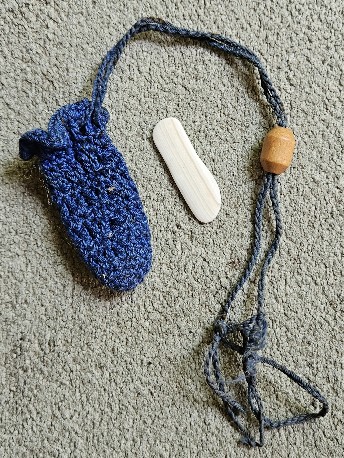
I still have that amulet bag, but my amulet has long since lost its purple. Tina M., if you read this, I remember you!

Before I left for my annual end-of-summer visit to the Vineyard in 1984, my first workshop year, a crafty (in more ways than one) member of Hallowmas Women Writers gave me an amulet bag she’d crocheted for me. For a while I wore that amulet bag around my neck with nothing in it. Then while I was walking on South Beach one afternoon an oblong bit of white-and-purple clam shell caught my eye. Into the amulet bag it went. When I returned to D.C., I wore it everywhere.

For a long time I liked to attribute my decision to move to Martha’s Vineyard to that amulet. There was, need I say, more to it. For years the lesbian feminist community and my writing had fed each other, confirmed each other, formed a dynamic whole. In the early ’80s fissures were growing just below the surface. In the early to mid 1980s AIDS, a barely identified syndrome with a dismal prognosis, was devastating the gay male community. Meanwhile, the lesbian community was polarizing around the so-called sex wars. The front lines included pornography and s/m, which one side saw as irredeemably misogynist and the other as liberating. Women I knew and admired were on both sides; the accusations were ugly and loud. As a writer I felt caught in a middle that was critical of both factions and wasn’t being heard. Did that middle even exist?

My experience at the 1984 Feminist Women’s Writing Workshop helped clarify and focus my uneasiness. If the community of lesbians and the community of writers diverged, my path would lie with the writers.

Looking back later, I realized that my urge to “get out of Dodge” had plenty to do with the Reagan administration, which altered the feel of D.C. whether you had any connection to the federal government or not. In July 1985, I left D.C. with all my belongings in a rental truck, deposited them in the basement of my parents’ home in the Boston suburbs, returned to the Feminist Women’s Writing Workshops for my first year as an assistant director, and by the end of the month was more or less living on Martha’s Vineyard.

Hot Wire & Ladyslipper

December got away from me, as it often does, but I’m back! My last few posts have focused on music, and this one does too.

I was down to the last two music-related T-shirts from my D.C. days and couldn’t figure out how to tie them together. Should each one maybe get its own short post?

Me in my Ladyslipper T in 2021. This design was “vintage” by the time I acquired it, probably after I started working at Lammas.. It’s unusual in my collection both for its long sleeves and its French cut. The long sleeves mean it gets worn regularly in spring and fall.

Then I got it: These two Ts, one from Ladyslipper Music and one from Hot Wire: The Journal of Women’s Music & Culture, both represent the national and international aspect of women’s music, but I had an up-close-and-personal relationship with both of them. I contributed a couple of articles to Hot Wire, including the one about the D.C. Area Feminist Chorus. At Lammas, I shared the upstairs office with Flo Hollis, a full-time Ladyslipper staffer, Lammas owner-manager Mary Farmer was a Ladyslipper distributor, and the code for the Lammas alarm system was Ladyslipper’s PO box number: 3124.

Turns out there was another close connection. Hot Wire has made all 30 of the issues it published between November 1984 and September 1995 available for free as downloadable PDFs, but rather than search each one for articles about Ladyslipper — I was 100% certain they had to have published at least one — I Googled. Imagine my surprise when the story I turned up had been written by me.

OMG. Turned out the date in that citation, May 1985, was wrong — Hot Wire didn’t publish an issue that month — but another reference to the same article had the correct date, March 1985. I downloaded the whole issue and read my own words from almost 37 years ago.

From Hot Wire, vol. 1, no. 2 (March 1985)

No question, it sounds like me. Many of the details came roaring back from my memory; others I’d never forgotten. Some of it I had no recollection of at all. What impresses me the most going on four decades later is the account of how the Ladyslippers dealt with a complete communications breakdown among the three full-time staff members in the winter of 1982–83. “What often happens in such situations,” I wrote, “is that one person leaves, and the level of tension drops for a while.” But at Ladyslipper, as staffer Sue Brown noted, “everyone was too stubborn to leave.”

So they went into counseling as a group. As I wrote, “They were not prepared for the speed and intensity with which issues came to the surface.” In retrospect, Liz Snow described the experience as “shocking.” They continued in counseling for “about ten months.” No one abandoned ship. Ladyslipper did not fall apart; it continued to develop as a major force in the women’s music and culture scene for as long as there was one.

By then I’d had plenty of experience with groups that foundered on their inability and/or unwillingness to work things through. I’d left the Women’s Center collective because the group dynamics were driving me crazy and I had no idea what to do about it. So Ladyslipper’s example was an inspiration: with hard work and, most likely, some help from the outside, we could get through the rough places.*

Fans of Dykes To Watch Out For will immediately recognize the image as the work of Alison Bechdel, who went on to international fame as the author of the graphic memoir Fun Home and other works. We really did know her when.

Which brings me back to those 30 issues of Hot Wire, all available for free download. What a treasure! They’re indispensable, sure, for anyone interested in the stars and rising stars of the women’s music scene of the 1980s and ’90s, but note how many articles are devoted to how-tos and behind-the-scenes movement building. We were starting from scratch in those days, pretty much building the plane as we were flying it, because there were so few experts to learn from.

At the same time, we knew we hadn’t come out of nowhere. Enough others had tended enough fires to leave sparks. It’s a relief to know that the fires are still being tended, and the sparks are still out there, like fireflies on a summer night.

If you want to leave a comment and don’t see a Leave a Reply box, click the title of the blog post (above) and then scroll to the bottom.

notes

* I don’t need to say (do I?) that these problems are not unique to feminist groups. After I moved to Martha’s Vineyard, I found no shortage of examples of groups that either fell apart or drove some of their most valuable members out. Not infrequently those who left would start a new group whose purpose duplicated or overlapped with the old. When the Vineyard finally discovered AIDS, around 1990, it became apparent that various complementary organizations either weren’t aware of or weren’t on speaking terms with each other. More about that later.

Introduction

I’ve got 190 T-shirts. If I wore one a day every day during T-shirt weather, it would take more than two years to wear them all. It’s never come close to happening. No one needs 190 T-shirts, right?

What if I said that these T-shirts date back to 1976, which is to say more than half my life, and that they chronicle the twists and turns that my life has taken since, well, 1976?

And touched on many events and movements of interest to the wider world?

The other day I took them out and tried to sort them into chronological order. They weren’t into chronology. Some of them insisted on sorting themselves by theme, even if they’d come into my life decades apart: feminism, lesbian community, demonstrations, science fiction, writing, editing, bookselling, music, horses, dogs, Martha’s Vineyard . . .

They weren’t into chronology . . .

I couldn’t ignore the shimmering lines where one shirt reached out to another, and often several others, sometimes over two or three decades, sometimes making connections I hadn’t anticipated. My T-shirts were hyperlinked. They wouldn’t fall into a straight line. Whatever shape they agreed to would have to be multi-dimensional.

Over the years quite a few people have suggested making a quilt — or, since sewing patches on jeans and buttons on shirts is all I can do with needle and thread, commissioning someone else to make a quilt. They’ve got a point. I’ve seen beautiful quilts that commemorate histories, personal and otherwise. But I don’t need another quilt, nor do I have wall space to hang one that’s purely decorative.

Besides, quite a few of my T-shirts come attached to stories that couldn’t be contained in a quilt square, and not infrequently those stories overlap. How would any quilter know what my shirts have to say about each other, and about me, without me standing by and pestering her with commentary? I’m a writer, not a quilter. I should be writing the stories, not dictating them to someone else. (Yes, I do know quite a few women who both quilt and write.)

Not to mention — T-shirts are meant to be worn. Which brings me round to why I glommed on to T-shirts in the first place. Here’s the story I’ve been telling myself:

Through my late teens and well into my early thirties I was fat. I’ve never been thin, but in those years I was fat enough to have to buy most of my clothing in plus-size stores. I knew nothing about fashion and cared less, and in any case, in those days the notion that a woman could be both fat and fashionable was oxymoronic. Fat women were supposed to dress to make ourselves unobtrusive, for instance by wearing dark colors and/or vertical stripes. Dark colors and/or vertical stripes don’t make you unobtrusive; they make it look like you’re trying to look unobtrusive — to efface if not erase yourself. To apologize for the space you were taking up.

My sartorial tastes ran more to denim and flannel. Relatively late in life it dawned on me that since I was about 12, I’d been arranging my life so I could dress as if I worked in a barn — which I did through my teen years and again through my fifties (we’ll get to that eventually). College campuses fit the bill, as did the antiwar and women’s liberation movements. I like to think that I went through the early to mid 1970s wearing only jeans and blue work shirts, but this could not possibly be true: I only had two or three of each, I didn’t do laundry all that often, and though I’m casual to a fault, grunge has never been my style.

Whatever I wore, though, it was not meant to draw attention to my body. I was not the least bit shy, however, about drawing attention to my political proclivities, which were made obvious by what came out of my mouth and what I put down on paper, and by my political buttons. When I imagine myself in those years, what I see is a stocky (to put it politely) woman of average height, with unruly (again, I’m being generous here) brown hair, wearing jeans, a baggy shirt, and an assortment of political buttons. The buttons identified me; to some extent they even spoke for me, though I was always ready, willing, and able to back them up with words.

My theory is that in the late 1970s, T-shirts supplanted buttons as my preferred way of announcing myself. They were colorful, they were cheap, the sizing was predictable, and they relieved me of having to shop. The blouses available in the plus-size stores weren’t me at all, and men’s sizes have never agreed with either my breasts or my hips — apart from T-shirts, of course, which in those days didn’t try to be form-fitting. So one shirt led to another, and another, and another. Even now they keep coming, no matter how often I say “Not one more!”

My wardrobe has diversified somewhat over the years, but T-shirts remain my go-to warm weather wear and on Martha’s Vineyard, where I’ve lived for the last 35 years, it’s absolutely OK to dress as if you work in a barn, or on a farm, or in a garden — which quite a few of us do.

Though T-shirts were an inextricable part of my life, and at some point in some circles I became somewhat notorious for my T-shirts, I never thought of using them to chronicle my personal history. Then, for my 50th birthday party, in June 2001, I hung 25 or 30 of my T-shirts around the living room to represent my previous two and a half decades. I loved the way they communicated with each other displayed side by side, out in the open. My party guests, almost none of whom had known me for more than five or six years and some of whom were barely half my age, were fascinated. They asked questions. I answered with stories.

I’m pretty sure that’s where the idea of the T-Shirt Chronicles took root. For many years it gestated underground. Eventually I started saying out loud that it was something I meant to do “one of these days.” Once I discovered social media and started blogging, the blog seemed the ideal format for it. Now “one of these days” has arrived.

If you don’t see the Leave a Reply box, go here and scroll down.