Apart from the cool slogan and great design, this shirt is distinctive for a couple of other reasons. I don’t have any other shirts in this color (what is it? “rust”?), and it’s one of the few I have in what used to be called “French cut” and now seems to be “women’s,” as opposed to “unisex.”
No, I wasn’t on the 1978 American Women’s Himalayan Expedition to Annapurna. I’ve never had any desire to climb anything that required more than the ability to walk upright. I first learned about the expedition when expedition leader Arlene Blum’s gorgeous book about it came out in 1980. Though the story went places I’d never been, it started in instantly recognizable territory: with the sexism and outright misogyny of the male mountain-climbing elite. I also recognized the powerful determination of women adepts in any male-dominated field to show the men that they are wrong.
I bought the T-shirt when Dr. Blum spoke in D.C. What year was it? I don’t remember, but I’m guessing 1981. Where did she speak? I don’t recall that either. Was I already working at Lammas then? I’ll only know that if I can find an exact date for the event, but my memory thinks I attended with Lammas owner Mary Farmer, which would explain how I knew about the event. For sure it didn’t take place at the shop, whose 400 square feet of selling space were far too small for talks and readings. Where did it take place? Once again I’m drawing a blank.[1]
My indelible memory is of Arlene Blum herself, or, more accurately, of my impression of her. In my mind’s eye she has long wavy dark hair, as she does in the Annapurna photos. She is tall, but she seems dressed to look smaller and younger than she is, in a purple and black dress that stops several inches above her knees. She’s trying to look like a schoolgirl, I thought at the time.
Which probably wasn’t her intent, and her dress may not have been purple and black either, but that’s what struck me: this physically and emotionally strong and highly intelligent (she had a doctorate in biochemistry) woman seemed to be downplaying all the traits that made her achievement possible. I’m guessing that she wasn’t nearly as comfortable with the whole book tour routine as she was organizing expeditions, climbing mountains, and doing research — building and leading teams rather than speaking to strangers whom she’d never see again.
By this time, I’d read and devoured Adrienne Rich’s collection The Dream of a Common Language: Poems 1974–1977. I know this for sure: I wrote my name and “Sept. 78” on the flyleaf of the book, a trade paperback that split along the spine maybe three decades ago from repeated readings. It includes Rich’s 1974 “Phantasia for Elvira Shatayev,” written for the leader of an all-women team that perished in a storm on Lenin Peak in August 1974. Narrated in Shatayev’s voice after death, it includes lines from the diary she wrote while she was living, like these:
Now we are readyand each of us knows it I have never loved
like this I have never seen
my own forces so taken up and shared
and given back
After the long training the early sieges
we are moving almost effortlessly in our love[2]
Visiting Arlene Blum’s website just now, I noticed a link for “Peak Lenin” in the Mountaineer section. The year was 1974. The coincidence of place and year gave me goosebumps, but the accompanying slide show was even more startling: Arlene Blum and her climbing buddies and Elvira Schatayeva and her team, along with other mountain-climbers, were all at base camp at Peak Lenin at the same time. Arlene was almost caught by the same storms that killed the Russian women. The slide show includes images of Elvira, known to her friends as Eva.
A cable of blue fire ropes our bodiesburning together in the snow We will not liveto settle for less We have dreamed of this
all of our lives
If you want to leave a comment and don’t see a Leave a Reply box, click the title of the blog post (above) and then scroll to the bottom.
notes
[1] To further confuse my already flummoxed memory, I just Googled Arlene Blum Annapurna Washington Post. This turned up a Washington Post story from December 9, 1980, that had Blum in town for an American Alpine Club meeting. This would have been shortly after the book came out. Did she give a public talk then, and did I attend it? If so, I definitely wasn’t working at Lammas, and it might explain why my sketchy memory of the venue doesn’t ring any bells. Another story, from April 1983, refers to a lecture Blum has just given, but it and the article itself focus on her 2,000-mile trek from one end of the Himalayas to the other. The talk I attended was definitely about Annapurna, so I’m pretty sure it wasn’t that one.
[2] Both this and the quote at the end are from Adrienne Rich’s “Phantasia for Elvira Shatayev,” in The Dream of a Common Language: Poems 1974–1977 (New York: W. W. Norton, 1978).
Like any self-respecting suburban/small-town kid I got my driver’s license as soon as I was old enough — 16 1/2 in Massachusetts if you’d taken driver’s ed — but I didn’t own a motor vehicle till I was 37, three years after I moved to Martha’s Vineyard. In D.C. I walked, took public transit, and rode my bicycle.
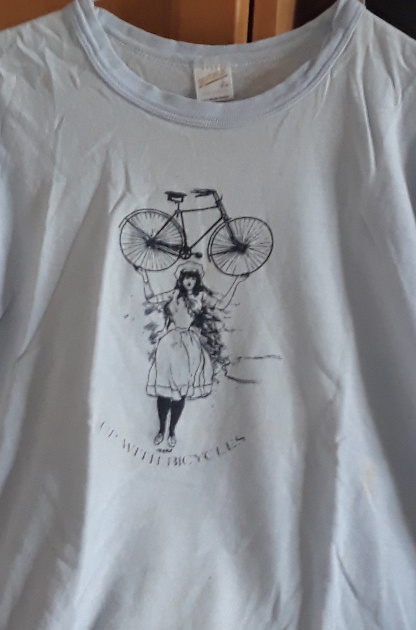
Neither of my bicycle Ts comes attached to a particular event. I got this one, “Up with Bicycles,” in my D.C. bike-commuting days, probably at Lammas Bookstore.
My bike, a blue Peugeot 10-speed, was my college graduation present to myself. I named her Blue Mist II, after the armored Rolls-Royce T. E. Lawrence rode in the desert during World War I.[1] In D.C. I thought of her as my “urban horse”: I was barely a decade out of horses at the time and had no idea that in my 40s I would get back in. I’ve got plenty of horse-related T-shirts and stories to go with them, but you’re going to have to wait awhile till we get there.
Biking to work at Red Cross National Headquarters, first from my Dupont Circle bedsit and then from group houses in the Mount Pleasant neighborhood (which is just north of Adams Morgan, which is just north of Dupont Circle), was easy. Google Maps tells me that my usual route, via 16th Street, was a little under three miles. In the morning it was mostly downhill. I still remember the visceral thrill of whizzing down 16th Street in rush-hour traffic, trying to avoid breathing too much bus exhaust, wearing a dress and (of course) no helmet.
On more than one Friday I biked home up 18th Street in dusk or dark after “processing the week” with colleagues in the rooftop lounge at the Hotel Washington. I was sometimes, I confess, a little tipsy when I set out, but the mostly uphill ride took care of that.
With my promotion to editor, my commute got longer: from Mount Pleasant to Old Town Alexandria by my route is a little over 11 miles. It was a great ride: bike path almost all the way, down into Rock Creek Park behind the National Zoo, a little maneuvering to get past the Lincoln Memorial and onto Memorial Bridge, then down the Mount Vernon Trail (whose official name I didn’t know when I was riding on it) all the way to Alexandria.
I made the round-trip by bike most days if the weather wasn’t awful. When it was, my public transit commute took about the same amount of time. Since Metrorail only went as far as National Airport at that point, the trip involved three transfers, one from the 42 bus to the Dupont Circle Metro station, one from the Red Line to the Blue Line at Metro Center, then a third from National Airport to the Old Town bus, whose number I don’t remember.
Washington was famously built on a swamp. Summers are hot and sultry. Thermal inversions are not uncommon: the exhaust from tens of thousands of cars hangs over downtown, visible to anyone who looks south from a higher elevation. Summer started in earnest not long after I was promoted to Publications, and I kept biking to work.
At the end of the day — quitting time was 4:45 p.m. — I’d be unlocking my bike and someone would ask, “You’re going to bike home? It’s a hundred and five degrees out.” I’d stop at the Lincoln Memorial, a little more than halfway, to drink at a water bubbler, splash my face, and soak my bandanna in cold water before tying it back around my head. (No helmet then either.) The last leg of my trip was by far the steepest uphill, out of Rock Creek Park up to my Mount Pleasant neighborhood. I could, and sometimes did, ride the whole way, going slower and slower till near the top bike and I were in danger of falling over, but more often I’d get off at some point and walk to where the terrain leveled off.
You’ll never guess where I bought this one! I probably got it when I was still an occasional visitor to the island, i.e., before 1985. Kennedy Studios, an art gallery and framing shop that still exists on Main Street, Vineyard Haven, offered at least one other version of this design, with sailboats instead of bicycles.
The morning commute wasn’t quite as hot, but biking more than 11 miles in the humid 80s would leave anyone in need of a shower. Trouble was, there was only one shower in the Eastern Field Office building, and it was located in the men’s room in the basement which was the level you entered from the parking lot where the bike rack was. The women’s room down the hall had no such amenities.
I and a couple of women who liked to run on their lunch hours successfully lobbied management to reserve the shower-equipped men’s room for women’s use for half an hour in the morning and half an hour at lunch. Nice idea, but in practice male employees would congregate outside the door at the restricted times, directing snotty remarks at us and complaining about having to wait to pee.
I gave up PDQ and went back to improvising a sponge bath in the women’s bathroom and changing out of my sweaty T-shirt and into more presentable office clothes. (My concession to being promoted into the professional ranks was to stop wearing T-shirts to work, which I had done on occasion in the training office.)
My other biking-related challenge was more momentous. In summer heat I was biking to Alexandria in rolled-up jeans. This was as clammy and uncomfortable as you can imagine. Why not wear gym shorts? you ask.
Why not indeed. Well, at the time I weighed over 200 pounds. I could wear men’s shirts, but men’s pants didn’t suit my shape so I had to buy pants in the plus-size women’s shops. In the affordable-price range these inclined to polyester and other unbreathable fabrics ill-suited to physical activity, so I stuck with jeans, which could be found in 100% cotton at any size.
I went looking in the plus-size stores for women’s gym shorts. They didn’t exist, not in Washington, D.C., at any rate, not at that time.[2] Plus-size women were presumed uninterested in or incapable of exercise. It didn’t take a Sherlock Holmes to deduce that plus-size women’s disinterest in exercise might have something to do with the lack of plus-size women’s exercise clothing. Plenty of men thought any fat woman riding a bike or jogging was fair game for their insults. They harassed thin women too, of course, but with wolf whistles and come-ons, not comments on how ugly they were.
In a sporting goods store I came upon a rack of men’s gym shorts that went up to XL. They looked like they might fit my hips. No way would I have tried them on in the store: that would have meant admitting that they were for me. I might even have mumbled to an inquiring clerk that I was buying them for a friend or a brother. I went out on a limb and bought three pair. I took them home and with trepidation tried them on, one after another. They all fit.
I loved those shorts. One was purple with yellow trim, one green with white trim, and I wish I could remember the third — blue with white trim sounds right, but I’m not sure. Being fat, I rarely wore shorts, period, so the rush of wind on my bare legs as I biked along the Potomac was a revelation. I felt immediate empathy with women of past and not-so-past generations as they shed corsets, voluminous skirts, and skirts so tight they practically locked your knees together.
The fat liberation movement was very visible in grassroots feminist and lesbian communities at the time. It freed me to take these issues seriously, and to look more closely at my own personal history with compulsive eating and getting fat, but the more closely I looked, the most pissed off I got. In an essay published in Lesbian Contradiction in its Winter 1983–84 issue, I wrote that “when I first discovered fat liberation literature, I felt so betrayed. I expected so much but found so many of my experiences dismissed as truisms, stereotypes, and self-delusions.” The essay takes off from that dismissal to warn against the temptation to formulate premature orthodoxies from women’s incredibly diverse experiences, which were being publicly articulated often for the first time.
About a year later my essay “‘Is This the New Thing We Have to Be P.C. About’” appeared in Sinister Wisdom 29. It too takes off from an incident involving fat and fat liberation, and goes a few steps further in exploring the notion of political correctness as understood by feminists and lefties at the time. (Before long, around the mid-1980s, the right wing got hold of it and turned it into an all-purpose slur against anyone who took sexism, racism, and social justice in general seriously.)
Looking back at these two essays from almost four decades later, I detect some clues as to why in mid-1985 I decided to leave the lesbian-feminist community and relocate to Martha’s Vineyard (for a year, mind you: just a year): as a fat woman and as a feminist who took fat liberation seriously but disagreed with its emerging ideology, I was feeling a little estranged from my community. But at the time, biking to Alexandria in gym shorts was wonderfully liberating.
Technological aside: Living in the District and working in Alexandria posed a problem. My bank, Riggs, was in the city, and “bankers’ hours” were still the rule: banks were only open weekdays from 9 a.m. to 3 p.m. Either ATMs (automatic teller machines) arrived in the nick of time (which is how I’ve remembered it all these years) or thanks to my new circumstances I realized how useful they could be (now that I’ve read up on the history of ATMs in the U.S., this seems more likely). I used them to deposit paychecks and obtain cash. What I don’t recall is what these ATMs required in the way of identification. Major credit cards were hard to get, and I didn’t have one.
However, in 1979, probably in the spring, my group household moved from the 1700 block of Kenyon NW to the 1700 block of Kilbourne. The move was complicated by the fact that only one of us had a credit card, it was maxed out, so we couldn’t rent a truck — and none of us had a car either. Thanks to the generosity of friends, we managed to move all our goods and furniture from one block to the next in a vehicle brigade that went on most of the day. That decided me: It was time to get myself a credit card.
In those days, major credit cards were not easy to get. Tempting offers did not arrive regularly in the mail. I followed the usual route: using my checking account and puny savings account as reference, I obtained the card offered by my bank. It’s plausible that ATM access was a more pressing motive to acquire a credit card than the knowledge that eventually I would move again and need to rent a truck. If plastic wasn’t required, how did one identify oneself to the cash-dispensing machine? I have no memory of what I actually did while standing at the ATM. If you were around at the time and remember how it actually worked, please drop a hint in the comments.
[1] In 2017 the original Blue Mist, a Rolls-Royce Silver Ghost, made headlines when a team of historians managed to trace the car’s history. That story is told in “Historians Discover the Identity of Lawrence of Arabia’s Rolls-Royce.” Note that the dateline on this July 5, 2017, story is Alexandria, Va. Here’s the tale as wittily told, with photographs, by a descendant of one of the pre-war owners: “Blue Mist – How Lawrence of Arabia Nicked Granny’s Roller.” An earlier pre-war owner went down with the Titanic. After the end of the war, the car was sold to an Egyptian businessman. So far it’s been lost to history. In the summer of 2017, however, it was reported that a couple of Rolls/Lawrence fans in Vermont were building a replica of Blue Mist, with completion expected in 2018. I haven’t found any updates on that either, but if/when I do, I’ll update this blog post. A replica was used in the 1962 film Lawrence of Arabia, but I don’t know how exact a copy it was. For sure it looked the part!
[2] The situation started to improve in the following decade and has improved plenty since then.
I’ve got 190 T-shirts. If I wore one a day every day during T-shirt weather, it would take more than two years to wear them all. It’s never come close to happening. No one needs 190 T-shirts, right?
What if I said that these T-shirts date back to 1976, which is to say more than half my life, and that they chronicle the twists and turns that my life has taken since, well, 1976?
And touched on many events and movements of interest to the wider world?
The other day I took them out and tried to sort them into chronological order. They weren’t into chronology. Some of them insisted on sorting themselves by theme, even if they’d come into my life decades apart: feminism, lesbian community, demonstrations, science fiction, writing, editing, bookselling, music, horses, dogs, Martha’s Vineyard . . .
They weren’t into chronology . . .
I couldn’t ignore the shimmering lines where one shirt reached out to another, and often several others, sometimes over two or three decades, sometimes making connections I hadn’t anticipated. My T-shirts were hyperlinked. They wouldn’t fall into a straight line. Whatever shape they agreed to would have to be multi-dimensional.
Over the years quite a few people have suggested making a quilt — or, since sewing patches on jeans and buttons on shirts is all I can do with needle and thread, commissioning someone else to make a quilt. They’ve got a point. I’ve seen beautiful quilts that commemorate histories, personal and otherwise. But I don’t need another quilt, nor do I have wall space to hang one that’s purely decorative.
Besides, quite a few of my T-shirts come attached to stories that couldn’t be contained in a quilt square, and not infrequently those stories overlap. How would any quilter know what my shirts have to say about each other, and about me, without me standing by and pestering her with commentary? I’m a writer, not a quilter. I should be writing the stories, not dictating them to someone else. (Yes, I do know quite a few women who both quilt and write.)
Not to mention — T-shirts are meant to be worn. Which brings me round to why I glommed on to T-shirts in the first place. Here’s the story I’ve been telling myself:
Through my late teens and well into my early thirties I was fat. I’ve never been thin, but in those years I was fat enough to have to buy most of my clothing in plus-size stores. I knew nothing about fashion and cared less, and in any case, in those days the notion that a woman could be both fat and fashionable was oxymoronic. Fat women were supposed to dress to make ourselves unobtrusive, for instance by wearing dark colors and/or vertical stripes. Dark colors and/or vertical stripes don’t make you unobtrusive; they make it look like you’re trying to look unobtrusive — to efface if not erase yourself. To apologize for the space you were taking up.
My sartorial tastes ran more to denim and flannel. Relatively late in life it dawned on me that since I was about 12, I’d been arranging my life so I could dress as if I worked in a barn — which I did through my teen years and again through my fifties (we’ll get to that eventually). College campuses fit the bill, as did the antiwar and women’s liberation movements. I like to think that I went through the early to mid 1970s wearing only jeans and blue work shirts, but this could not possibly be true: I only had two or three of each, I didn’t do laundry all that often, and though I’m casual to a fault, grunge has never been my style.
Whatever I wore, though, it was not meant to draw attention to my body. I was not the least bit shy, however, about drawing attention to my political proclivities, which were made obvious by what came out of my mouth and what I put down on paper, and by my political buttons. When I imagine myself in those years, what I see is a stocky (to put it politely) woman of average height, with unruly (again, I’m being generous here) brown hair, wearing jeans, a baggy shirt, and an assortment of political buttons. The buttons identified me; to some extent they even spoke for me, though I was always ready, willing, and able to back them up with words.
My theory is that in the late 1970s, T-shirts supplanted buttons as my preferred way of announcing myself. They were colorful, they were cheap, the sizing was predictable, and they relieved me of having to shop. The blouses available in the plus-size stores weren’t me at all, and men’s sizes have never agreed with either my breasts or my hips — apart from T-shirts, of course, which in those days didn’t try to be form-fitting. So one shirt led to another, and another, and another. Even now they keep coming, no matter how often I say “Not one more!”
My wardrobe has diversified somewhat over the years, but T-shirts remain my go-to warm weather wear and on Martha’s Vineyard, where I’ve lived for the last 35 years, it’s absolutely OK to dress as if you work in a barn, or on a farm, or in a garden — which quite a few of us do.
Though T-shirts were an inextricable part of my life, and at some point in some circles I became somewhat notorious for my T-shirts, I never thought of using them to chronicle my personal history. Then, for my 50th birthday party, in June 2001, I hung 25 or 30 of my T-shirts around the living room to represent my previous two and a half decades. I loved the way they communicated with each other displayed side by side, out in the open. My party guests, almost none of whom had known me for more than five or six years and some of whom were barely half my age, were fascinated. They asked questions. I answered with stories.
I’m pretty sure that’s where the idea of the T-Shirt Chronicles took root. For many years it gestated underground. Eventually I started saying out loud that it was something I meant to do “one of these days.” Once I discovered social media and started blogging, the blog seemed the ideal format for it. Now “one of these days” has arrived.
If you don’t see the Leave a Reply box, go here and scroll down.




 The T-Shirt Chronicles